-
-
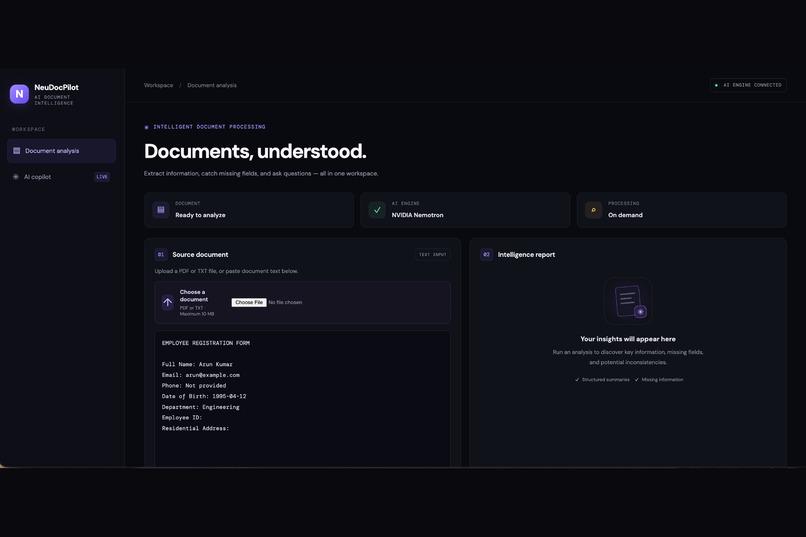
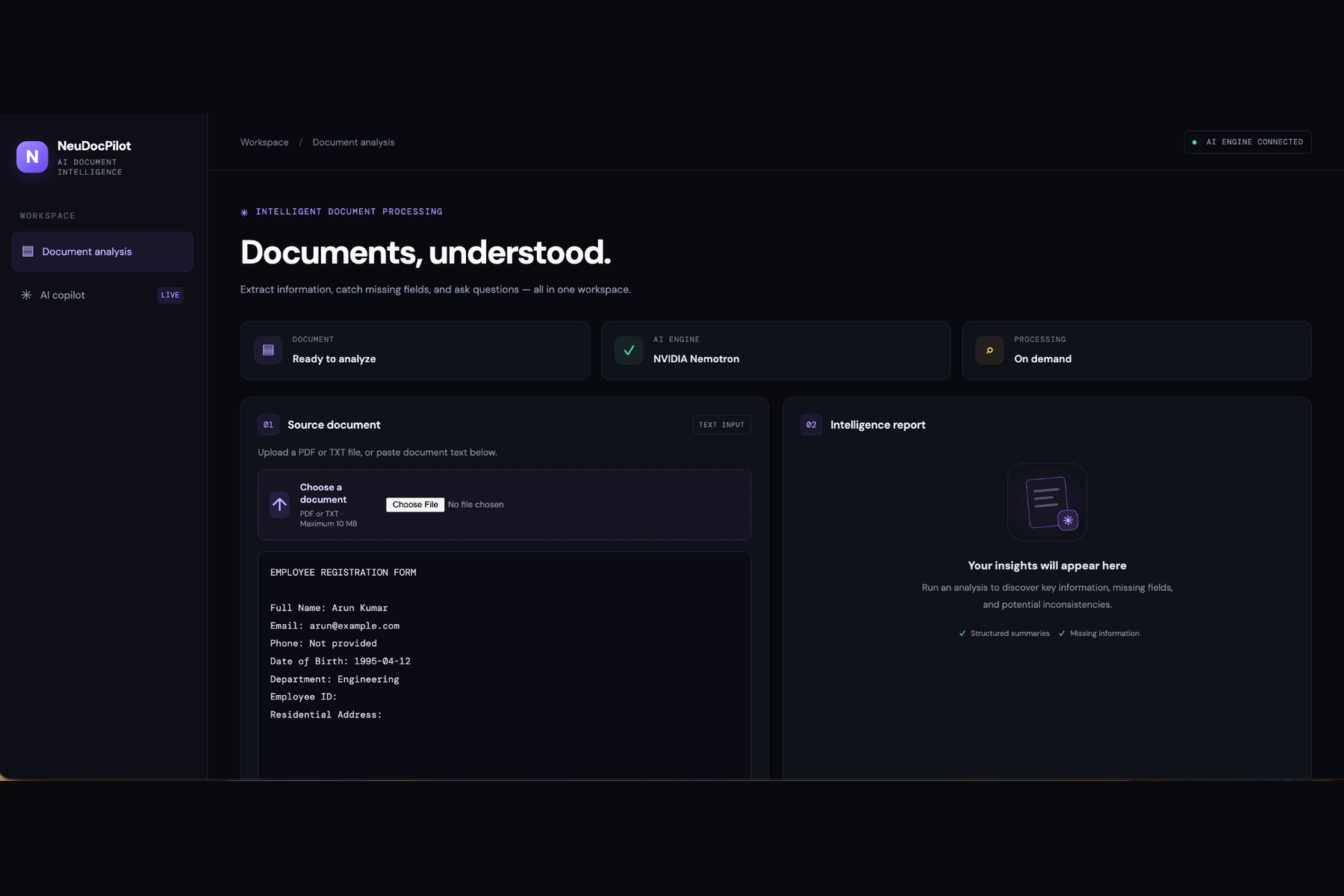
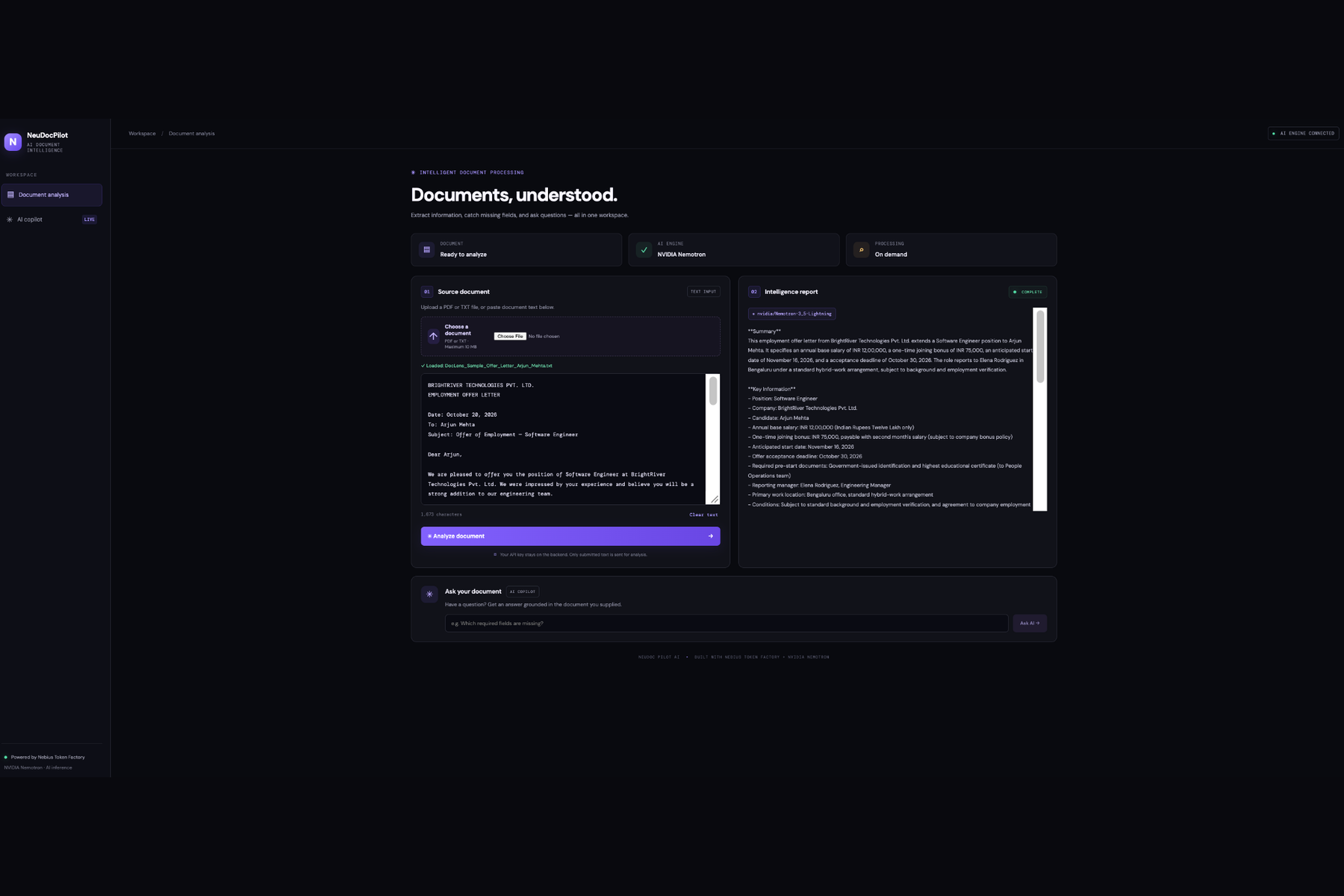
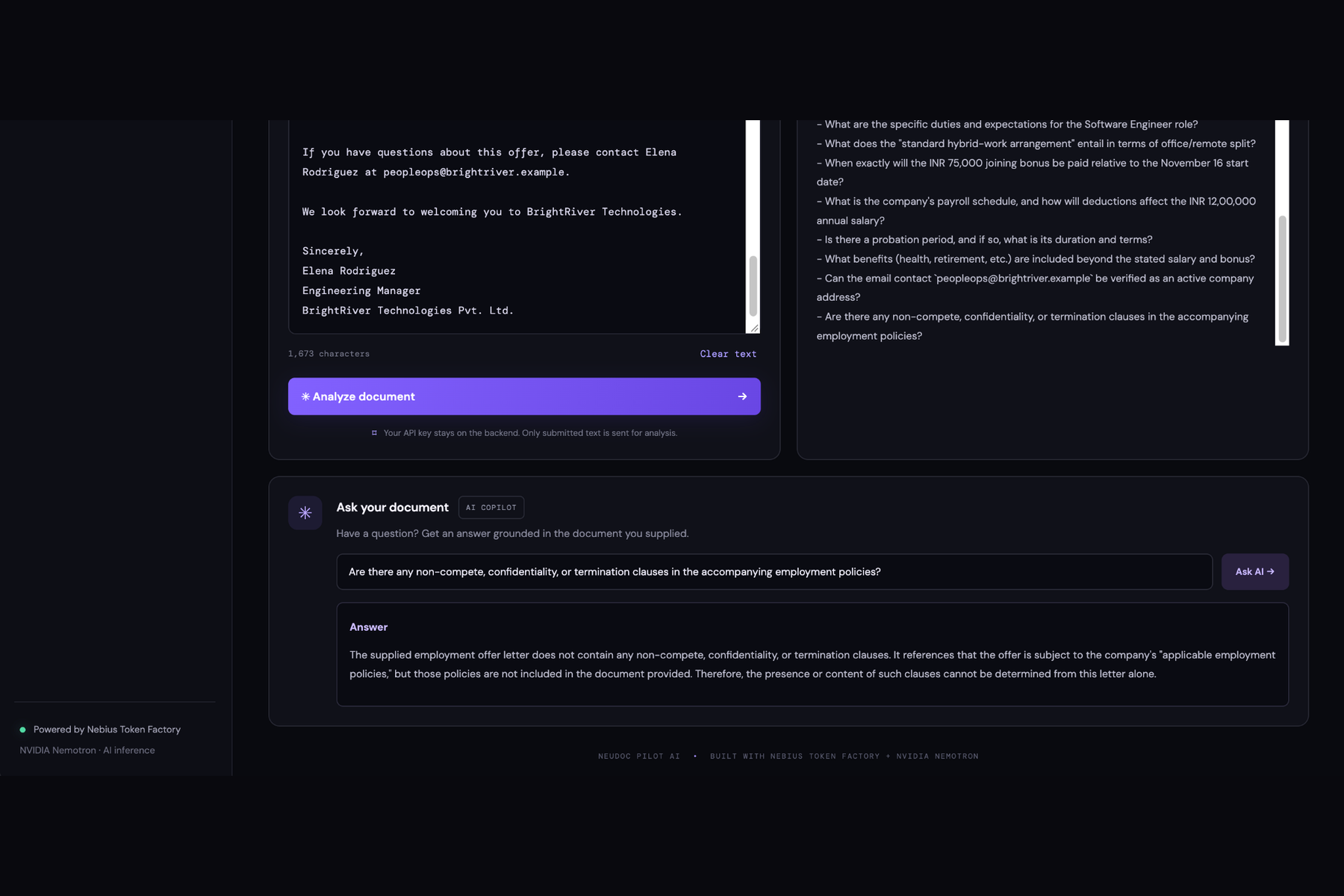
The NeuDocPilot AI workspace brings document upload, AI-powered analysis, and document-grounded assistance together in one interface.
-
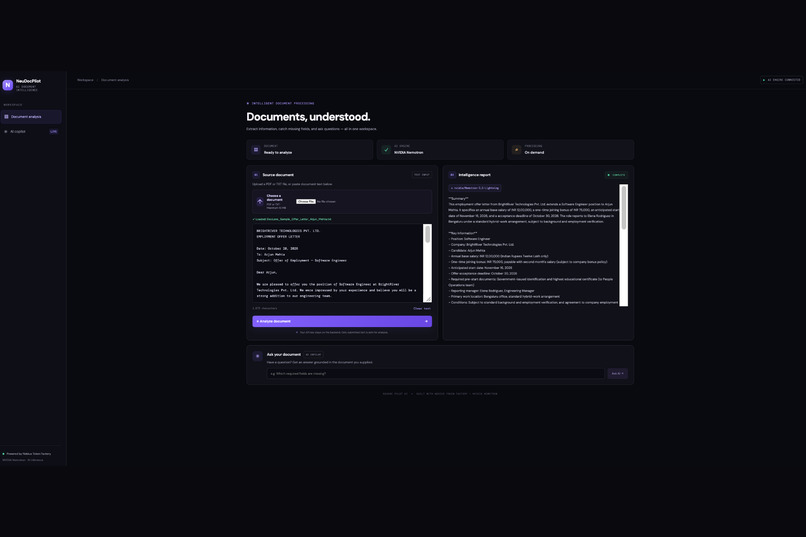
Upload a document and let NVIDIA Nemotron generate a structured report with key information, missing details, and potential inconsistencies.
-
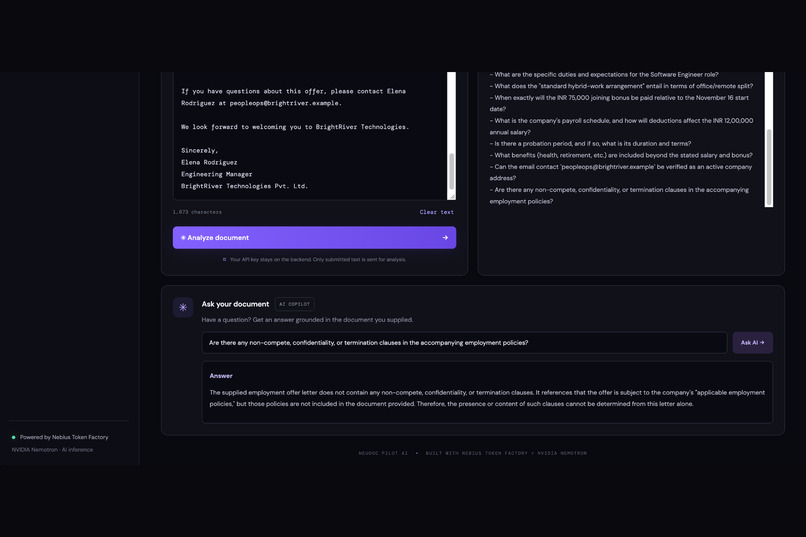
Ask questions about your uploaded documents and receive context-aware answers grounded in the supplied content.
Inspiration
Important information is often buried inside lengthy documents such as invoices, offer letters, reports, and business records. Reviewing these documents manually takes time, and missing details or inconsistencies can easily go unnoticed.
We wanted to build a practical AI-powered document assistant that does more than simply summarize PDFs. The goal was to help people understand documents, identify information that may need attention, and ask questions about the content.
What NeuDocPilot AI Does
NeuDocPilot AI transforms uploaded documents into structured, actionable insights.
Users can upload PDF or TXT documents and receive:
- Document Summary: A concise overview of the document.
- Key Information: Important details extracted and organized for easier review.
- Missing or Unclear Information: Highlights details that may be incomplete or difficult to understand.
- Potential Inconsistencies: Identifies information that may require further verification.
- Document-Grounded Q&A: Allows users to ask questions and receive answers based on the uploaded document.
The goal is to make document review faster, clearer, and more accessible while keeping human verification part of the process.
How We Built It
We built NeuDocPilot AI as a full-stack web application.
Frontend
- React
- TypeScript
- Vite
Backend
- Node.js
- Express
- TypeScript
- PDF text extraction using
pdf-parse
AI Infrastructure
- Nebius Token Factory
- NVIDIA Nemotron 3.5 Lightning
- OpenAI-compatible API integration
The backend extracts text from uploaded PDF and TXT files, then sends the document content to NVIDIA Nemotron through Nebius Token Factory for analysis. The model generates structured findings and supports follow-up questions grounded in the document content.
The application is deployed with Vercel for the frontend and Render for the backend.
Challenges We Faced
One of the main challenges was building a reliable document-processing workflow that connects file uploads, PDF text extraction, AI analysis, and follow-up questions.
We also worked through:
- Integrating the Nebius Token Factory API with an NVIDIA Nemotron model.
- Handling PDF parsing and limiting the amount of document text sent for analysis.
- Structuring AI responses into useful sections instead of generic summaries.
- Keeping follow-up answers grounded in the uploaded document.
- Configuring and deploying the frontend and backend as separate services.
What We Learned
This project gave us practical experience integrating NVIDIA Nemotron models through Nebius Token Factory into a working application.
We learned how to build an end-to-end AI workflow, manage document context, structure model outputs, and deploy an AI-powered application for real-world use.
Most importantly, we learned that useful document intelligence is not just about generating answers. It is about helping users identify what matters and what deserves a closer look.
What's Next
We envision expanding NeuDocPilot AI with support for more document formats, improved extraction capabilities, advanced document comparison, and more powerful document workflows.
NeuDocPilot AI — Turn documents into actionable intelligence.
Note: The current version supports text-based PDF and TXT documents. AI-generated findings are intended to assist review and should be verified against the original document.
Built With
- ai
- api
- artificial
- document
- express.js
- factory
- generative
- intelligence
- javascript
- language
- large
- models
- nebius
- nemotron
- node.js
- nvidia
- processing
- react
- rest
- token
- typescript
- vite

Log in or sign up for Devpost to join the conversation.