Inspiration The rising number of cyber threats globally, especially those targeting critical infrastructure, industries, and government entities in Indian cyberspace, inspired us to create Netsec2.0. The lack of real-time visibility into cyber incidents and actionable intelligence motivated us to build a solution that not only detects threats but also categorizes them into specific sectors, enabling faster response and mitigation. We wanted to empower organizations with a tool that leverages AI and machine learning to enhance cybersecurity defense mechanisms and foster proactive threat hunting.
What it does Netsec2.0 is a comprehensive cyber incident monitoring tool that:
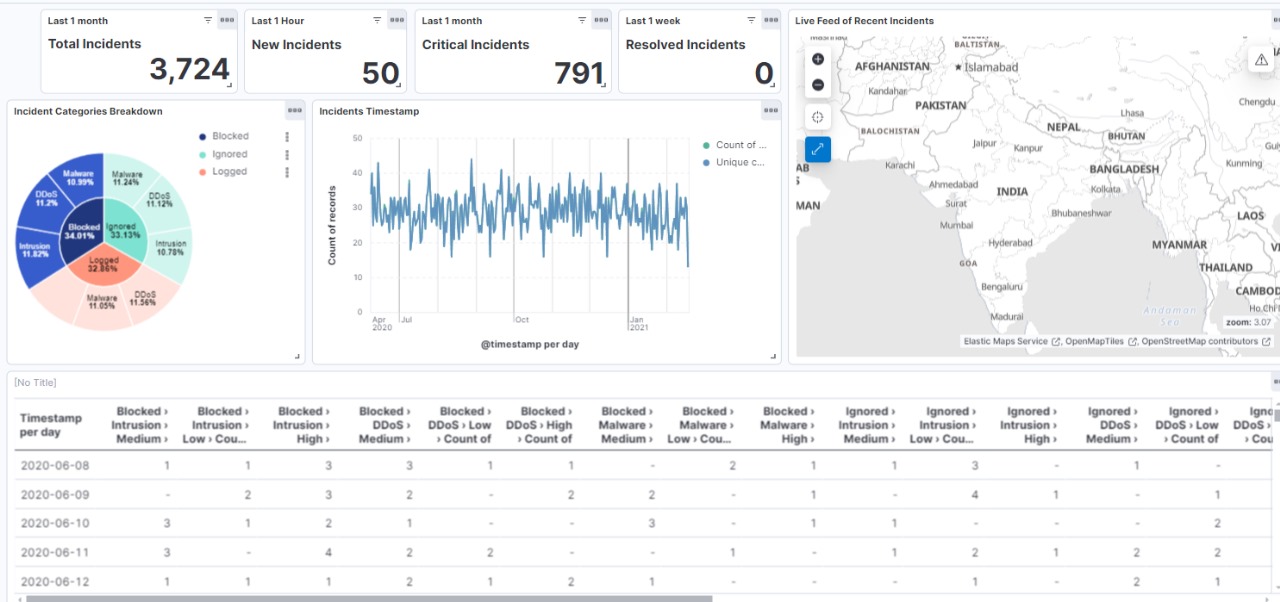
Scrapes Real-Time Data: Gathers information on cyber threats from multiple open-source intelligence (OSINT) platforms, RSS feeds, and APIs. Processes and Categorizes: Filters and processes raw data, mapping incidents to the seven critical sectors as defined by NCIIPC. Indicators of Compromise (IOC) Integration: Integrates threat intelligence feeds such as OTX AlienVault and ThreatFox to highlight IOCs like malicious IPs, domains, and hashes. Visualizes Threats: Uses ElasticStack (Kibana) for visualizing trends, patterns, and detailed insights into cyber incidents. User-Friendly Dashboard: Provides an interactive interface with features like customizable alerts, filtering, and reporting options. Enables Collaboration: Allows users to report incidents and share threat data to strengthen the collective defense system.
How we built it Backend: Built using Node.js and Express.js to handle REST APIs and manage backend logic. Python scripts were used for data scraping, preprocessing, and ingestion. Logstash was used to format data and feed it into Elasticsearch.
Frontend: Designed an intuitive user interface using React.js, enabling real-time data visualization and incident reporting. Integrated a search and filter functionality for enhanced user experience. Data Processing: Used Python (Pandas, NumPy) for cleaning and preprocessing scraped data. Leveraged ElasticSearch for indexing and querying large volumes of structured data. Visualization: Designed dashboards on Kibana to present actionable insights, trends, and incident details. APIs and Threat Feeds: Integrated OTX AlienVault and ThreatFox API to fetch real-time IOCs and Advanced Persistent Threat (APT) data.
*Cloud Deployment: *
Deployed the solution using AWS services (EC2, S3, and Elastic IP). Implemented Docker for containerized deployment. Challenges we ran into Data Integration: Combining data from multiple sources and maintaining consistency during preprocessing. Authentication Errors: Faced issues while integrating ElasticSearch and Logstash due to authentication and version mismatches. Visualization Complexity: Designing dynamic Kibana dashboards that adapt to real-time data updates. Sector Mapping: Accurately categorizing incidents into the seven NCIIPC-defined critical sectors. Scalability: Ensuring the tool could handle high volumes of real-time data without performance bottlenecks.
Accomplishments that we're proud of End-to-End Solution: Successfully created a pipeline that scrapes, processes, and visualizes cyber threat data in real time. Sector Mapping Algorithm: Developed an AI-based algorithm to map incidents to specific critical sectors accurately. Real-Time Dashboard: Built a visually appealing and highly functional Kibana dashboard for data insights. Collaboration: Integrated features to report incidents and share threat intelligence within the platform. Practical Utility: Designed the tool with real-world applications for government agencies and industries. What we learned ElasticStack Mastery: Gained expertise in setting up and troubleshooting ElasticSearch, Logstash, and Kibana workflows. Threat Intelligence: Learned how to leverage threat intelligence APIs for identifying IOCs and APTs. Teamwork and Problem-Solving: Overcame technical and logistical challenges through effective collaboration. End-to-End Deployment: Understood the intricacies of deploying an application on cloud services like AWS. Cybersecurity Insights: Enhanced our understanding of NCIIPC-defined critical sectors and their relevance in real-world scenarios.
What's next for Netsec2.0 Advanced Machine Learning Models: Implement anomaly detection to predict potential threats based on historical data. Threat Correlation: Introduce a correlation engine to identify relationships between incidents across multiple sectors. Geolocation Analysis: Map incidents geographically to provide a visual representation of affected regions. Mobile Application: Develop a mobile app for on-the-go monitoring and real-time alerts. Integration with SOCs: Enable integration with Security Operations Centers (SOCs) for automated response mechanisms. Global Expansion: Adapt the tool to monitor international cyberspace while maintaining a focus on India.
Built With
- alienvault
- amazon-web-services
- beautiful-soup
- elasticsearch
- express.js
- feed
- github
- javascript
- kibana
- logstach
- mongodb
- node.js
- numpy
- otx
- pandas
- python
- react.js
- rss
- threatfox


Log in or sign up for Devpost to join the conversation.