-
-
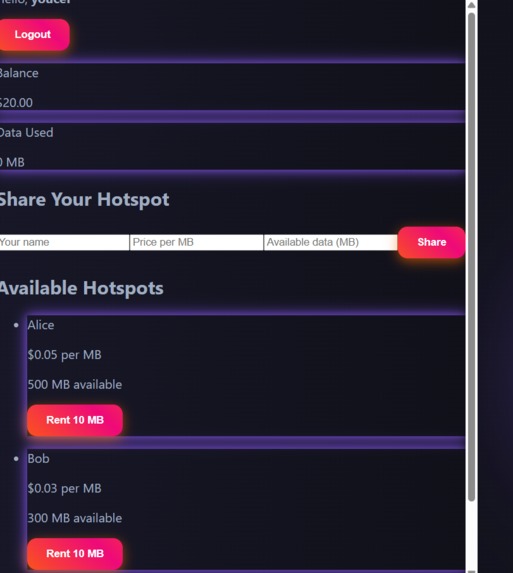
screenshot of the demo
Inspiration
The idea for NetNest was born from real-life experiences — that one friend or neighbor who always asks to borrow mobile data. We thought: What if you could turn that into an opportunity? What if mobile data became shareable, rentable, and profitable — peer-to-peer? That inspired us to create a decentralized hotspot-sharing platform where users can rent data per megabyte to others in need
What it does
NetNest allows users to:
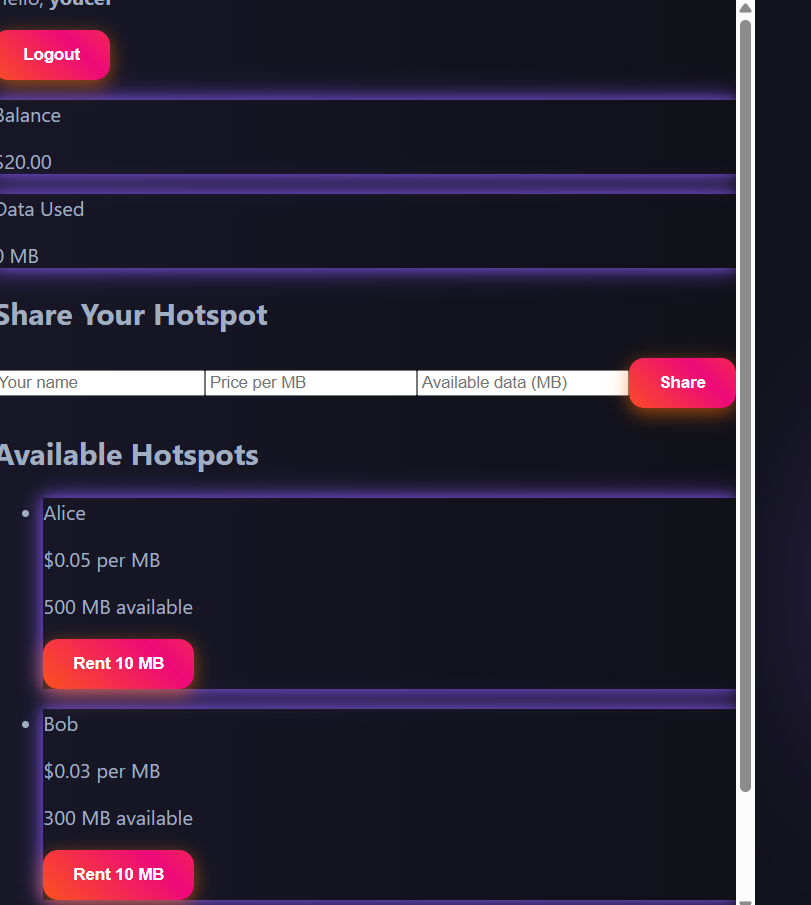
Log in securely and view their balance and data usage.
Browse nearby mobile hotspots shared by others, each with a price per megabyte.
Rent mobile data (e.g., 10MB at a time) directly from another user’s hotspot.
Share their own hotspot, setting a custom price and data availability.
Track transaction history showing who rented from whom, how much, and at what cost.
It's like Airbnb for mobile data — direct, social, and monetized.
How we built it
NetNest allows users to:
Log in securely and view their balance and data usage.
Browse nearby mobile hotspots shared by others, each with a price per megabyte.
Rent mobile data (e.g., 10MB at a time) directly from another user’s hotspot.
Share their own hotspot, setting a custom price and data availability.
Track transaction history showing who rented from whom, how much, and at what cost.
It's like Airbnb for mobile data — direct, social, and monetized.
Challenges we ran into
Designing a modern, interactive UI under tight time constraints
Managing state cleanly without using a backend or database
Creating a smooth user flow for login, hotspot sharing, and transactions
Handling edge cases like low balances or low data availability
Accomplishments that we're proud of
A fully working demo with clean and minimal dark-mode UI
Functional data-sharing simulation between users
Interactive login, real-time transaction handling, and dynamic hotspot lists
Strong team collaboration under pressure
What we learned
How to rapidly prototype and polish a real-world app idea in under 10 hours
Advanced use of React state and UI design in Tailwind
The importance of simplifying UX and focusing on core functionality
How to think like a product designer, not just a developer
What's next for NetNest
Backend integration using Firebase, Supabase, or blockchain to store real user/hotspot data
Real-time updates via sockets or WebRTC to track data usage live
Payments via crypto microtransactions or in-app purchases
Geolocation features to find real nearby users
Mobile version for on-the-go hotspot sharing
Smart contracts/IPFS to store user agreements on-chain for transparency
We want to build a future where internet access becomes peer-powered and decentralized.

Log in or sign up for Devpost to join the conversation.