-
-
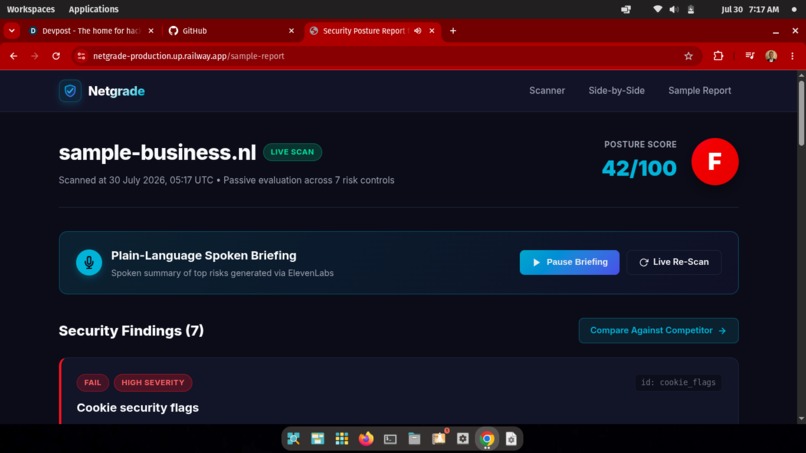
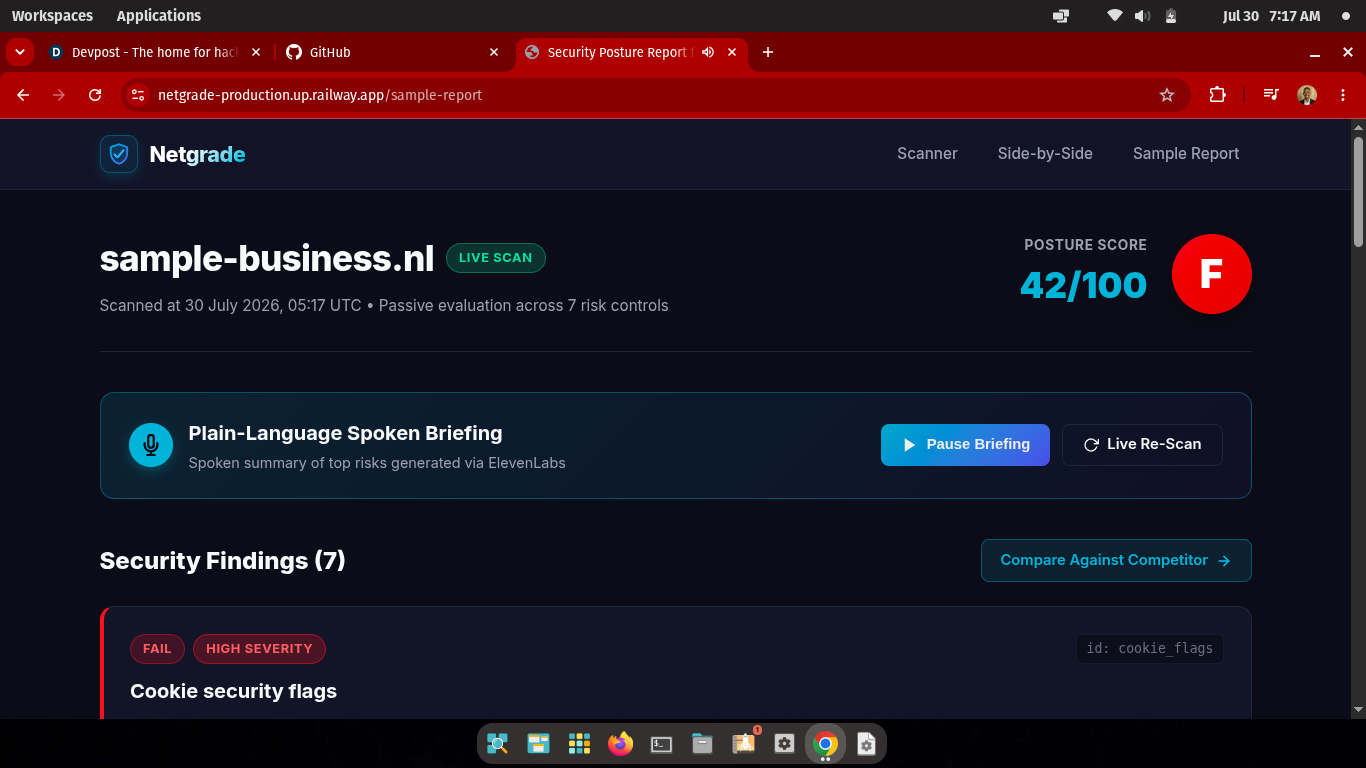
sample results
-
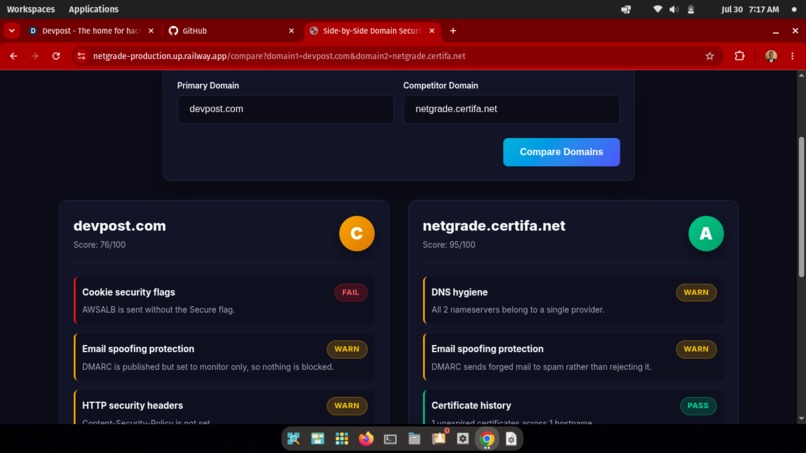
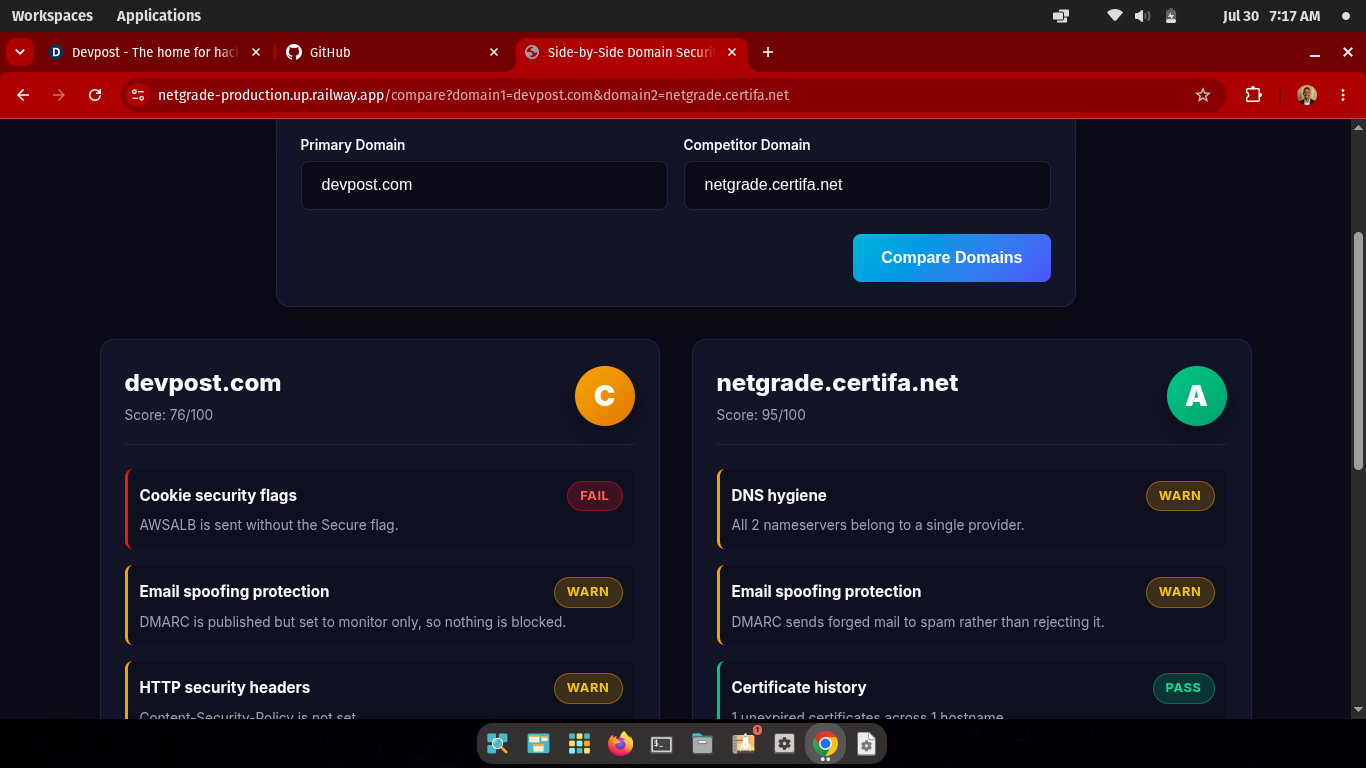
comparison
-
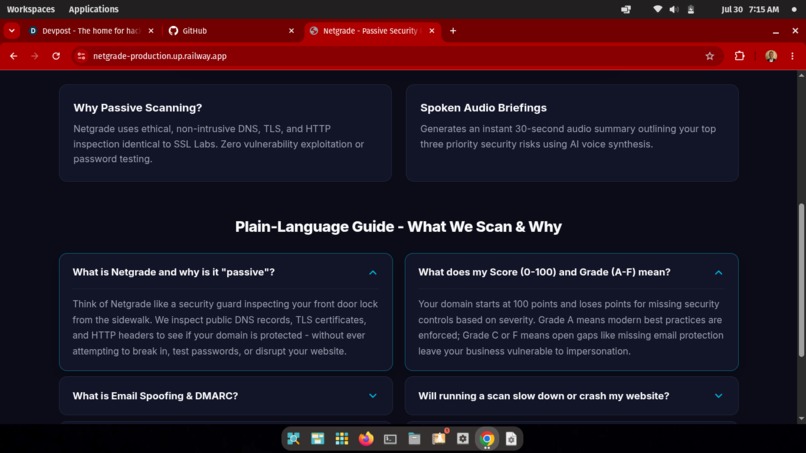
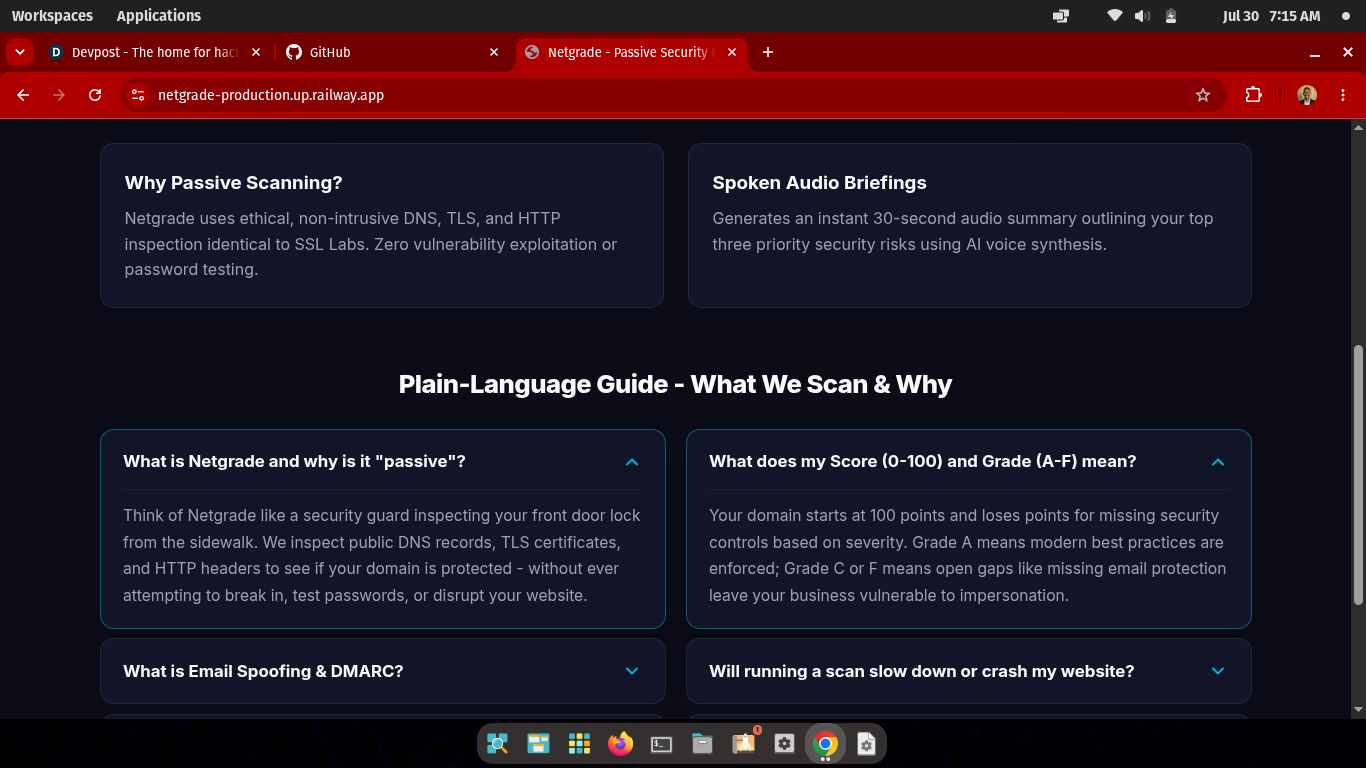
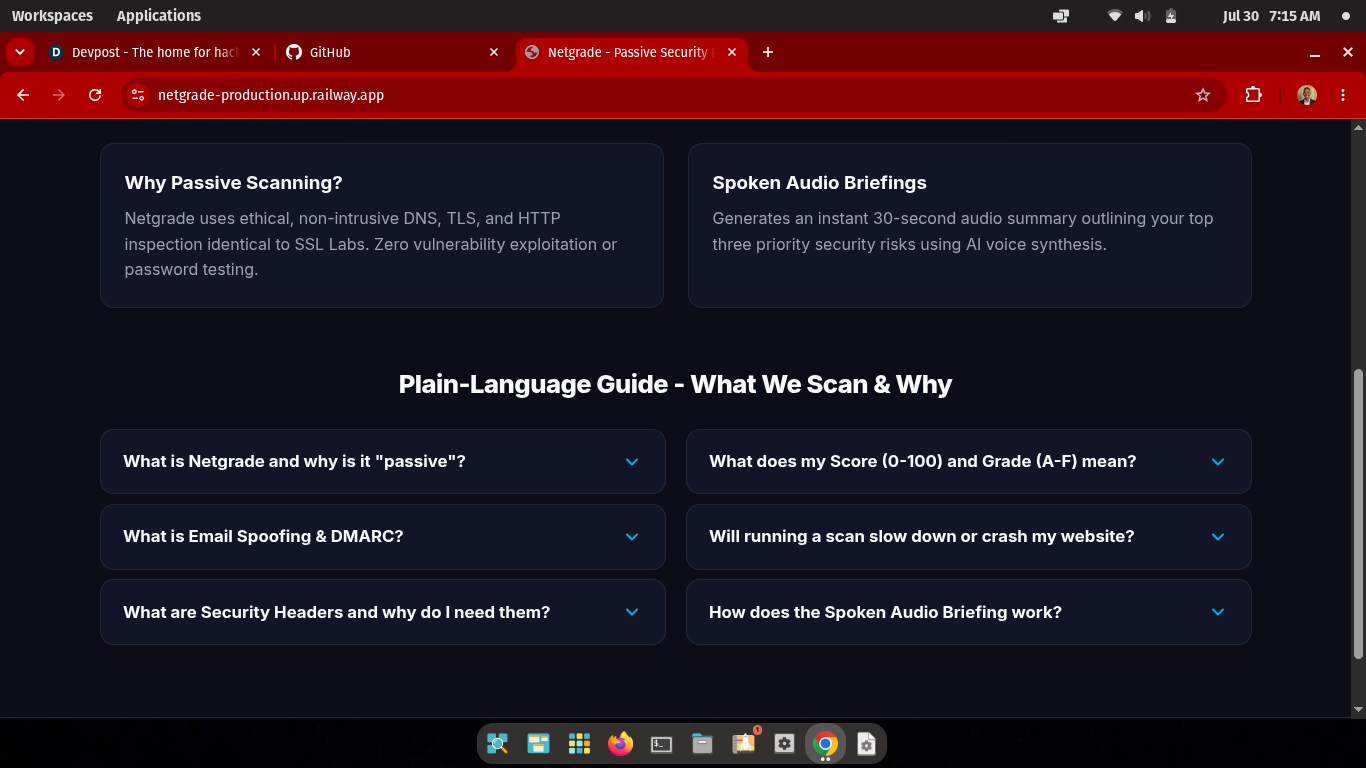
faq and more info
-
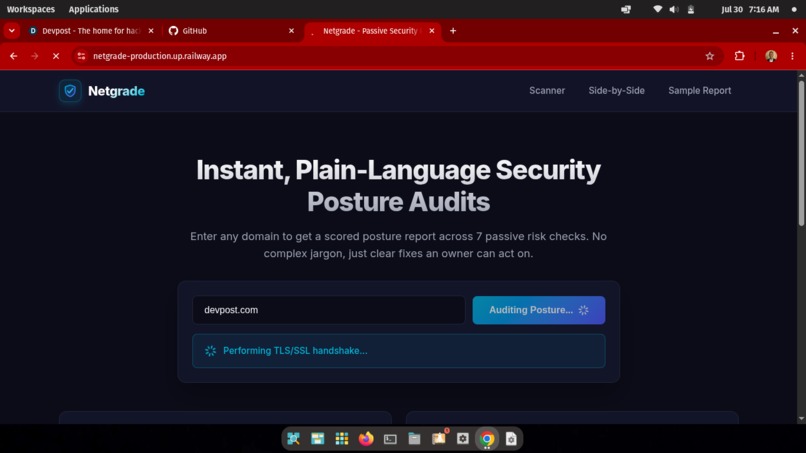
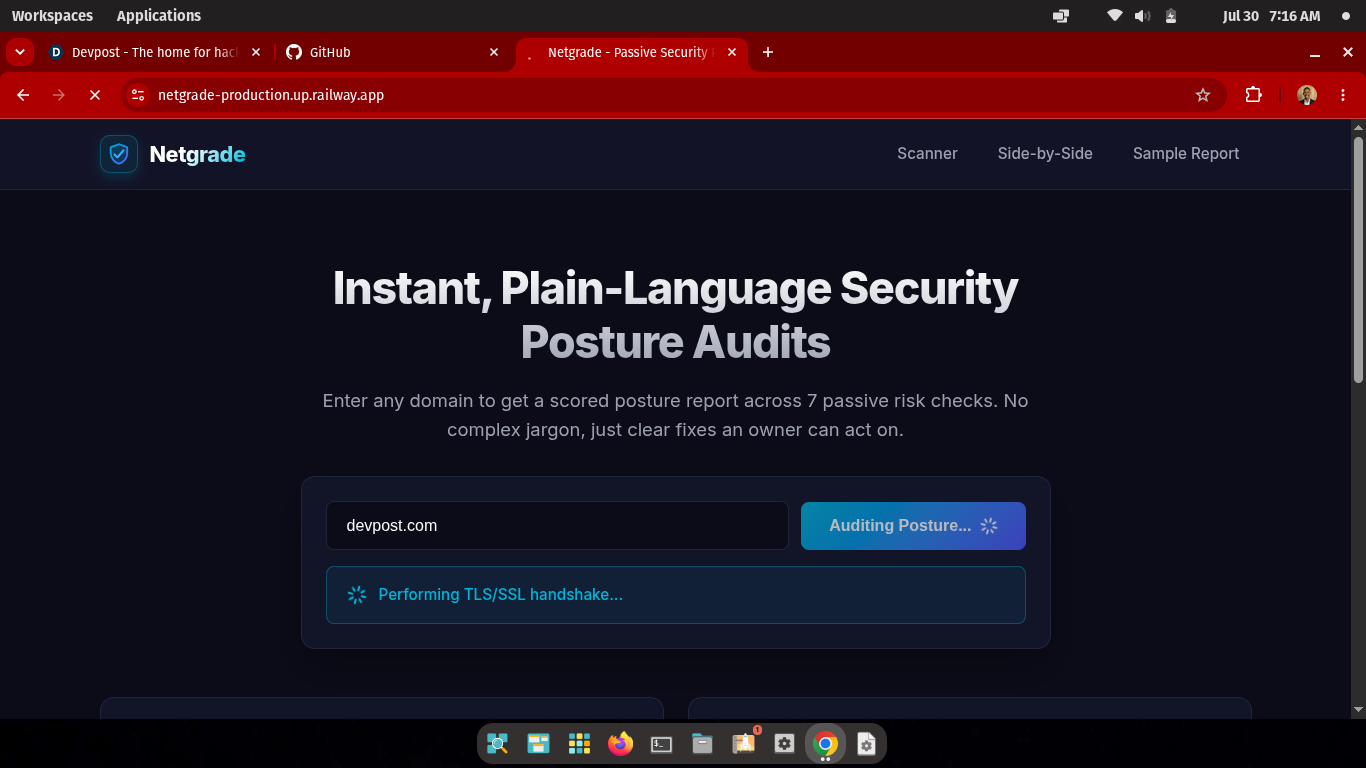
scanning
-
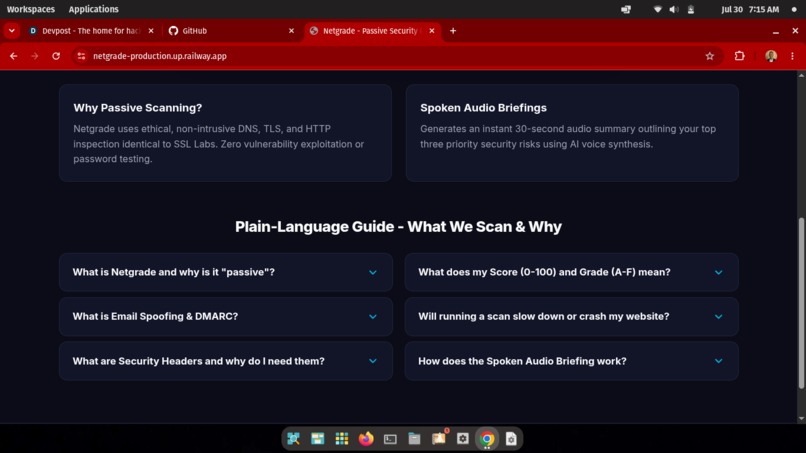
faq and more info
-
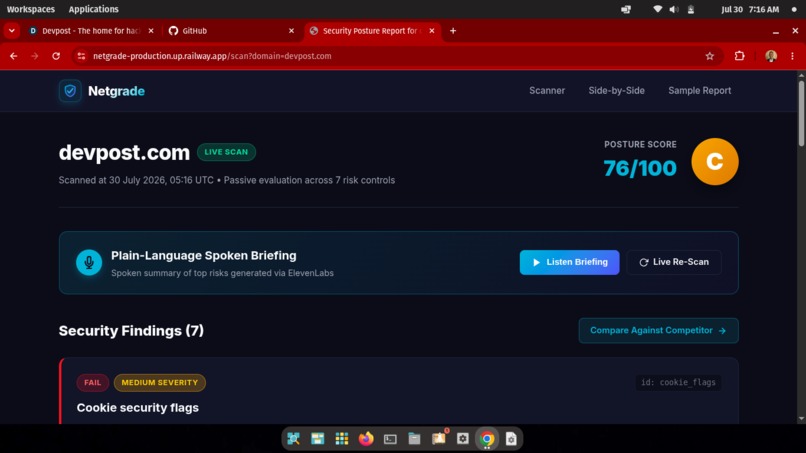
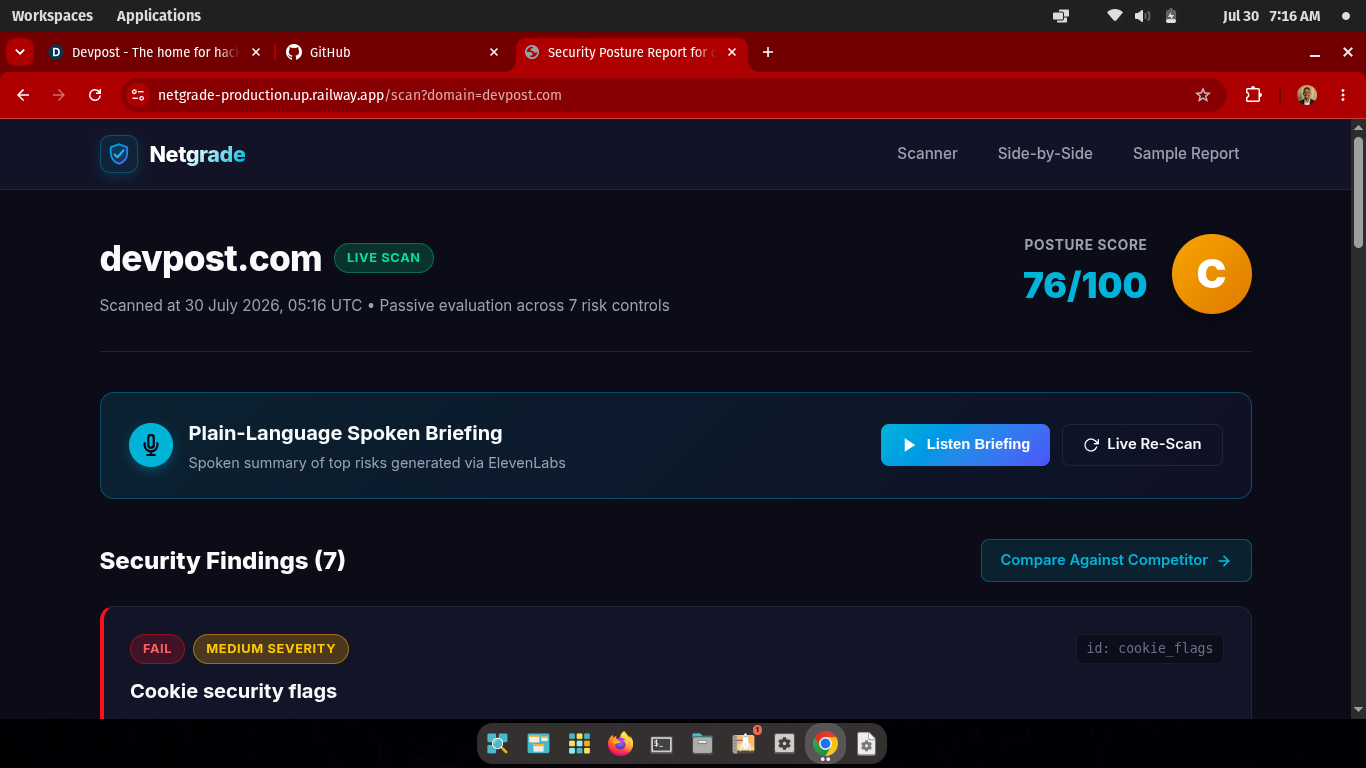
after scan
-
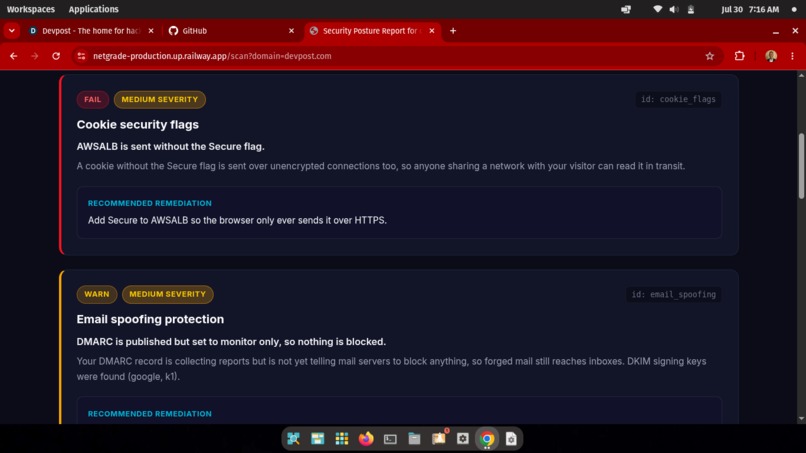
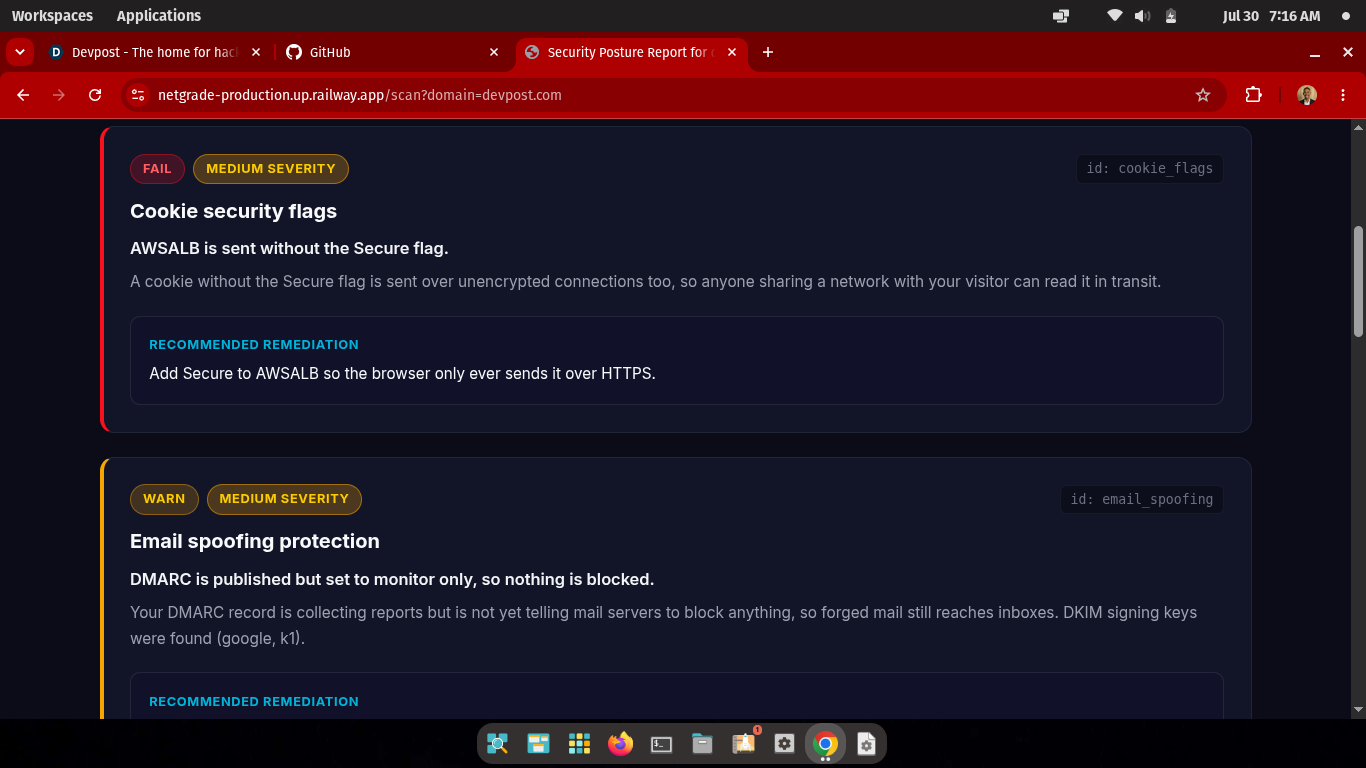
results after scan
-
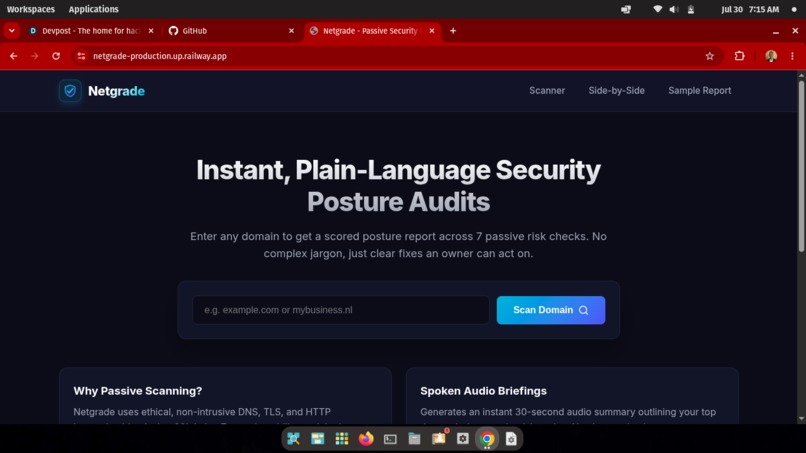
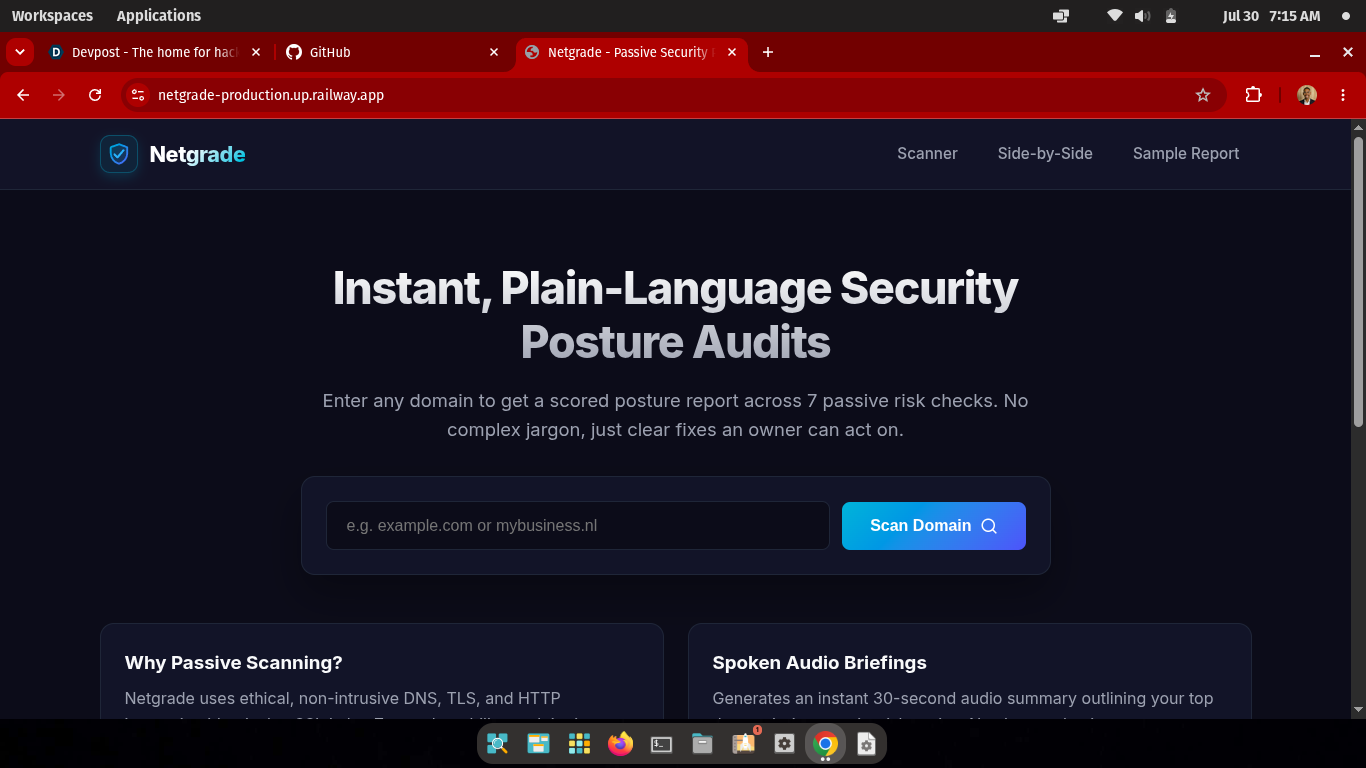
home page
Inspiration
Over 70% of small business owners lack dedicated IT or cybersecurity personnel. When non-technical business owners try to audit their web posture, standard vulnerability scanners act like "military weapons": they launch intrusive probes that risk crashing services or output 40-page PDF reports filled with raw cryptographic acronyms like DMARC $p=\text{quarantine}$, HSTS $\text{max-age}=31536000$, and TLS cipher suites.
Small business owners don't need terrifying vulnerability dumps — they need a zero-risk posture grade with plain-language remediations they can act on immediately. That inspired us to build Netgrade: a passive, non-intrusive security posture scanner designed specifically for small business resilience.
What it does
Netgrade audits any public domain across 7 key passive security controls without ever attempting exploitation, password testing, or intrusive probing:
- Email Spoofing (SPF/DKIM/DMARC): Detects whether scammers can impersonate your domain via email.
- TLS/SSL Configuration: Evaluates certificate validity, days until expiry, and modern protocol enforcement (TLS 1.3).
- HTTP Security Headers: Checks for HSTS, Content-Security-Policy (CSP), X-Frame-Options, and X-Content-Type-Options.
- Session Cookie Flags: Verifies Secure, HttpOnly, and SameSite flags on session tokens to prevent XSS hijacking.
- Exposed Artefacts: Audits known sensitive paths (such as
.git,.env,.DS_Store) that leak credentials. - DNS Hygiene & NS Spread: Checks nameserver redundancy and zone transfer exposure to prevent single points of outage failure.
- Certificate Transparency Logs: Queries public CT logs via crt.sh to uncover forgotten or exposed subdomains.
Netgrade synthesizes these findings into a weighted score $S \in [0, 100]$ and grade $G \in {A, B, C, D, F}$. It generates an instant 30-second spoken AI audio briefing powered by ElevenLabs voice synthesis, provides an interactive Plain-Language FAQ Guide, and supports Side-by-Side Competitor Benchmarking so business owners can audit their posture relative to industry peers.
How we built it
Netgrade is built with Python 3.13, FastAPI, and an asynchronous inspection engine:
- Asynchronous Inspection Orchestrator: Uses
asyncio.waitto fan out all 7 risk checks concurrently. - Process-Wide Outbound Semaphore: Bounds socket usage at $N_{\text{max}} = 24$ concurrent connections globally across all users, preventing connection exhaustion during traffic bursts.
- Raw DER TLS Certificate Parsing: Rather than relying on
ssl.getpeercert(), which fails on unverified sockets, Netgrade parses raw DER bytes directly withcryptographyto explain why an untrusted or expired certificate was rejected. - Frozen Schema Contract: A Pydantic
ScanResultschema strictly decouples the passive inspection engine from presentation rendering. - Frontend & Accessibility: Built with custom HSL dark glassmorphism styling, high-contrast WCAG 2.1 AA accessibility, keyboard navigation focus rings (
--focus-ring), ARIA roles, anti-spam submission guards, and dynamic scan step overlays. - Deployment & Testing: Containerized with Docker and
docker-compose.yml, deployed live atnetgrade.certifa.net, and backed by a Pytest suite of 414 passing unit and integration tests.
Challenges we ran into
"A Failure to Look is Not a Finding": Scoring an unreached check as a failure produces reports that are confidently wrong during temporary DNS blips or third-party outages. We designed a scoring rule where errored checks are excluded from the denominator rather than penalized with an F grade. To prevent flattering unmeasured domains, we implemented a grade cap when fewer than 4 checks complete: $$\text{Grade} = \min\left(\text{CalculatedGrade}, \text{'C'}\right) \quad \text{if } N_{\text{completed}} < 4$$
Parsing Unverified TLS Certificates: Standard Python socket verification closes the connection on bad certificates. We implemented a two-pass TLS handshake: first attempting strict verification, and if rejected, retrying unverified purely to extract DER certificate bytes and explain the exact failure reason to the user.
Handling Third-Party Rate Limits: Public CT logs (crt.sh) can be slow or return HTTP 502 errors. We implemented tight 6-second request timeouts, single-retry policies, 5-minute TTL scan result caching, and token-bucket rate-limiting middleware to protect system performance.
Accomplishments that we're proud of
- 100% Test Coverage & Green Suite: Built a comprehensive test suite with 414 passing tests (
pytest -v) covering edge cases, scoring math, check isolation, and custom 404/500 exception handlers. - Production Deployment: Successfully deployed live to https://netgrade.certifa.net.
- Spoken AI Audio Briefings: Integrated ElevenLabs AI voice synthesis with local spoken fallback engines for offline testing.
- Zero Intrusive Risk: Guaranteed 100% passive, read-only inspection that small businesses can run with complete confidence.
What we learned
- Decoupling Security Logic from Presentation: Establishing a frozen Pydantic schema early allowed us to iterate on engine checks and UI styling independently without contract breakages.
- Process-Wide Resource Management: Bounding outbound concurrency at the application process level rather than per-request is essential for web scanners handling concurrent users.
- Designing for Non-Technical Users: Translating complex security concepts into plain-language fixes and spoken briefings makes security actionable rather than overwhelming.
What's next for Netgrade - Passive Security Posture Scanner
- Automated Policy Drift Alerts: Email notifications when a business domain's certificate is approaching expiry or DMARC record disappears.
- Distributed Edge Scanner Nodes: Running passive checks from multi-region edge locations to detect geo-specific CDN and DNS discrepancies.
- Executive PDF Export: Generating 1-page printable executive summary reports for board meetings and insurance compliance audits.
- API Access: Developer API keys for automated CI/CD posture checks.
Built With
- api
- cloudflare
- css3
- cybersecuritry
- docker
- elevenlabs
- fastapi
- html5
- javascript
- pytest
- python
- railway
- ruff


Log in or sign up for Devpost to join the conversation.