-
-
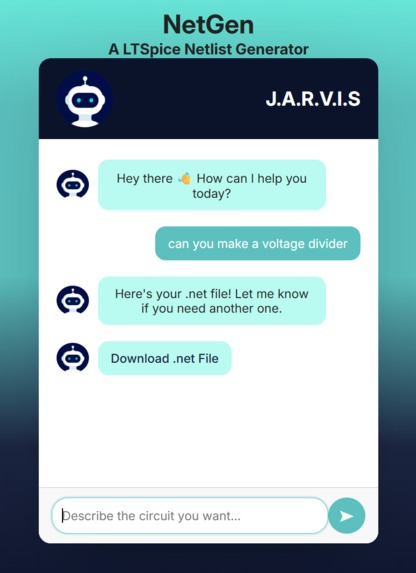
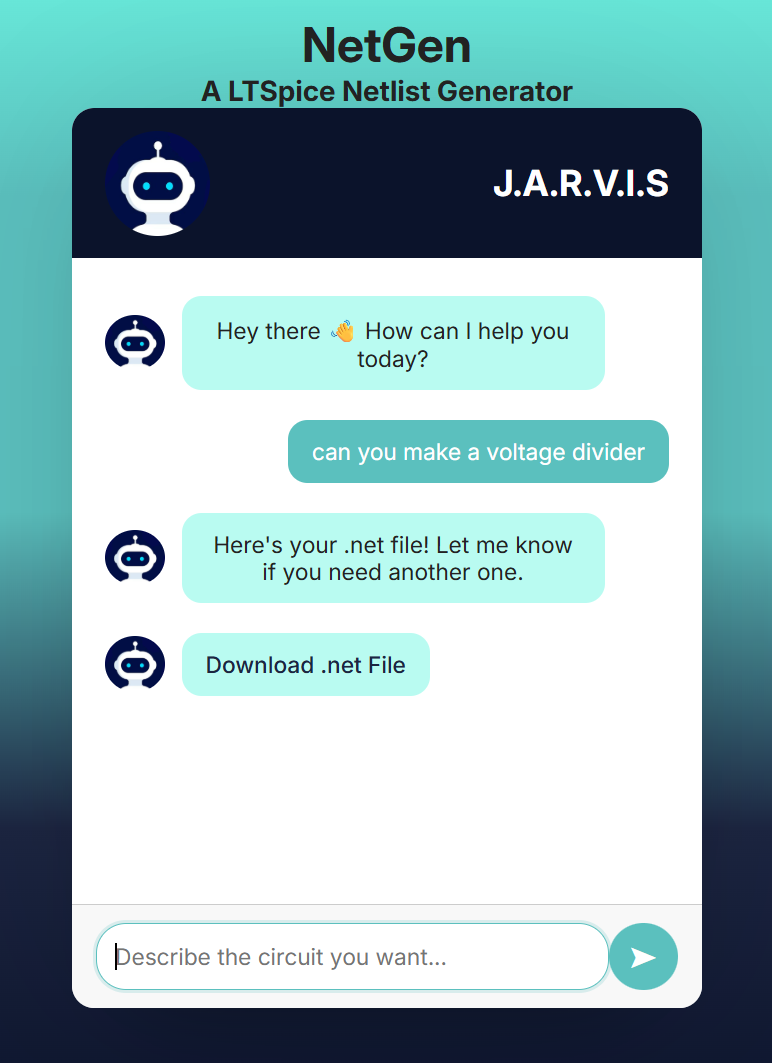
User interacting with the chat to produce a .net file
Inspiration
As engineering students, we often found ourselves sketching circuit ideas and then spending too much time wiring them in schematic editors like LTSpice. We wanted a faster, more intuitive way to go from concept to simulation. That's when we thought: what if we could just describe our circuit in plain English and get a netlist instantly? That idea became NetGen
What it does
NetGen takes a natural language description of a circuit, such as "an AC to DC converter with a Zener diode", and generates a valid LTSpice-compatible netlist file. Users can upload the output directly into LTSpice to simulate circuit behavior without drawing anything.
How we built it
OpenAI’s GPT-4 to translate natural language into netlist format.
A React frontend for users to enter prompts and download .net files.
A Flask backend to handle prompt processing and serve the generated netlist.
Vite for fast development and deployment.
Challenges we ran into
GPT often hallucinated incorrect netlist syntax or pin names.
LTSpice is tricky to work with and troubleshooting invalid netlists took time.
We had to create custom prompt engineering to enforce proper formatting and realistic component values.
Managing frontend-backend communication and downloads smoothly required trial and error.
Accomplishments that we're proud of
We successfully created a tool that bridges natural language and electrical simulation.
We reduced hours of schematic work to a 10-second interaction.
The app reliably produces valid netlists for a wide range of circuits.
What we learned
How to translate real-world language into structured code using AI.
The quirks of LTSpice syntax and component rules.
Prompt engineering and how critical it is for LLM performance.
What's next for NetGen
Create a new page where users can upload a schematic, and the chat will generate step-by-step instructions for mapping the circuit onto a breadboard.
Creating a Login page

Log in or sign up for Devpost to join the conversation.