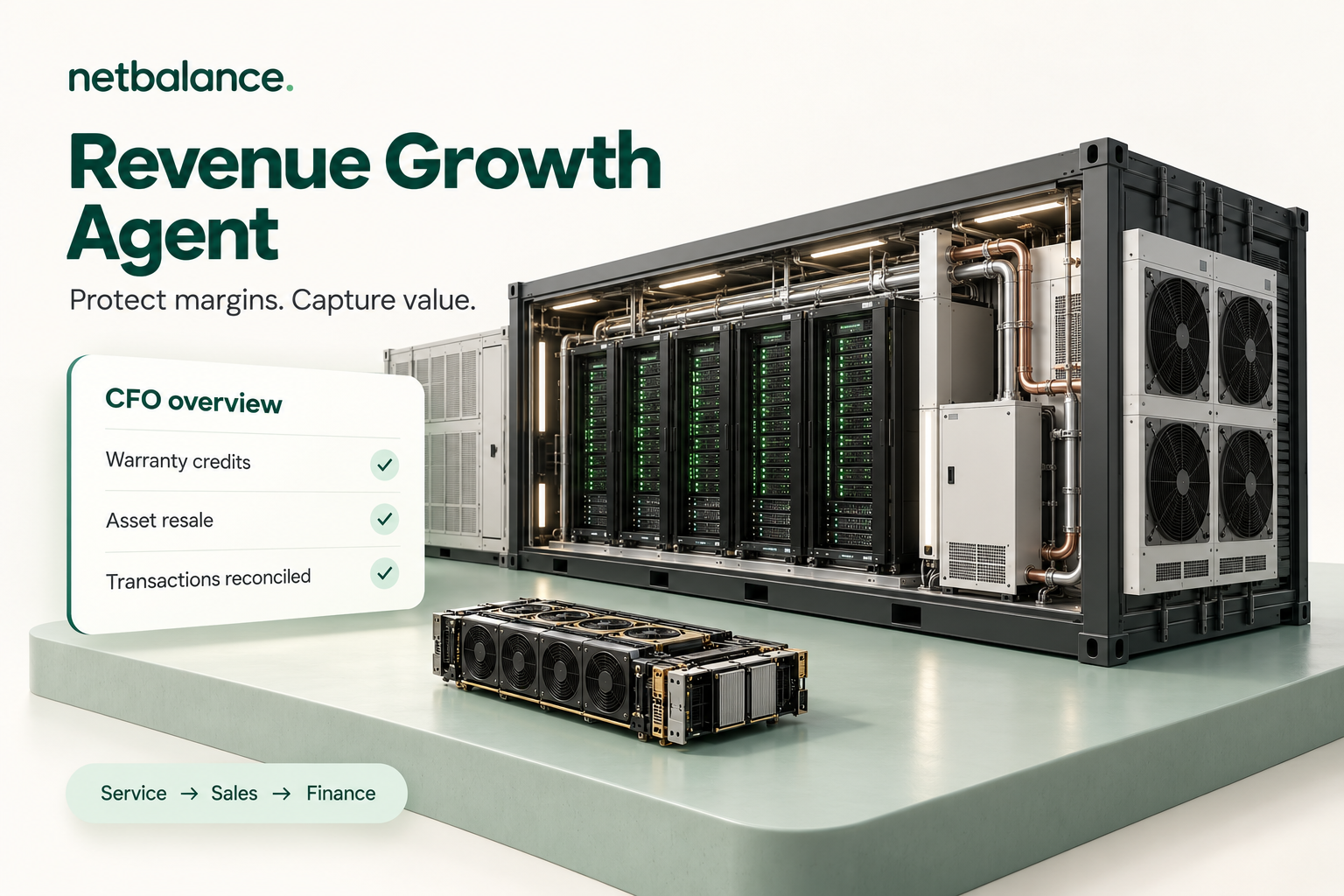

Inspiration
Every datacenter incident is also a financial event.
When a coolant leak damages a GPU rack, the warranty claim sits with service, the replacement quote with sales, the damaged hardware with procurement, and the payments with accounting. The CFO remains accountable for the outcome, but finance must chase every team to understand what the incident actually cost.
We wanted the CFO to be able to say:
“AWS has a cooling leak in Rack 12. Take care of it.”
And have an agent respond:
“I’ll pursue warranty credits, recover value from affected GPUs, and reconcile every transaction. You approve transfers.”
What it does
Netbalance Revenue Growth Agent connects service, sales, and finance to protect margins, capture available value, and reconcile cash.
Our demo follows six steps:
- Call & dispatch. An ElevenLabs voice agent takes the support call, logs the incident, and initiates the simulated technician dispatch.
- Inspect & cover. The inspection photo starts the warranty assessment. The scenario provides a $200,000 credit for the container and racks, while excluding GPUs damaged by the external cooling system. Nicrron explains the decision.
- Approve the credit. The application holds the transfer until the CFO approves the permitted destination. Requests to transfer credits elsewhere are refused.
- Choose the replacement. The customer selects an integrated cooling module with a three-year leak monitoring plan. The warranty credit, customer payment, and GPU financing fund the replacement.
- Recover the GPUs. The agent compares three resale offers and selects the highest net proceeds after shipping.
- Reconcile & report. Four transaction types are matched against five receipts. The CFO sees contribution, cash received, outstanding balances, and a sourced carbon estimate.
The illustrative cash receipts are:
$$\text{Cash received} = \$280{,}000 + \$200{,}000 + \$200{,}000 + \$2{,}000 + \$30{,}000 = \$712{,}000$$
These comprise a $680,000 replacement invoice settlement, $2,000 financing referral fee, and $30,000 net GPU resale proceeds.
The modeled contribution increases from $130,000 to $234,000, an improvement of $104,000:
$$\text{Contribution uplift} = \frac{234{,}000 - 130{,}000}{130{,}000} = 80\%$$
Financial transactions, warranty decisions, dispatch, and financing arrangements are simulated for the demo.
How we built it
- Next.js and TypeScript power the application, with financial calculations and carbon logic in a pure core supported by 51 Vitest tests.
- One shared case record connects presenter actions, the live voice conversation, and agent execution through the same application tools.
- Nicrron provides the model gateway for the Claude-powered agent. The model chooses actions and calls tools; application code calculates the financial amounts.
- ElevenLabs provides the live voice conversation, with a client tool that logs the incident directly into the case.
- PRISM by Block Convey receives case traces, spans, trajectories, guardrail events, and validation results. Transfer restrictions are enforced by application code, with PRISM providing the audit trail.
- Live EPA source data, including WARM v16, the GHG Emission Factors Hub 2025, and eGRID2023, supports an illustrative avoided-carbon estimate. Sources, units, and proxy assumptions are identified, while unsupported values remain pending.
- We developed the designer’s six-step prototype into a working application with Claude Code during the hackathon.
Challenges we ran into
Avoiding double counting
The four transaction amounts total $912,000, but total receipts are $712,000. The $200,000 warranty credit is already included in the replacement invoice settlement and must not be counted again.
We made this distinction a tested rule.
Enforcing controls where money moves
Observability alone cannot stop an unauthorized transfer. Approval and destination restrictions therefore live inside our application tools, while PRISM records holds, refusals, and approvals.
Caller statements are checked as they arrive, including requests to redirect funds to another account.
Making carbon assumptions visible
The selected EPA data did not provide a direct GPU-refurbishment pathway. We documented the proxy used, checked conversions from short tons to kilograms, and kept unsupported values pending.
The result is presented as an estimate with explicit assumptions.
Keeping generated summaries grounded
The summary is checked for monetary amounts, percentages, or emissions figures that were not returned by the tools. The model explains the financial result; application code supplies the numbers.
What we learned
Useful financial AI depends on clear permissions, reliable calculations, and supporting evidence.
The CFO needs to know who approved a transfer, where each number came from, and whether the transactions were settled. Our agent coordinates the work while keeping the CFO involved at the credit-transfer approval checkpoint.
What’s next
Connect a real support phone number, warranty and ERP systems, and payment settlement data.
Then expand from one case to a portfolio view, giving the CFO visibility into financial exposure, available credits, recovery opportunities, and unresolved transactions across every incident.
Built With
- css
- elevenlabs
- next.js
- nicrron
- node.js
- react
- tailwind
- typescript
- vitest

Log in or sign up for Devpost to join the conversation.