Inspiration
Although political and parliamentary information is available to the public it is generally spread out among various sources and hard to research efficiently. That is why we decided to make civic research more accessible by bringing key public records together on a single, structured platform.
AI agents are at the same time turning into a new means of interacting with software, and we wanted to find out what would occur if an AI could go beyond drawing on its own knowledge to directly interact with a civic data platform.
That was the result of NetaWatch WebMCP.
What We Built
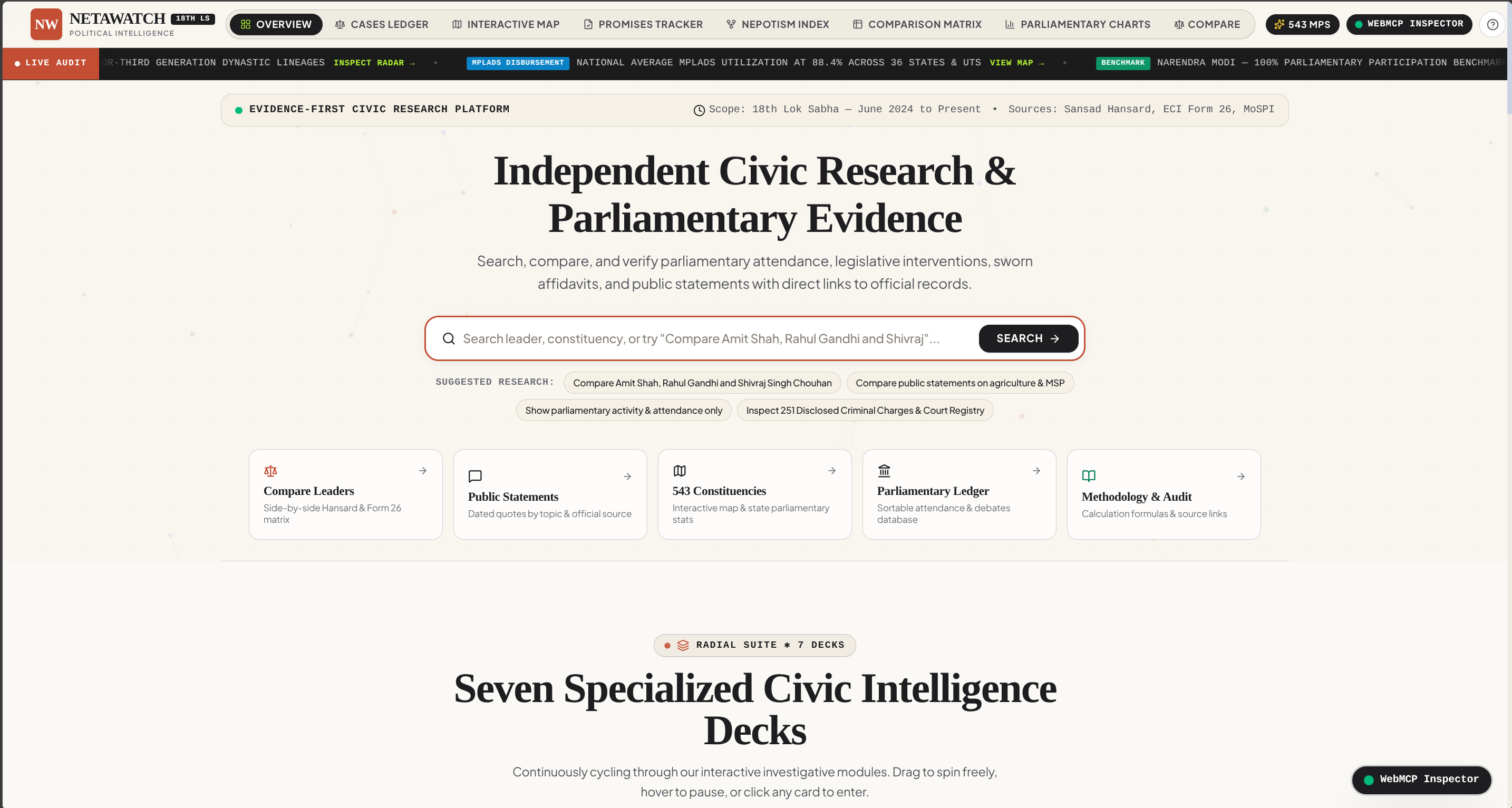
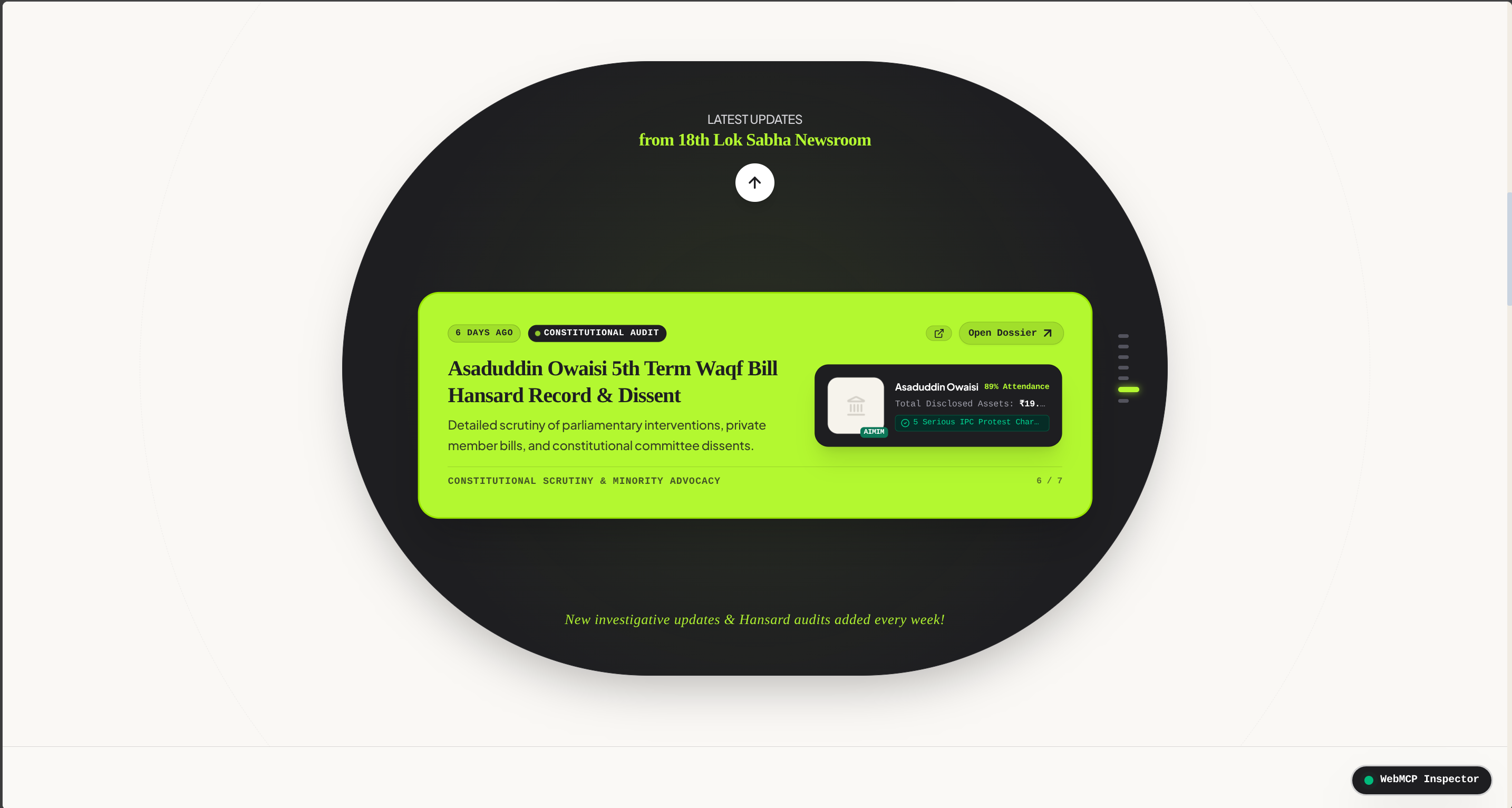
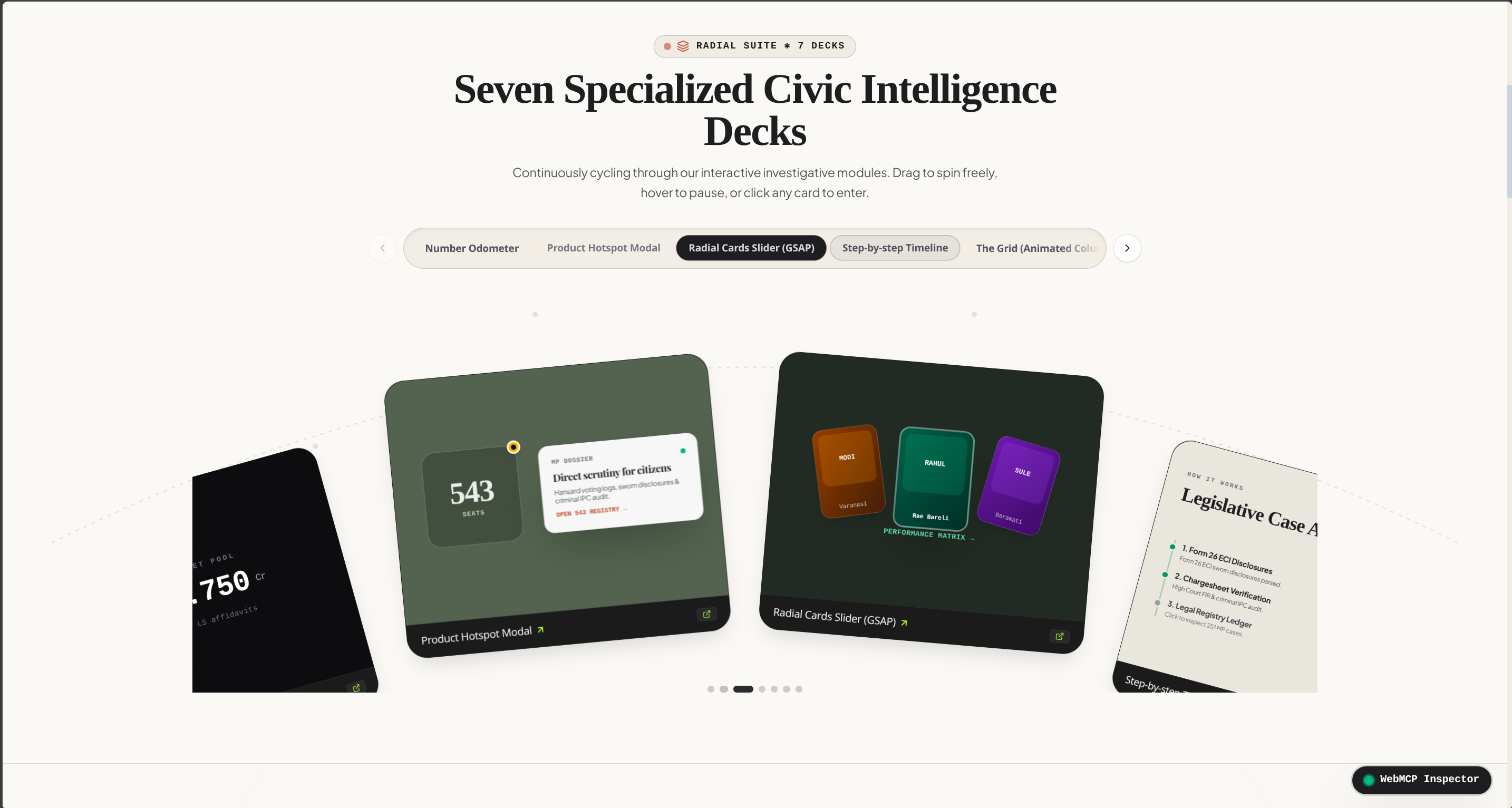
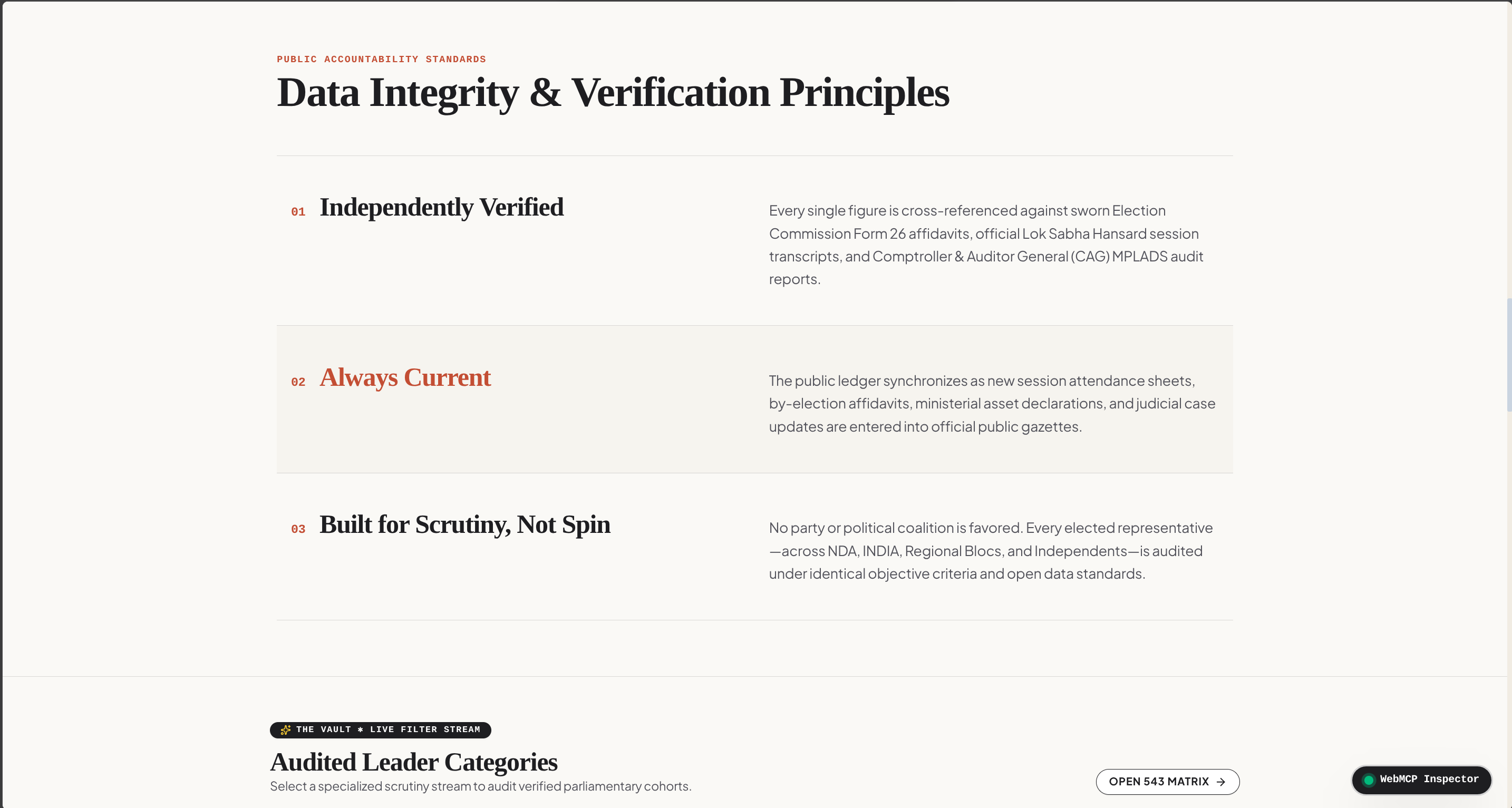
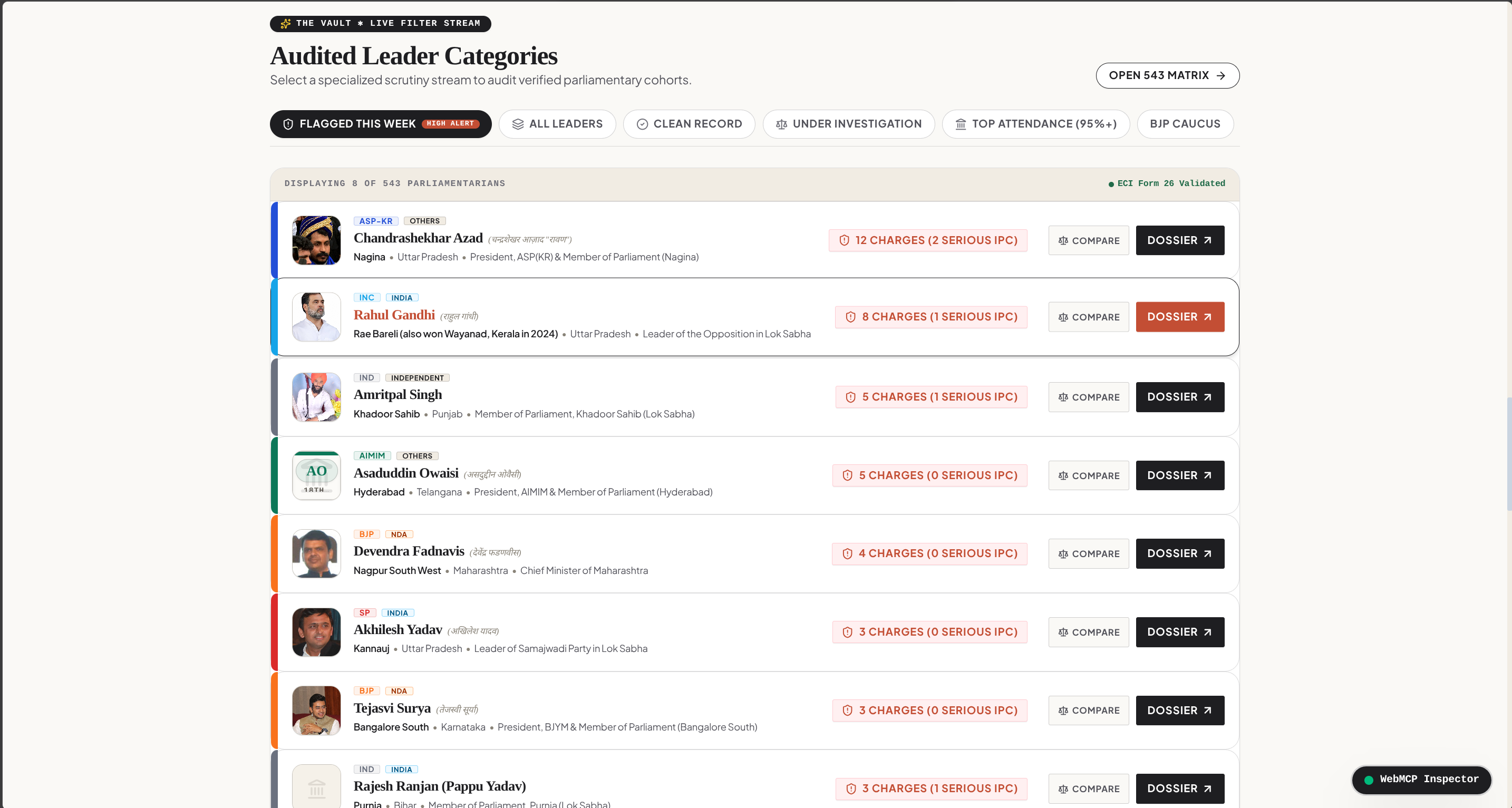
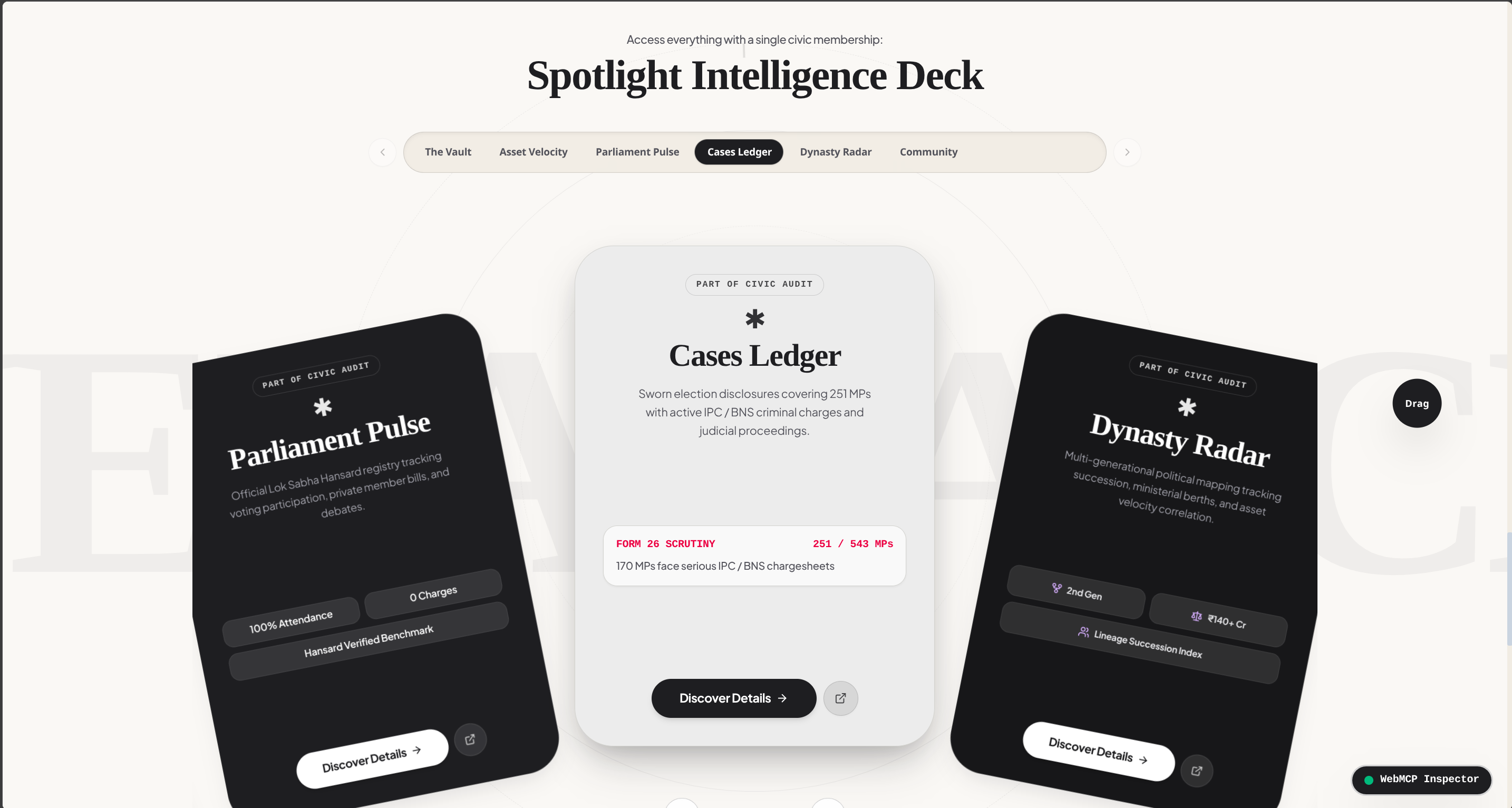
NetaWatch is a civic research platform guided by evidence which arranges information on politicians into structured research dossiers. It combines data on parliamentary activity, public statements, election affidavits, assets, legal records and other publicly available information.
We then included WebMCP features so that AI agents will be able to interact directly with NetaWatch.
Instead of manually navigating through the website, a user can ask an AI agent to perform tasks such as:
- Find a politician's dossier
- Retrieve specific civic or parliamentary information
- Answer research questions using NetaWatch data
- Compare politicians across important metrics
For instance, in the demo we request that ChatGPT finds Rahul Gandhi's dossier using NetaWatch; the agent identifies and makes use of the exposed features, retrieves the relevant information, and then makes it available in the conversation.
The workflow becomes:
ASK → DISCOVER → VERIFY → COMPARE
How We Built It
We created NetaWatch as a structured civic research platform, including politician-specific dossiers and organized datasets; the WebMCP layer makes available certain NetaWatch features so that compatible AI agents are able to discover and call them.
The key idea is to separate the system into two parts:
NetaWatch is the source of the structured evidence.
The interface offered by WebMCP enables AI agents to interact with it.
It turns natural-language requests into real interactions with the application rather than just chatbot responses.
Challenges
A major difficulty was working out how to make useful application capabilities available to an AI agent without ending up with an interface that consisted of too generally worded tools.
We also had to give careful consideration to structured data, reliable retrieval, and making it easy for the user to understand the agent's interactions. In order for a workflow to be a success it had to be not only technically functional but also easy to demonstrate.
A further difficulty was giving users complex civic information without it being overwhelming. To deal with this we grouped the information into targeted dossiers and important metrics.
What We Learned
We discovered that attaching AI to an application is fundamentally different from just attaching AI to a database, the agent having to have clear and well-defined capabilities which correspond naturally to user intent.
We also found that structured civic data becomes considerably more useful when it can be queried using natural language and still keeps the underlying evidence and context.
Most importantly, this project demonstrated to us how WebMCP is able to convert a conventional website into something that an AI agent can actively use, thus establishing a new kind of interaction model between users, AI, and web applications.
What's Next
We would like to enhance NetaWatch WebMCP by adding more research capabilities, incorporating a wider range of civic datasets, providing richer comparisons, and including further agent actions.
We want evidence-based civic research to be just as easy as posing a question—yet at the same time we want the basic information to remain structured, transparent, and verifiable.
Built With
- css3
- lucid-css
- react
- typescript
- vite
