-
-
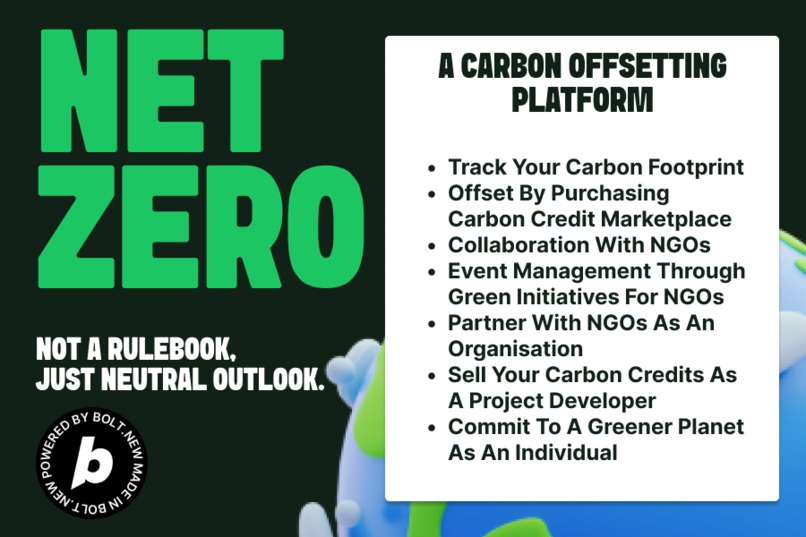
Net Zero - Not a rulebook, just neutral outlook.
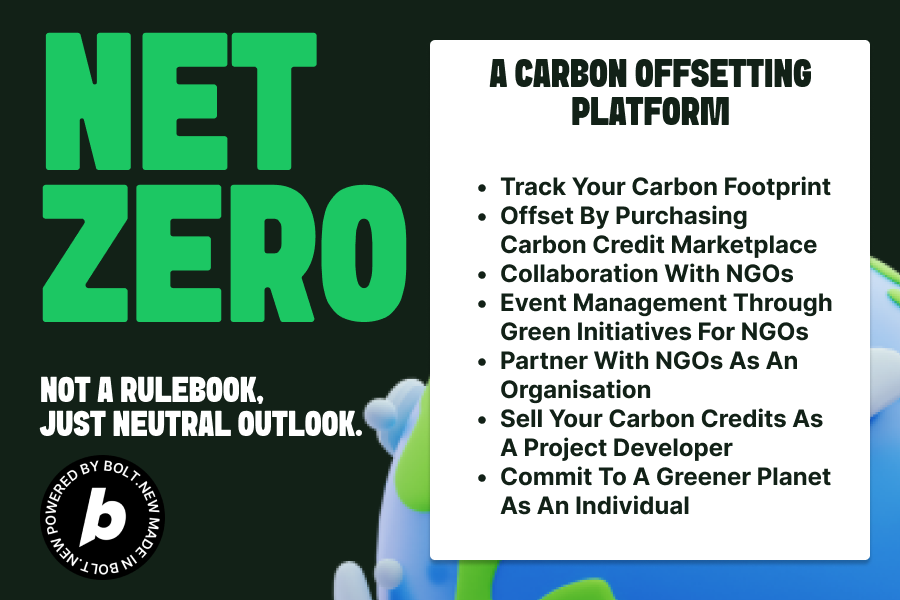
🌱 Net Zero – A Carbon Offsetting Platform
🌍 Inspiration
Climate change is a pressing global challenge, and while many individuals, organizations, and NGOs are eager to contribute to sustainability, they often lack a unified, transparent, and engaging platform to act effectively. Net Zero bridges this gap by creating a comprehensive ecosystem that connects project developers, organizations, NGOs, and individuals to drive carbon neutrality through actionable, rewarding, and community-focused solutions.
💡 What It Does
Net Zero is a multi-user platform designed to empower different stakeholders in the fight against climate change. It combines carbon footprint tracking, a carbon credit marketplace, event management, volunteer coordination, partnerships, and rewards to foster a holistic approach to sustainability.
Key Features
- User Authentication: Role-based access for Project Developers, Organizations, NGOs, and Individuals.
- Carbon Footprint Tracking: Tools to monitor and visualize emissions for individuals and organizations.
- Carbon Credit Marketplace: Buy and sell verified carbon credits to offset emissions.
- NGO Event Management: Create and manage environmental events and coordinate volunteers.
- Partnership System: Facilitate collaborations between organizations and NGOs.
- Rewards System: Incentivize sustainable actions with rewards for individuals.
- Analytics & Reporting: Detailed dashboards for tracking impact and generating reports.
- Community Engagement: Features to connect users and promote collective action.
User Roles and Functionality
Project Developers
- Create and manage carbon offset projects.
- Track credit sales and revenue.
- Respond to inquiries from potential buyers.
- Access detailed project analytics.
Organizations
- Monitor corporate carbon emissions.
- Purchase carbon credits to offset emissions.
- Partner with NGOs for sustainability initiatives.
- Commit volunteers to environmental events.
NGOs
- Create and manage environmental events.
- Process volunteer applications.
- Submit and track funding requests.
- Manage partnerships with organizations.
Individuals
- Track personal carbon footprint across various categories.
- Volunteer for environmental events.
- Purchase carbon credits to offset emissions.
- Earn rewards for sustainable actions.
🔧 How We Built It
- Frontend: React with TypeScript, styled with Tailwind CSS for responsive design, and Lucide React for icons.
- Backend: Supabase for authentication and database management, with a relational schema for users, projects, events, volunteers, purchases, and partnerships.
- Data Visualization: Recharts for interactive charts and dashboards.
- Carbon Logic: Custom carbon calculator for tracking emissions across fuel, electricity, food, and travel.
- Additional Features: Responsive design, event management, volunteer coordination, partnership system, and rewards integration.
🚧 Challenges We Ran Into
During development, we encountered several challenges that required careful resolution:
- Balancing UX for 4 different user types without clutter
- Designing a reward system that’s impactful but fair
- Building a carbon credit listing system
- Handling diverse CO₂ input categories with flexible calculator logic
🏆 Accomplishments We're Proud Of
- Built a multi-role platform that seamlessly connects project developers, organizations, NGOs, and individuals in a unified sustainability ecosystem.
- Developed a robust carbon credit marketplace with project management and transaction tracking.
- Created responsive, role-specific dashboards with interactive visualizations using Recharts.
- Implemented a rewards system to incentivize sustainable behavior, enhancing user engagement.
- Integrated Supabase for secure authentication and efficient data management with proper relational schemas.
📚 What We Learned
- The importance of clear role-based access control to cater to diverse user needs.
- How to design a scalable database schema for complex relationships (e.g., projects, purchases, volunteers).
- The value of responsive design and intuitive UX in driving user adoption.
- The need for robust error handling and validation in async operations, especially for marketplace and dashboard functionality.
- The ethical responsibility of building transparent and verifiable climate tech solutions.
🚀 What's Next for Net Zero
- Mobile Apps: Launch native iOS and Android apps for broader accessibility.
- API Integrations: Connect with external carbon APIs (e.g., Carbon Interface) and energy providers for enhanced tracking.
- Partnerships: Collaborate with standards like Verra and Gold Standard, and regional NGOs for project verification.
- Advanced Features: Introduce more sophisticated rewards, ESG reporting tools, and enterprise white-labeling.
- Blockchain Integration: Explore tokenized carbon credits and reward points for enhanced transparency (Phase 3).
Built for a cleaner, greener world — one user, one offset, one verified project at a time. 🌍
Built With
- react
- supabase
- typescript


Log in or sign up for Devpost to join the conversation.