-
-
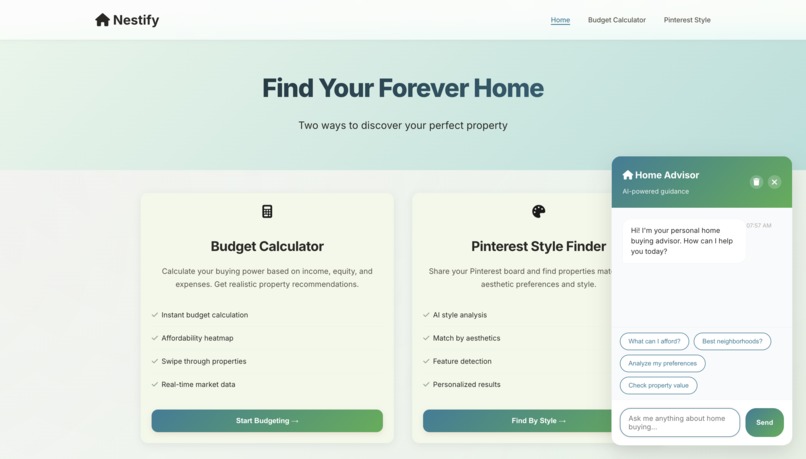
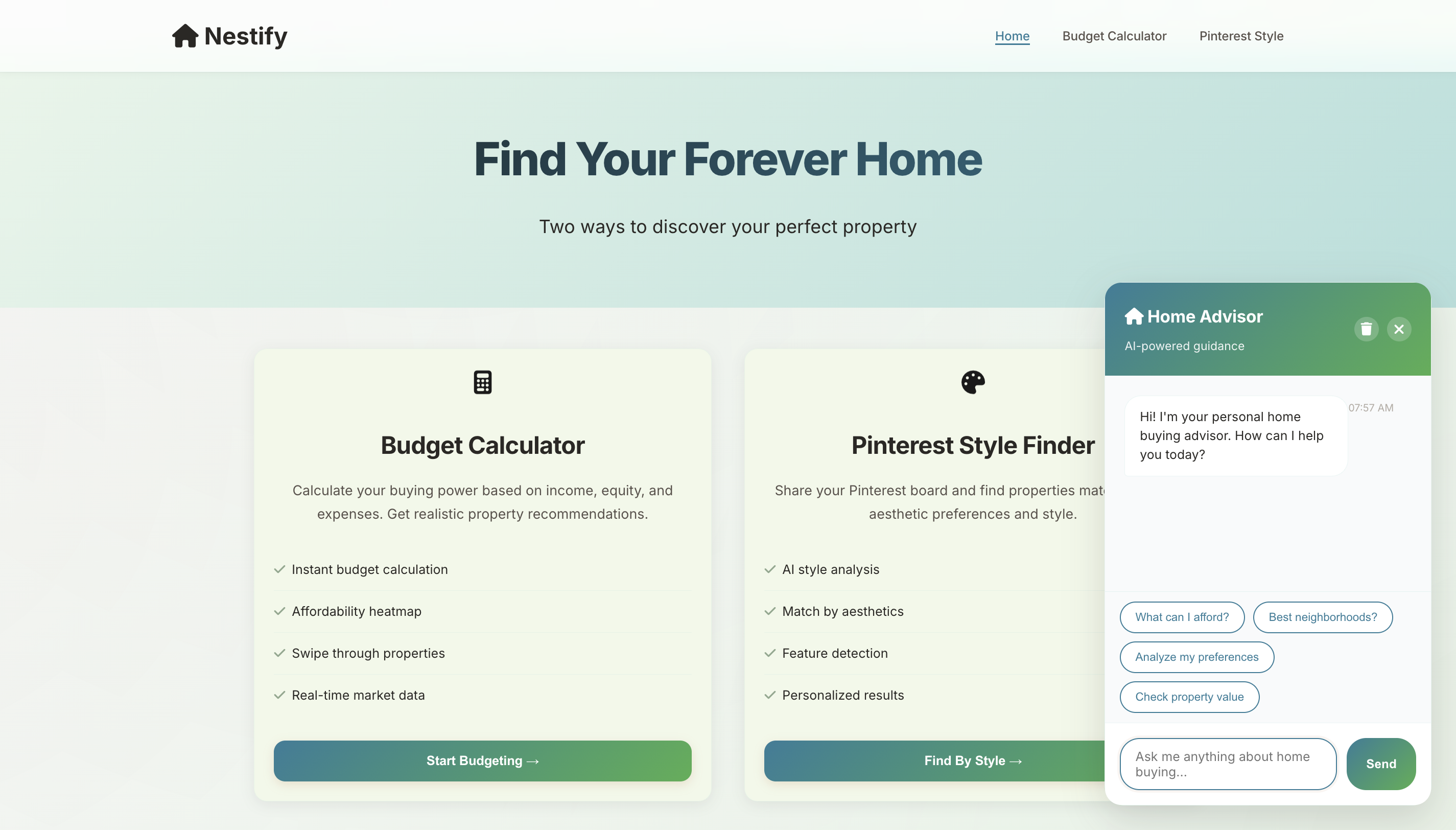
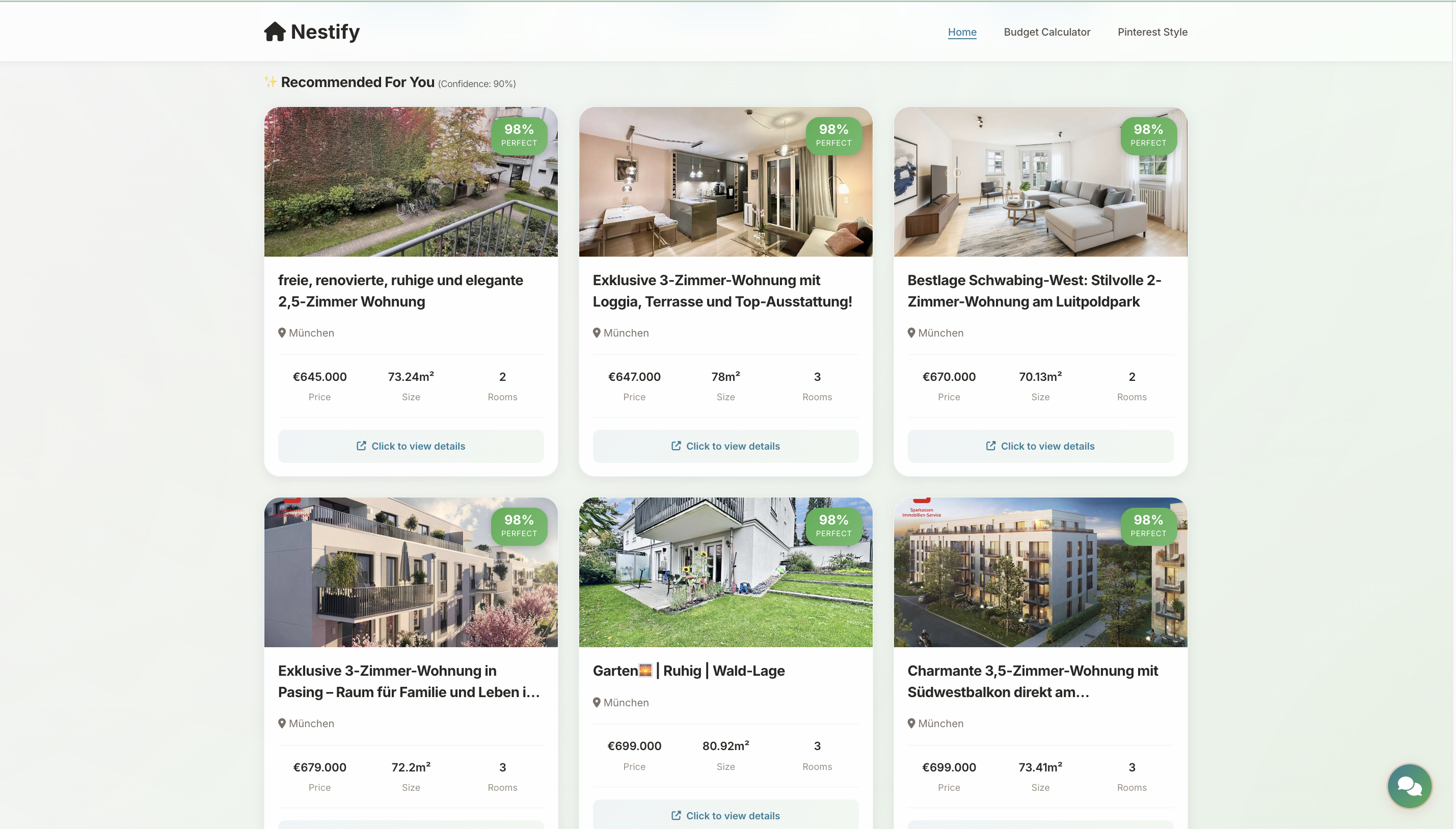
Nestify’s main landing page, guiding users into the budgeting, exploration, and home advisor chat.
-
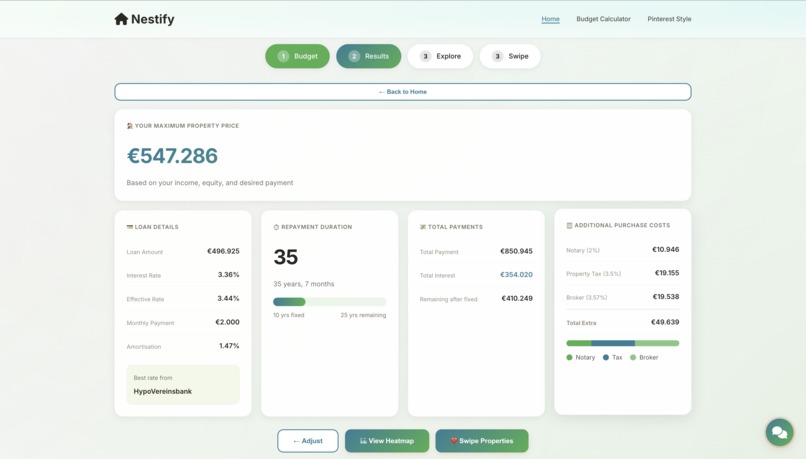
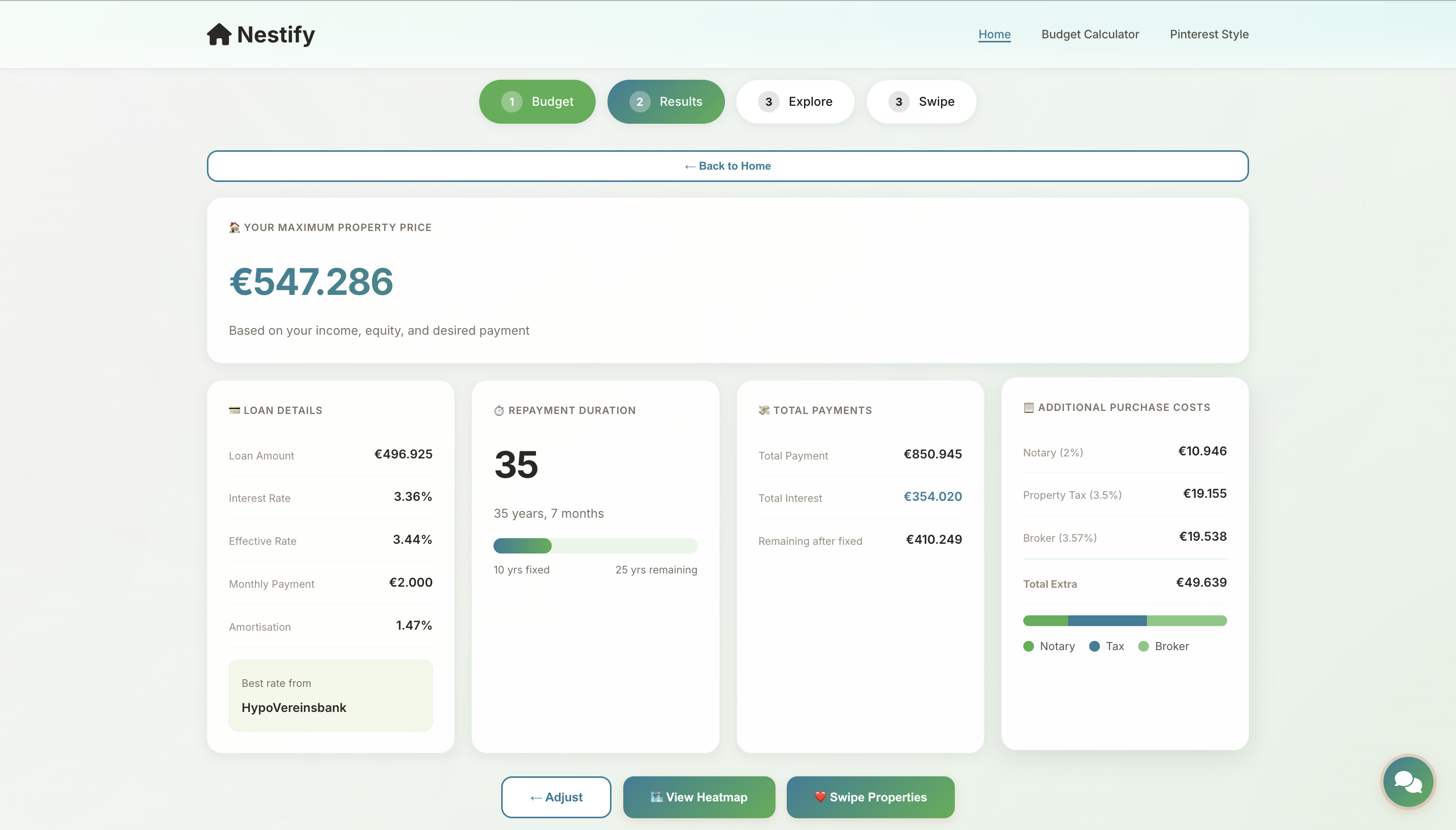
Smart Budget Calculator showing realistic affordability with full cost breakdown for German home purchases.
-
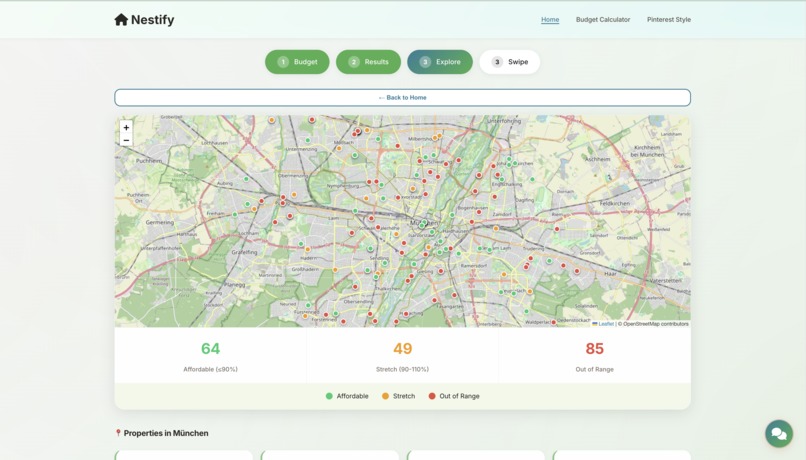
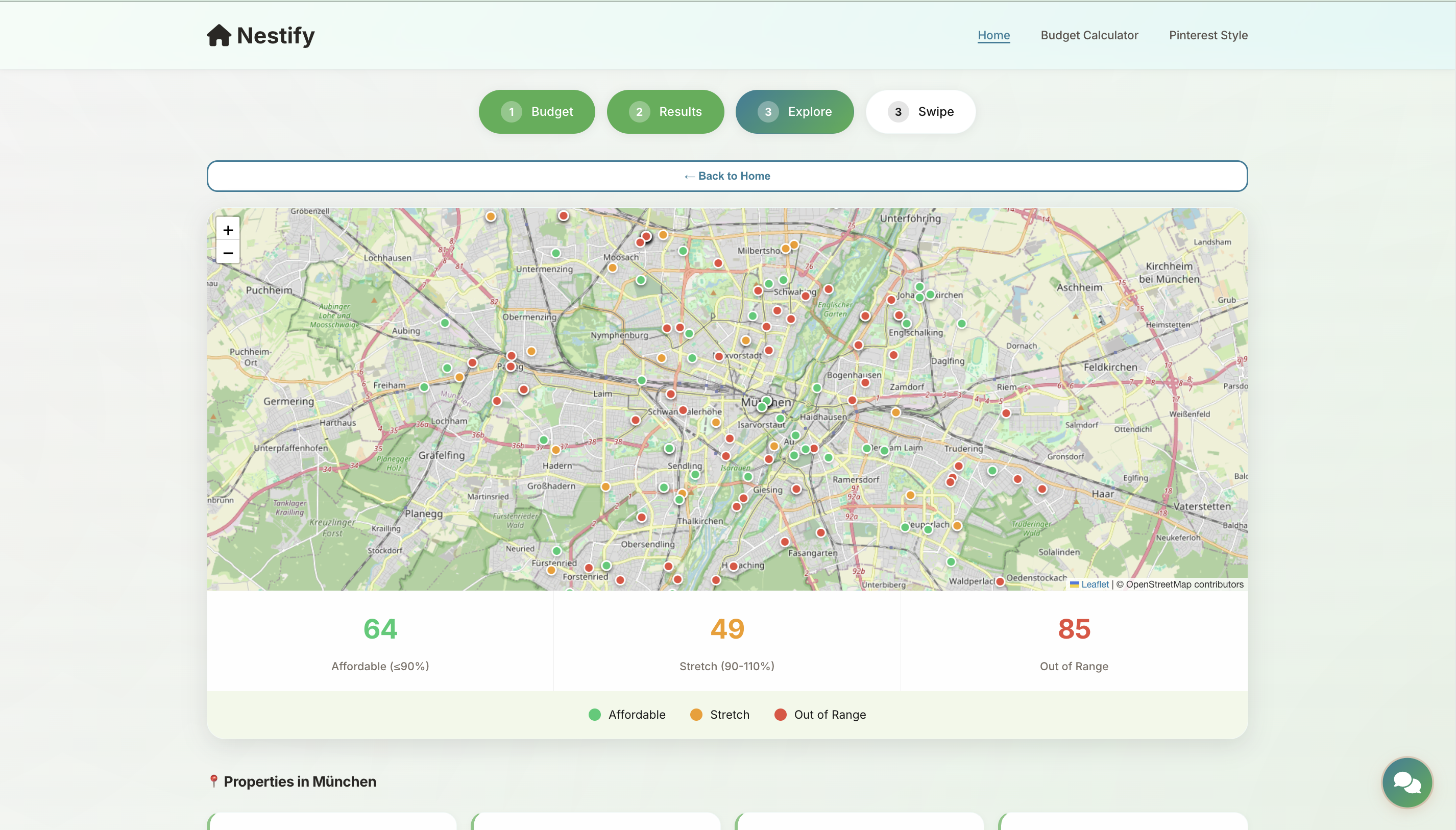
Affordability Heat Map visualizing which areas fit the user’s budget, stretch range, or exceed it.
-
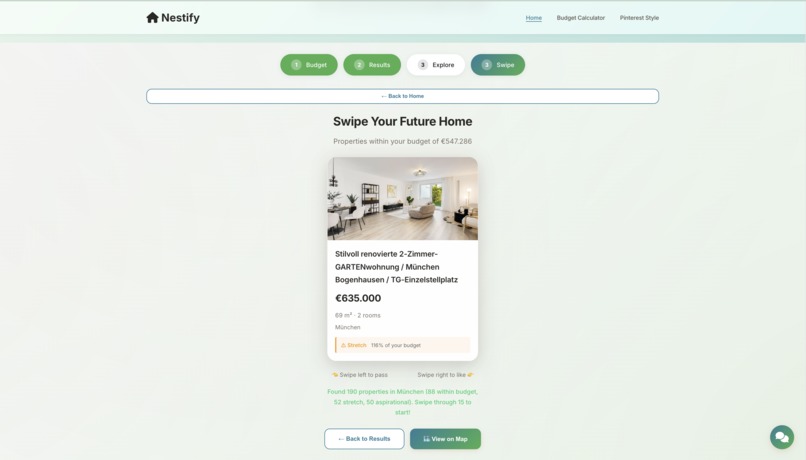
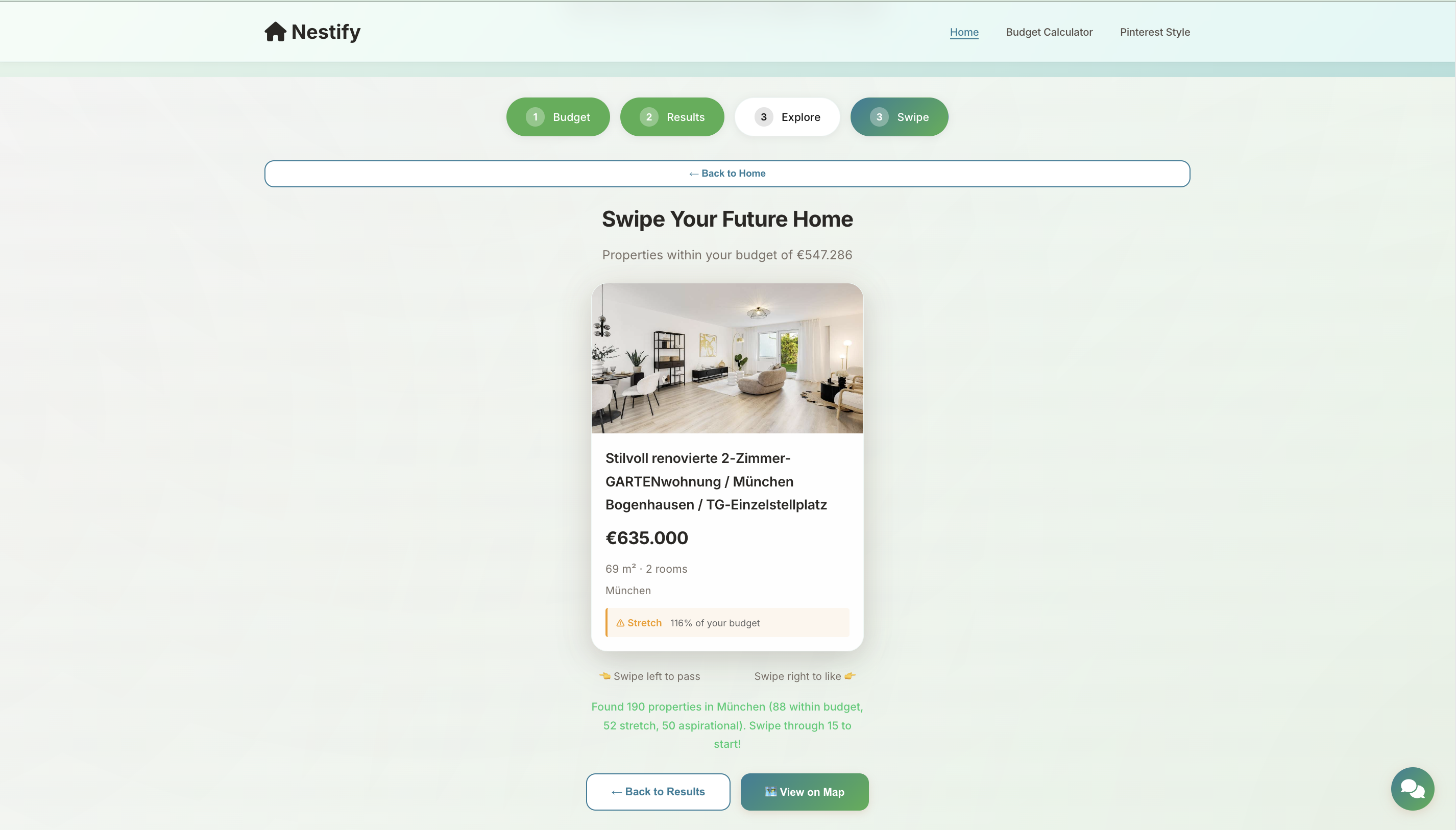
Swipe-to-Discover interface learning user preferences and generating personalized recommendations.
-
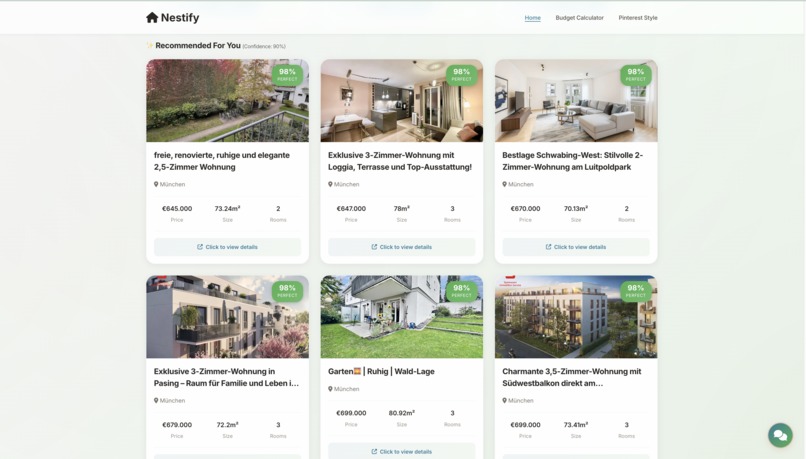
High-confidence recommended properties generated after the swipe learning phase.
-
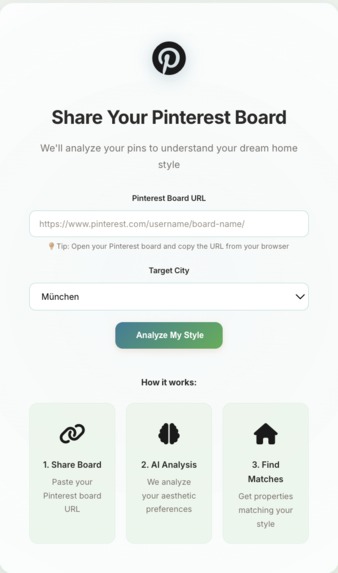
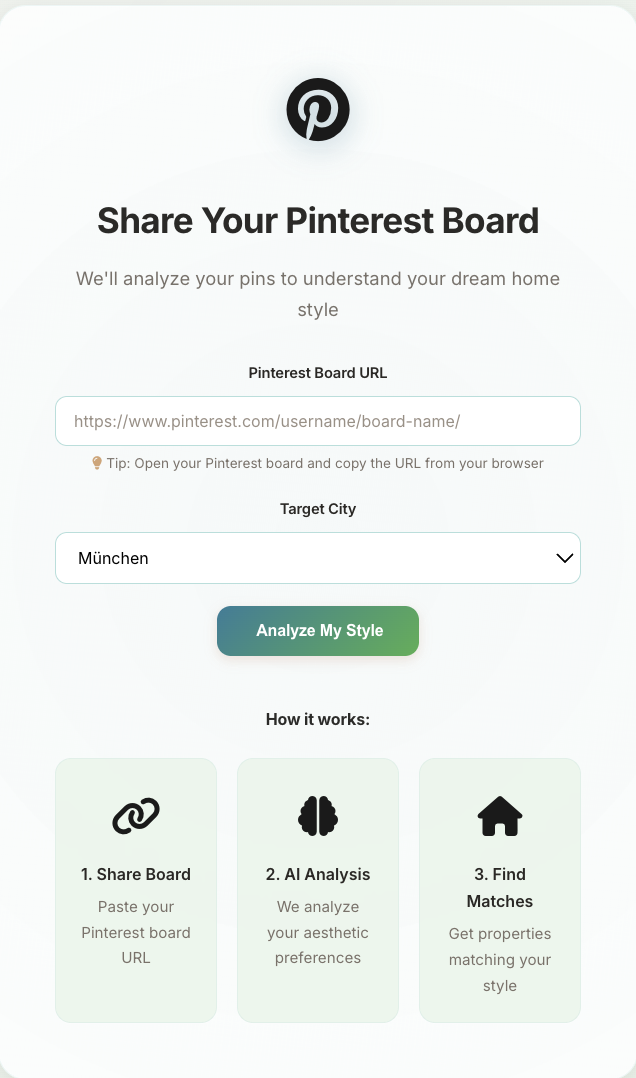
Pinterest board input screen where users paste their board URL for aesthetic style analysis.
-
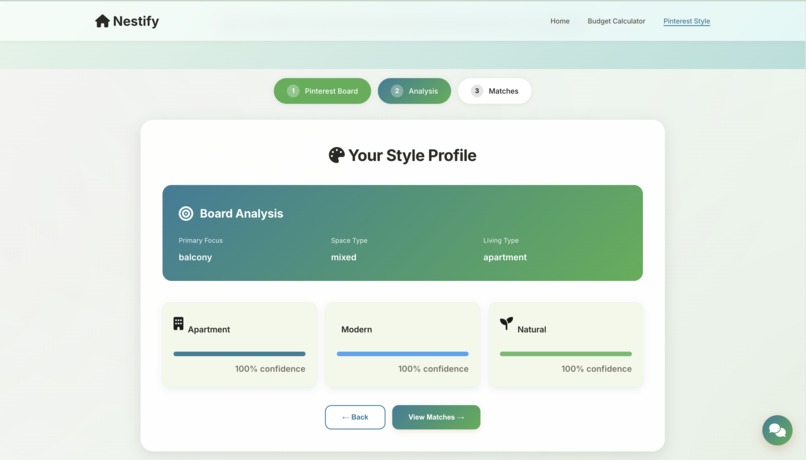
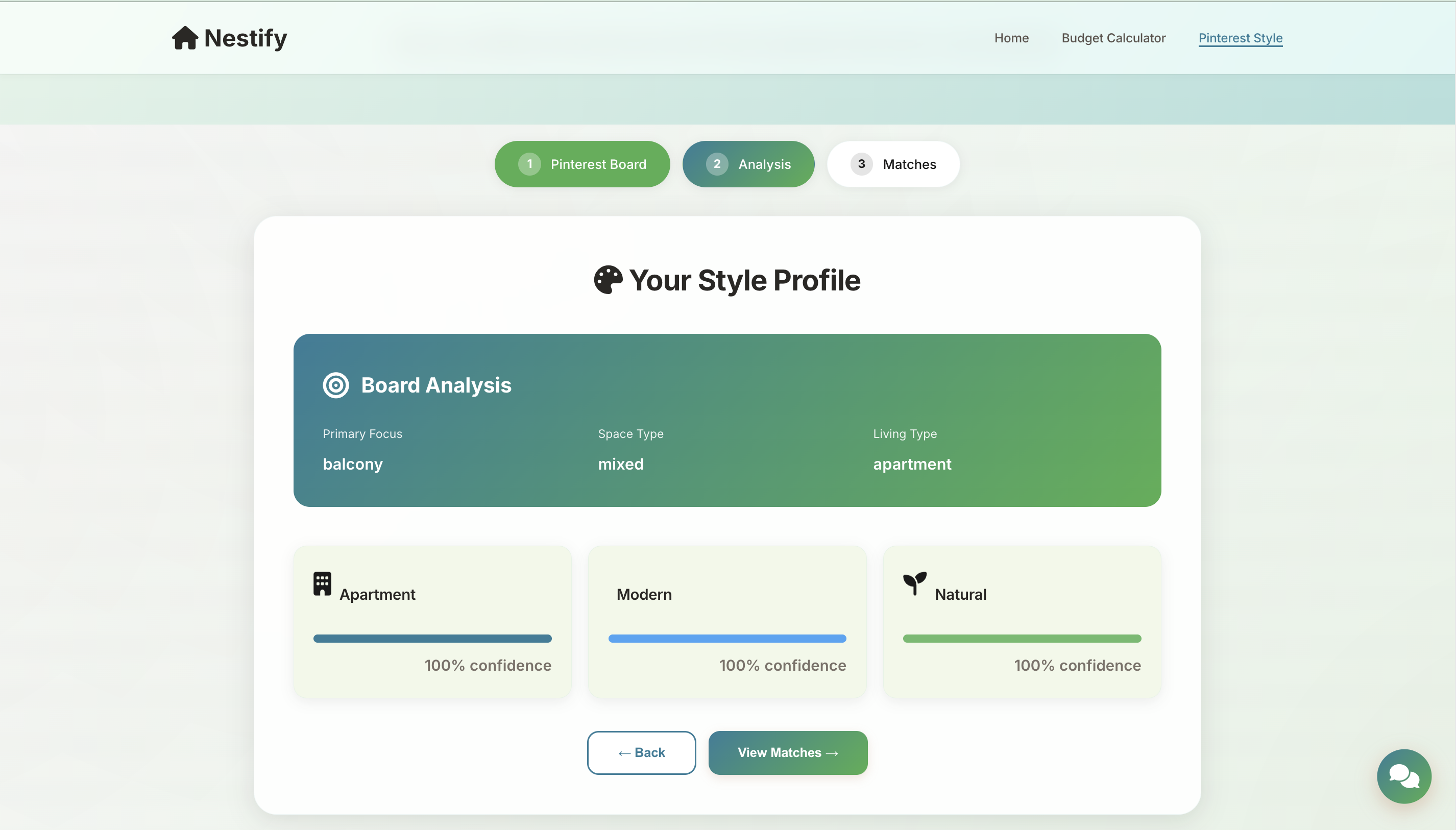
Nestify extracting themes and aesthetic elements from the user’s Pinterest board using semantic analysis.
-
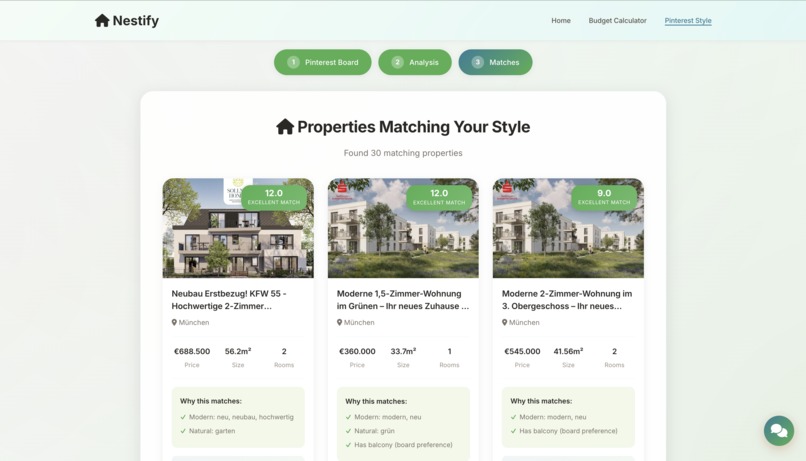
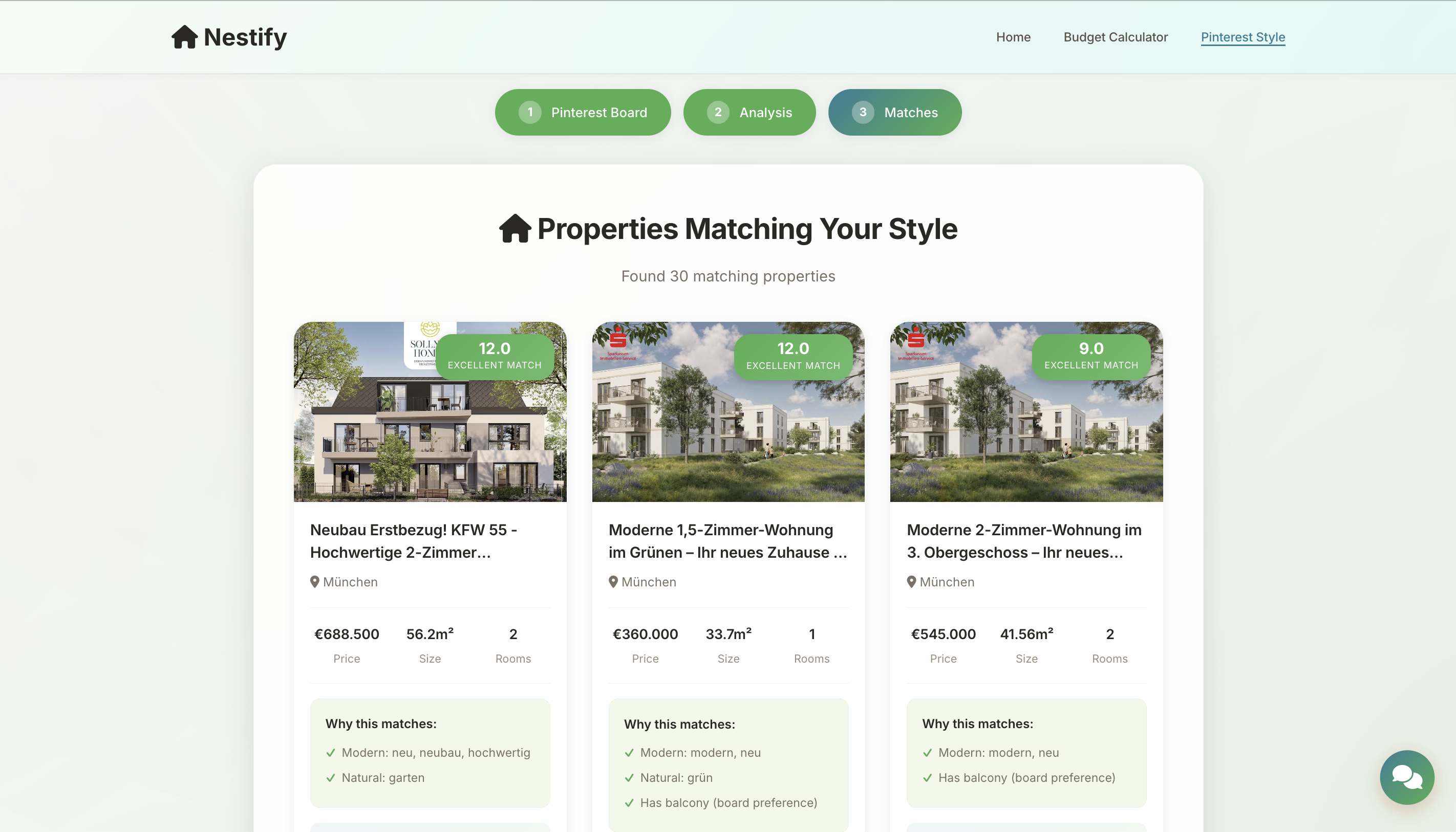
Aesthetic-based property matches scored and filtered according to the user’s Pinterest style profile.
Nestify
Inspiration
Buying a home is one of the most significant decisions people make, yet the process remains confusing, opaque, and emotionally overwhelming. Existing real estate platforms offer thousands of generic listings but provide no personal guidance, no financial clarity, and no connection to the buyer’s individual aesthetic preferences.
At the same time, many users maintain detailed Pinterest boards that reflect their ideal home style—yet none of this personalized taste is incorporated into traditional property search platforms.
We built Nestify to bridge this gap. Our goal was to combine financial accuracy, aesthetic understanding, and intelligent exploration into a single, modern home-finding experience.
What it does
Nestify is a full-stack, data-driven home discovery platform designed to help users understand what they can afford, where they should look, and which properties match both their finances and their aesthetic preferences.
It consists of five core functionalities presented to the user in a logical journey:
1. Smart Budget Calculator
A comprehensive affordability tool that analyzes a user’s income, equity, desired monthly payment, and state-specific German purchase fees.
The calculator provides:
- Maximum affordable property price
- Loan structure and amortisation schedule
- Notary, broker, and property transfer tax fees
- Monthly and long-term financial commitments
This forms the foundation for all later recommendations.
2. Affordability Heat Map
Using real property listings from the ThinkImmo API, Nestify visualizes which areas are affordable, stretch-level, or out of range based on the user's personal budget.
This gives users a clear geographic overview of realistic options before they begin swiping or exploring styles.
3. Swipe-to-Discover Recommendation Engine
An adaptive swipe interface that learns from user behavior.
The system:
- Tracks consistency across price, size, rooms, and city
- Computes statistical measures (standard deviation, coefficient of variation)
- Adjusts weighting dynamically
- Produces a confidence score between 20% and 100%
- Generates curated recommendations once enough data is collected
Users can swipe between 15 and 50 properties depending on how much confidence they prefer the system to build.
4. Pinterest Style Matching
Users can paste the URL of their Pinterest board.
Nestify analyzes the board by:
- Parsing all pins via RSS
- Extracting over 200 aesthetic keywords
- Using GPT-based semantic analysis for deeper interpretation
- Detecting style categories (e.g., modern, natural, minimalist)
- Identifying property-level preferences such as balcony, garden, interior materials, color themes
The system then matches real listings to the user’s aesthetic profile and scores them according to construction type, features, materials, and stylistic alignment.
5. AI-Powered Home Advisor
A conversational assistant powered by GPT-4o-mini that answers user questions such as:
- “What can I afford in this city?”
- “Which neighborhoods match my budget?”
- “Why is this property a good match?”
- “How do German purchase fees work?”
It supports users throughout the entire journey with personalized, context-aware guidance.
How we built it
Nestify is built as a multi-layer application combining frontend interactivity, backend computation, and AI-driven analysis.
Frontend
- HTML5
- CSS3 (responsive design, gradients, animations)
- Vanilla JavaScript (ES6+)
- Leaflet.js for heat map visualization
Backend
- Python FastAPI for REST endpoints
- ThinkImmo API for real German property data
- Pinterest RSS feed parsing for board analysis
- OpenAI GPT-4o-mini for semantic aesthetic interpretation and conversational assistance
Algorithms and Data Processing
- Pinterest → Property pipeline with multi-stage keyword extraction and semantic interpretation
- Adaptive swipe algorithm:
- Weight shifting based on user consistency
- Standard deviation and coefficient of variation calculations
- Confidence score generation
- Weight shifting based on user consistency
- Dual-layer geographic filtering (backend and frontend) for exact city matching
- Property scoring model based on features, style keywords, and construction attributes
Challenges we ran into
API results returning zero listings
Incorrect geographic filtering caused ThinkImmo queries to return empty datasets. Implementing the correct geoSearches structure resolved this.Swipe experience optimization
Users experienced fatigue when forced to swipe too many items. Through user testing, we shifted to an adaptive system starting with 15 but allowing up to 50 based on user preference.RSS parsing compatibility issues
Python 3.13 removed thecgimodule, breaking older versions offeedparser. Upgrading to version 6.0.12 resolved the issue.Maintaining UI consistency
Aligning the Pinterest-style property card design across the home page, swipe page, results page, and style matching page required significant layout restructuring.Accurate modeling of German purchase fees
Researching real, state-specific fees (notary, broker, transfer tax) was necessary to avoid misleading financial projections.Image fetching restrictions from external websites
Some property listings required additional verification before allowing image downloads. As a result, certain cards displayed empty image placeholders, which affected consistency. Handling these authentication-based image access limitations became an unexpected challenge during development.
Accomplishments that we're proud of
One of the achievements we value most is creating a solution that genuinely resonates with our generation. For many young people today, homeownership feels distant, confusing, and emotionally draining. By combining data, design, and AI, we believe we found a way to make this journey more transparent, more hopeful, and more human. Nestify does not promise miracles, but it offers clarity and direction—something our generation has been missing in the housing conversation. Building a tool that reduces anxiety, empowers informed decisions, and brings a sense of possibility back into the process is something we are truly proud of.
- Building a complete end-to-end home discovery workflow combining financial modeling, aesthetic analysis, and recommendation systems.
- Successfully integrating real estate data with a Pinterest-based aesthetic interpretation pipeline.
- Creating an adaptive swipe engine that learns from user behavior with statistically grounded confidence scoring.
- Designing a cohesive, modern, and responsive user interface across all core features.
- Delivering a functional AI advisor that enhances user understanding throughout the home-buying process.
What we learned
- Aesthetic-based matching requires both semantic understanding and structured keyword analysis for high accuracy.
- Transparency increases user trust: showing confidence scores, match explanations, and cost breakdowns significantly improves user engagement.
- Geographic precision is essential: even minor mismatches in city filtering reduce relevance dramatically.
- Adaptive recommendation algorithms outperform static filters for exploratory user journeys.
- Simple UI flows (Budget → Results → Explore → Swipe) help reduce cognitive load in complex decisions like home buying.
What's next for Nestify
The next major step is upgrading our recommendation engine with more advanced machine learning models. Currently, our confidence scoring is based on weighted percentages and statistical consistency across selected features. While this approach works well, it does not yet capture deeper preference patterns, non-linear relationships, or hidden correlations within user behavior. Implementing real ML algorithms, such as gradient-boosted ranking models, collaborative filtering, or representation learning, would allow Nestify to deliver significantly more accurate, personalized, and adaptive recommendations.
- User accounts with persistent budgets, style profiles, and swipe history
- Side-by-side property comparison
- Expansion into additional cities and regions
- Collaborative filtering recommending “users like you also liked…”
- Integration of 3D tours and virtual walkthroughs
- Mortgage pre-qualification through partner lenders
- Neighborhood intelligence including commute times, amenities, and demographic data
- Automated notifications when new matching listings appear

Log in or sign up for Devpost to join the conversation.