Inspiration
Bruno DiBartolo is Brazilian, and his family still lives in Brazil. Caleb Cruz Torres is Cuban. For both of them, sending money to family back home has always been a struggle, with fees, delays and transfers that go wrong. They've watched their families lose money along the way.
The team has a background in crypto and knows stablecoins move value across borders very well. The push to build Nest came from the news. On November 3, 2026, Paraguay's central bank put Ueno Bank into resolution after its solvency ratio fell below half the legal minimum. About 2.9 million customers lost access to their money.
That bank failure made it clear to the team that a family's savings shouldn't depend on one local bank staying healthy. They wanted an account that belongs to the family, held in US dollars, with much stronger protection on every payment.
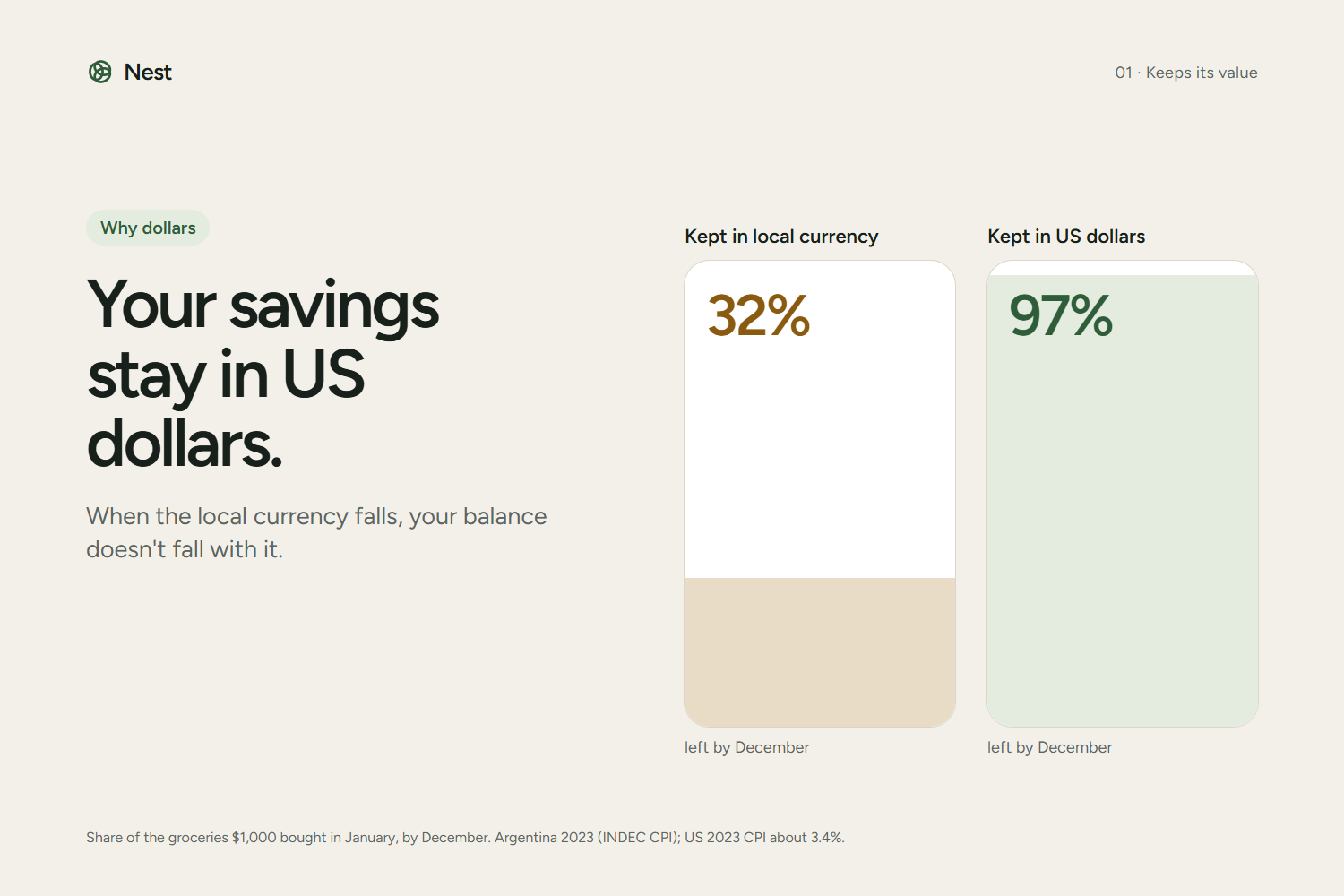
Inflation makes it harder. In Argentina, prices roughly tripled in a single year (INDEC, 2023), and families in Brazil know rising prices too. Nest lets them keep their money in dollars, so it doesn't shrink when the local currency falls.
What it does
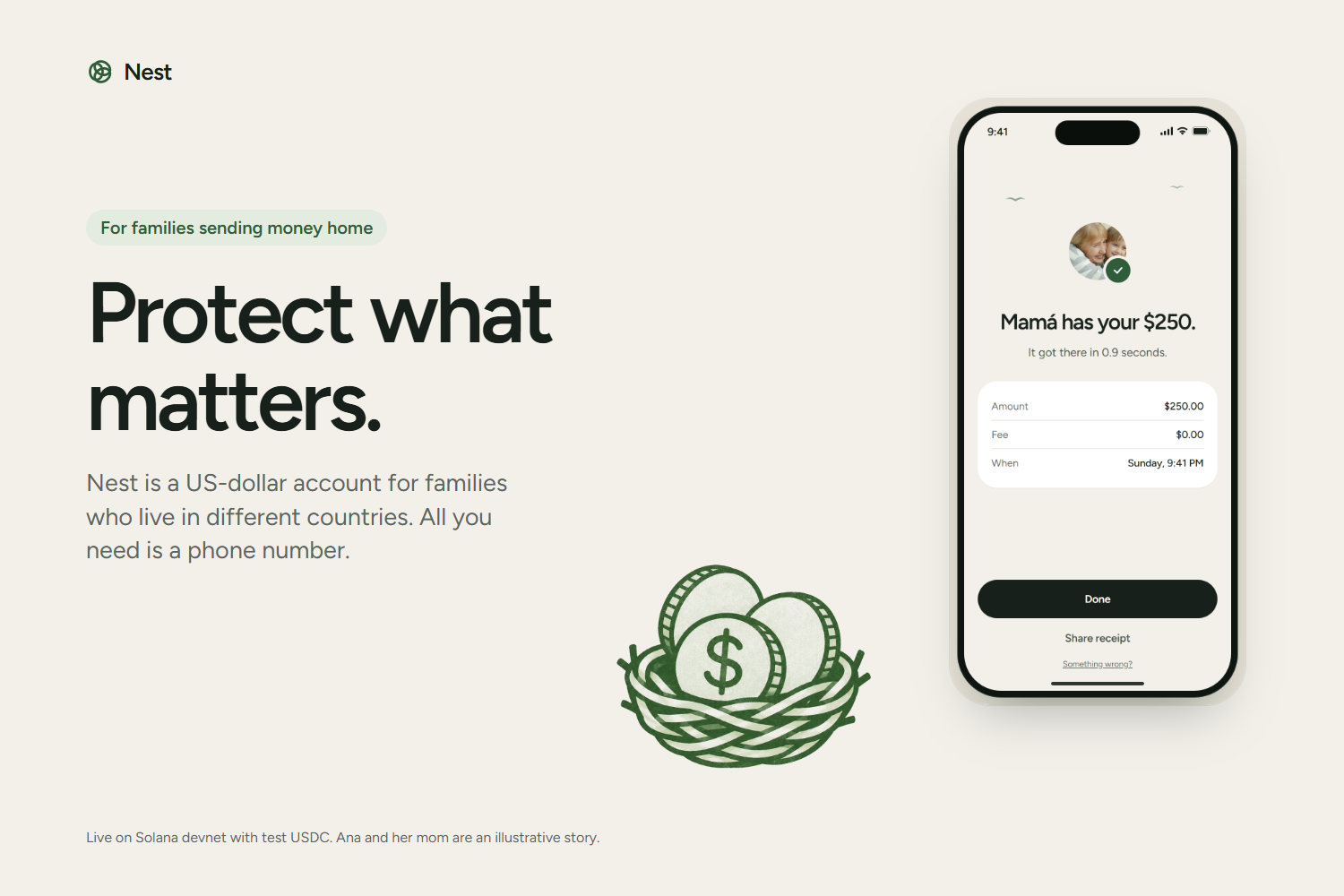
Nest is a US-dollar account for families who live in different countries.
- Holds dollars. Balances are kept in digital US dollars (USDC on Solana), so they don't shrink when the local currency falls.
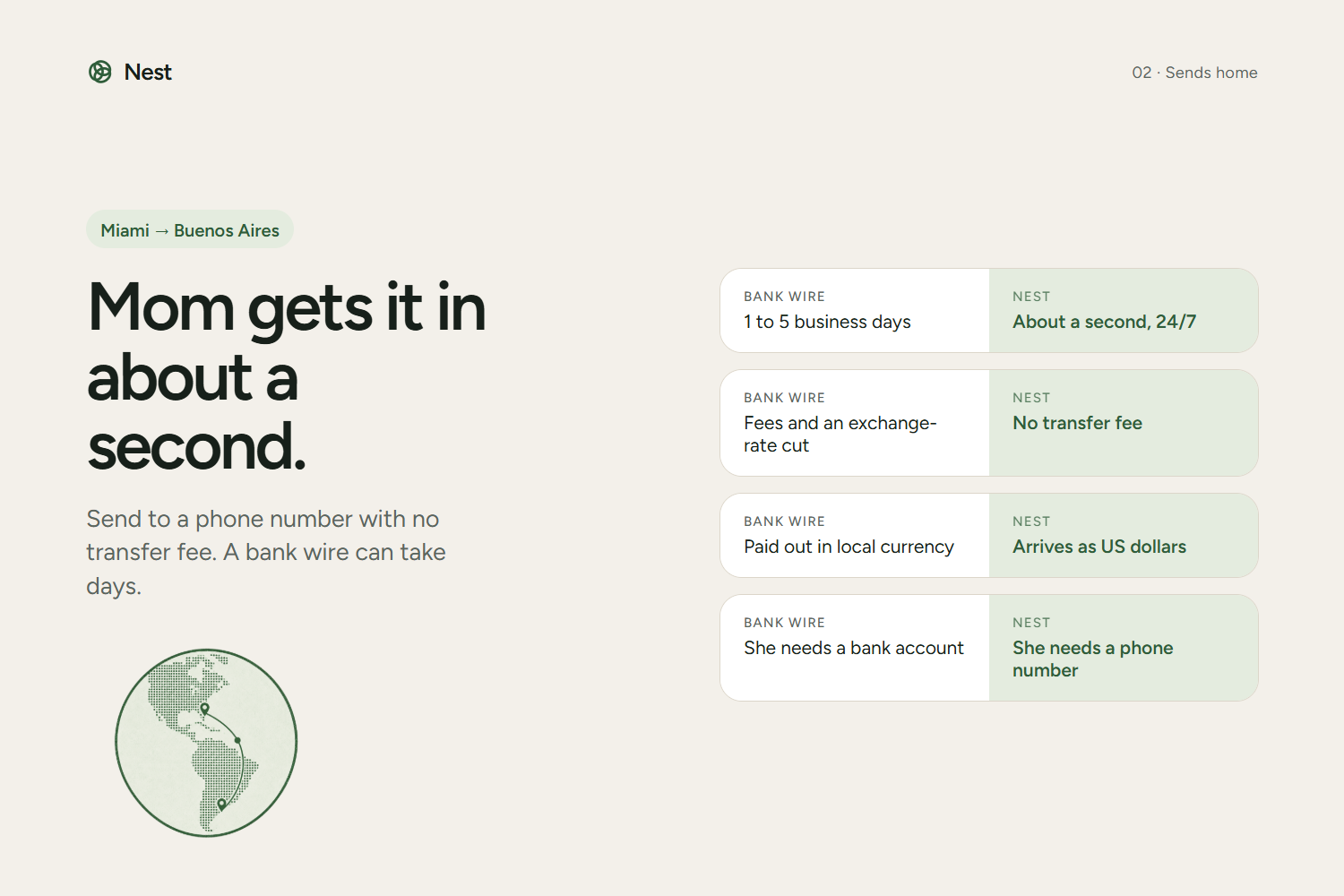
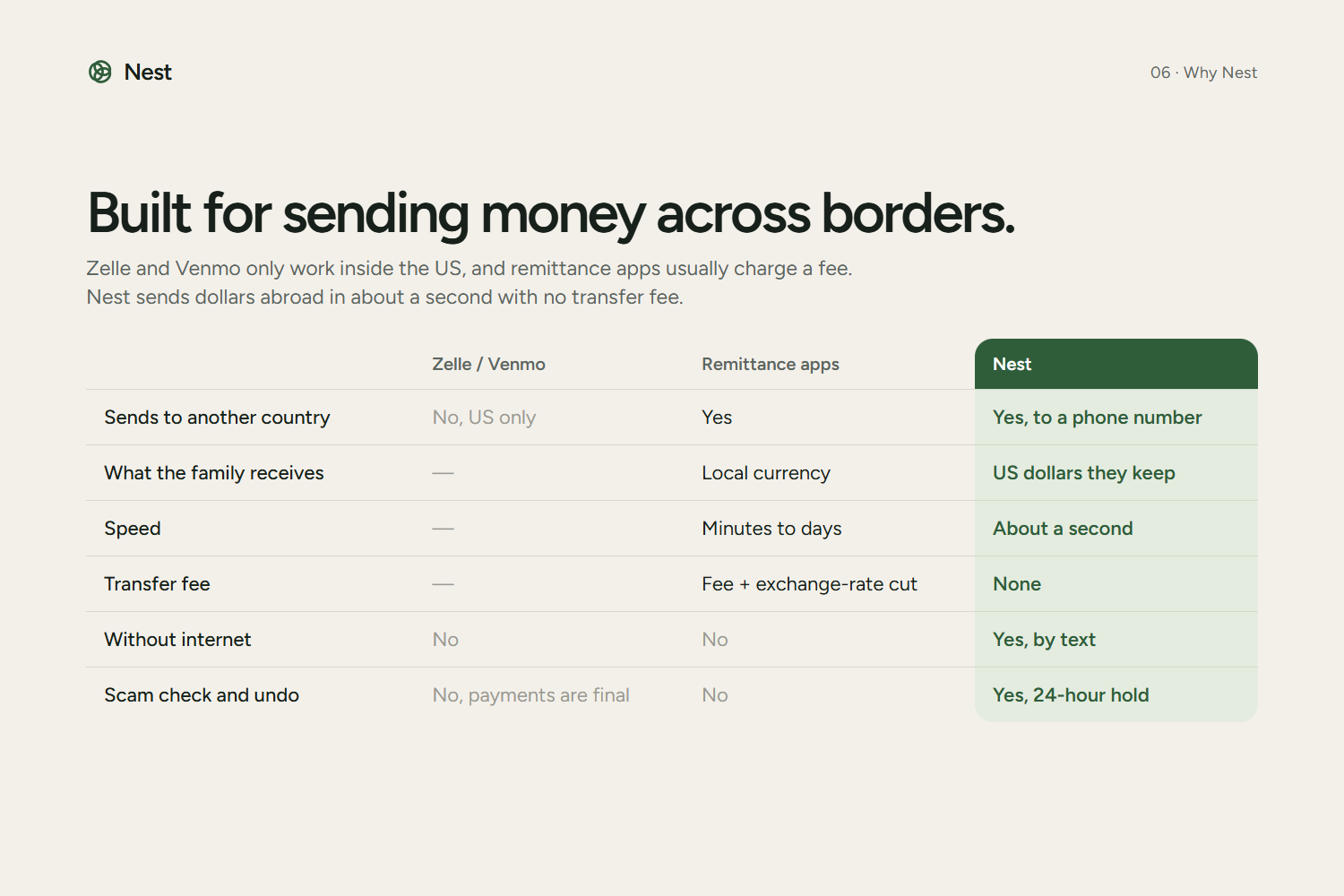
- Sends in about a second. A user sends to a phone number. The money arrives in about a second, with no transfer fee, any time of day.
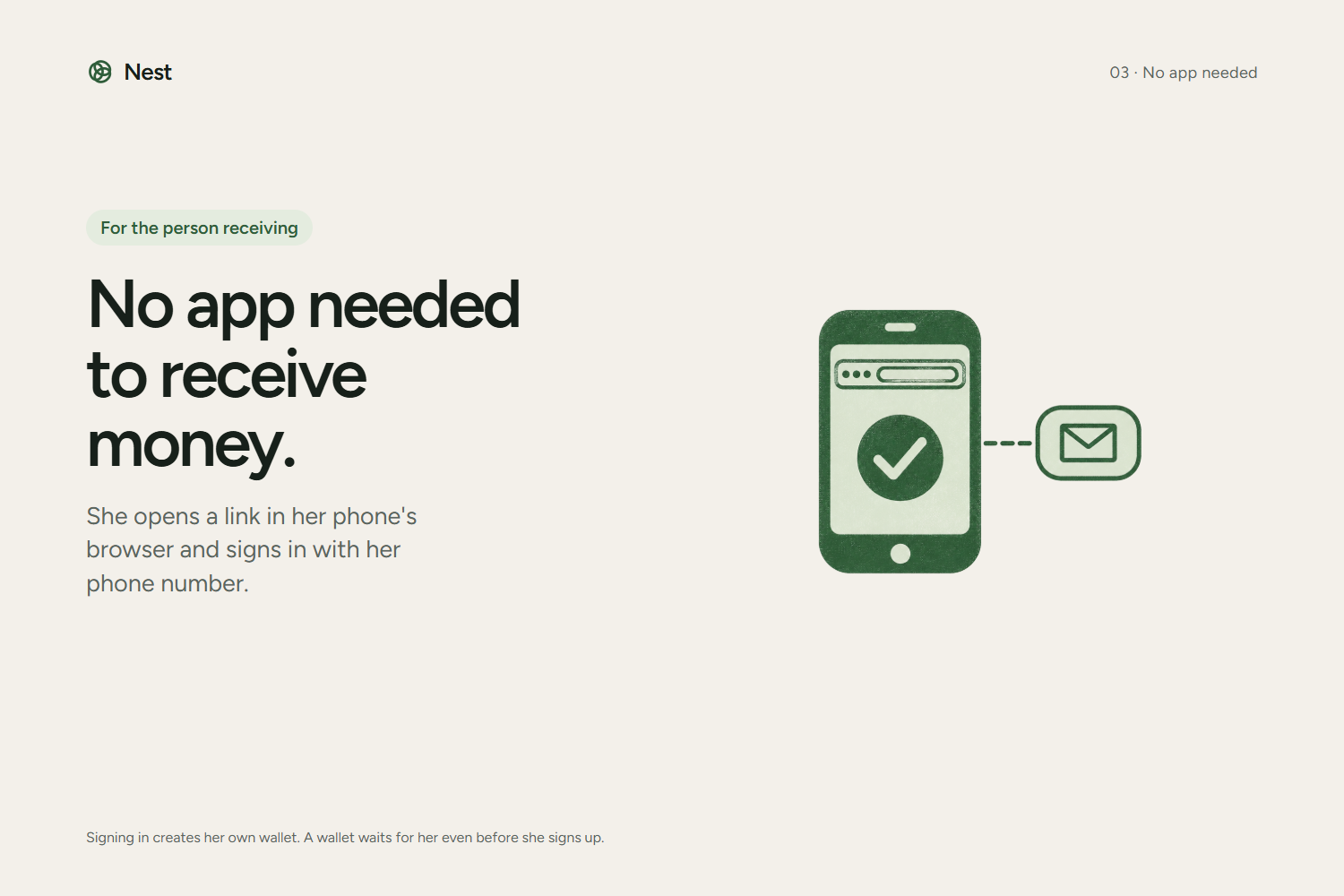
- No app needed to receive. The recipient gets a link, opens it in their phone's browser, signs in with their phone number and keeps the money in dollars.
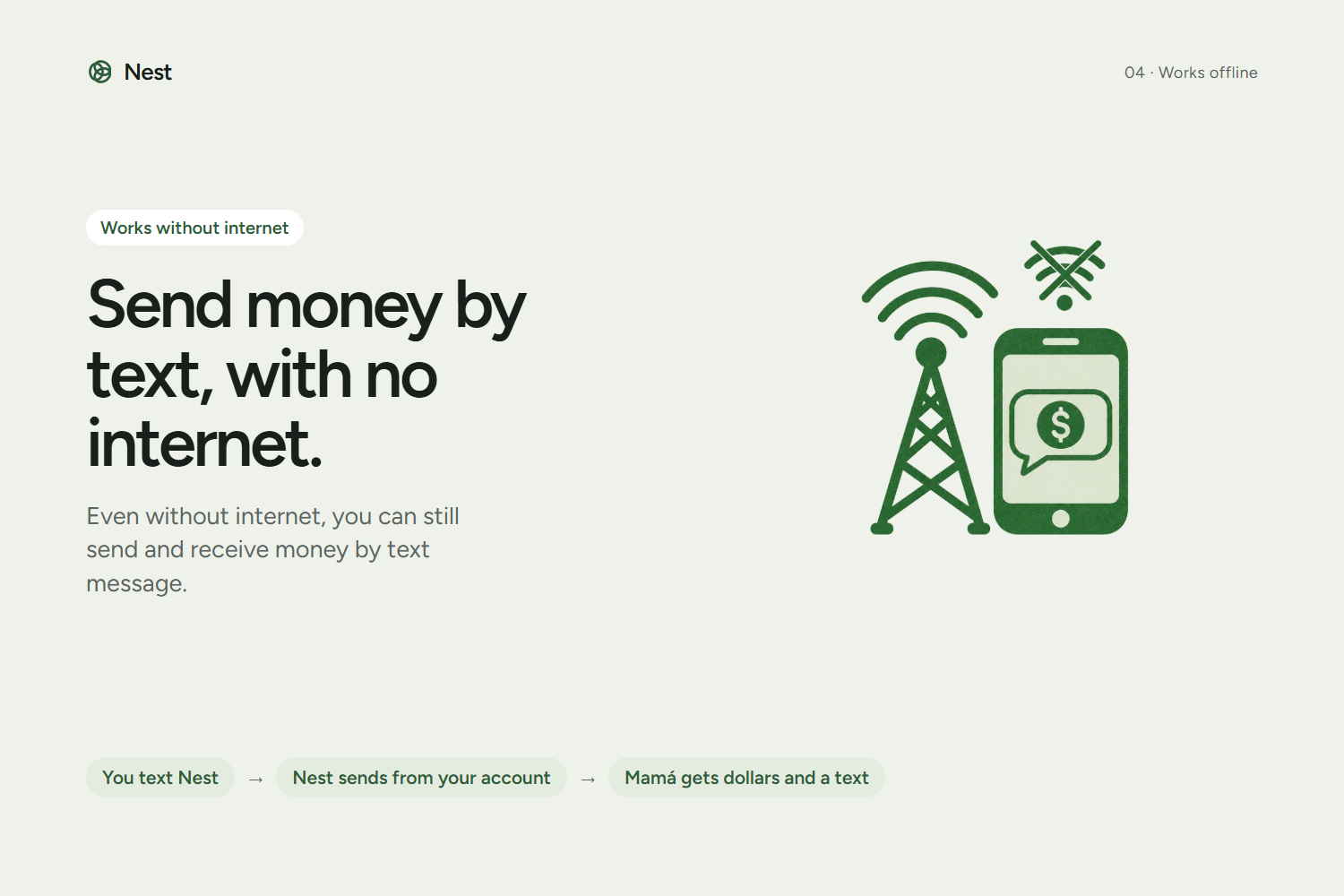
- Works without internet. Even without internet, users can still send and receive money by text message, so their money is never stuck.
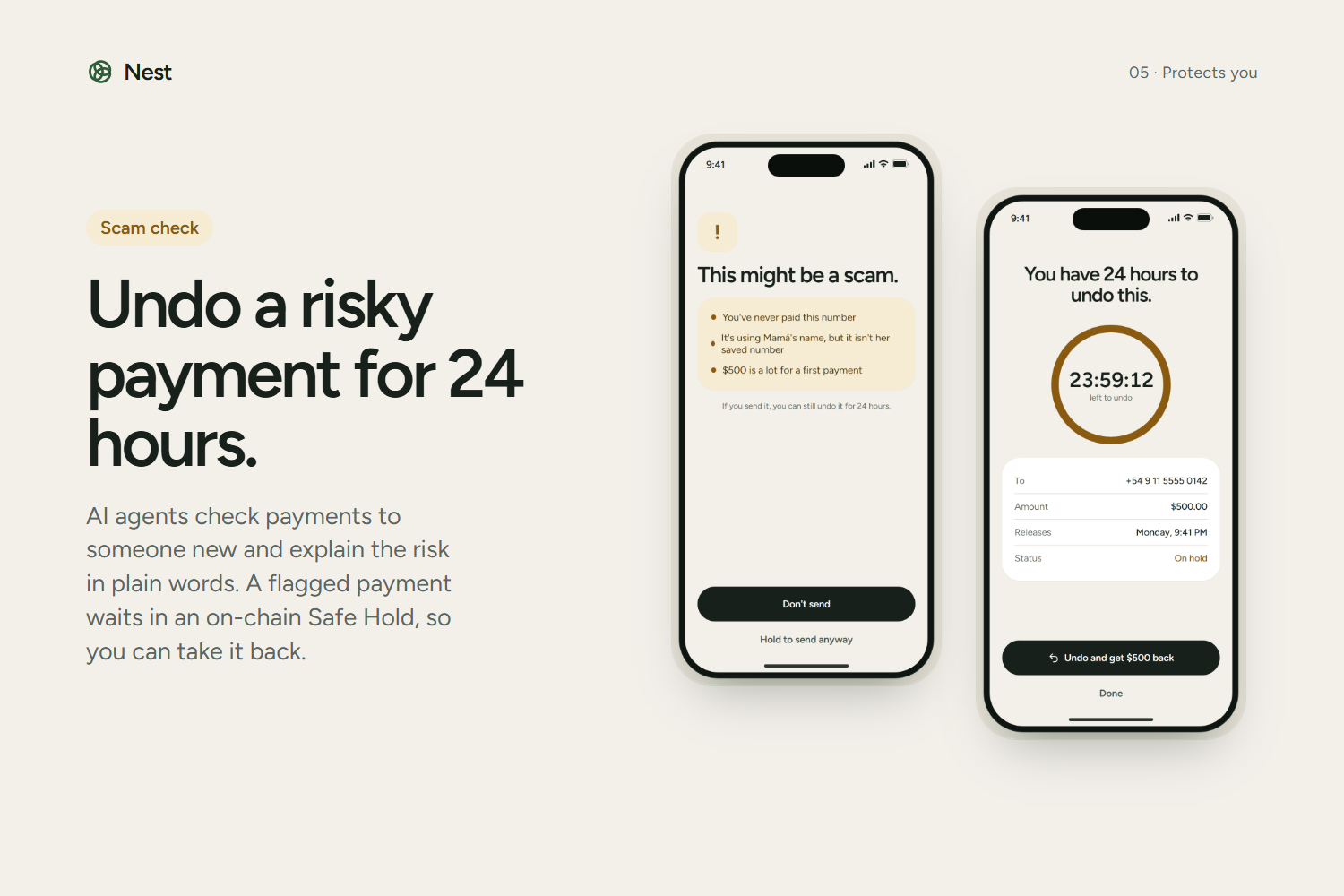
- Checks for scams before money leaves. A team of AI agents reviews a transfer to someone new and explains in plain language why it might be a scam.
- Allows an undo. A flagged payment waits in an on-chain Safe Hold for 24 hours and needs a second confirmation, so the sender can still take it back.
- Only the owner approves payments. Payments need the owner's fingerprint, face or PIN, and the owner can add a trusted family contact.
How it was built
- Mobile and web app: React Native, Expo SDK 58 and Expo Router, in TypeScript. The same screens run on iPhone and in the browser, and the Nest website serves the web app at
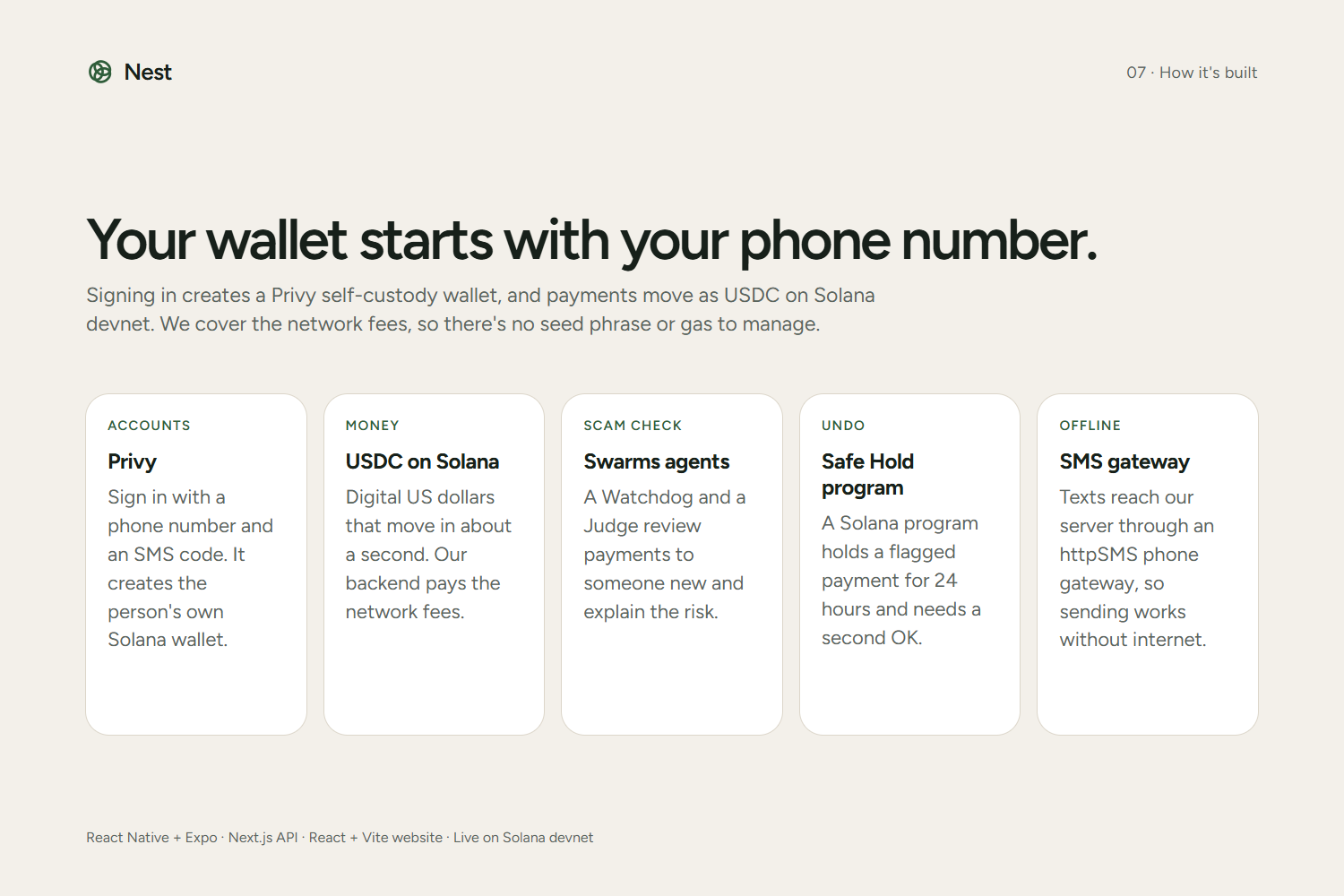
/app. - Accounts and wallets: Privy. Signing in with a phone number and an SMS code creates a self-custody Solana wallet. Someone who receives money before signing up gets a wallet waiting for them.
- Money: USDC on Solana devnet. Nest's backend pays the network fees, so users never need SOL.
- Backend: Next.js API routes for balances, sends, recipients, transaction history and adding money (Stripe test card).
- Text payments: an Android phone with an eSIM runs httpSMS as the gateway. It forwards texts to the
/api/smsroute, which checks a PIN and sends through a limited Privy signer. - Scam review: Swarms API agents (a Watchdog and a Judge) review transfers, tested against a red-team suite of scam calls and messages. The transfer form can also be filled in by speech in 16 languages.
- Safe Hold: a Solana program that holds a flagged transfer for 24 hours and needs a double confirmation.
- Website: React, Vite and Tailwind.
- Demo film: motion graphics built in code with Remotion.
Challenges they ran into
- Building the Safe Hold program. Solana's toolchain pins Rust 1.75, so the team pinned crate after crate before it built in CI.
- Sending without data. The team had to get a real SMS gateway working, keep PINs salted and hashed, and limit what the server is allowed to sign.
- Keeping the claims honest. "Undo" only works before the money is released, so the team built a real on-chain hold instead of promising to reverse a finished transfer.
- Designing for someone who has never used crypto. No seed phrases, no gas, no wallet addresses: just a phone number and dollars.
Accomplishments they're proud of
- Real USDC moves between real wallets on Solana devnet, from phone number to phone number.
- Money can be sent by text message with no internet at all.
- A scam check that explains itself in plain language, plus a 24-hour hold that lives on-chain.
- The person receiving money never has to download anything.
What they learned
- For families sending money home, what matters is keeping its value and stopping scams.
- Self-custody can feel as simple as a bank login when the wallet is created behind a phone number.
- Offline access isn't a nice-to-have where data is expensive or unreliable.
What's next for Nest
- Mainnet launch with audited programs.
- Cash-out to local currency through a licensed partner.
- More countries and languages, starting with Latin America.
- Bring the scam review into every send, not just new contacts.
Built With
- expo.io
- httpsms
- next.js
- node.js
- privy
- python
- react
- react-native
- remotion
- rust
- solana
- stripe
- swarms
- tailwindcss
- typescript
- usdc
- vite
