-
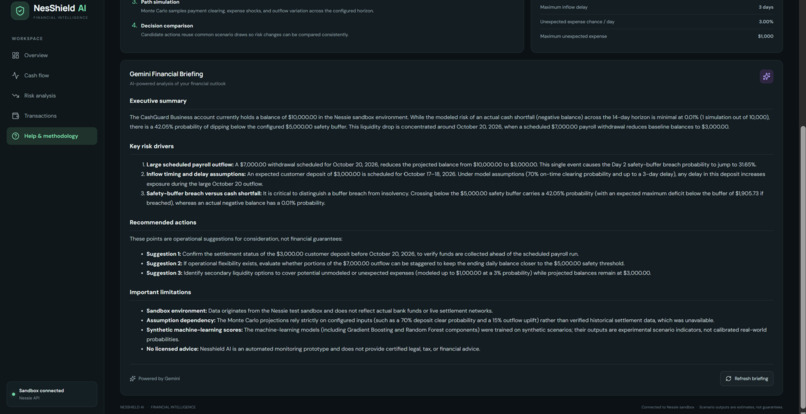
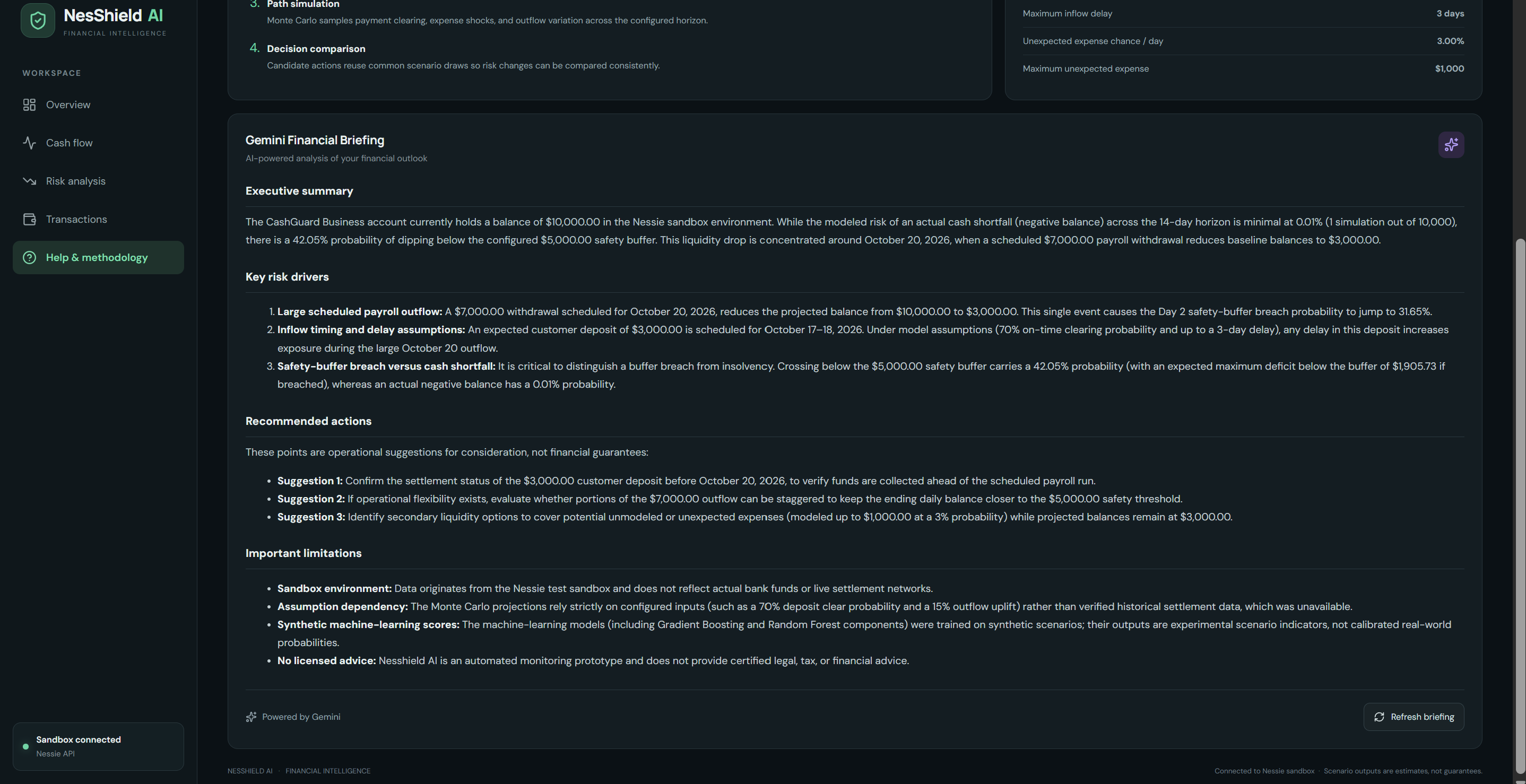
Gemini Integration
-
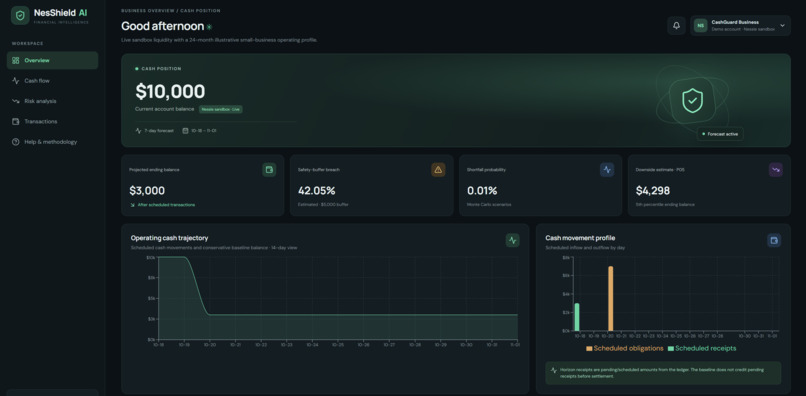
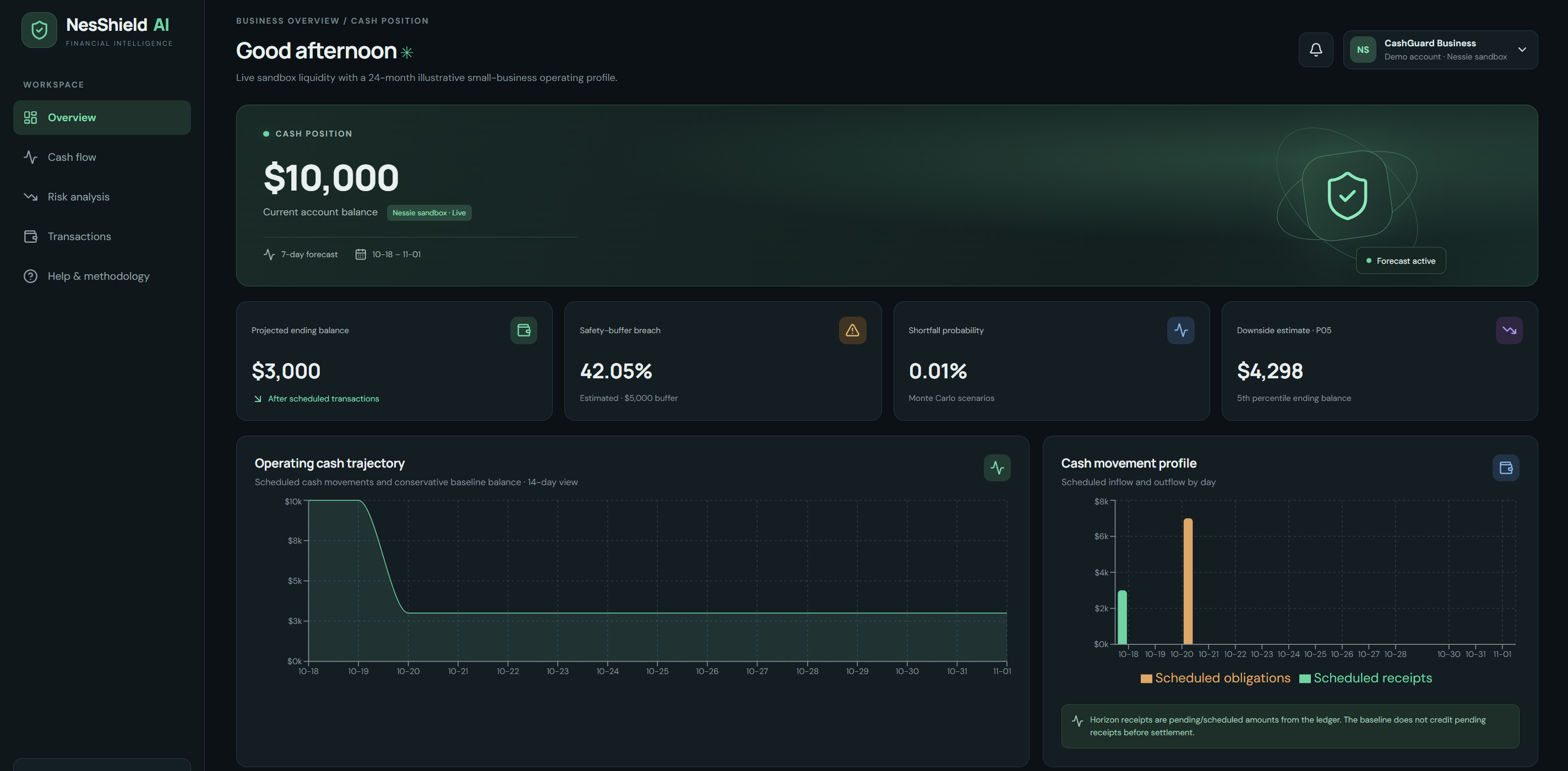
Dashboard with Current Balances
-
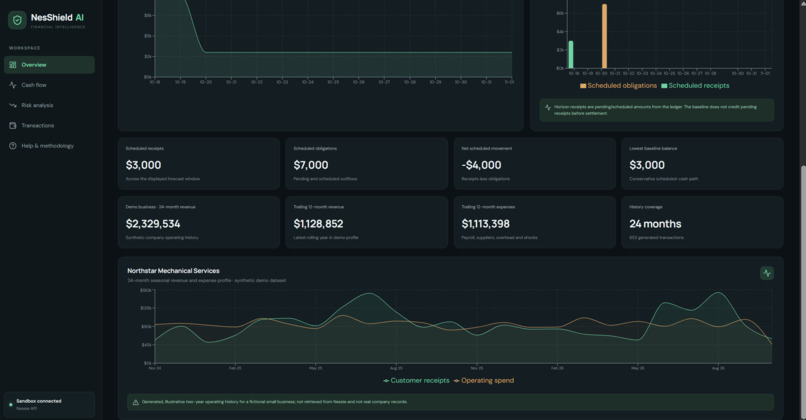
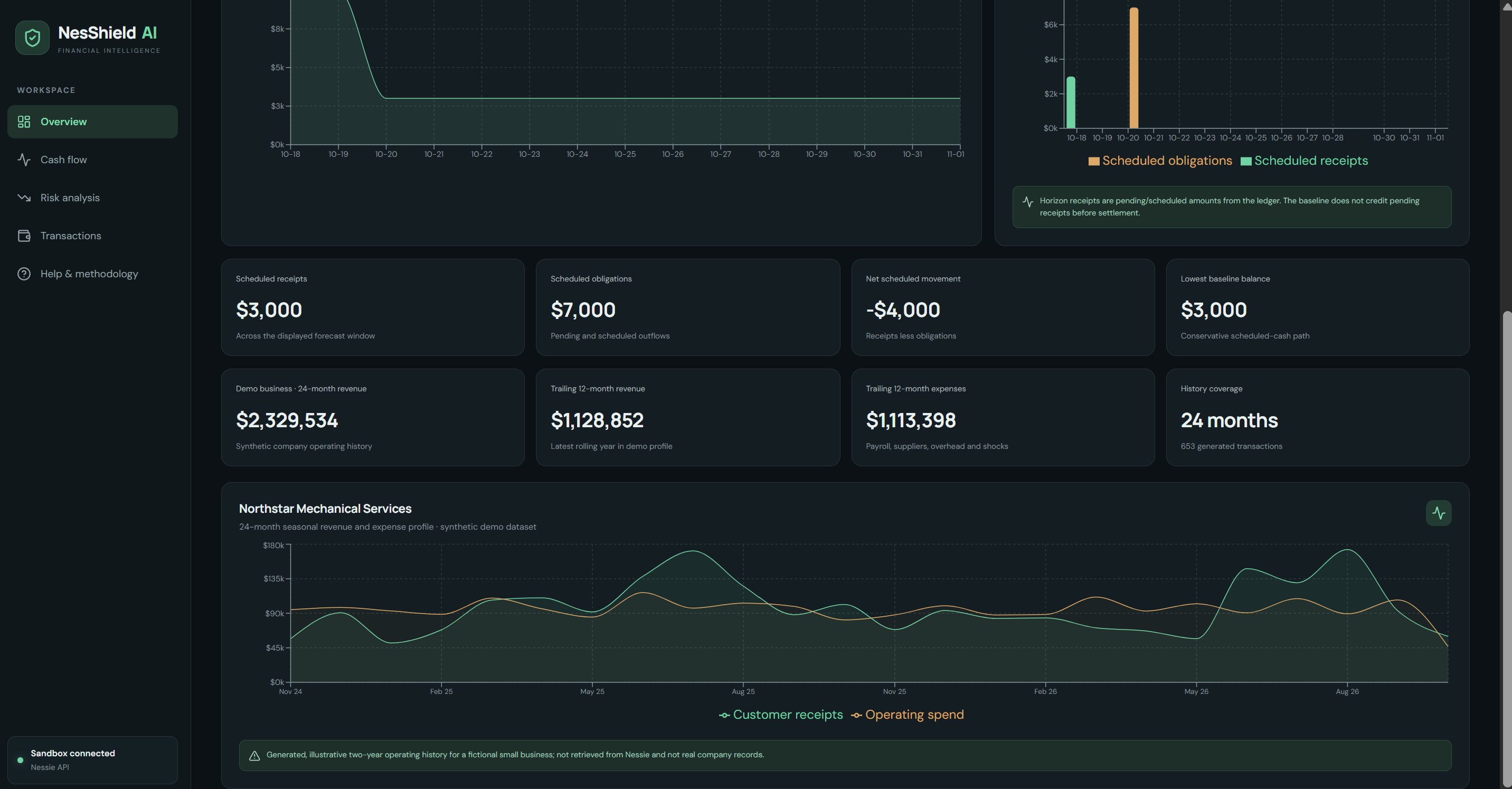
Dashboard with Metrics
-
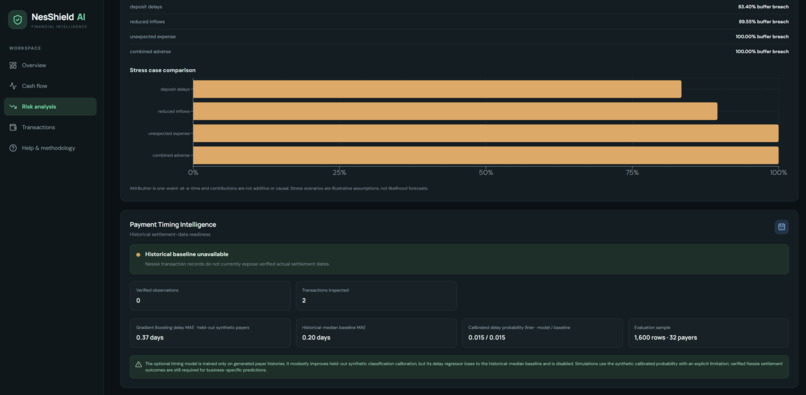
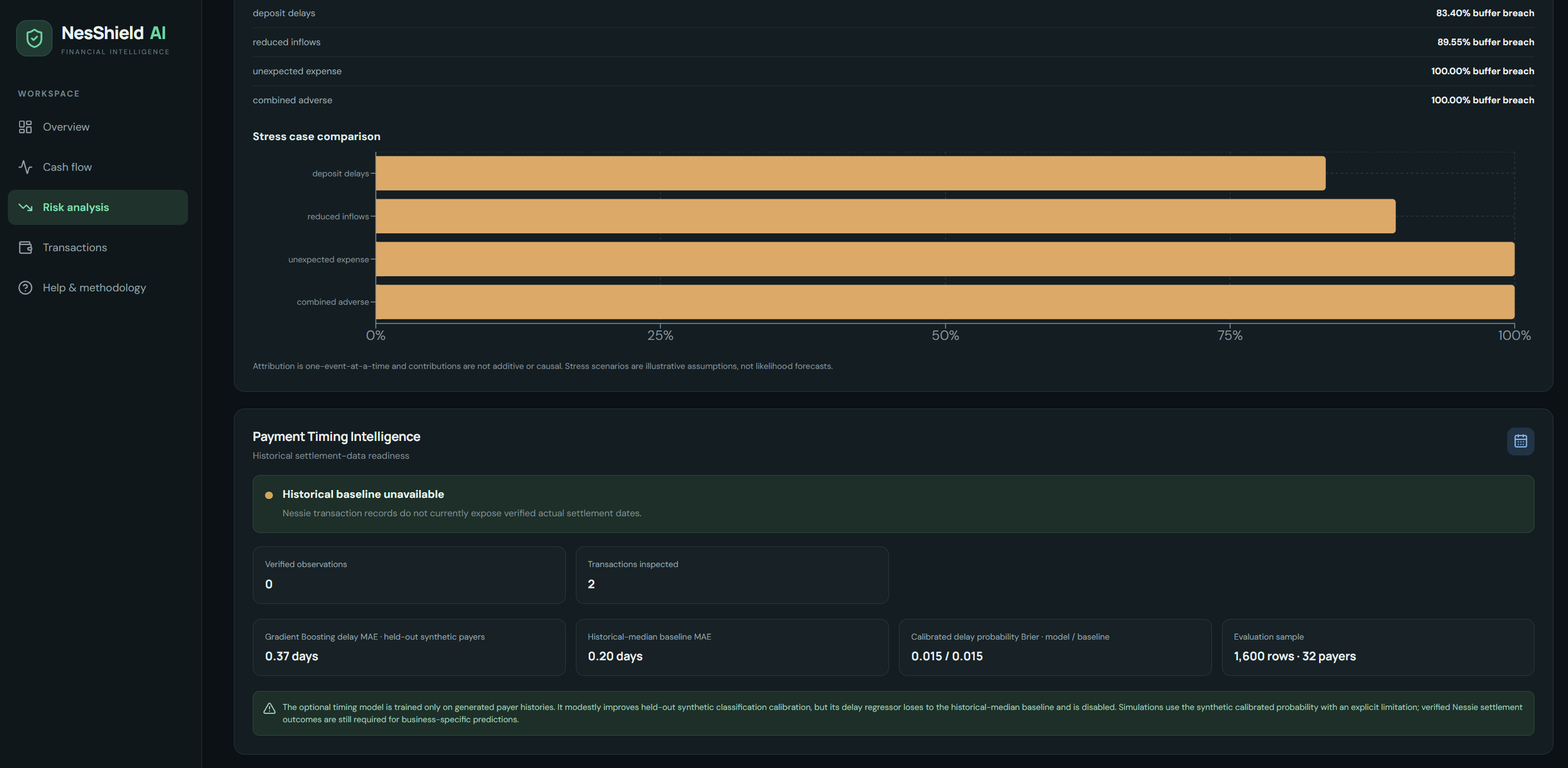
STRESS POINTS AND CASE
-

WHAT IF - SIMULATOR
-
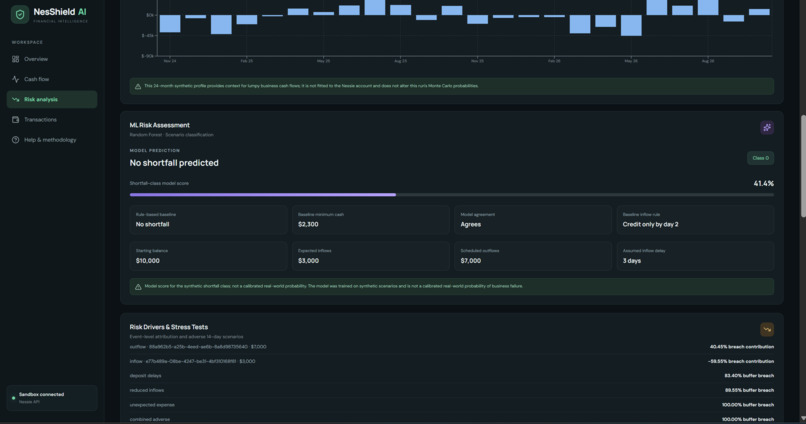
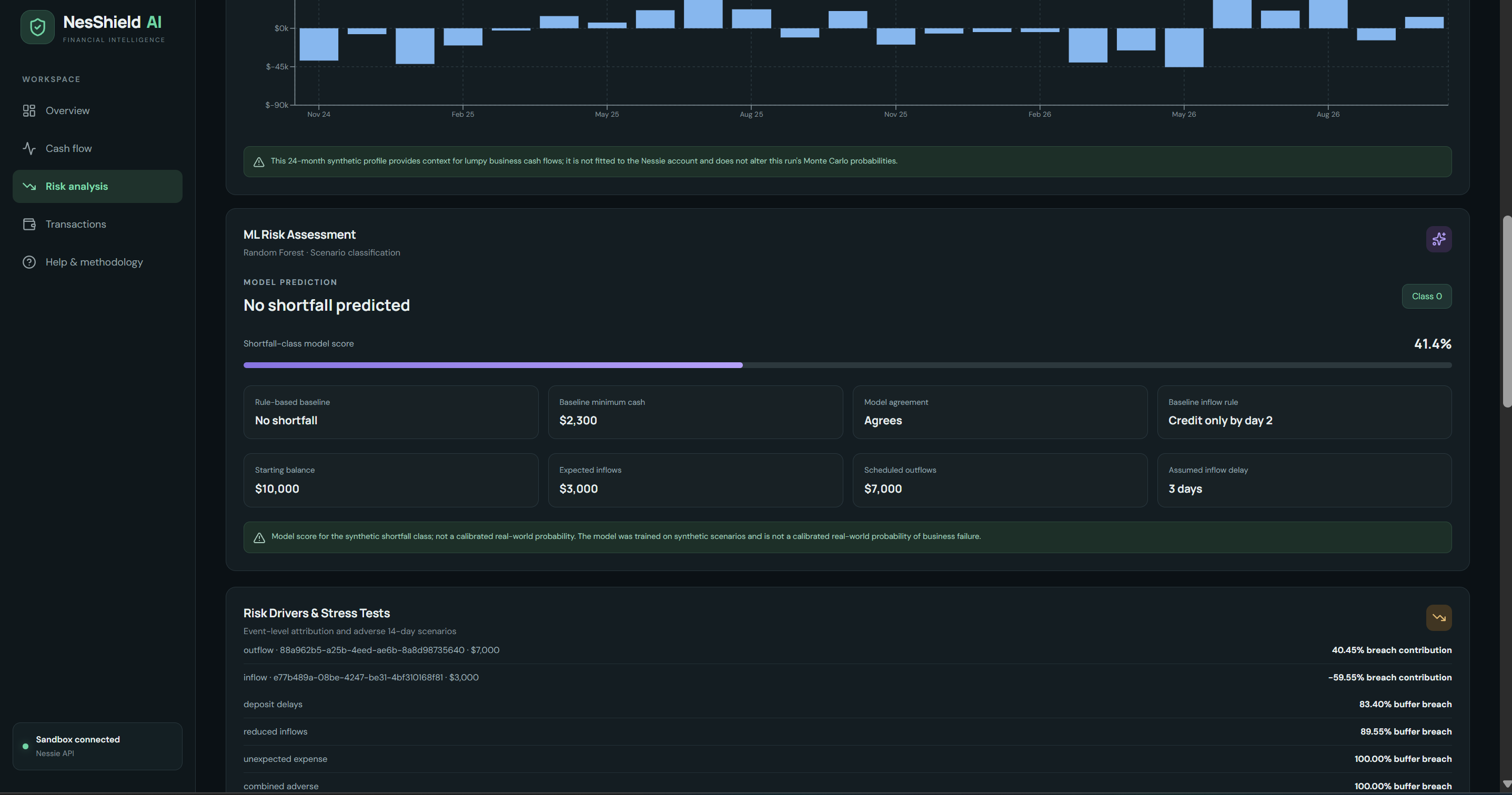
RISK ANALYSIS SHORTFALL
-
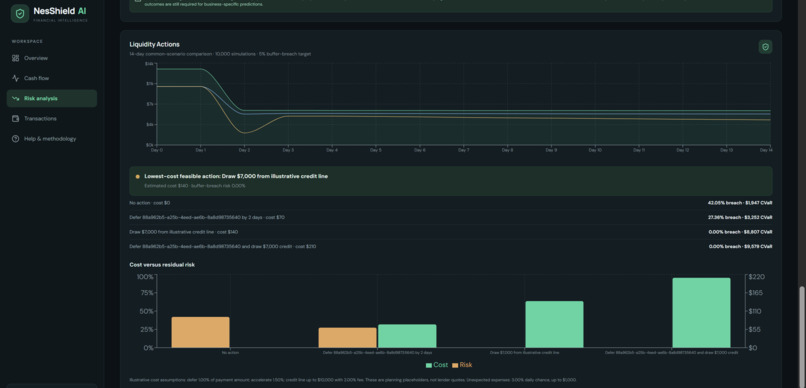
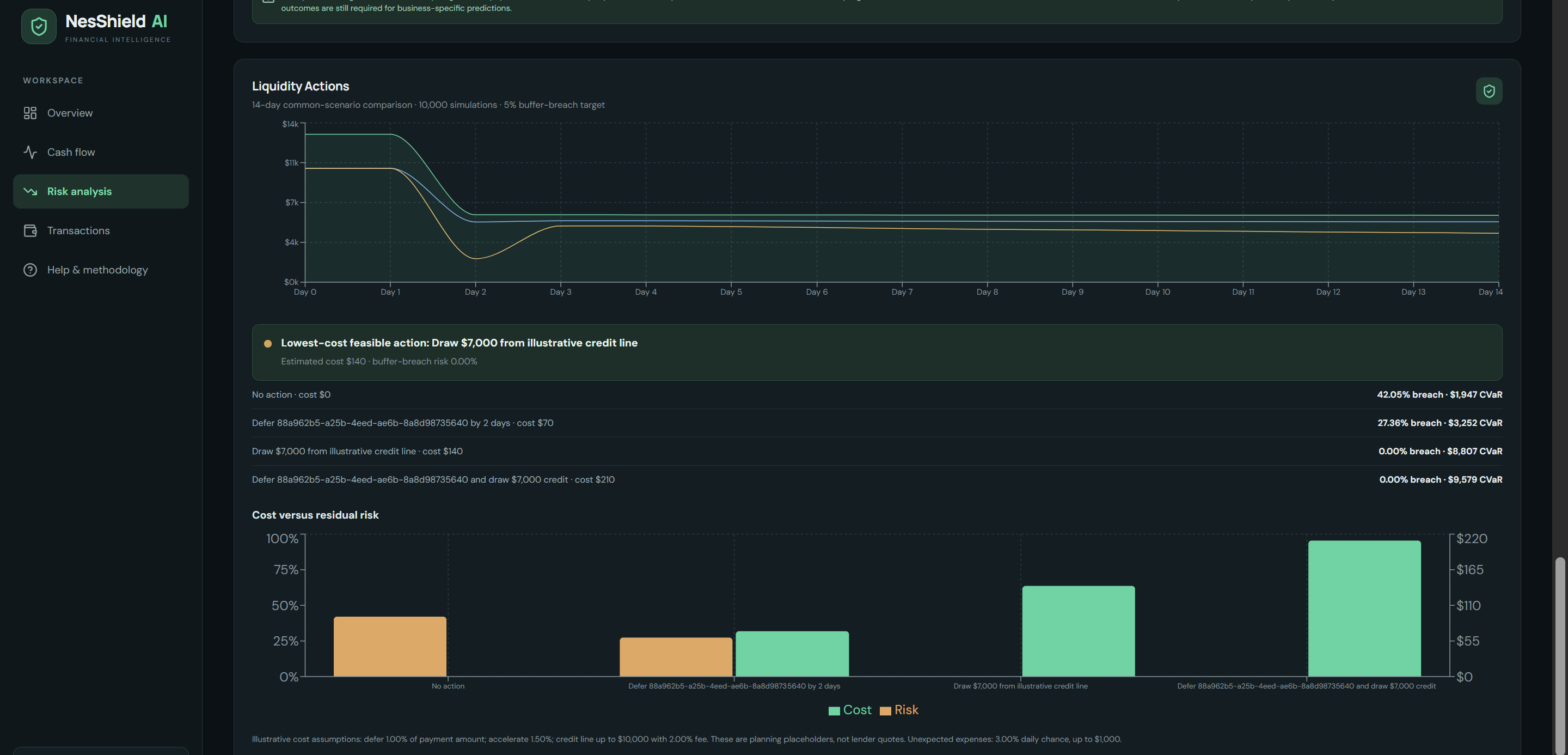
LIQUIDITY ANALYSIS
-
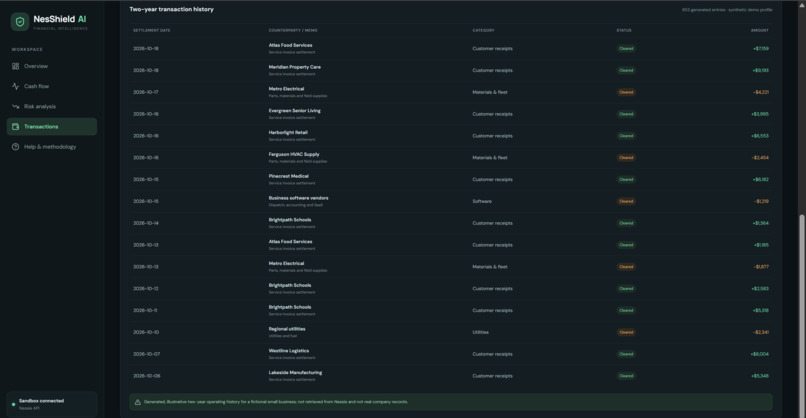
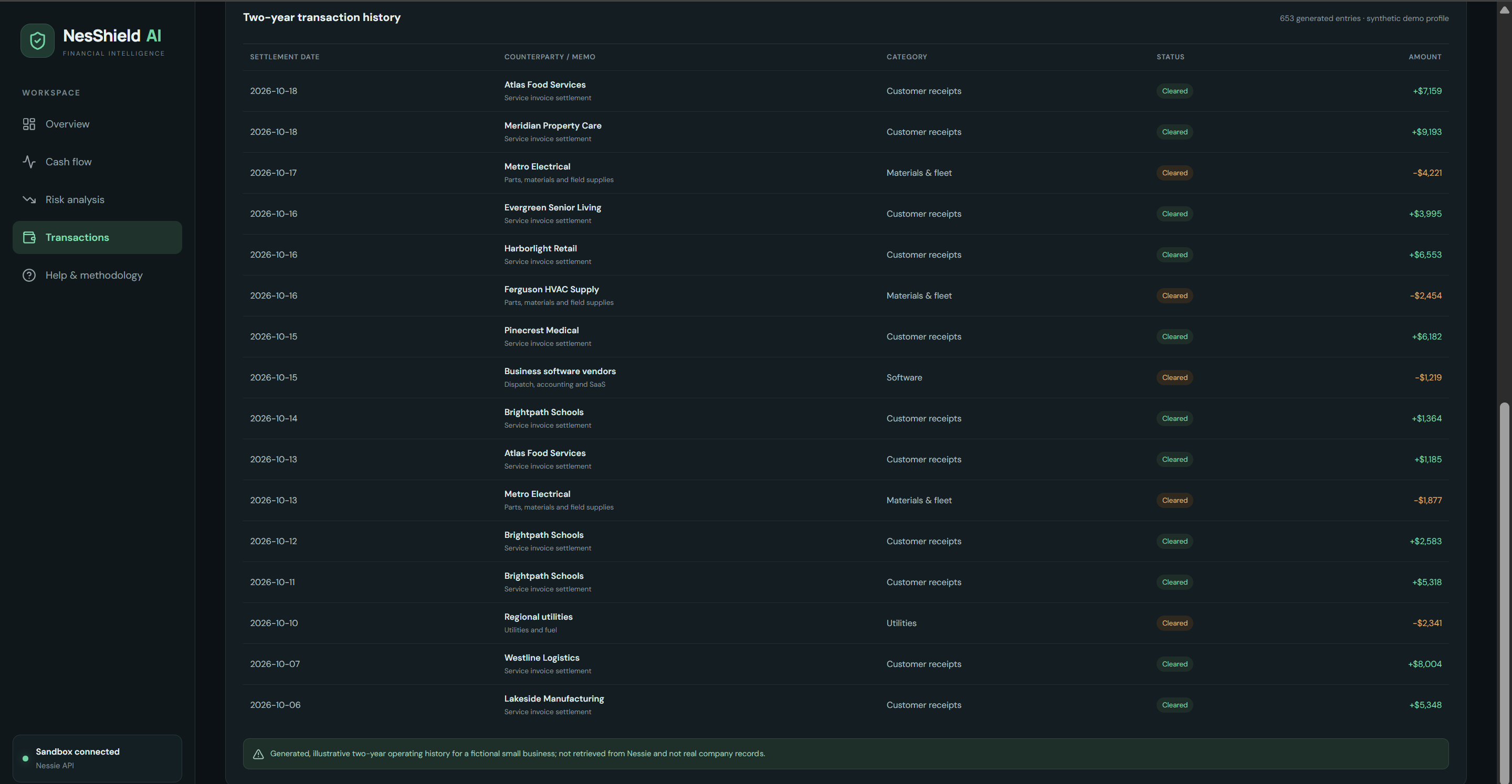
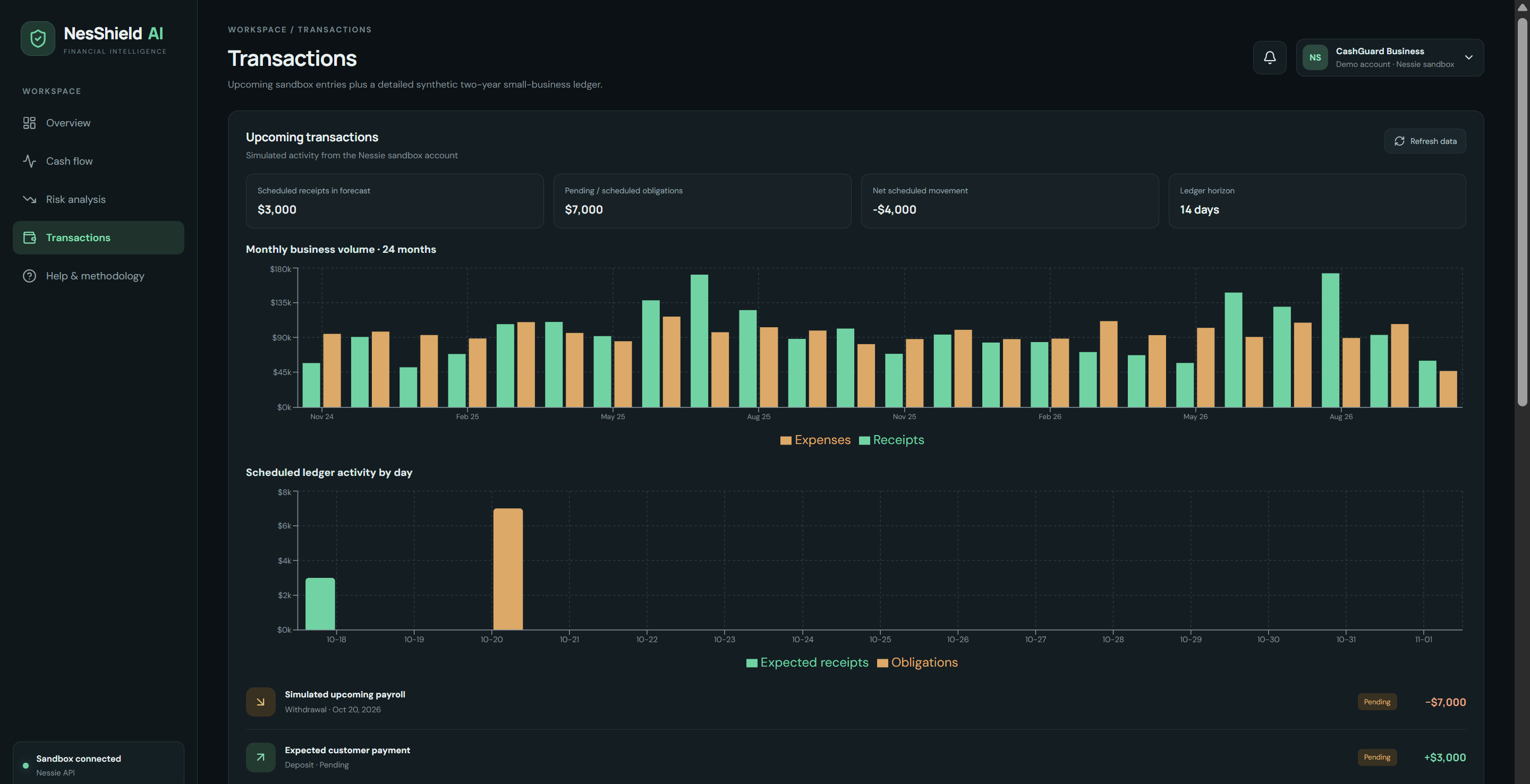
TRANSACTIONS 2
-
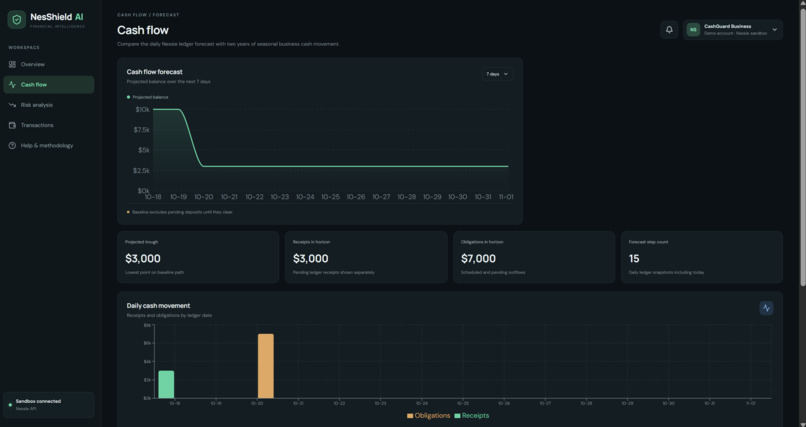
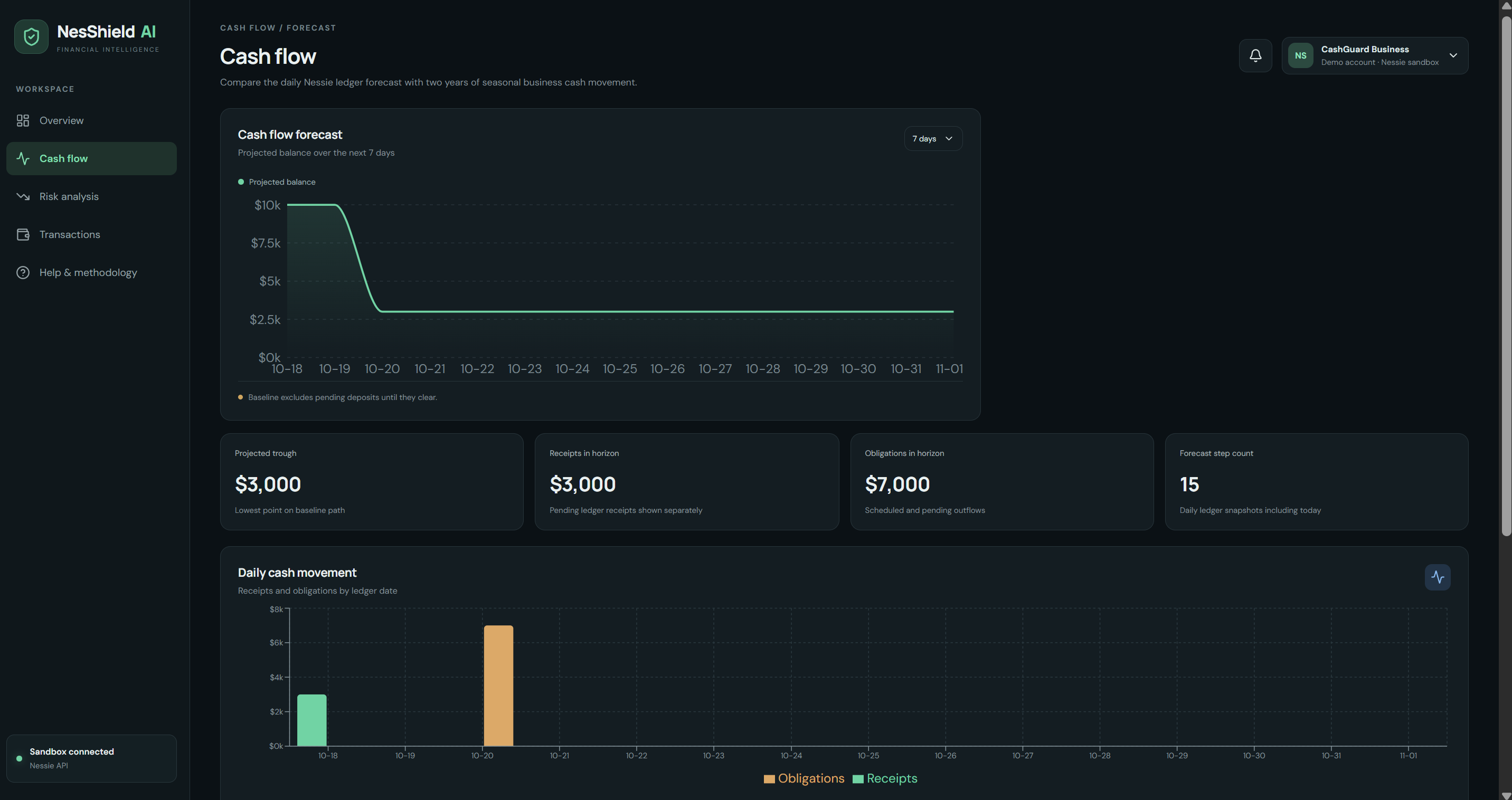
CASHFLOW
-
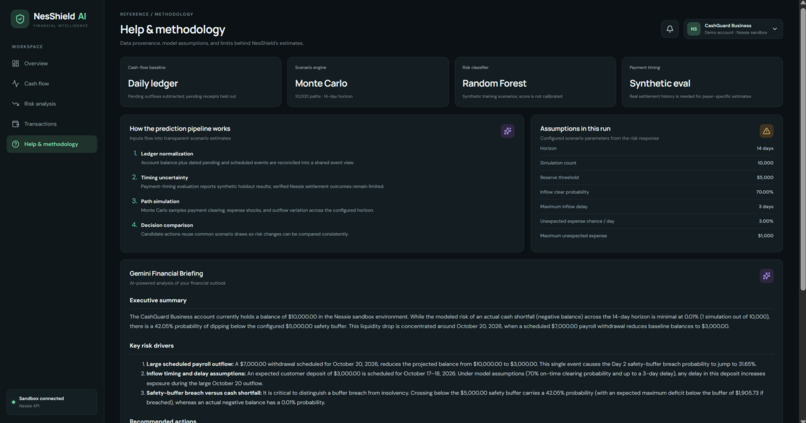
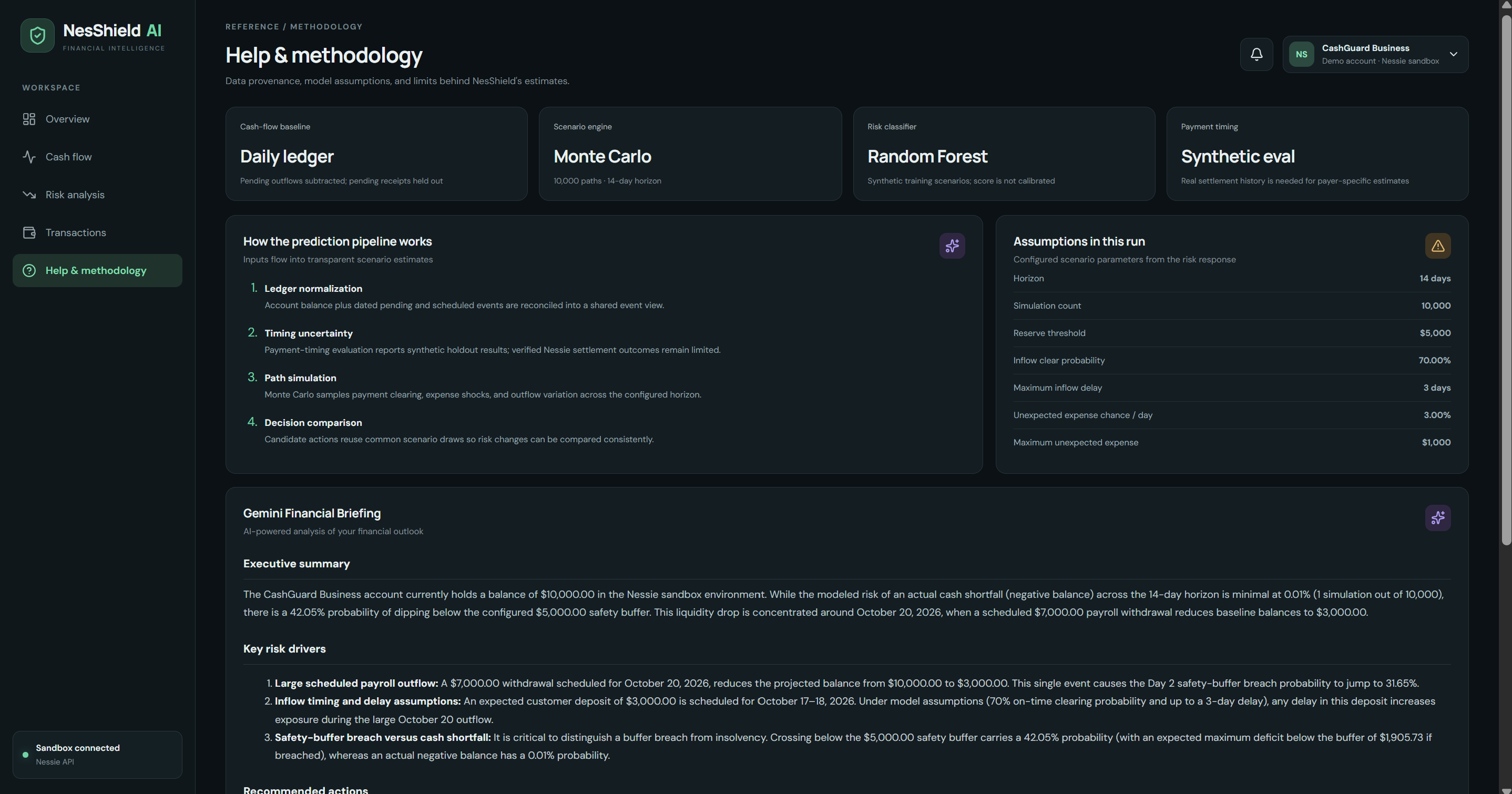
PROECT OVERVIEW
-
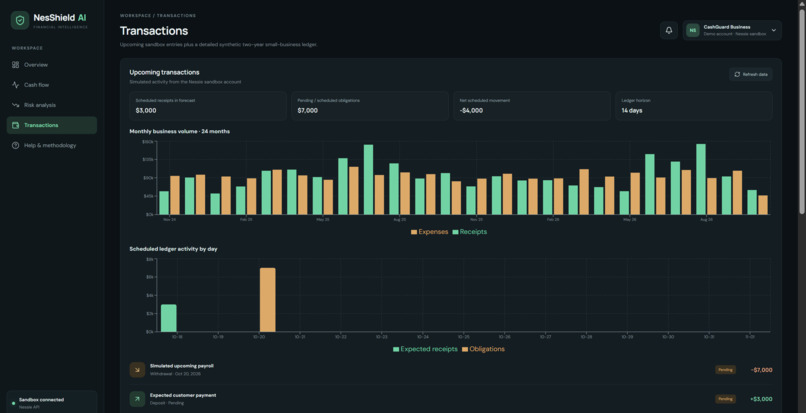
TRANSACTIONS 1

Inspiration
Small businesses can be profitable on paper and still run out of cash because customers pay late, bills arrive at the wrong time, or unexpected expenses disrupt their cash flow. We wanted to tackle this problem before it becomes a crisis.
Inspired by the idea of protecting humanity from Titans in Attack on Titan, we built NesShield AI to protect small businesses from their own financial Titans: late payments, cash shortages, and unexpected financial shocks. Our goal is to turn financial data into early warnings and actionable insights, helping businesses anticipate risks instead of simply reacting to them.
What it does
NesShield AI is an AI-powered cash-flow early-warning system that helps small businesses understand and prepare for potential financial shortfalls.
- Cash-flow forecasting: Projects expected cash balances over the next seven days using banking data.
- Monte Carlo risk simulation: Simulates thousands of possible financial scenarios to estimate the probability and potential severity of a cash shortage.
- Machine learning: Uses predictive models to analyze financial patterns and explore how payment timing affects future cash flow.
- What-if analysis: Compares potential financial interventions to understand how they could change a business's risk exposure.
- AI-powered explanations: Uses Gemini to translate complex financial projections into understandable insights and recommendations.
Rather than simply displaying a balance, NesShield AI helps answer a more important question: Could my business run short on cash soon, and what can I do about it?
How we built it
We built NesShield AI using a full-stack architecture that combines financial data, predictive analytics, probabilistic simulation, and an interactive dashboard.
- Nessie API: Provides sandbox banking data for account balances and transactions.
- Python and FastAPI: Power the backend, API endpoints, forecasting, and risk analysis.
- Machine learning: Supports predictive modeling of financial risk and payment behavior.
- Monte Carlo simulation: Generates thousands of possible cash-flow trajectories to estimate shortfall probabilities and downside risk.
- Gemini: Generates natural-language explanations of quantitative results.
- Frontend dashboard: Brings forecasts, risk metrics, and what-if comparisons together in one interface.
Our central design principle is to keep the quantitative engine responsible for calculating risk while using AI to help users understand the results. This makes the system more interpretable and avoids relying on a language model to perform financial calculations.
Challenges we ran into
One of our biggest challenges was working with limited sandbox banking data. Realistic payment-timing models need historical invoice and customer payment records, which are not readily available from basic account transactions alone.
We also had to distinguish between a deterministic forecast and the uncertainty of real-world cash flow. A single projected balance cannot capture all the ways payments and expenses might unfold, which motivated our use of Monte Carlo simulation.
Another challenge was connecting predictive models to the simulation engine in a meaningful way. A model is only useful if its predictions improve downstream risk estimates, so evaluating models against simple baselines and avoiding unsupported performance claims became important design considerations.
Finally, integrating banking data, backend services, simulation logic, and AI-generated explanations into one coherent experience required careful attention to data flow and reliability.
Accomplishments that we're proud of
We are proud of building a system that goes beyond conventional financial dashboards. NesShield AI is designed not only to show users their current financial position, but also to explore possible futures and quantify the risks they may face.
Our key accomplishments include:
- Building a cash-flow forecasting and risk-analysis workflow around banking sandbox data.
- Using Monte Carlo simulation to quantify uncertainty rather than presenting a single deterministic prediction.
- Designing what-if analysis to compare potential interventions.
- Integrating AI-generated explanations with quantitative financial results.
- Creating a unified experience that connects financial data, predictive analytics, and actionable insights.
Most importantly, we established a foundation for turning financial risk analysis into something small-business owners can actually understand and use.
What we learned
We learned that adding AI to a financial product is not enough on its own. The predictions must be grounded in appropriate data, the risk calculations must be mathematically consistent, and the resulting insights must be useful to the person making the decision.
We also learned that synthetic data can help develop and test models when real historical data is scarce, but synthetic results must not be mistaken for proven real-world performance.
Finally, we learned that predictive accuracy and financial decision quality are different objectives. A model should ultimately be evaluated on whether it improves the reliability of cash-flow forecasts and the quality of downstream risk estimates, not simply on whether it uses a sophisticated algorithm.
What's next for NesShield AI
Our next steps focus on making NesShield AI more predictive, robust, and useful for real businesses.
- Deep-learning payment prediction: Develop and evaluate GRU-based models that learn from chronological invoice and payment histories, comparing them against simpler statistical and gradient-boosting baselines.
- More realistic simulations: Introduce correlated payment delays and shared economic shocks to better represent periods when several customers pay late at once.
- Richer risk metrics: Expand beyond shortfall probability to measure the severity of adverse outcomes and conditional tail risk.
- Smarter counterfactuals: Help businesses compare interventions using consistent simulation scenarios and quantify their potential impact.
- Improved real-world validation: Test against suitable historical data, evaluate calibration, and measure whether model improvements translate into better financial risk estimates.
- Personalized financial insights: Make recommendations more specific to each business's cash-flow patterns, constraints, and risk tolerance.
Our long-term vision is for NesShield AI to act as an early-warning and decision-support system that helps small businesses see financial threats coming, evaluate their options, and protect their financial future.
Built With
- data-visualization
- deep-learning
- fastapi
- financial-forecasting
- gemini-api
- javascript
- machine-learning
- monte-carlo-simulation
- nessie-api
- python
- quantitative-finance
- react
- risk
- scikit-learn
- vite

Log in or sign up for Devpost to join the conversation.