-
-
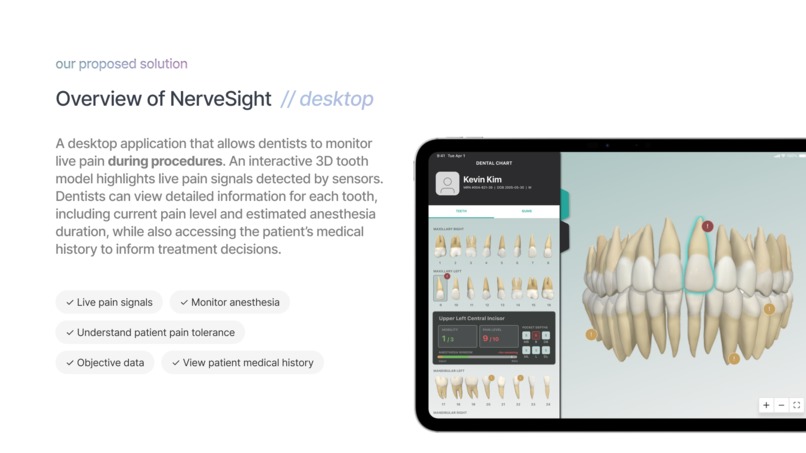
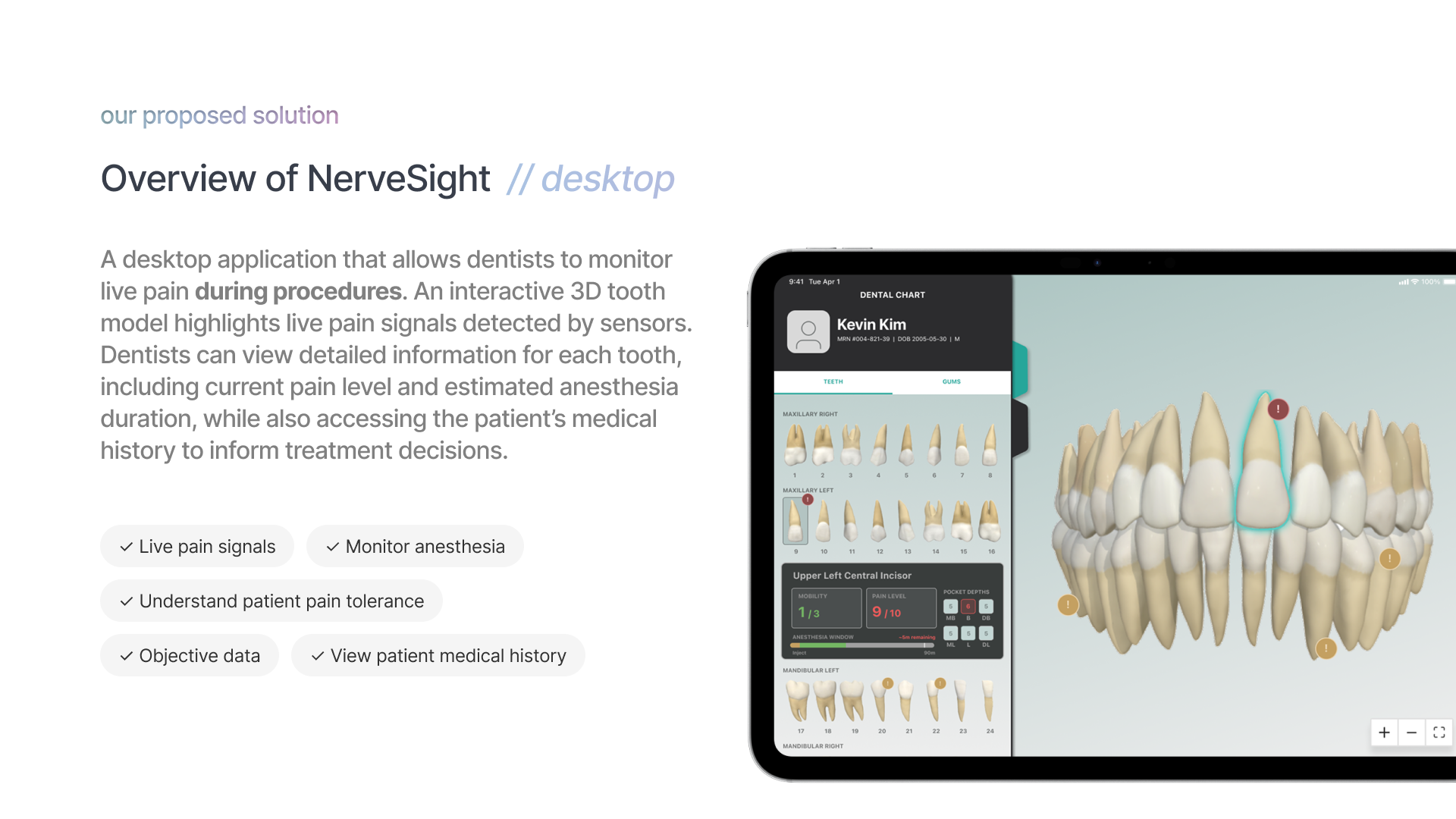
Desktop app
-
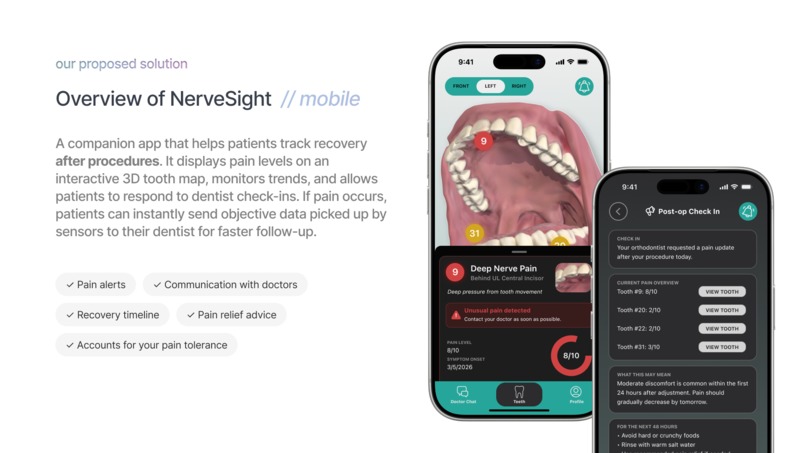
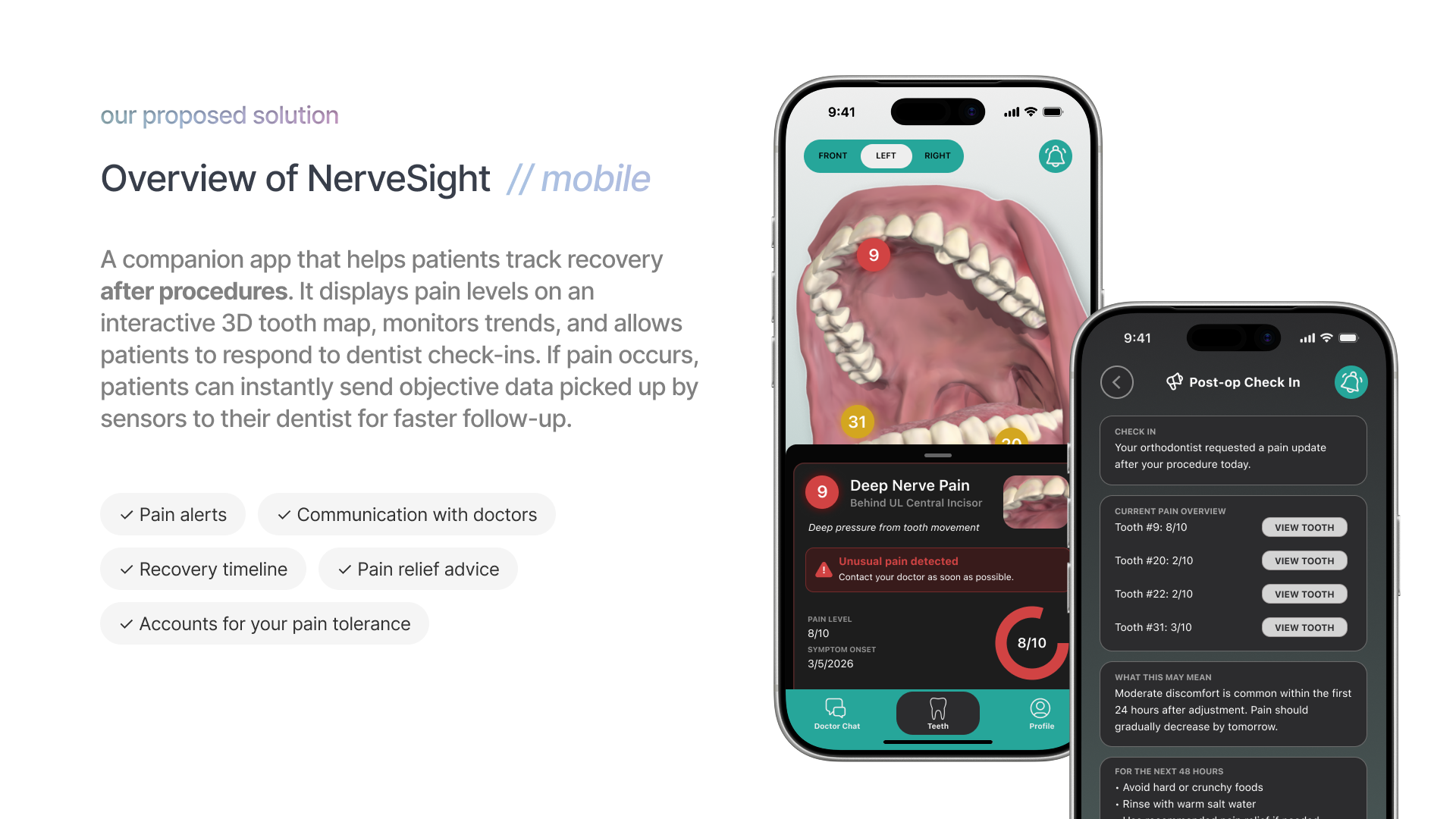
Mobile companion app
Inspiration
Have you ever been at the dentist and felt pain but struggled to communicate it clearly? With your mouth open and instruments in use, it can be difficult to speak, point to the exact tooth, or explain how severe the pain actually is. Dentists often rely on hand signals or small reactions to guess what a patient is feeling, which can make it harder to respond quickly or precisely. Many of us have experienced this frustration firsthand, which inspired us to explore how technology could help make pain easier to understand and communicate during dental procedures. We wanted to design a solution that helps dentists better perceive what their patients are feeling in real time, while also giving patients greater confidence that their pain is recognized and addressed during and after treatment.
What it does
NerveSight is a platform for visualizing dental pain in real time. By combining brain activity signals and nerve responses monitored by cheek sensors connected to trigeminal nerve branches, the system estimates the presence, intensity, and location of pain. Dentists can view this information through a desktop interface with an interactive 3D tooth model that highlights areas of discomfort during procedures. After treatment, patients can use a companion mobile app to monitor recovery, view pain on a tooth map, and send objective pain reports to their dentist if unusual discomfort occurs.
How we built it
We researched existing technologies related to pain detection, including EEG sensors that measure brain activity linked to pain perception and dental nerve testing methods such as Electric Pulp Testing. These insights helped us propose a concept where multiple signals could be combined to estimate dental pain and visualize it on a 3D tooth model. For this project, we focused on designing the user interface for how such a tool would work in practice. Using Figma, we created a desktop interface for dentists to monitor real-time pain signals during procedures and a mobile app that allows patients to track recovery, view pain on a tooth map, and send reports to their dentist after treatment. We also used Sketchfab to source 3D tooth models that we integrated into our interface designs to create a more realistic visualization of pain location.
Challenges we ran into
Our first challenge was researching the feasibility of measuring pain and how it would be best implemented if it were possible. Because technology that directly measures dental pain does not currently exist, we spent time researching related medical technologies and making reasonable assumptions about how signals like brain activity and nerve responses could potentially be combined. Our goal was to keep the concept grounded in existing research while still imagining how it could evolve in the future.
Another struggle was incorporating a 3D tooth model into our interface designs. Figma does not support fully interactive 3D objects, so we used wireframing and prototype navigation to mimic how a user would rotate and explore the model. In a real implementation, the interface would likely use a 3D engine or web-based 3D framework to allow true interactive manipulation of the tooth model.
Finally, we were not initially familiar with designing interfaces for healthcare software. We spent time looking at existing medical and health applications to understand how they balance functionality, clarity, and visual design. This helped us design an interface that communicates complex information clearly while still remaining intuitive for dentists.
Accomplishments that we're proud of
Despite starting with little background in dentistry, we were able to quickly learn about dental anatomy, nerve pathways, and existing diagnostic tools to better understand how pain in the mouth is currently interpreted and treated. This research helped us design a concept that, while not required for the project, feels grounded in real dental practices rather than purely speculative.
We are also proud of designing an interface that tackles the challenge of visualizing a sense that is typically invisible and subjective. Translating something as complex as pain into clear visual information required careful thinking about how physiological signals could be represented in an intuitive way. Through features like the interactive tooth map and location-specific pain indicators, we created a concept that allows dentists and patients to better understand and respond to pain in ways that are not currently possible.
What we learned
This project challenged us to think carefully about how to design interfaces around something as subjective and difficult to visualize as pain. We learned how important it is to present complex health information in a way that is clear and actionable for all users. Designing both the dentist desktop interface and the patient mobile app pushed us to think about how layout, visual cues, and interaction design can support different contexts. The process also helped us develop stronger skills in prototyping, wireframing, and iterating on interface ideas to make the experience intuitive.
What's next for NerveSight
In the future, systems like NerveSight could expand beyond dental care into other medical fields where pain is difficult to monitor or communicate. Similar tools could help track recovery after surgery, support physical therapy by monitoring pain responses during rehabilitation, or assist clinicians in caring for patients who cannot easily communicate their discomfort. Beyond clinical settings, similar technology could also help individuals better understand and track everyday pain such as headaches, stomachaches, or muscle soreness.
Built With
- figma
- sketchfab


Log in or sign up for Devpost to join the conversation.