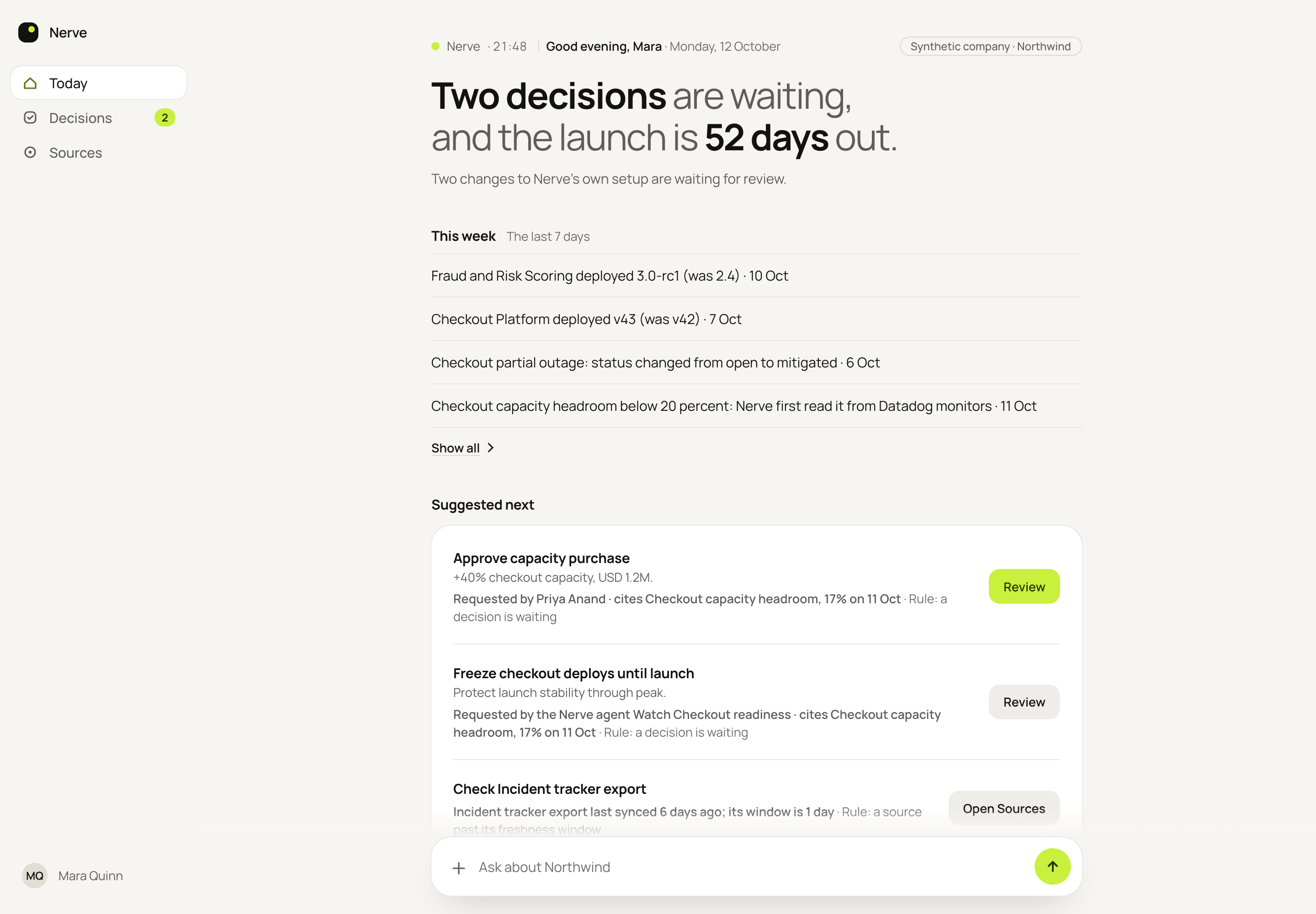
Nerve started with a question that kept coming up as we worked with AI agents: how useful can an agent really be if it doesn’t have a reliable understanding of the company it’s helping? A company’s context is spread across conversations, documents, projects, repositories, and the people who remember why a decision was made. Bringing that information into a chat window helps, but there’s still a harder problem underneath it. The system needs to understand where an answer came from, whether the information is current, and whether the person asking should be able to see it. We started building Nerve around that problem. Our idea is an evidence-backed company brain that gives people and agents a shared understanding of the organization. Someone should be able to ask what needs attention, understand how it affects a project or goal, and follow the answer back to the source. That means keeping distinctions that are easy to lose in an AI summary. A conversation about a possible deadline isn’t an approved commitment. An active project isn’t necessarily on track. A missing measurement isn’t zero. We want those differences to remain visible because they can change the decision someone makes. We built the foundation in Rust with SQLite, using structured records and explicit relationships to connect company context with supporting evidence. The core runs locally, and its evidence queries and calculations are deterministic. An optional, model-agnostic intelligence layer can help interpret that context, while the underlying records remain independent of whichever model is being used. This separation is important to us because companies should be able to keep control of their knowledge and choose when information leaves their environment. It also gives us a clear way to distinguish what Nerve can establish from what a model is suggesting. For the demo, we use Northwind, a synthetic company with a launch-readiness scenario. The story follows a business question down through a goal, a connected system, a source repository, and the technical evidence behind it. Along the way, the scenario includes uncertainty and incomplete information rather than making every result look successful. It gives us a way to demonstrate how an investigation should work without exposing real company data. We’re shaping the interface around conversation and reusable widgets so a useful finding can also become something a person keeps on their home screen, with dedicated views available when they need to investigate further. Some of the hardest work has been making these ideas hold up beyond the obvious cases. Filtering a restricted record isn’t enough if its name still appears in a relationship, a count, or a saved answer. A decision also needs to refer to the exact content that was reviewed, and database changes need to preserve existing evidence without inventing missing history. We’ve spent a substantial part of development on authorization tests, migration and restore checks, and deliberately conflicting or unavailable data. That work has taught us to judge progress by whether a complete user journey stays truthful under failure, rather than simply whether an endpoint returns successfully. Nerve is an ongoing project, and this submission represents a preview of that work. As we’ve developed it, we’ve also become more focused on where it could be useful first. We’re exploring roofing as an initial industry, where questions about job readiness can depend on information spread across schedules, materials, permits, and customer communication. Our next step is to validate a specific workflow with real operators and build around the decisions they actually need to make. We haven’t established those customer outcomes yet, and Northwind remains our demonstration environment. Longer term, we want Nerve to learn from reviewed decisions and outcomes so repeated, useful procedures can become governed workflows. The lesson guiding us is that better intelligence needs a trustworthy foundation: clear sources, explicit uncertainty, controlled access, and a way to check what happened. We want to make that foundation practical enough that understanding the state of a company becomes part of everyday work.
Nerve
Nerve pairs an offline, deterministic company brain with model-agnostic agents to connect business decisions to exact evidence, surface uncertainty, and enforce scoped access.
Updates

Leave feedback in the comments!
Log in or sign up for Devpost to join the conversation.