-
-
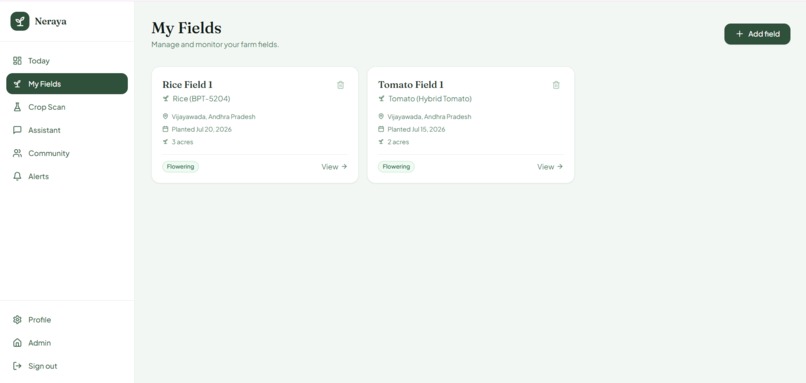
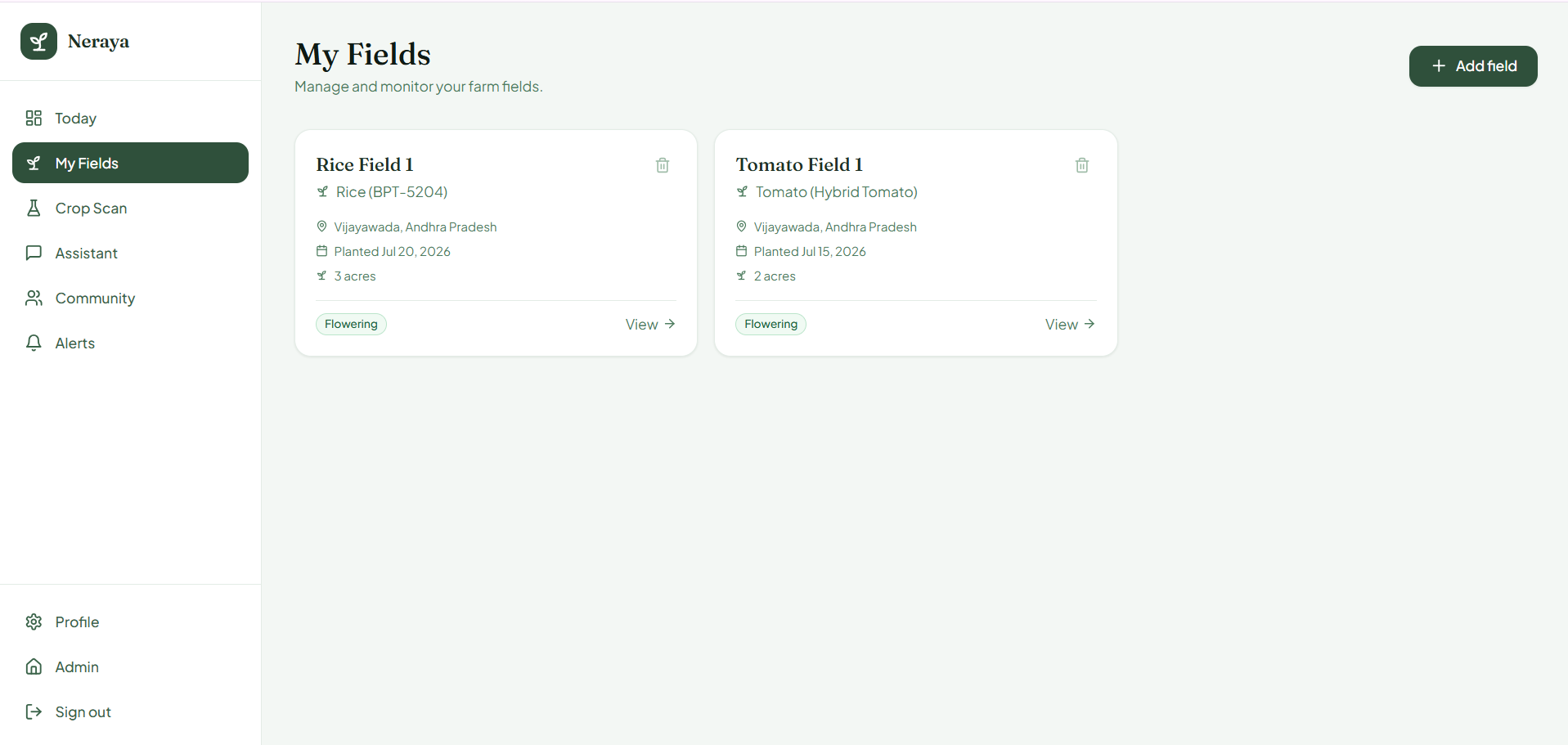
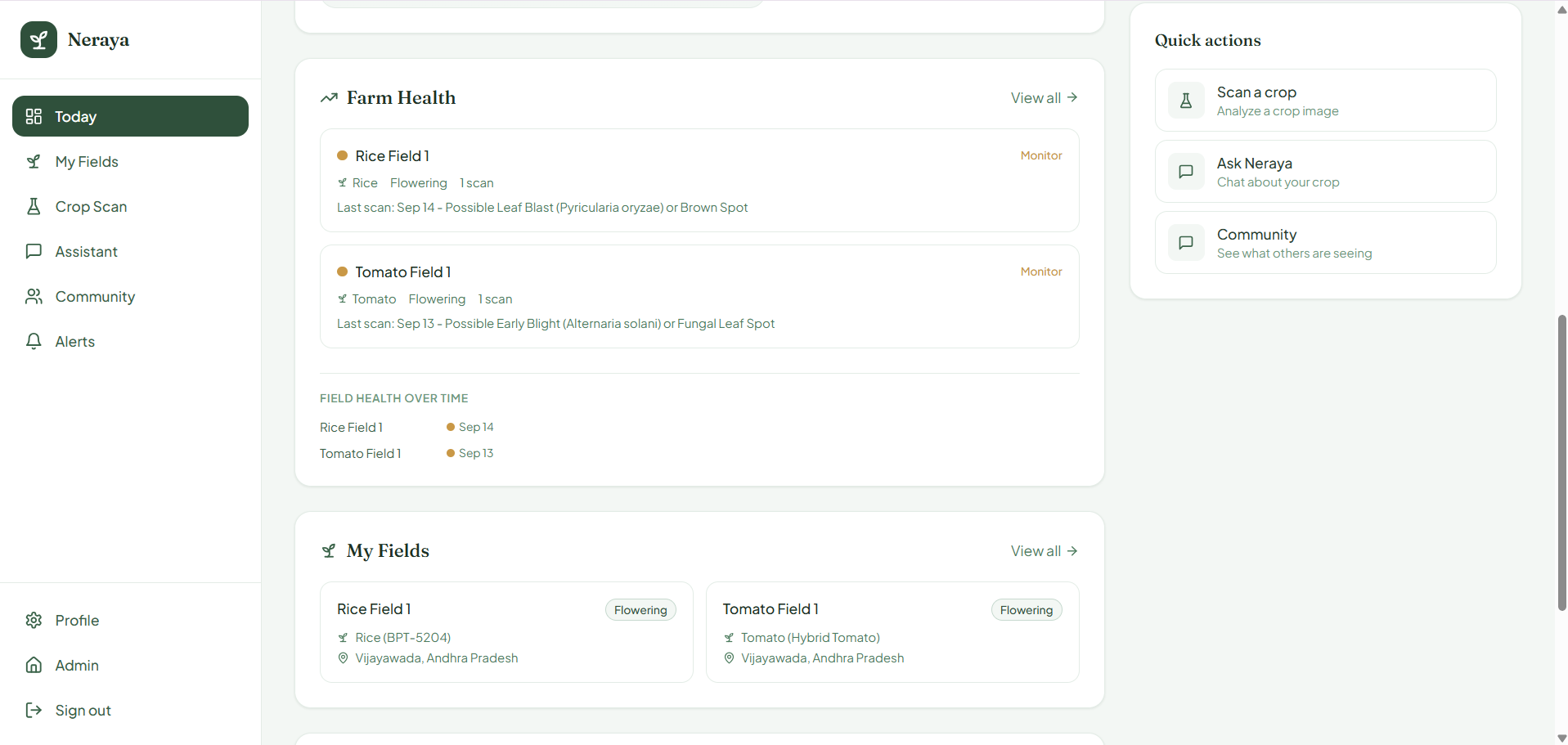
My Fields keeps the farmer's crops, locations, planting details, and growth stages organized in one place.
-
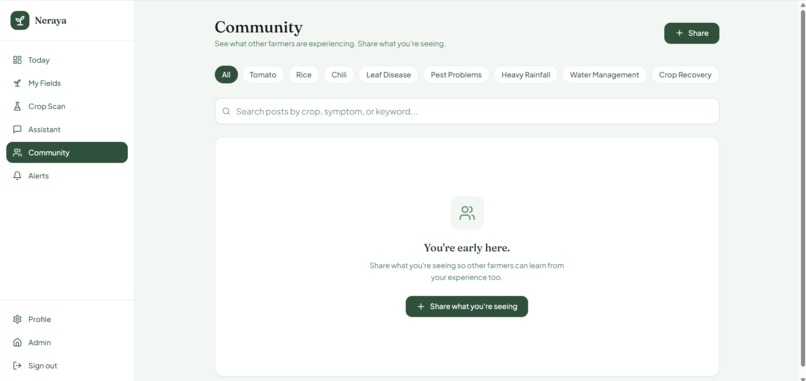
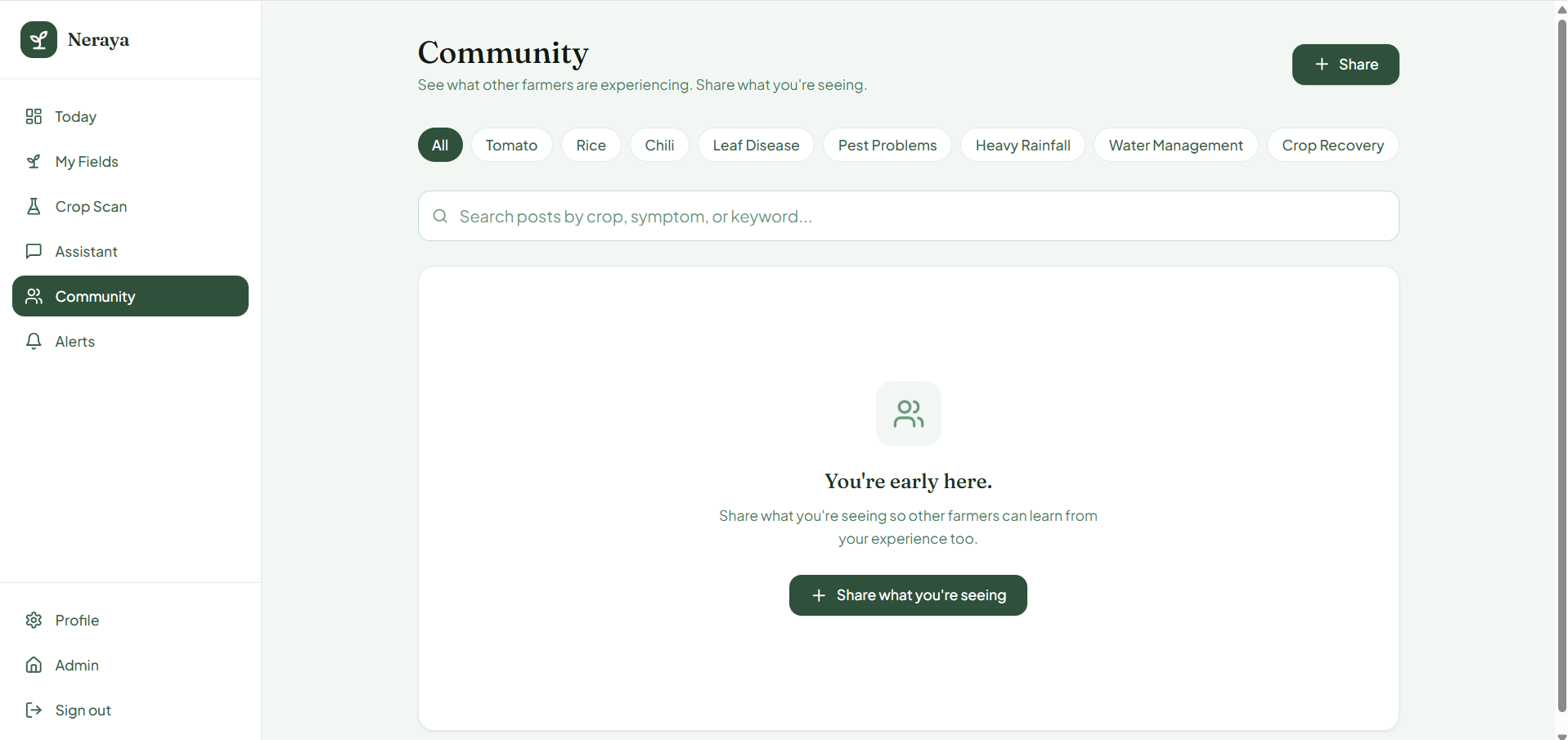
The Community is designed for farmers to share real experiences, practical knowledge, and what happened after they took action.
-
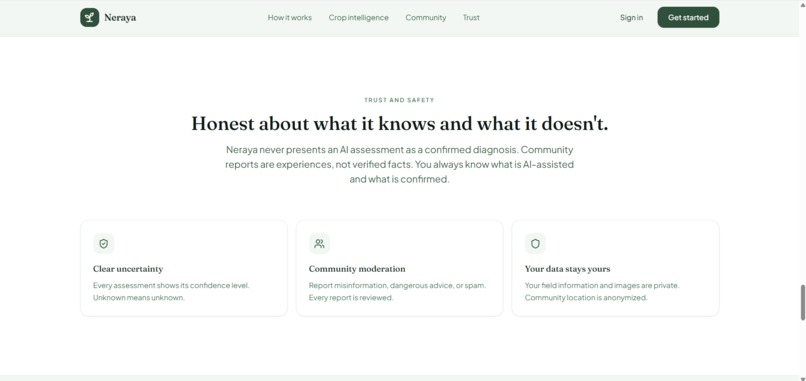
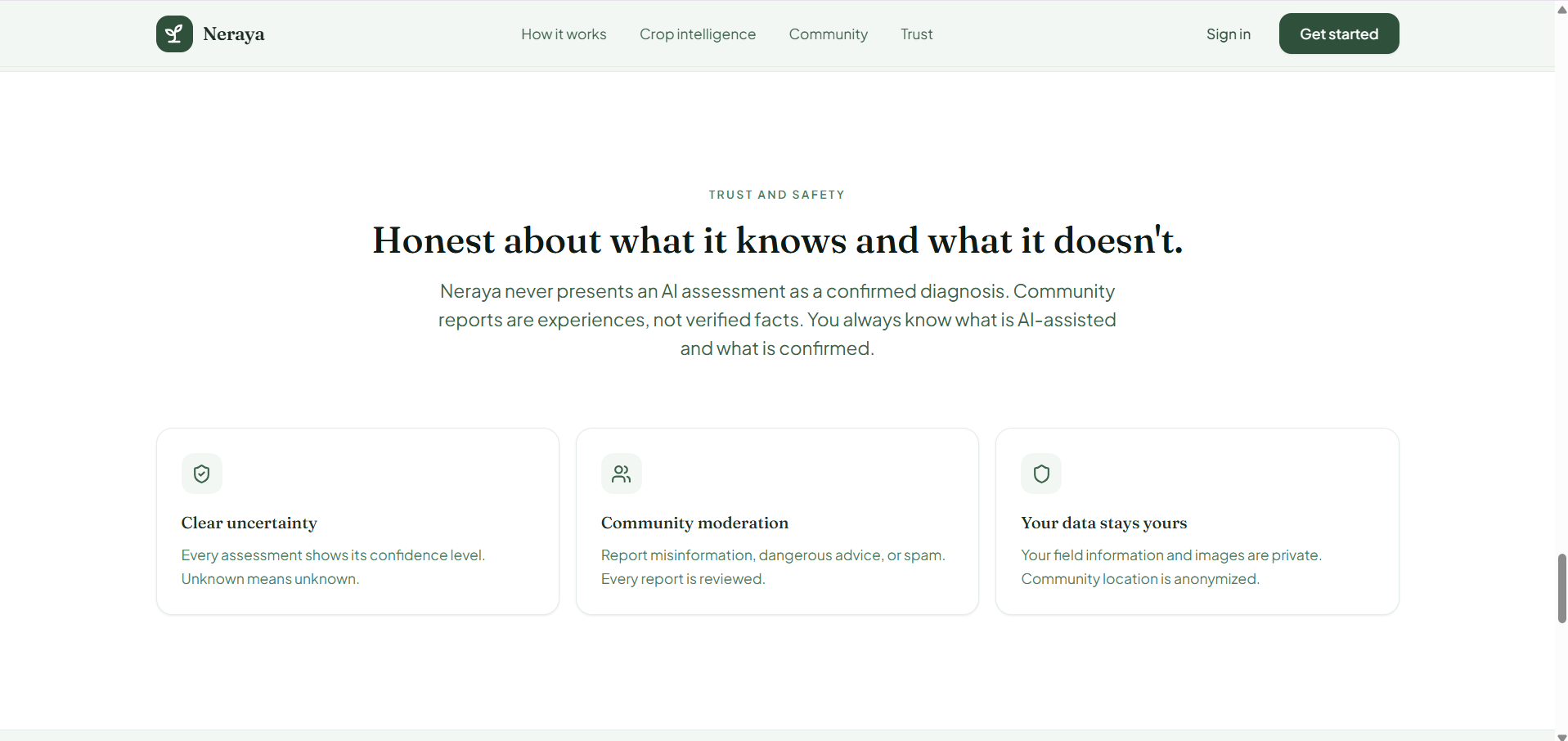
Neraya makes uncertainty visible and clearly separates AI assisted assessments, community experiences, and confirmed information.
-
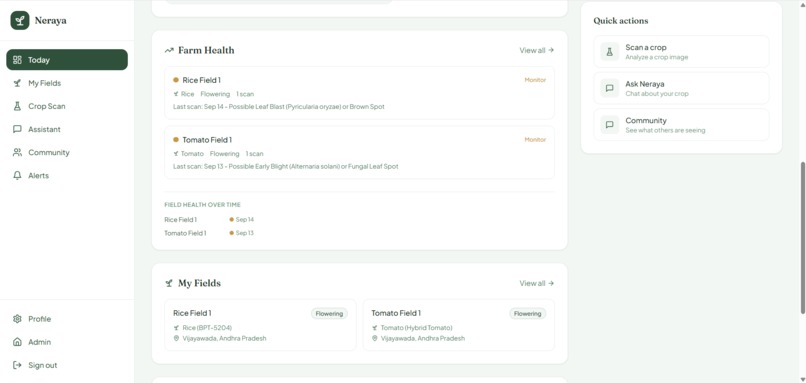
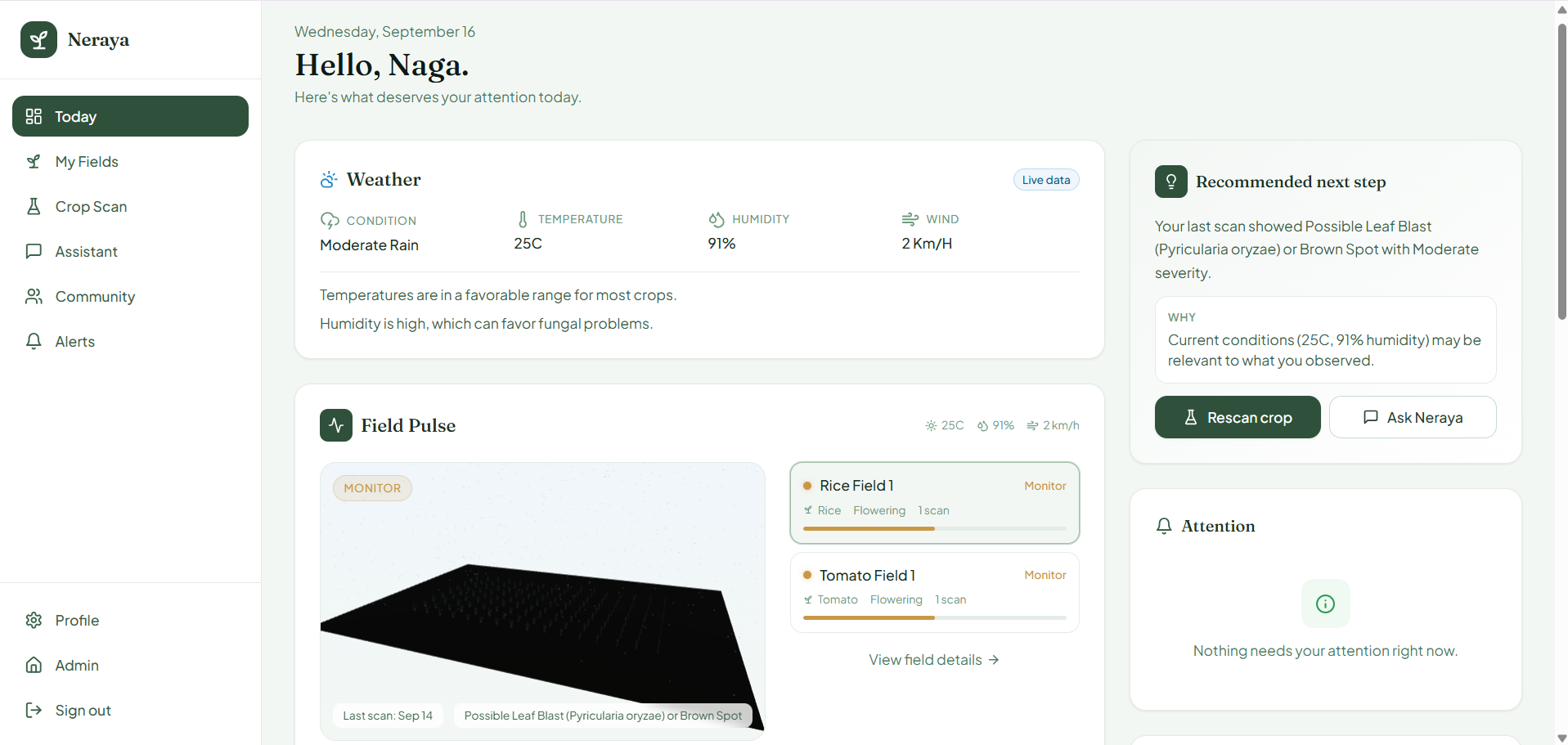
The Today view gives the farmer a clear picture of current weather, field health, recent scans, and the next step.
-
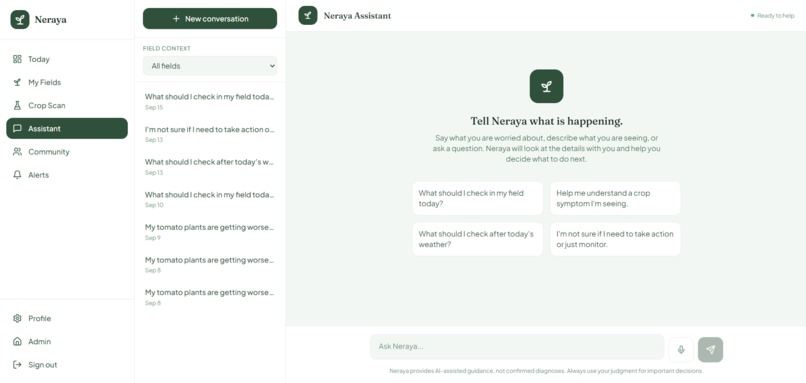
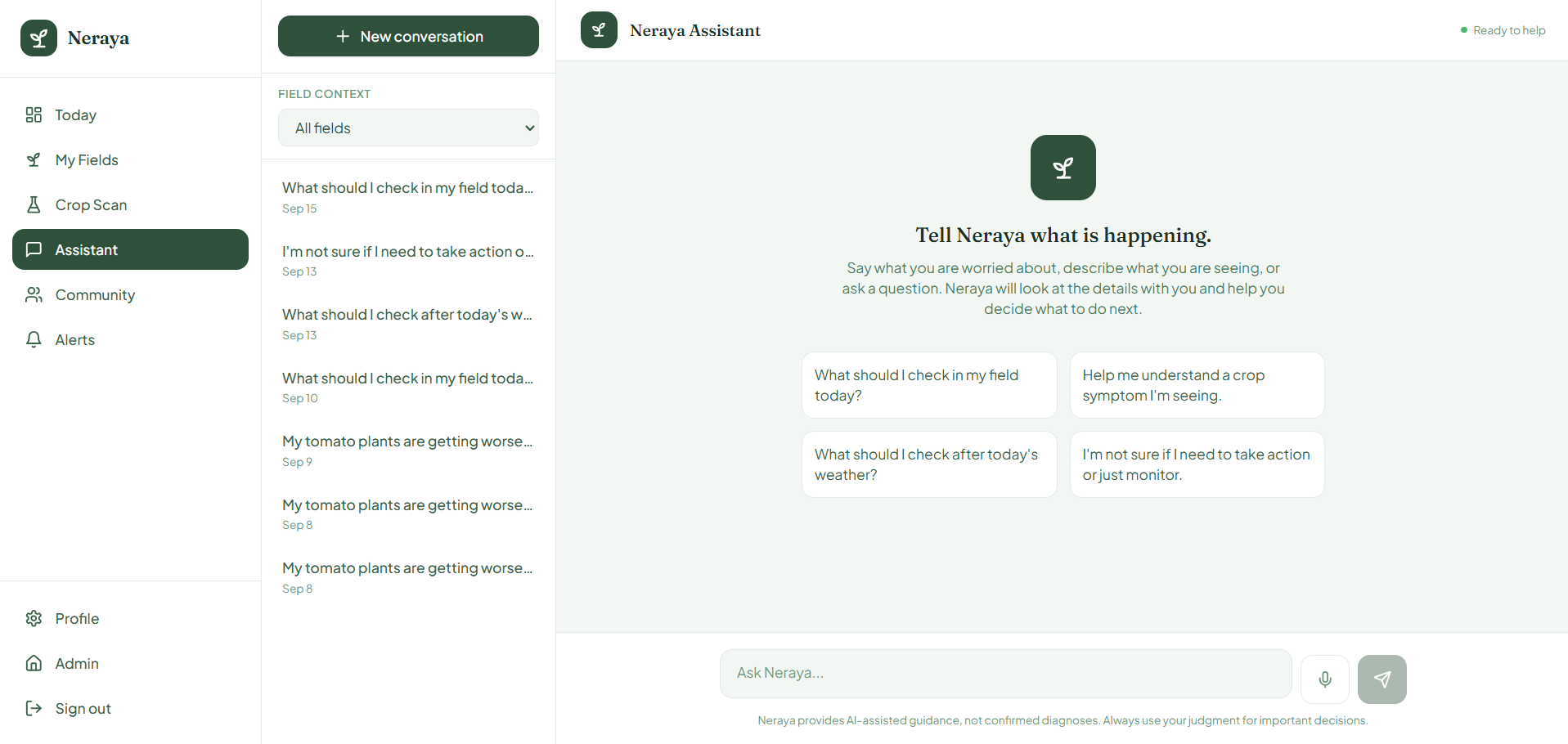
Neraya Assistant lets the farmer ask questions while keeping the selected field and its available context in view.
-
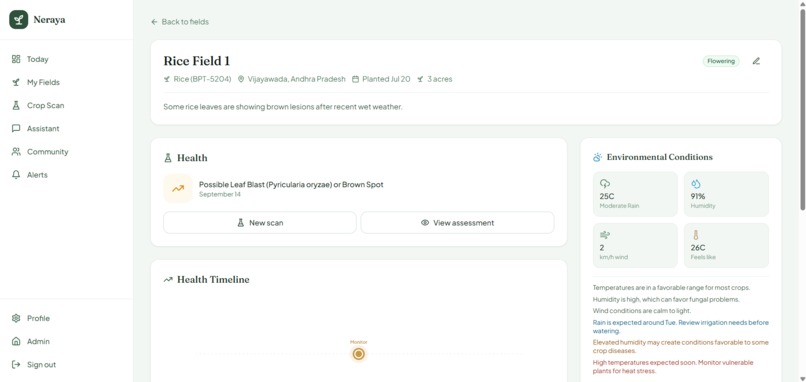
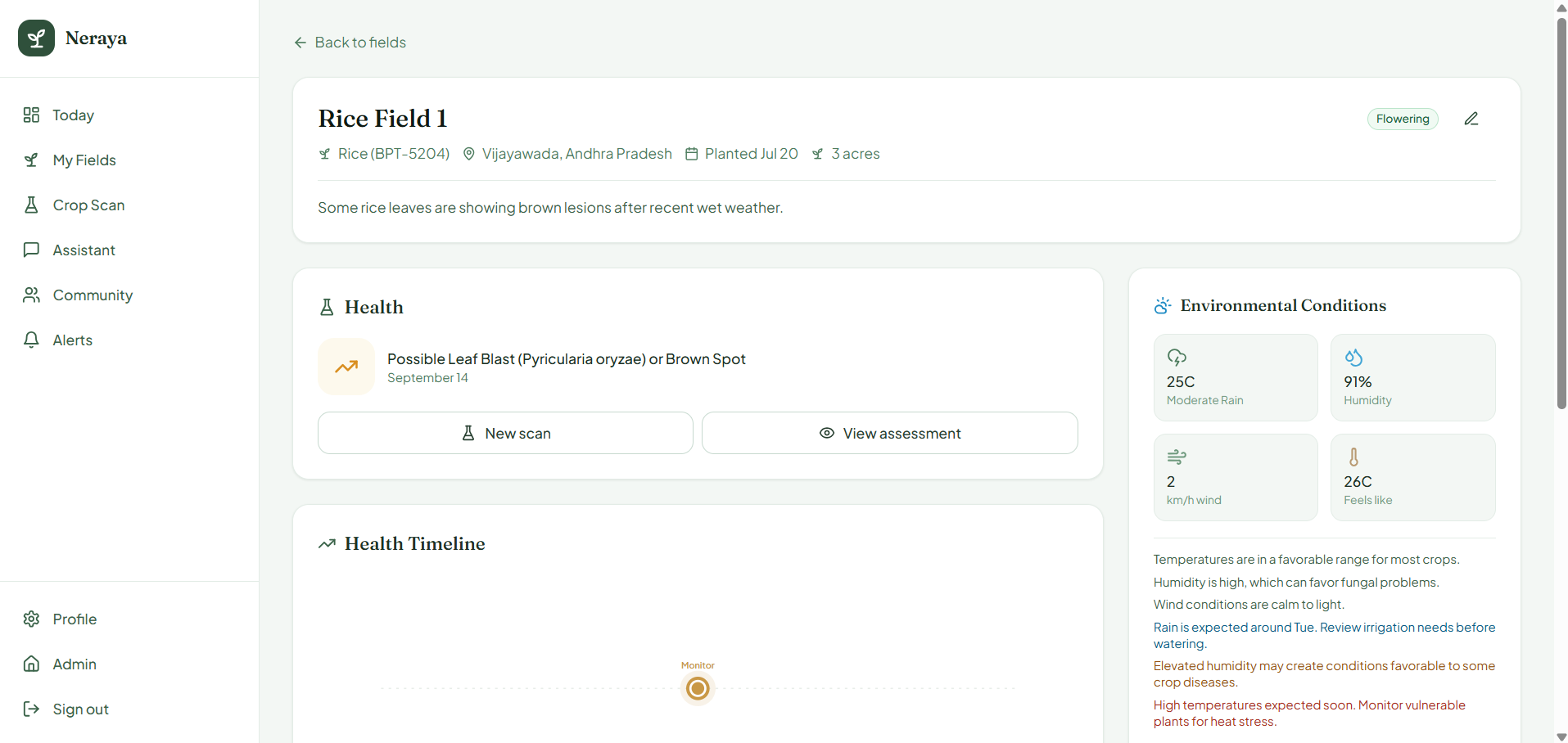
Field Details connects crop health with environmental conditions, weather, and the field's assessment history.
-
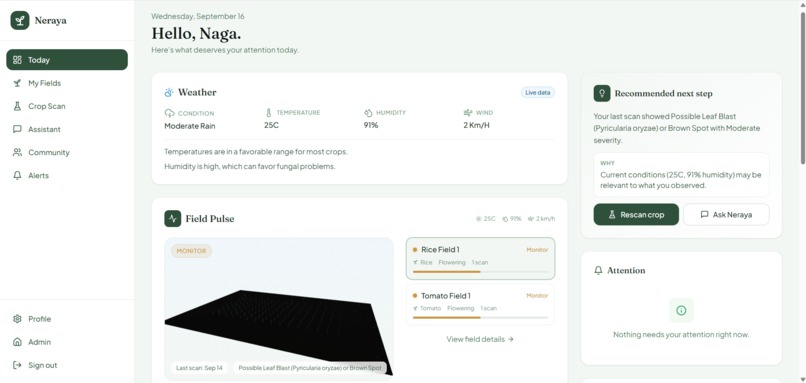
Field Pulse gives the farmer a visual view of the field based on crop type, growth stage, weather, and current health.
-
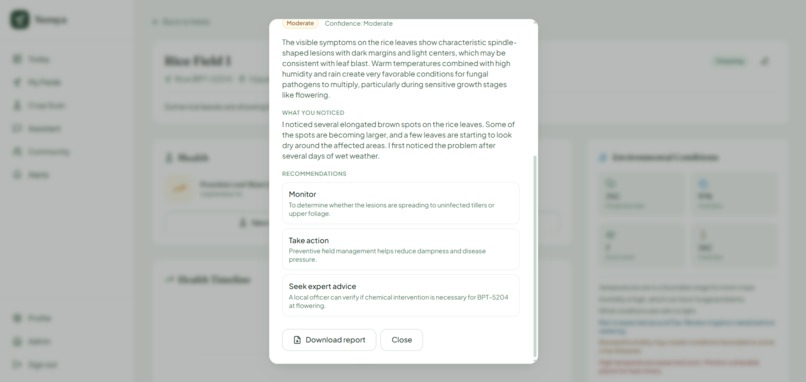
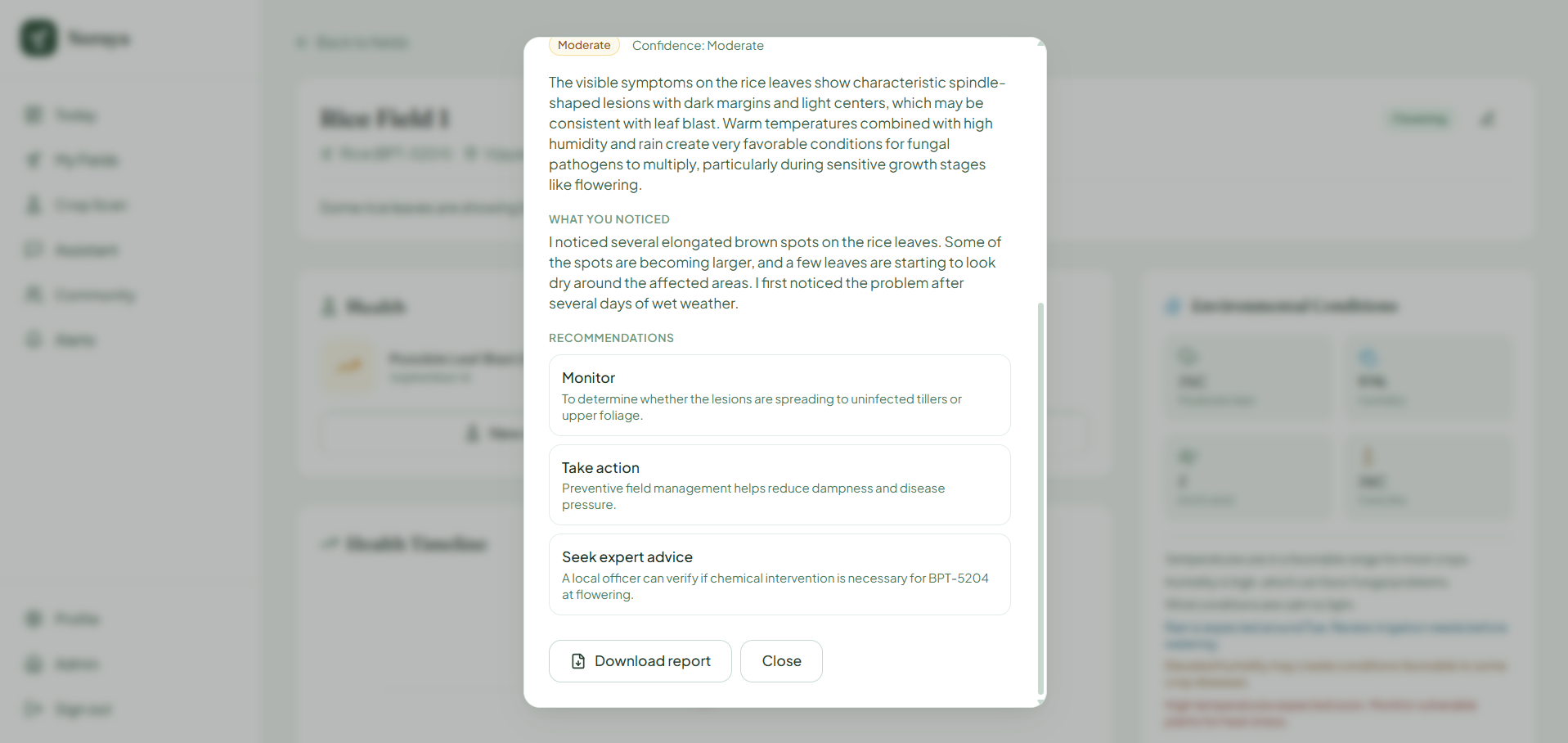
The assessment explains what was noticed, what to monitor, and when taking action or seeking expert advice may be appropriate.
-
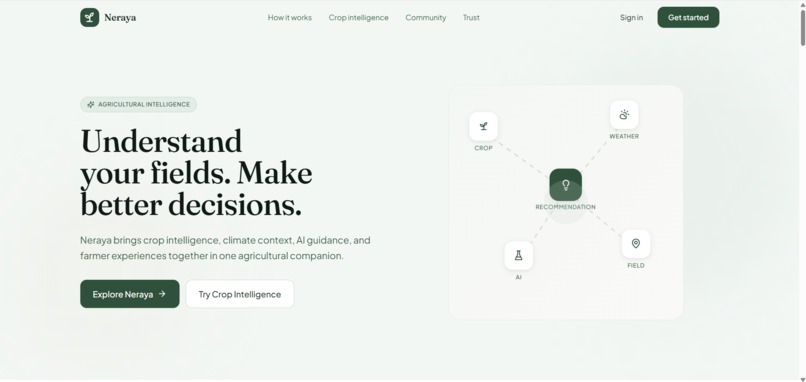
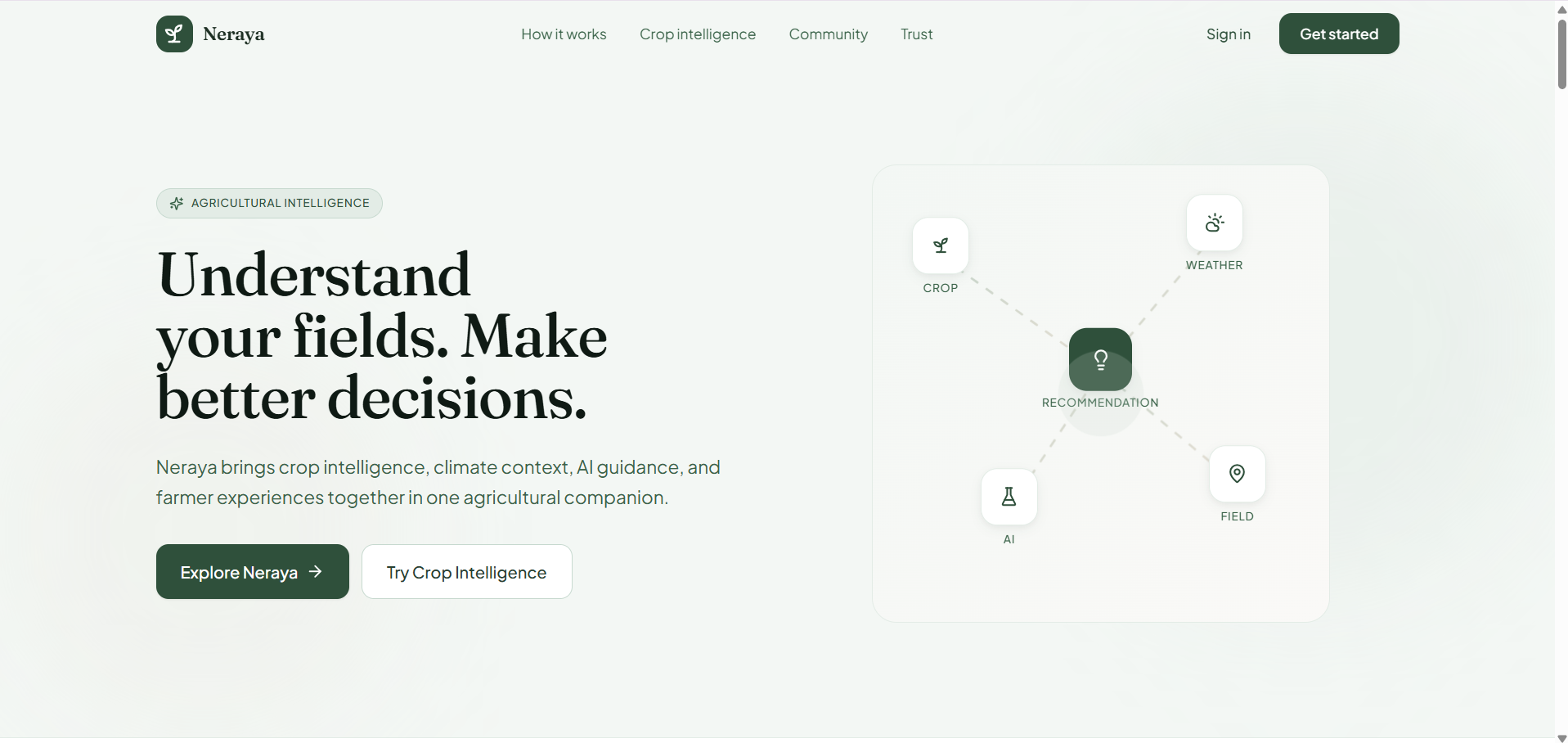
Neraya brings crop intelligence, weather context, AI guidance, and farmer experiences together in one place.
-
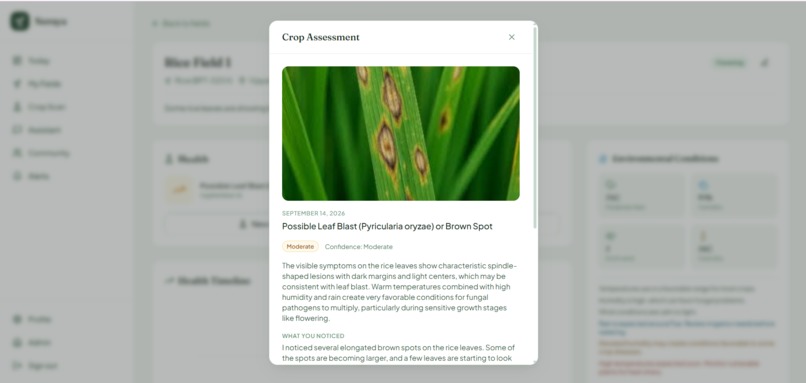
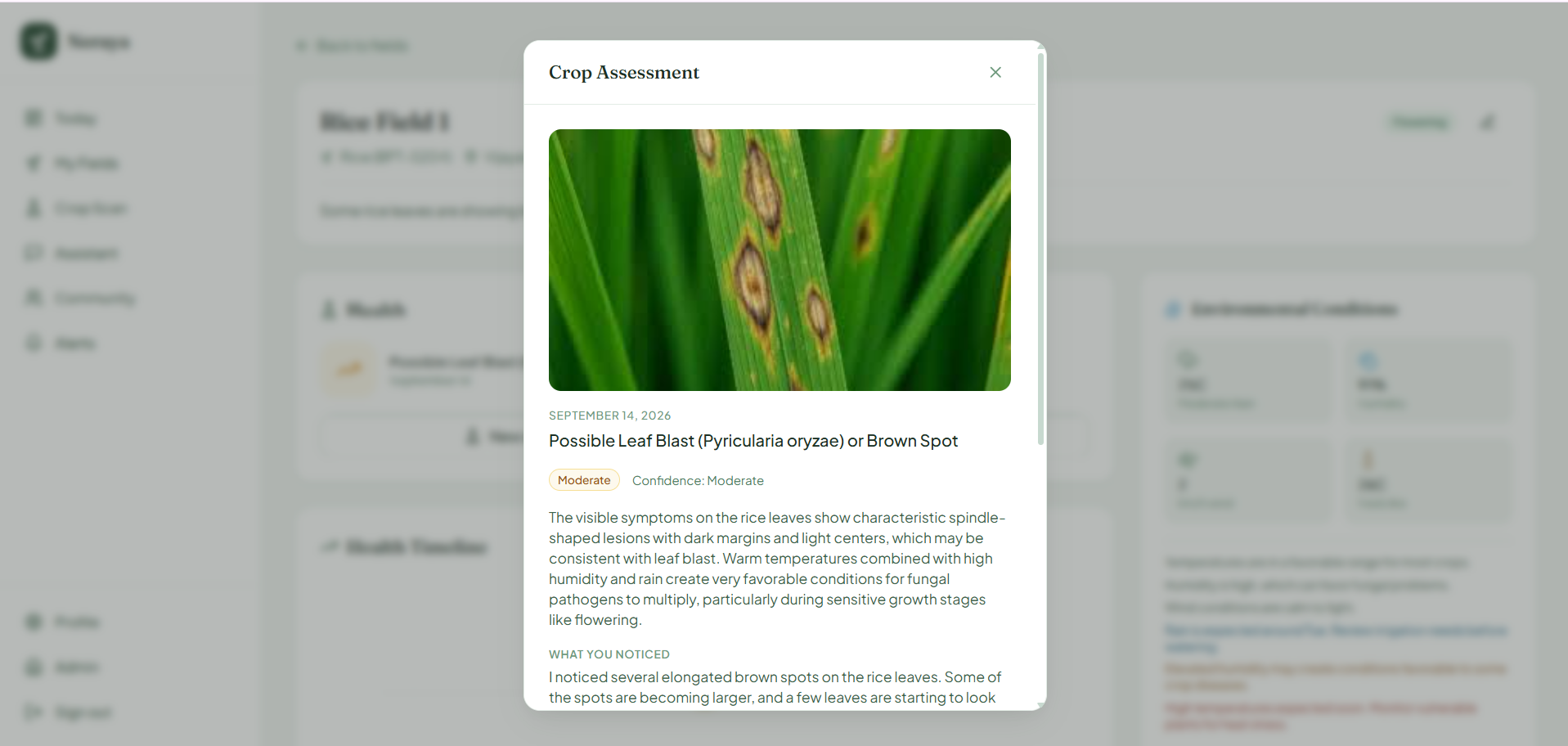
A real rice leaf image is assessed using visible symptoms, farmer observations, field context, and current weather.
Inspiration
I started thinking about Neraya from a simple question: what happens when a farmer knows that something is wrong with their crop, but does not know what to do next?
A farmer may notice spots on a leaf, changes in the plants, unusual weather, or something that just does not look right. They may have their own experience to rely on, but they may still want to know what could be happening, whether the situation is getting worse, and what other farmers have done when they faced something similar.
I did not want to build just another tool where a farmer uploads a crop image and gets a prediction.
I wanted to build something that looks at the bigger picture, and more importantly, remembers that there is a person standing behind that field.
That became Neraya.
The name and the idea grew around the thought that agricultural technology should not make farmers feel more distant from the information and people they depend on. It should help bring those things closer.
What it does
Neraya is an agricultural intelligence platform built around both the field and the farmer.
A farmer can create and manage their fields, add crop and growth information, describe what they are seeing, and upload crop images for an AI assisted assessment.
Neraya does not look at the image alone. It can bring together the crop image, the farmer's observations, field information, current weather, forecast information, and previous assessments to give the situation more context.
The assessment shows what was observed, what evidence was used, what information is still missing, the assessment confidence, severity, recommendations, and what the farmer can check next.
Neraya also includes Field Pulse, which gives a visual representation of the current state of a field, weather intelligence, field history, reports, and Neraya Assistant for asking questions using the context of the farmer's own field.
But the part of Neraya that is especially important to me is the human side.
Farming is not always about solving a technical problem. Sometimes a farmer wants to know how another farmer handled the same situation. Sometimes they want to learn from someone else's experience before making a decision. And sometimes farming can simply feel exhausting and lonely, especially when things keep going wrong and it feels like nothing is working.
That is why Neraya is also designed with a farmer community in mind.
The community is meant to give farmers a place to share real experiences, talk about problems they have faced, learn what others did in similar situations, and support each other. I want it to become a place where knowledge does not only come from a model, but also from people who have actually lived through these situations.
The idea behind the whole platform is:
Evidence → Context → Reasoning → Action
Neraya does not predict for the farmer. Neraya helps the farmer decide.
How I built it
I built Neraya as a solo project using React, TypeScript, Vite, and Tailwind CSS for the frontend.
For the backend and data layer, I used Supabase with PostgreSQL, storage, and Supabase Edge Functions.
The AI assisted crop assessment uses Gemini's multimodal capabilities so that crop images can be considered together with the farmer's description and other field context.
I also integrated OpenWeatherMap so that weather conditions and forecasts can become part of the agricultural context instead of treating the crop image as an isolated input.
Field assessments and history are stored in Supabase so that the farmer can look back at what happened to a field over time.
For Field Pulse, I used Three.js and WebGL to create a real 3D representation of the crop field. The visualization changes based on things such as the crop type, growth stage, assessment state, and weather conditions.
I deployed the application through Vercel and connected the project to GitHub for source control.
I also made sure that sensitive API keys are kept inside server side Edge Functions rather than being exposed in the frontend.
Challenges I ran into
One of the hardest parts was making several different pieces of the system work together as one experience.
It was not enough to make the AI return an answer. I had to make sure that the assessment could use the farmer's actual field information, weather, observations, images, and previous assessments without losing that context.
I also spent a lot of time testing what happens when the AI cannot confidently identify something. I did not want the application to confidently invent an answer just because an image had been uploaded. Neraya needed to be able to say when the available evidence was not enough.
Another challenge was building Field Pulse. I wanted it to feel like an actual field rather than another flat dashboard graphic, while still keeping it lightweight enough to run smoothly in a browser.
There were also smaller problems along the way, from weather data becoming stale in the Assistant to making sure assessments were actually saved and correctly connected to the right field.
I had to test, break things, fix them, and test them again.
Accomplishments that I'm proud of
I am proud that Neraya became a working product rather than staying as an idea.
I built the entire project as a solo participant and connected the frontend, database, AI, weather service, storage, field history, reports, Assistant, and 3D visualization into one application.
I am especially proud of the way the crop assessment turned out.
For example, during testing with a real rice leaf image, Neraya did not simply return a disease name. It identified a possible Leaf Blast or Brown Spot situation with moderate confidence, explained the visual indicators it noticed, considered the recent wet weather and flowering stage, listed what evidence was still missing, and suggested what to inspect next.
That is the kind of interaction I wanted from the beginning.
I am also proud that Neraya does not hide uncertainty. If the available evidence is not enough, the system can say so.
And I am proud of the human direction of the project. I did not want Neraya to stop at "here is your prediction." I wanted to create something that could eventually help farmers learn from each other too.
What I learned
Building Neraya taught me that a useful AI product is not just about choosing a model and getting an answer from it.
The context around the answer matters just as much.
I learned how much difference it makes when an AI system knows what field it is looking at, what crop is growing there, what the farmer has observed, what the weather has been doing, and what happened in that field before.
I also learned that uncertainty should not be hidden. A system can be more useful when it clearly explains what it knows, what it does not know, and what the user can do next.
Most of all, I learned that technology can solve only part of a problem.
For something like farming, knowledge and human experience matter too. A model can help interpret an image or connect different pieces of information, but another farmer's experience can sometimes be just as valuable.
That changed the way I think about building AI products.
What's next for Neraya
There is still a lot I want Neraya to become.
The next major direction is the farmer community. I want farmers to be able to share real experiences, discuss situations they have faced, and learn from what others tried and what happened afterwards.
I also want to expand the agricultural intelligence behind Neraya with more crop specific knowledge, stronger long term field insights, and better ways of connecting current observations with previous seasons and regional conditions.
Over time, I want Neraya to bring two things closer together: agricultural intelligence and human experience.
A farmer should be able to look at their field and understand what may be happening, have better information when making a decision, learn from someone who has faced something similar, and know that they do not always have to figure everything out alone.
That is the Neraya I want to keep building.
Built With
- agriculture
- css
- gemini
- github
- openweathermap
- postgresql
- react
- supabase
- tailwind
- three.js
- typescript
- vercel
- vite
- webgl

Log in or sign up for Devpost to join the conversation.