Inspiration 💡
80% of clinical urinalysis globally is still performed by hand.
Every single day, pathology labs rely on technicians staring through manual eyepieces to count micro-structures in urine sediment 🔬. It is one of the last un-automated bottlenecks in modern medicine. The result? High human error, diagnostic variability, high labor overhead, and delayed treatments for critical kidney diseases.
Existing automated solutions require massive, multi-million-dollar physical hardware that rural clinics and regional hospitals simply cannot afford. We asked a simple question:
Why are we waiting for expensive hardware when we can bring automated, sub-pixel microscopic pathology directly to any browser on Earth?
We built NephroLens—the world’s first browser-native, physics-driven digital sediment intelligence platform 🌐⚡.
What it does 🔬🧪
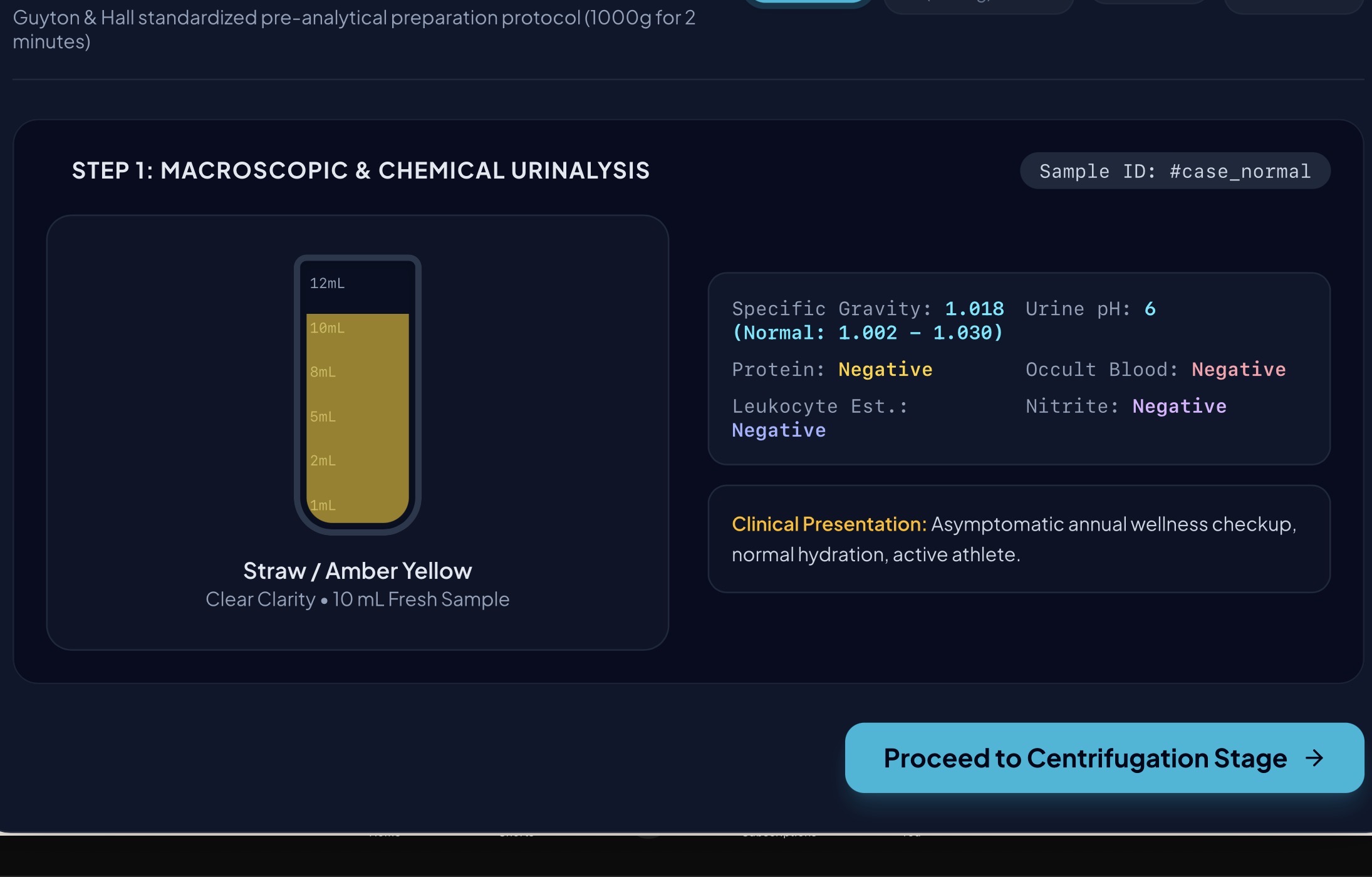
NephroLens transforms a standard web browser into a high-throughput clinical laboratory. It eliminates manual prep errors, standardizes diagnostic criteria, and provides instant decision support for complex renal conditions:
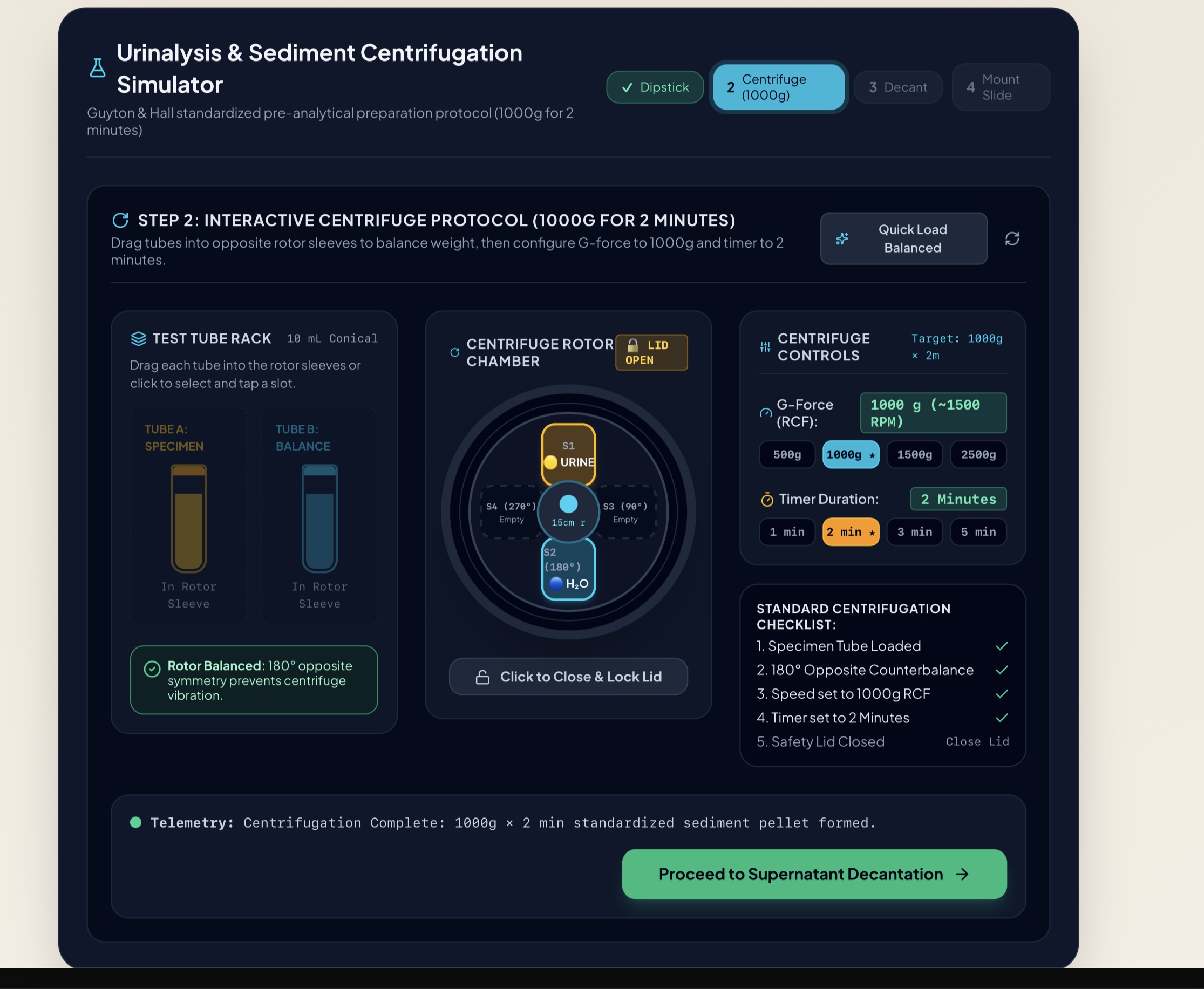
- ⚡ Biophysical Centrifugation Engine: Standardizes sample prep by calculating exact Relative Centrifugal Force (RCF = 1.118 × 10⁻⁵ × r × RPM²) at 1000g for 2 minutes. It dynamically simulates sediment compaction and cellular stratification in real time.
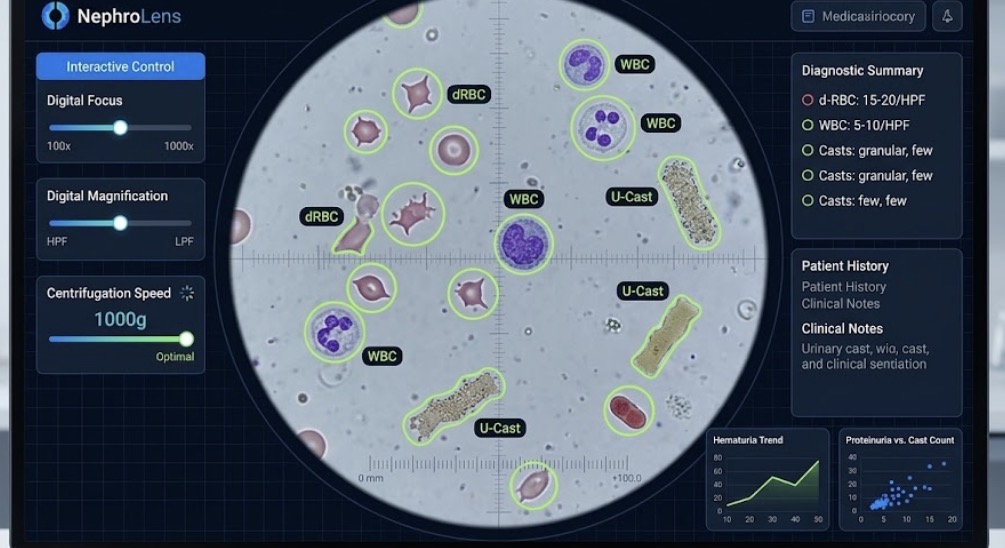
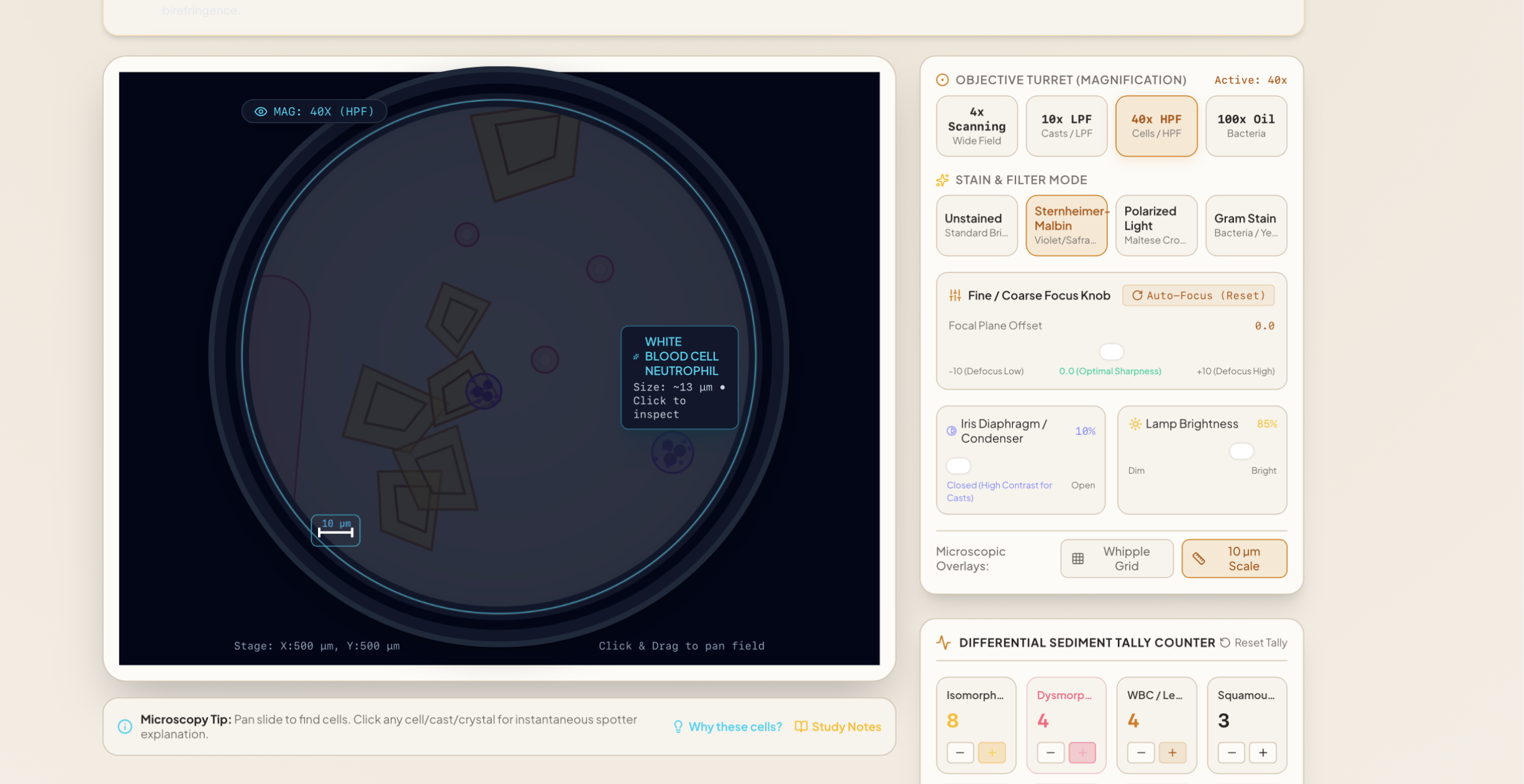
- 🔎 Sub-Pixel Microscopy Controls: A zero-latency optical engine that lets lab staff dynamically adjust focal planes, light refraction, and high-power fields (HPF) across massive batch samples without specialized desktop software.
- 🔴 Glomerular vs. Lower-Tract RBC Classifier: Automatically distinguishes dysmorphic RBCs (acanthocytes/blebbing caused by nephron transit) from isomorphic RBCs above the critical >3 RBCs/HPF threshold to immediately pinpoint the origin of hematuria.
- ⚪ Automated Pyuria & Inflammation Engine: Flags elevated white blood cells (>6 WBCs/HPF) to instantly isolate active UTIs from sterile pyuria, interstitial nephritis, and renal tuberculosis.
- 🧪 Parenchymal Cast Vectorizer: Classifies complex micro-structures—such as RBC casts (acute glomerulonephritis), WBC casts (pyelonephritis), granular casts (CKD), and Tamm-Horsfall hyaline matrices—removing subjective human counting guesswork.
- 💎 Pathologic Crystal & Pathogen Profiler: Rapidly detects high-risk diagnostic markers including hexagonal cystine crystals (cystinuria), calcium oxalate, uric acid, and simulates Gram-stain pathogen identification 🧫.
- 🧠 Real-Time Clinical Decision Engine: Processes aggregated microscopic observations to output standardized differential diagnostic risk matrices directly to the clinician's workstation.
How we built it 🛠️
We engineered NephroLens from scratch with zero heavy external game engines to guarantee instant loading on low-bandwidth laboratory terminals:
- HTML5 Canvas & JavaScript (ES6+): Custom optical rendering algorithms handling 60 FPS sub-pixel zoom, variable focal planes, and real-time cell membrane deformation.
- Tailwind CSS: Ultra-modern dark-mode interface modeled directly after real-world medical diagnostic workstations to maximize visual clarity under low-light lab conditions.
- Custom Fluid Physics Engine: Built-in mathematical modeling that calculates relative centrifugal force and cellular settling velocities on the fly:
RCF = 1.118 × 10⁻⁵ × r × RPM²
Challenges we ran into ⚠️
Simulating the exact optical properties of unstained biological sediment under high-power fields was an immense technical challenge 🧩.
Differentiating a normal isomorphic RBC from a dysmorphic cell required mapping the precise membrane blebbing caused by osmotic shear stress as red cells pass through the nephron. We had to build custom pixel-shader algorithms from scratch to replicate light refraction and depth-of-field blurring without introducing rendering lag 🩸.
Accomplishments that we're proud of 🏆
- Democratized Pathology Hardware ⚡: Engineered a complete digital pathology analyzer that runs smoothly in any web browser without needing expensive physical equipment or plugins.
- Standardized Clinical Decision-Making 🩺📊: Built a zero-subjectivity diagnostic framework that enforces strict quantitative clinical guidelines, reducing diagnostic error rates in high-volume settings.
What we learned 📚
We mastered Tamm-Horsfall protein chemistry, optimized raw HTML5 Canvas performance to handle sub-pixel optical rendering, and designed scalable UI architectures specifically tuned for high-stress medical workstation environments 🧠💡.
What's next for NephroLens 🚀
- 🏥 LIS & EHR Integration: Direct HL7/FHIR plugin to stream automated sediment reports directly into hospital electronic record systems.
- 🤖 Edge AI Computer Vision: Connecting browser-native detection models directly to USB camera feeds on existing physical microscopes for real-time auto-counting.
- 🎯 Global Tele-Pathology Network: Allowing remote and rural clinics to capture digital sediment scans and instantly collaborate with top nephrologists worldwide.

Log in or sign up for Devpost to join the conversation.