-
-
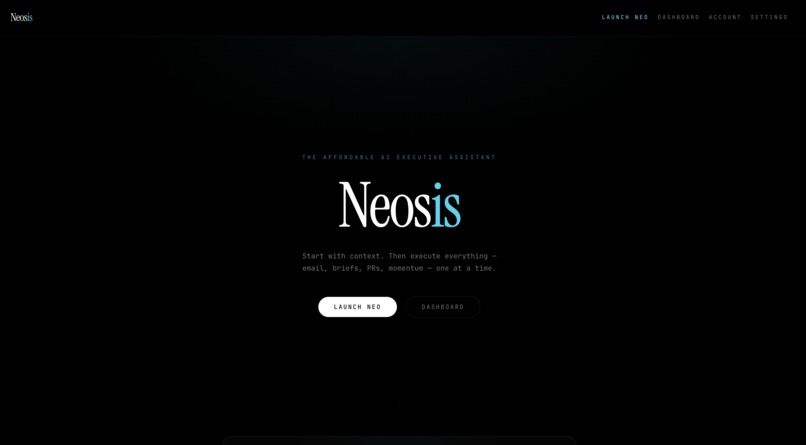
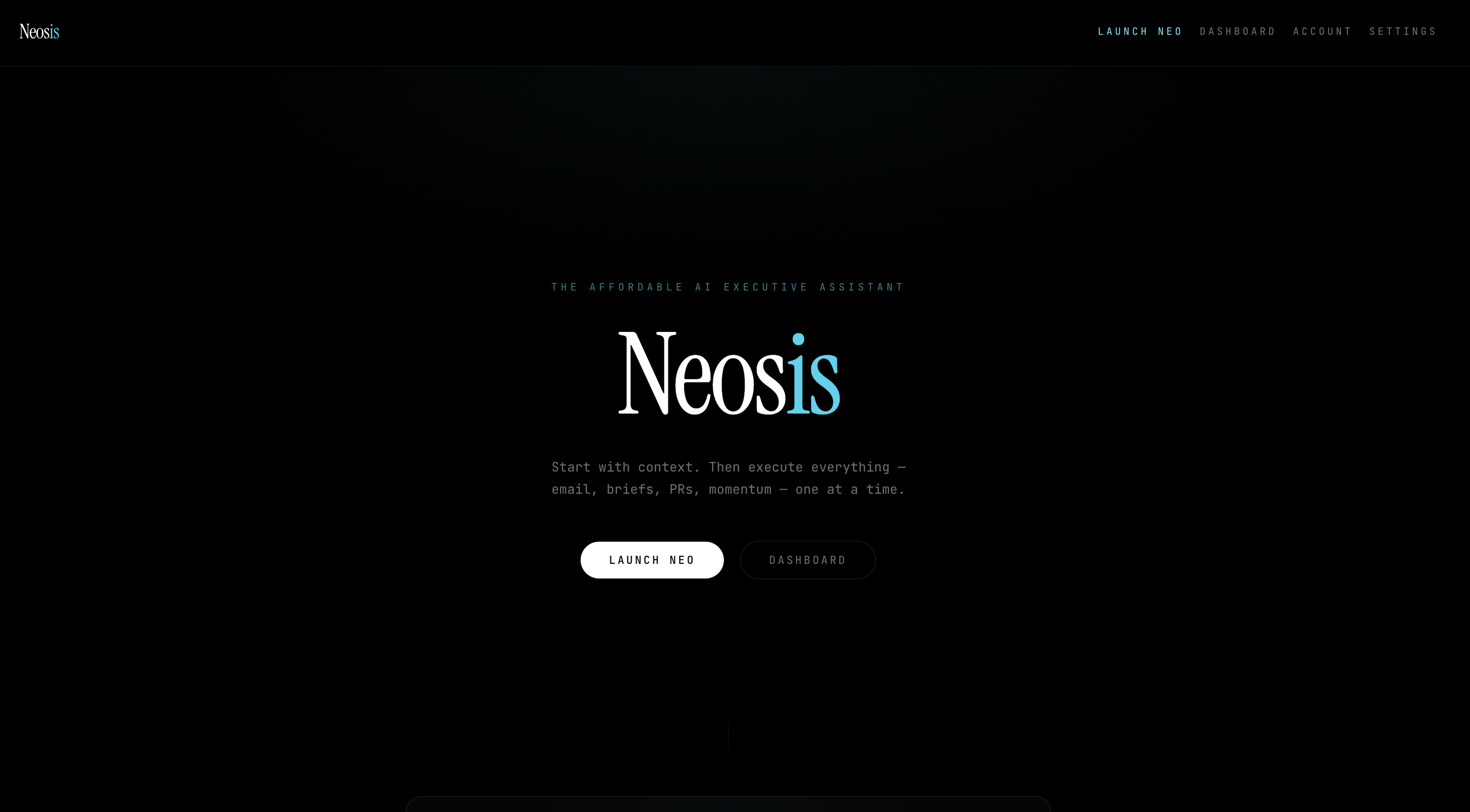
Landing page
-
-
Inspiration
Software engineering is facing a massive productivity crisis, and it has nothing to do with writing code. Studies show that developers lose an average of 23 minutes of deep focus every single time they are interrupted to switch contexts, whether that's toggling between tabs to hunt down a PR reviewer, digging through Jira to find ticket context, or messaging back and forth to schedule a quick sync. On top of that, the median pull request sits waiting for over 14 hours before merging, creating massive bottlenecks in the delivery pipeline.
Working on engineering teams, we felt this friction daily. We were inspired to build Neosis to solve this multi-billion-dollar problem of wasted developer time. We didn't want to build just another chatbot; we wanted to build a proactive, agent-to-agent system that aggressively protects a developer's flow state by automating the administrative friction of shipping software.
What it does
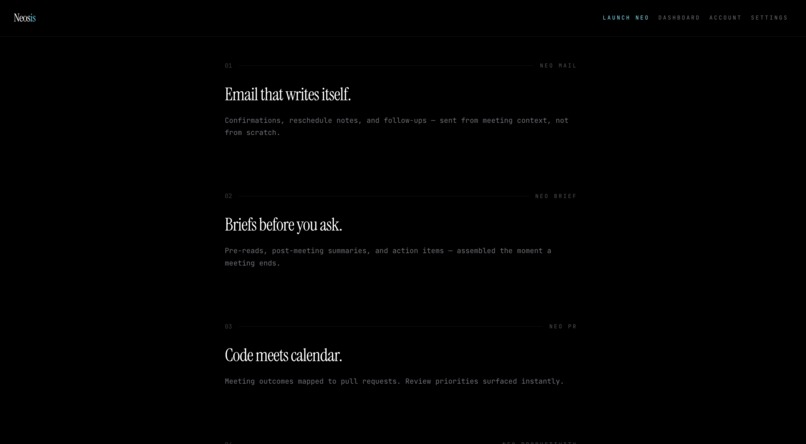
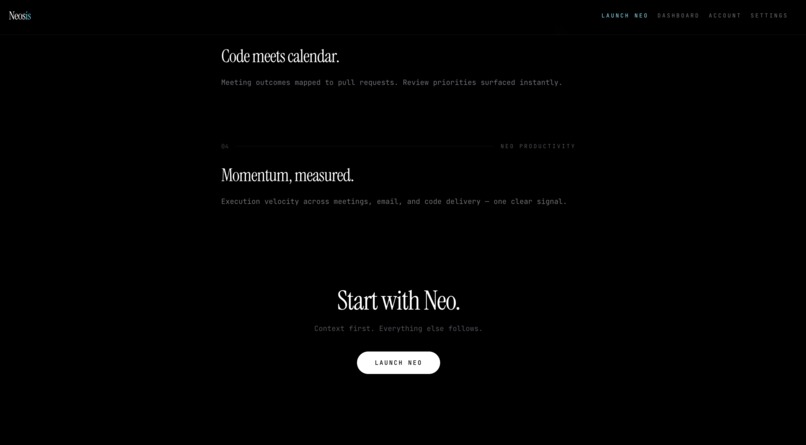
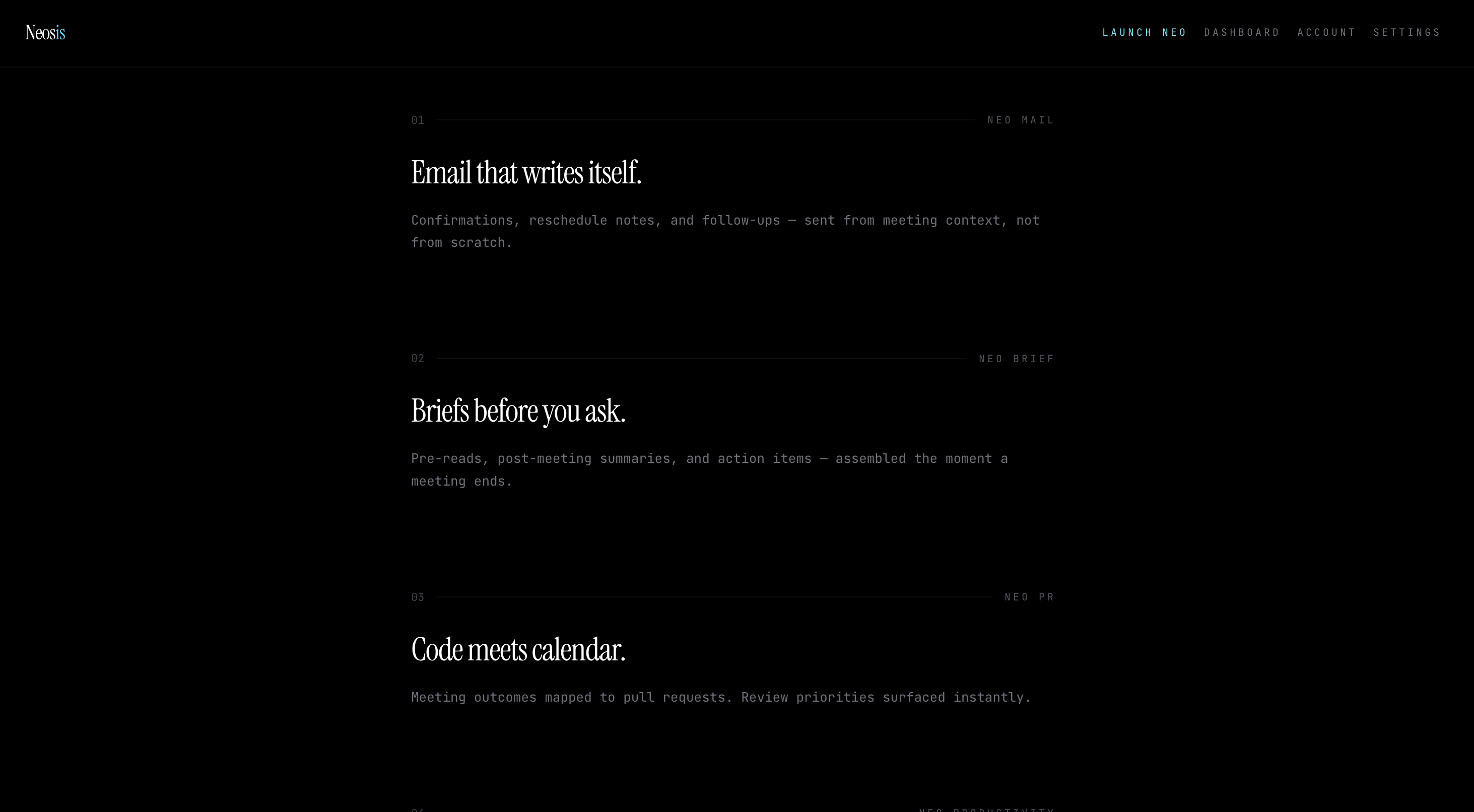
Neosis is a voice-first AI executive assistant designed specifically for engineering teams. It deploys five autonomous agents that continuously monitor GitHub, Slack, Jira, and calendars:
Neo Brief: Delivers personalized morning and evening audio briefings detailing your schedule, PRs needing review, and urgent priorities.
Neo PR: Hunts for stale pull requests and intelligently routes reviews to the people with the most git history context on those files.
Neo Sched: Negotiates meeting times directly with other agents on the team and books them seamlessly.
Neo Root: Acts as a detective, using vector search across Slack threads and Jira tickets to find the actual human reason for delayed tasks.
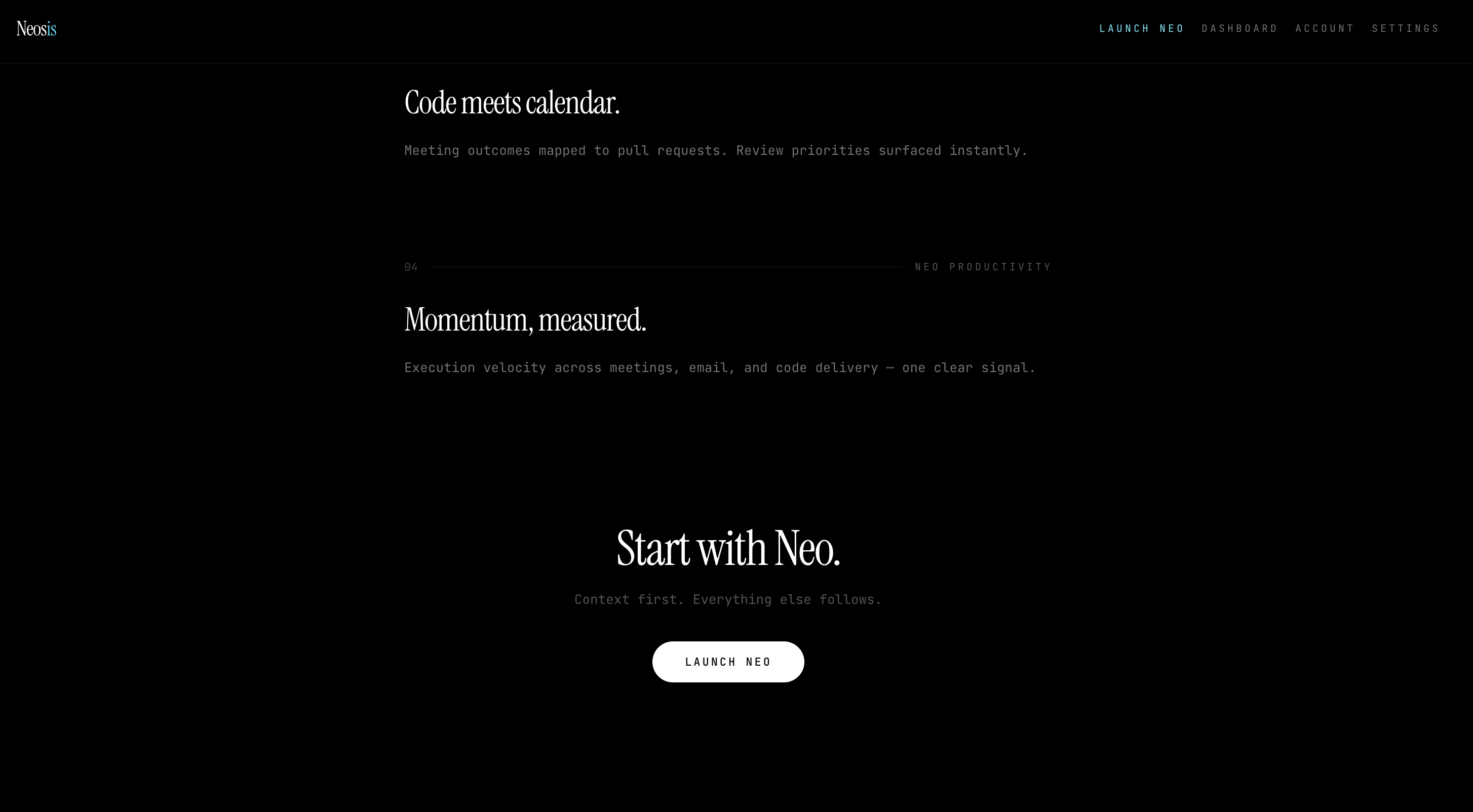
Neo Sprint: Forecasts sprint health and automatically generates structured release notes.
Crucially, Neosis operates on a strict confirmation gate: it always asks "say okay" before taking any irreversible action, like booking a calendar slot or pinging a coworker.
How we built it
We built the web platform using Next.js 14, React, and Tailwind CSS. All our data, including our RAG context, is stored in MongoDB Atlas. We leveraged MongoDB Atlas Vector Search combined with Voyage AI embeddings to rapidly retrieve semantic context from GitHub, Slack, and Jira webhook data.
For the AI logic, we routed all LLM calls through Lava Gateway, utilizing Claude (Haiku and Sonnet) for complex reasoning tasks like scheduling negotiation and root cause analysis, and Groq (Llama 3.1 70B) for fast generation tasks like PR nudges. We used ElevenLabs for real-time, streaming text-to-speech to deliver the voice briefings natively in the browser. Finally, user authentication and OAuth scoping were securely handled by Auth0 AI, while calendar API interactions were managed through Nylas.
Challenges we ran into
Agent-to-agent negotiation for scheduling required building a reliable protocol where one subagent could query another user's calendar availability via their specific Nylas OAuth tokens, without confusing timezones or overlapping busy blocks. Setting up reliable vector embeddings across highly varied text formats, from informal Slack pings to dense GitHub PR comments and code files, also required tuning our chunking strategy to maintain accurate semantic context.
Accomplishments that we're proud of
We successfully built an ecosystem of five distinct, specialized agents that communicate seamlessly within a single platform. Getting the ElevenLabs audio stream to play the morning brief natively on page load, achieving a natural voice interaction with a time-to-first-word of around 300ms, was a massive "wow" moment.
We are also highly proud of our strict, OAuth-scoped security architecture that ensures each agent only accesses the specific integrations and data that the user has explicitly permitted.
What we learned
We learned how to orchestrate multiple foundation models based on their specific strengths and unit economics, using Claude for deep reasoning and Groq for high-speed structured output. We also learned that building AI for engineers requires a very high bar for trust; implementing the "say okay" confirmation gate taught us a lot about the UX requirements of truly agentic software.
What's next for Neosis
We plan to expand the platform to mobile, allowing engineers to listen to their Neo Briefs during their morning commute or while away from their desks. We also want to explore deeper integrations directly into CI/CD pipelines, allowing Neosis to automatically trigger test runs, rollbacks, or deployments based on the team's spoken commands.
Built With
- auth0-ai
- claude
- elevenlabs
- groq
- inngest
- lava-gateway
- mongodb-atlas
- mongodb-atlas-vector-search
- next.js-14
- node.js
- nylas
- railway
- react-18
- shadcn/ui
- tailwind-css
- typescript
- vercel
- voyage-ai


Log in or sign up for Devpost to join the conversation.