-
-
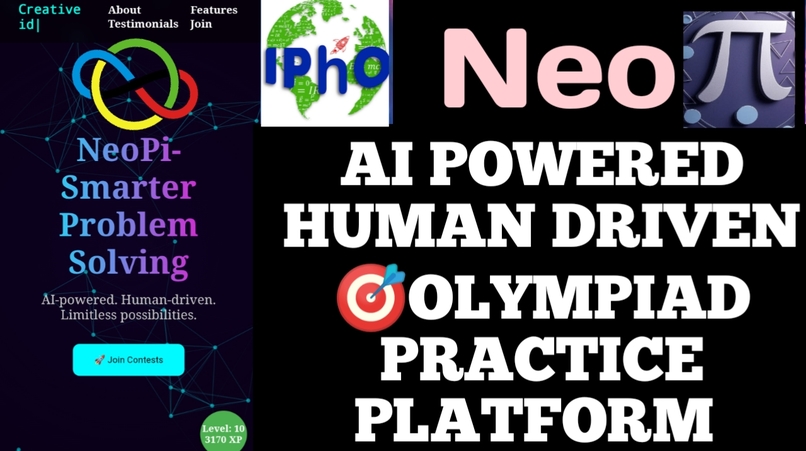
Maximize Your Problem Solving skills
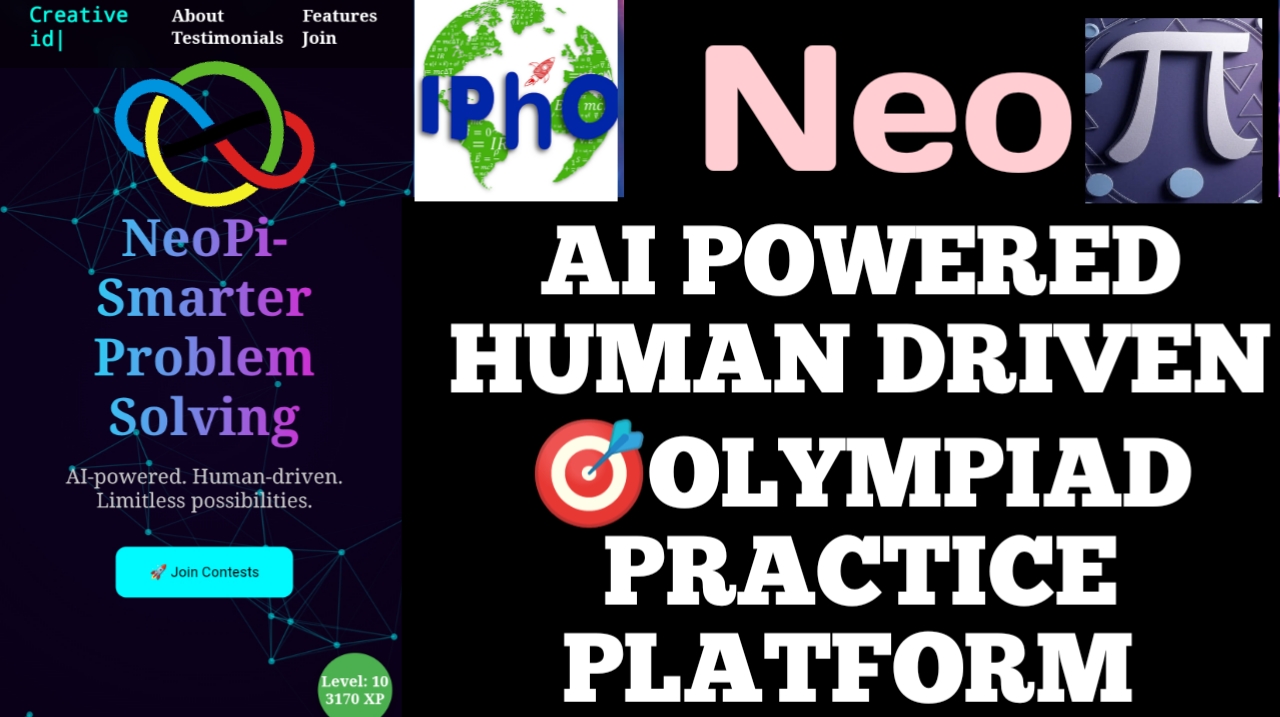
Inspiration
NeoPi was born from a simple belief: STEM education should feel like leveling up — not logging in.
I grew up without a computer or formal coaching. I only had curiosity and a phone — and that's how NeoPi was built: entirely on a $60 Android phone using browser tools.
Many students worldwide lack resources but have ambition. NeoPi exists to bring Olympiad-level AI tutoring to them without needing hardware, credentials, or high-speed internet.
Inspired by gamified apps and motivated by educational inequality, NeoPi merges an AI chatbot, contest library, global leaderboard and a playful XP system — all into one seamless experience.
What it does
NeoPi is an AI-powered Olympiad learning platform designed for math, physics, and computer science enthusiasts. It combines creative gamification with intelligent tutoring:
NeoPi-GPT, your multi-mode AI companion, offers:
Problem Solving Mode: Step-by-step help with Olympiad-level questions.
Idea Mode: Quick brainstorming for projects or problem approaches.
Holistic Review Mode: AI feedback on mindset, learning strategies, and college prep.
Even fun modes like Exam Mode, Funny Mode or Religious Mode — for breaks and mental refresh.
Instant AI Feedback & Hints — receive algorithmic explanations and clarity on advanced topics as you practice.
Interactive XP System Without Login — earn XP, see yourself in the leaderboard just by exploring contests or problem sets. No signup, no backend. Progress is saved in your browser via localStorage.
Animated, interactive visual tools bring problems to life and help you engage with solutions more effectively
Floating Messenger-Style Level Tracker — a bubble shows real-time level and XP, keeping progress visible at all times.
Push Notifications via OneSignal — receive daily problem alerts, level-up reminders, and streak boosters — all powered by intelligent scheduling.
Mobile-first and Lightweight — built to work even on low-end phones, with minimalist JS and fast-loading UI.
NeoPi lets learners solve, explore, and level up — guided by AI, with no friction.
How we built it
NeoPi was built entirely on a $60 Android phone, without access to a laptop or desktop. Using nothing but a mobile browser, online code editors, and a lot of determination, I stitched together every line of code by hand.
Key technologies and steps:
HTML, CSS, JavaScript (Vanilla) – for the frontend, fully mobile-optimized.
Game-like XP system – coded in pure JavaScript; it detects clicks on “contest” elements and updates levels in real time.
Global Leaderboard for top problem solvers! I developed it without backend and PC. Used Google form, Sheet and made a script with JavaScript that connects it to NeoPi leaderboard!
Floating XP Bubble – inspired by the Messenger chat head, made draggable using touch events and CSS transforms.
LocalStorage – stores XP and levels without any login or backend.
OneSignal – added for push notifications to encourage daily learning.
SEO + PWA – optimized meta tags and manifest to make the site installable and indexable.
Hosting – deployed on a static hosting platform with custom .xyz domain: neopi.xyz
Every part of NeoPi was written, tested, and refined using only mobile tools, proving that innovation isn’t limited by equipment — only by imagination.
Challenges we ran into
No computer, no IDE I had no access to a PC. Everything — from coding to debugging to publishing — was done on a low-end Android phone using browser-based editors and code-runner apps. This made file management, version control, and previewing extremely difficult.
No backend, no database I had to design an XP and level system without user login, databases, or server logic. I creatively used localStorage to track user progress — pushing JavaScript to its limits for persistent gamification.
Drag-and-drop on mobile Making the XP bubble float and drag smoothly on all screen sizes (especially with finger gestures) was a major challenge. I had to custom-build the logic from scratch, since most libraries were too heavy or incompatible with my workflow.
Low-bandwidth optimization Many users (including myself) have limited internet access. I had to ensure every asset was compressed, every script lightweight, and every feature responsive — all while keeping the experience engaging.
Lack of formal environment Without a mentor, team, or physical lab, I relied entirely on online resources and self-learning. Staying motivated and solving bugs solo — without Stack Overflow-like convenience on mobile — was mentally demanding.
Despite all this, NeoPi is now live — fast, clean, and ready to level up young minds.
Accomplishments that we're proud of
Built 100% on a phone Every single feature — from drag-and-drop XP bubbles to gamified interaction tracking — was created without a laptop. Just a basic Android device and sheer willpower.
No-login XP system Designed a fully working level-up mechanic using only JavaScript and localStorage. Users can engage, earn XP, and track progress — instantly, with no signup or backend.
Floating Messenger-style XP bubble Created an interactive, draggable UI element that updates in real-time based on user behavior. Works smoothly across mobile browsers, even with touch gestures.
Super lightweight and fast NeoPi loads fast even on slow connections, making it accessible to users in underprivileged areas — the very audience it was built for.
Made learning fun NeoPi transformed browsing STEM resources into an experience. It feels like a game — encouraging students to explore more, not just passively consume.
Fully SEO-optimized and PWA-ready The site is not just functional but discoverable — indexed by Google, installable as an app, and optimized for engagement.
Already launched at neopi.xyz This isn’t a prototype. It’s live, growing, and empowering thousands of curious minds every day.
What we learned
Limitations spark creativity Not having a computer, IDE, or advanced tools forced us to think differently. We learned how to break big problems into smaller parts and solve them with what we had — a smartphone and determination.
Frontend can do more than we think We realized how much is possible with just HTML, CSS, and JavaScript — from building a drag-and-drop XP tracker to simulating game mechanics, all without a backend.
User experience matters more than complexity Simple ideas like a floating XP bubble or instant feedback made a huge difference in engagement. It taught us that interaction design can turn passive users into active learners.
Persistence beats perfection We faced technical bugs, screen limitations, network issues, and performance struggles, but we didn’t give up. Every bug fixed made us better problem-solvers.
Self-learning is powerful With no formal training, no team, and no physical resources, we used online forums, docs, and trial-and-error to build a working product. We now believe: if you're curious enough, you can build anything.
What's next for NeoPi - AI Powered Human Driven Olympiad Practice Platform
Global leaderboard without login We plan to build a privacy-first ranking system where users can join global leaderboards using temporary anonymous IDs — no registration needed.
Offline mode for underserved areas We'll make NeoPi accessible even without internet, caching key resources and allowing XP tracking offline — especially valuable in remote regions.
Dynamic contests & badges New weekly contests and unlockable achievement badges will encourage deeper learning and regular engagement.
Smart assistant & hint bot We’re developing an AI-powered bot that can guide learners through difficult topics, suggest challenges based on skill level, and give real-time hints — directly inside the browser.
Open-source launch To help others build similar gamified learning platforms, we’ll soon make parts of NeoPi’s core system open-source — especially the XP engine and interaction tracker.
Collaborations with STEM communities We aim to partner with educators, Olympiad groups, and rural STEM clubs to scale NeoPi’s impact — making science fun and rewarding for all.


Log in or sign up for Devpost to join the conversation.