-
-
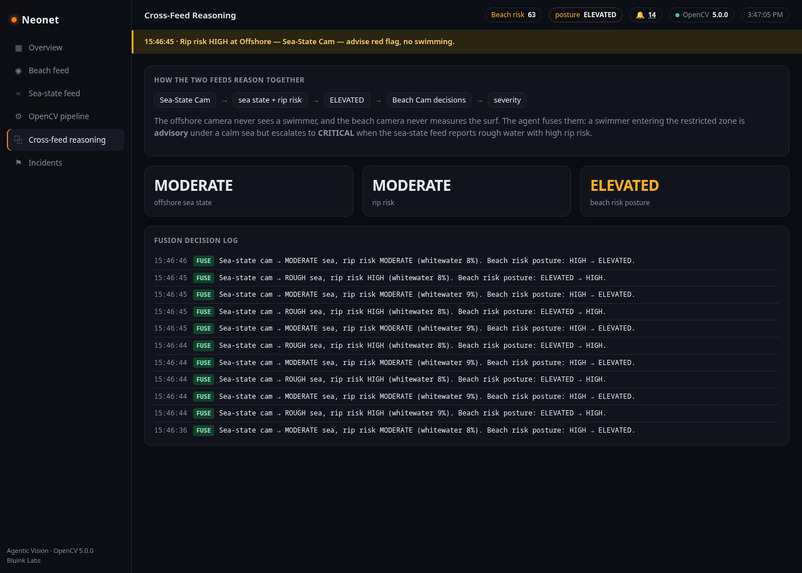
open cv pipeline
-
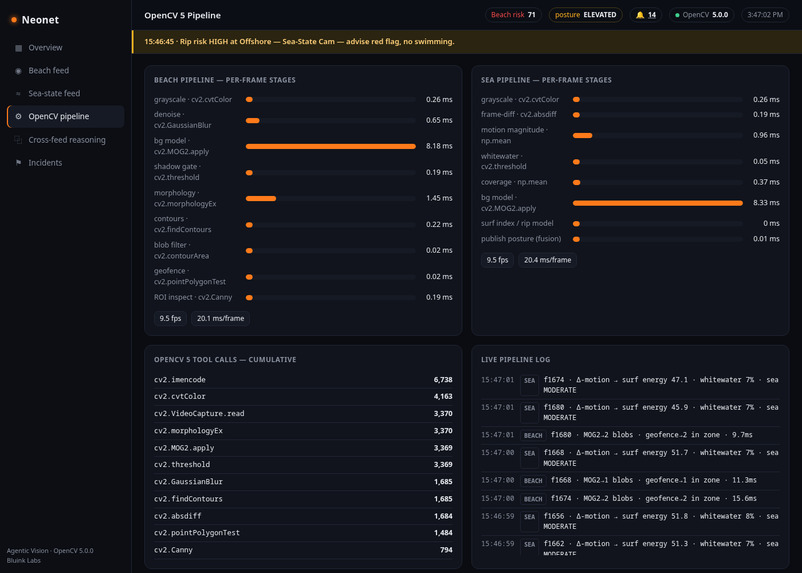
open cv5 utilization
-
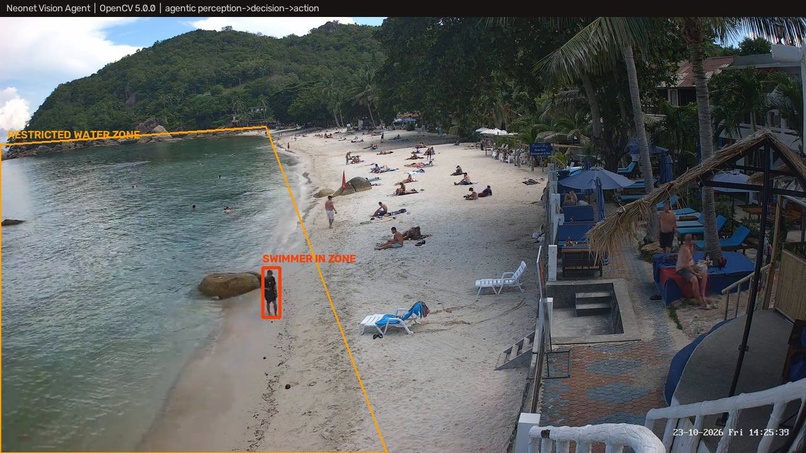
beach restriction
-
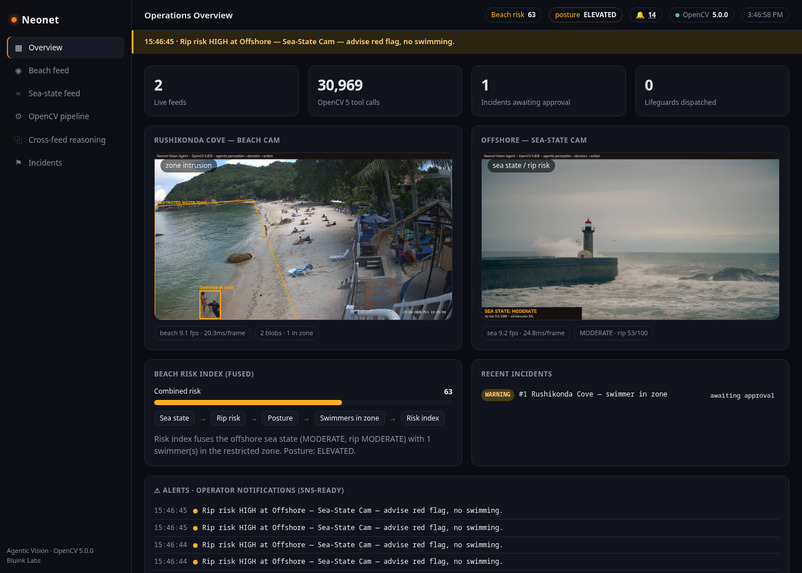
multifeed dashboard
Neonet Vision Agent
What it is
Neonet Vision Agent is an agentic coastal-safety system that turns ordinary beach CCTV into a continuous lifeguard. An autonomous agent watches two live camera feeds, reasons over what it sees using OpenCV 5 vision tools, fuses the two feeds into a single risk picture, and escalates confirmed hazards to a human operator for approval before any action is taken.
The agentic loop (perceive → decide → act → human)
Every tick, on each feed, the agent calls OpenCV 5 tools, and the visual result of one tool decides the next tool call and the next action:
- Perceive —
cv2.createBackgroundSubtractorMOG2+cv2.findContourssegment moving objects in the scene. - Geofence —
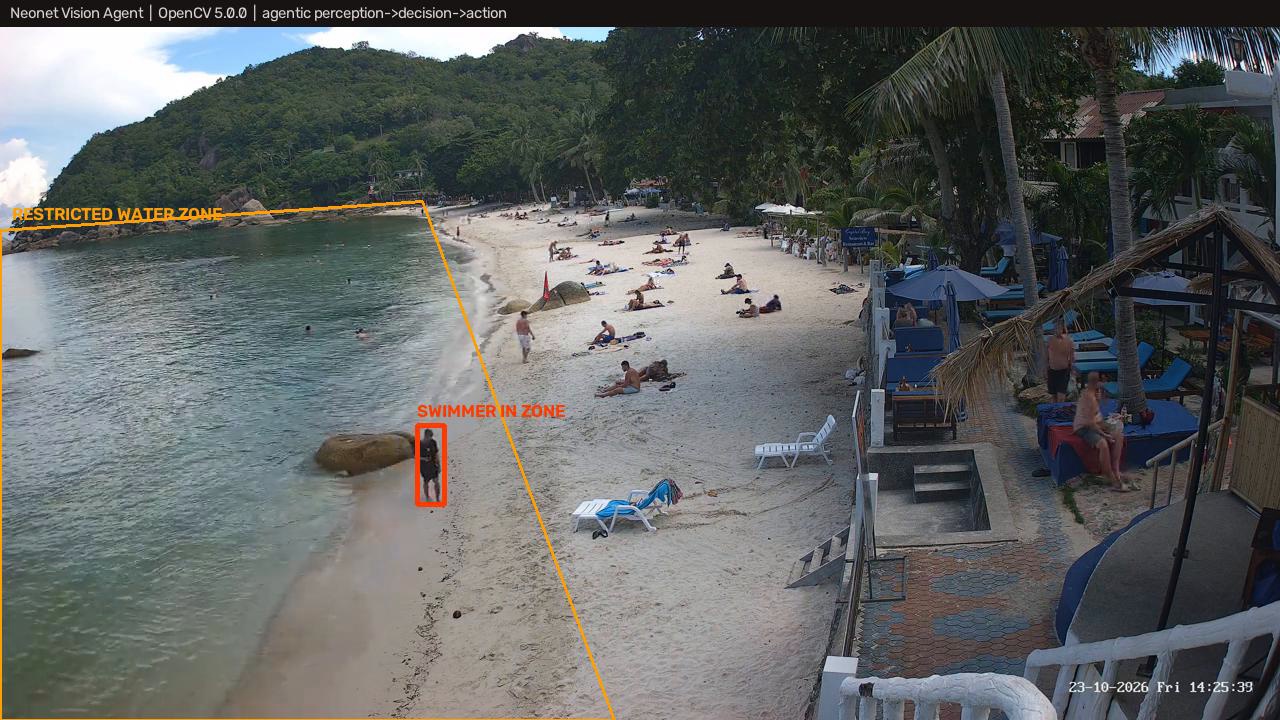
cv2.pointPolygonTestchecks whether a blob's foot point is inside the restricted water zone. - Inspect — a second look, triggered only when step 1–2 flag a blob:
cv2.Cannyon a cropped ROI confirms a real swimmer vs. surf glint. - Decide + act — above the confidence gate, the agent raises an incident and requests operator approval.
- Human-in-the-loop — the operator approves (dispatch a lifeguard) or dismisses (false alarm). The decision closes the loop.
Only confirmed detections produce actions; surf glint (small area / wrong aspect ratio) is rejected; a human is always in control before a dispatch.
Cross-feed reasoning (two feeds, fused)
- Feed A — Beach cam: geofenced water zone, swimmer-in-zone detection.
- Feed B — Offshore sea-state cam: surf energy from
cv2.absdiffframe-differencing + whitewatercv2.threshold→ sea state + rip-risk score.
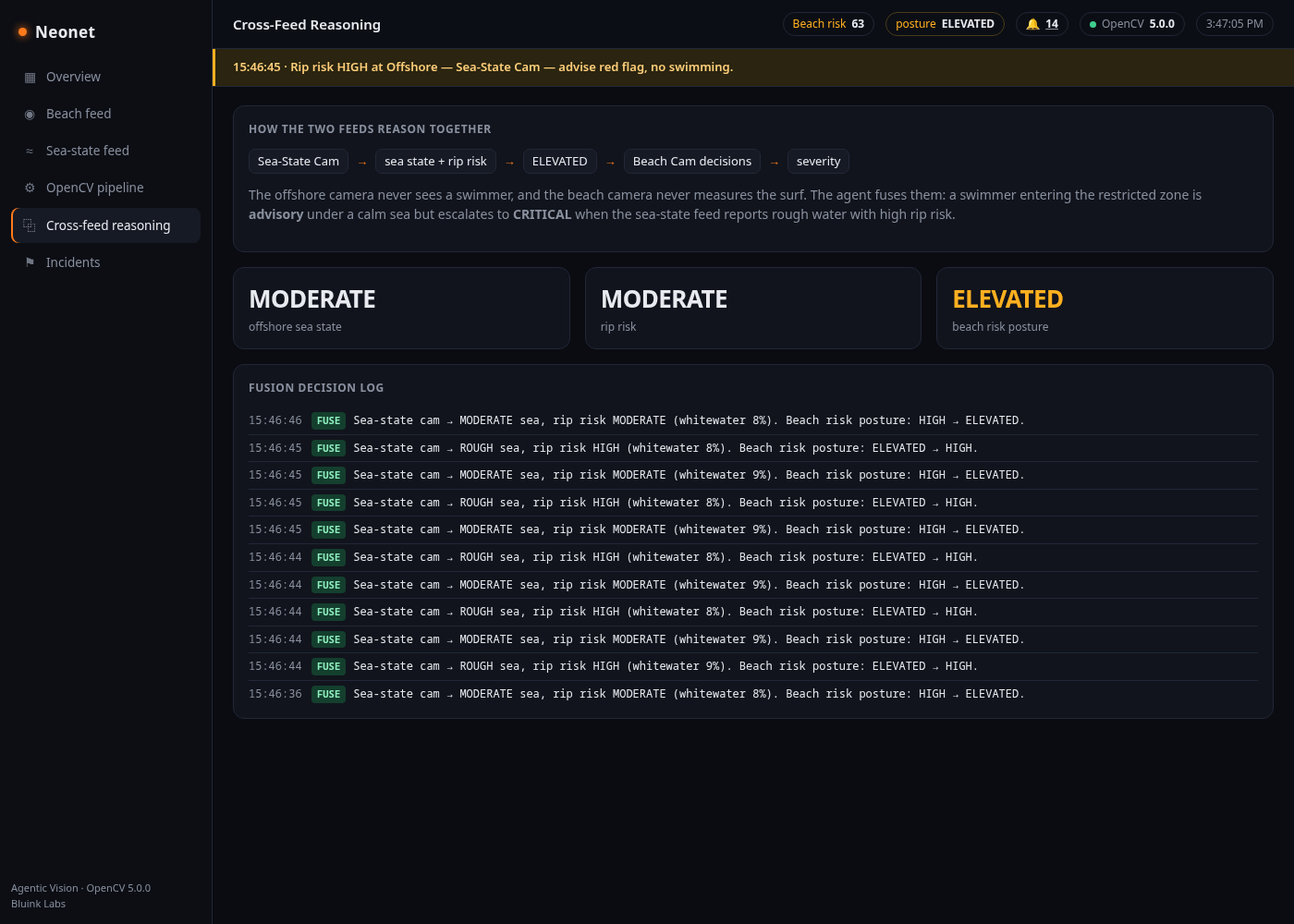
The offshore camera never sees a swimmer and the beach camera never measures the surf. The agent fuses them into a single risk posture: a swimmer entering the restricted zone is treated as advisory under a calm sea, but escalates to CRITICAL when the sea-state feed reports rough water with high rip risk. This is genuine multi-feed reasoning — one camera's visual state changes how the agent acts on another camera's events.
Where OpenCV 5 is used
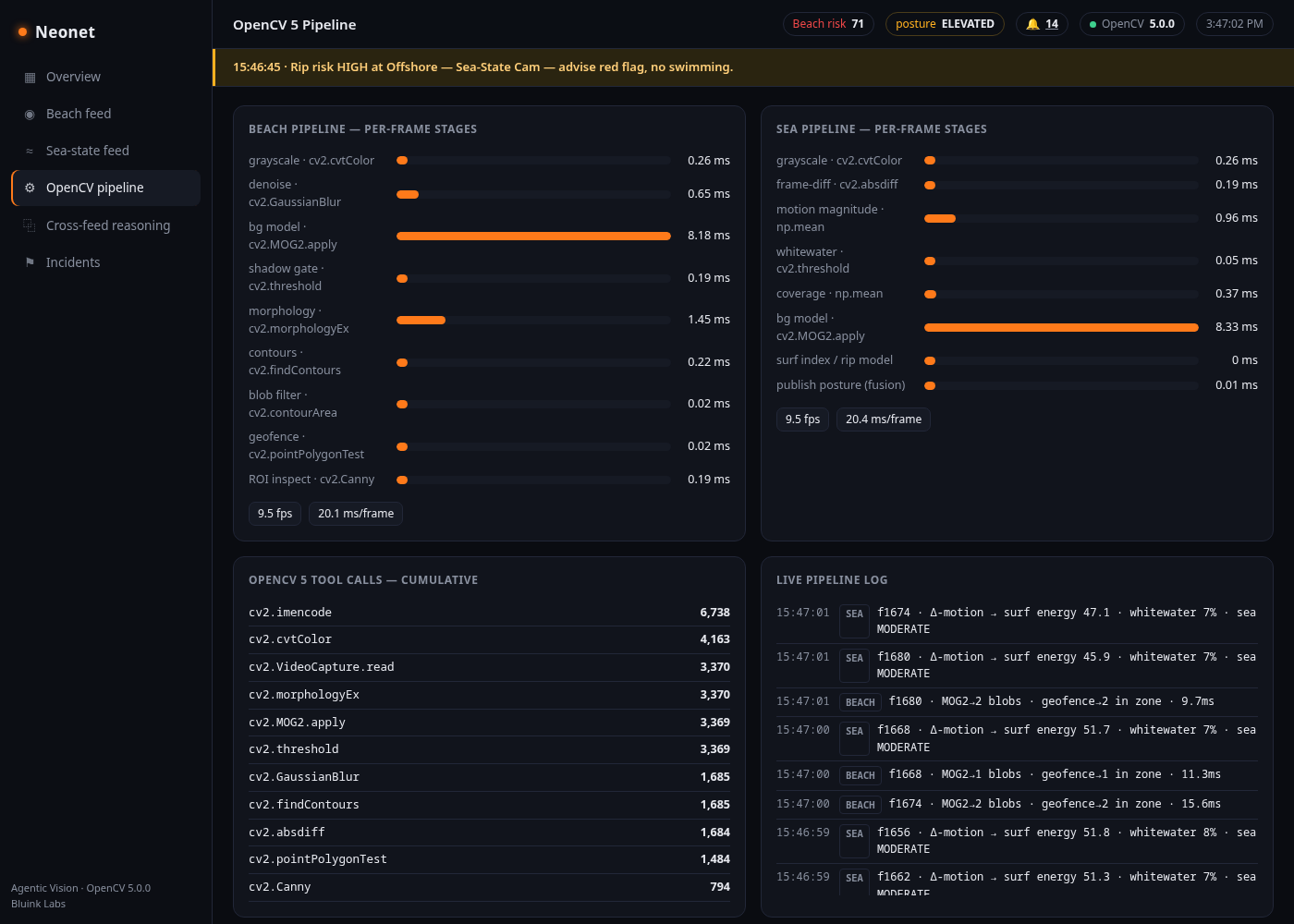
All substantive vision runs on OpenCV 5.0.0, surfaced live in the dashboard's OpenCV pipeline view:
cv2.VideoCapture · cv2.cvtColor · cv2.GaussianBlur ·
cv2.createBackgroundSubtractorMOG2 · cv2.threshold · cv2.morphologyEx ·
cv2.findContours · cv2.contourArea · cv2.boundingRect ·
cv2.pointPolygonTest · cv2.Canny · cv2.absdiff · cv2.imencode
Each stage is timed per frame and every call is counted, so you can watch OpenCV 5 doing the work in real time (tens of thousands of calls within the first minute).
AWS component
The service is a single CPU container, designed for AWS:
- Image → Amazon ECR.
- Compute → the container on EC2 (t3.large) or ECS/Fargate, operator console behind an Application Load Balancer.
- Alerts → the alert stream (rip-risk warnings, confirmed incidents, dispatch confirmations) is SNS-ready for operator/lifeguard notification.
- Audit → incidents and the agent's reasoning trace are emitted as JSON
(
/state) for S3 / CloudWatch.
Operator console
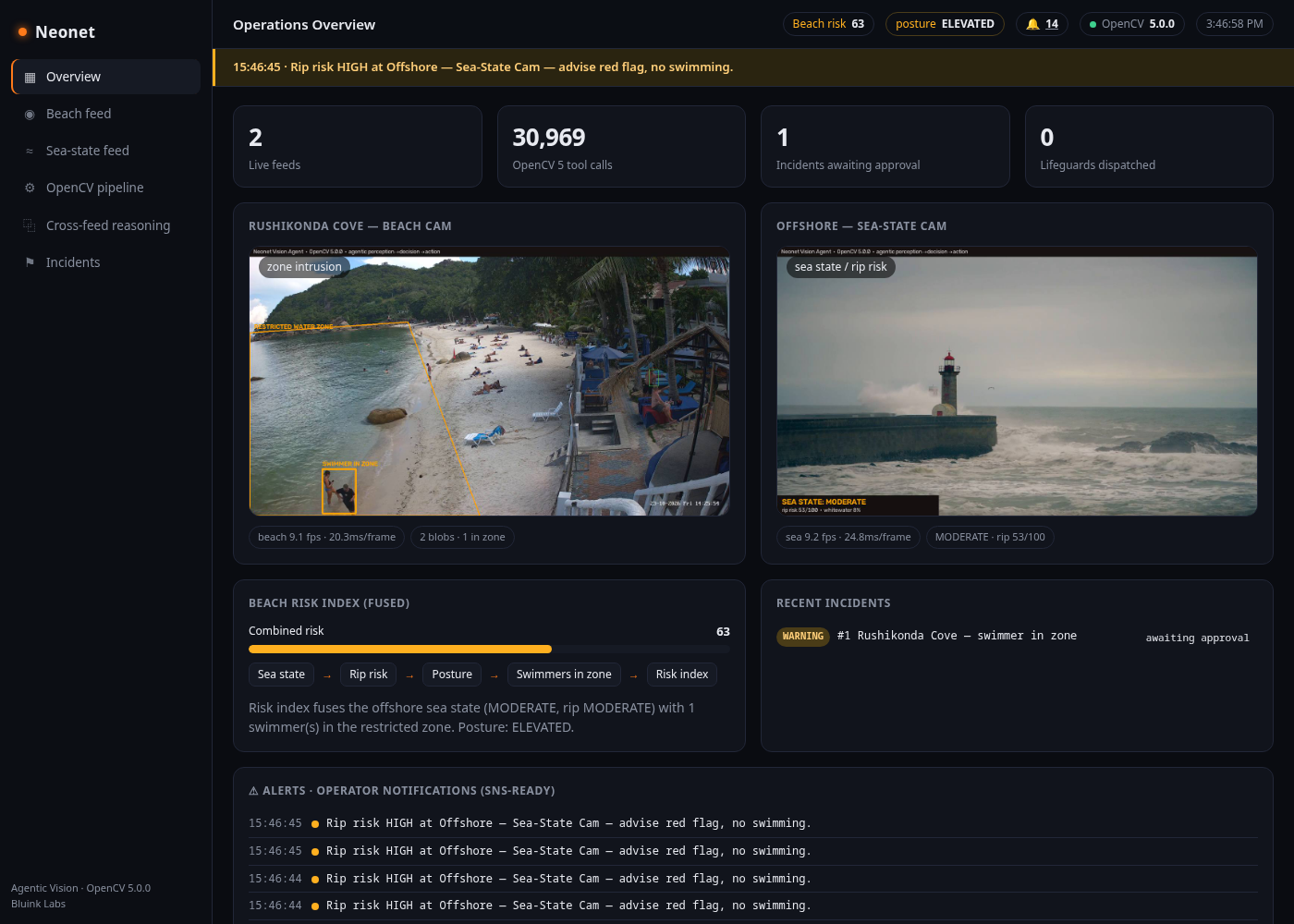
A single web app with six views: Overview, Beach feed, Sea-state feed, OpenCV pipeline, Cross-feed reasoning, and Incidents — live annotated video, the agent's reasoning trace, the OpenCV telemetry, an alert bar, and the human approve/dismiss controls.
Stack
Python · FastAPI · OpenCV 5 · NumPy · vanilla HTML/CSS/JS (no build step).
Runs with pip install -r requirements.txt && uvicorn app:app, or docker build.
See testing_instructions.txt.

Log in or sign up for Devpost to join the conversation.