-
-
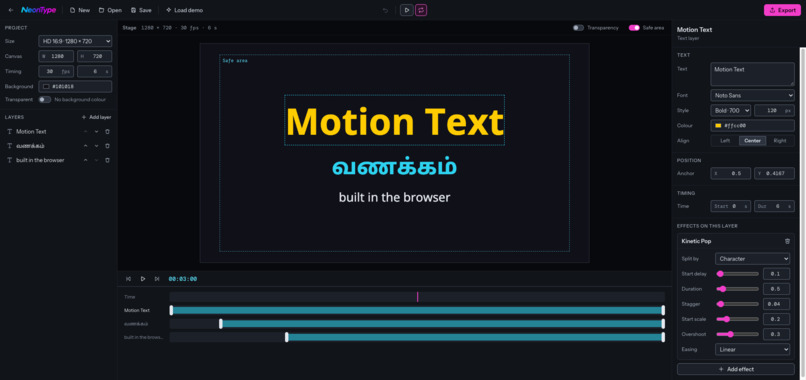
Studio Editor
-
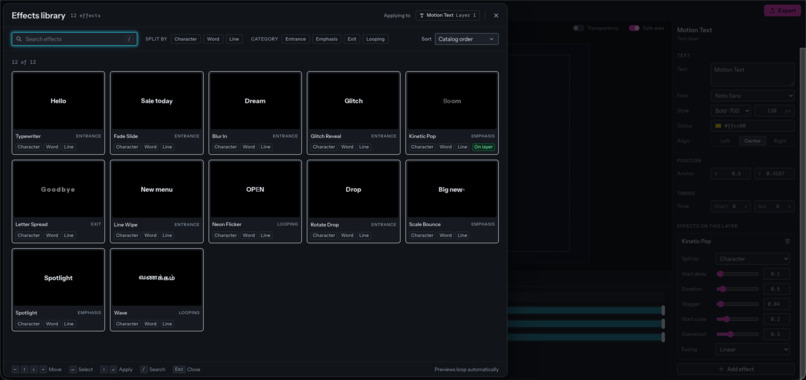
Effects Library
-
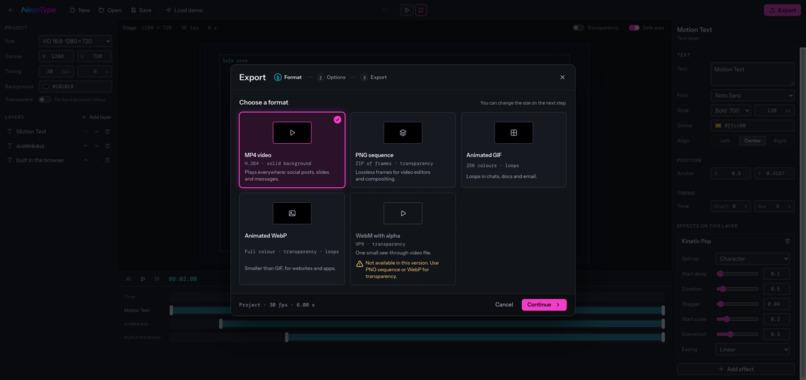
Export Flow
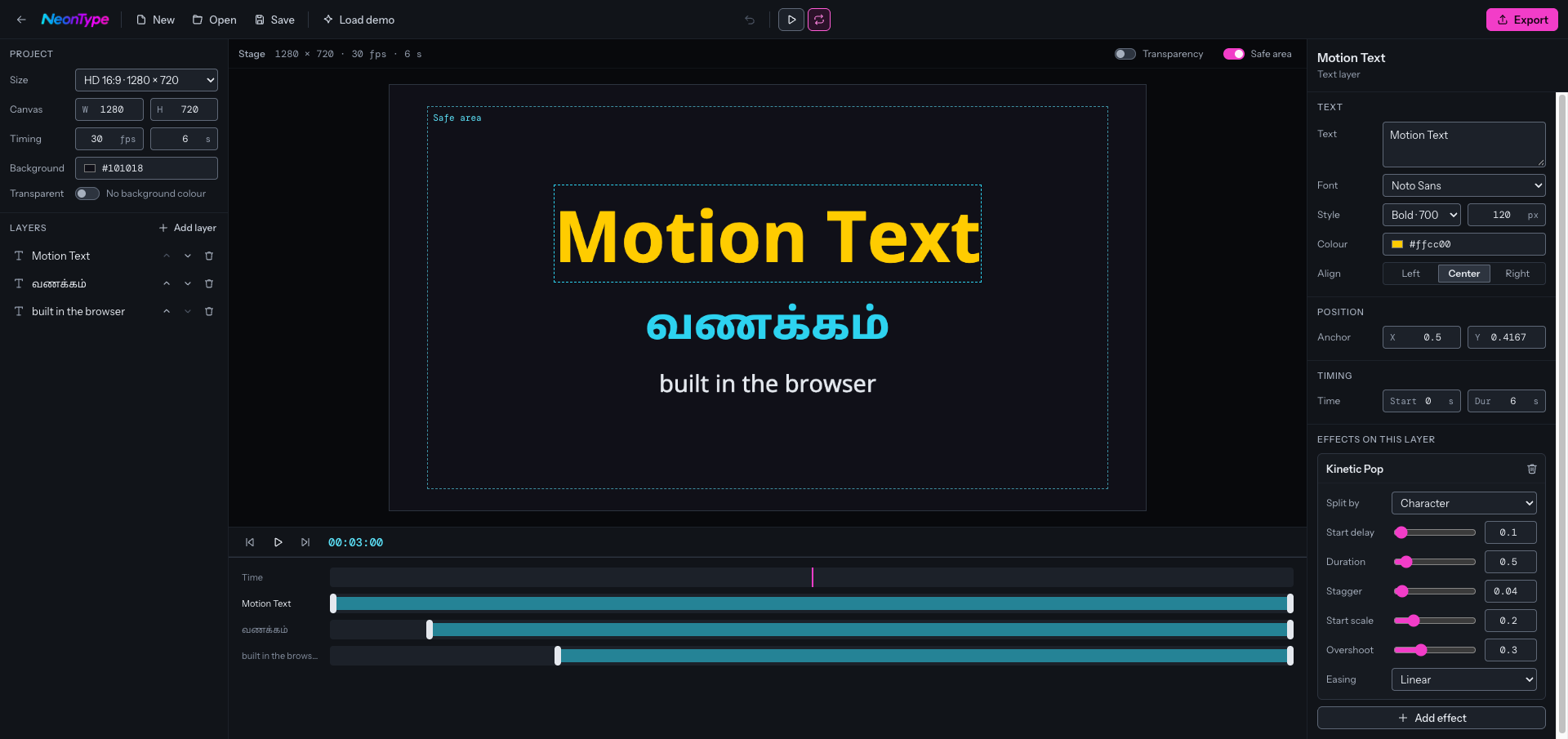
Inspiration
In the early 2000s, animated text on the web meant Flash-era authoring tools: type a word, pick an effect, watch it fly, bounce and glow. When Flash was switched off, those effects and the tools that made them went dark with it. Neon Type resurrects that kinetic typography for the modern web: no plugin, no backend, no account.
What it does
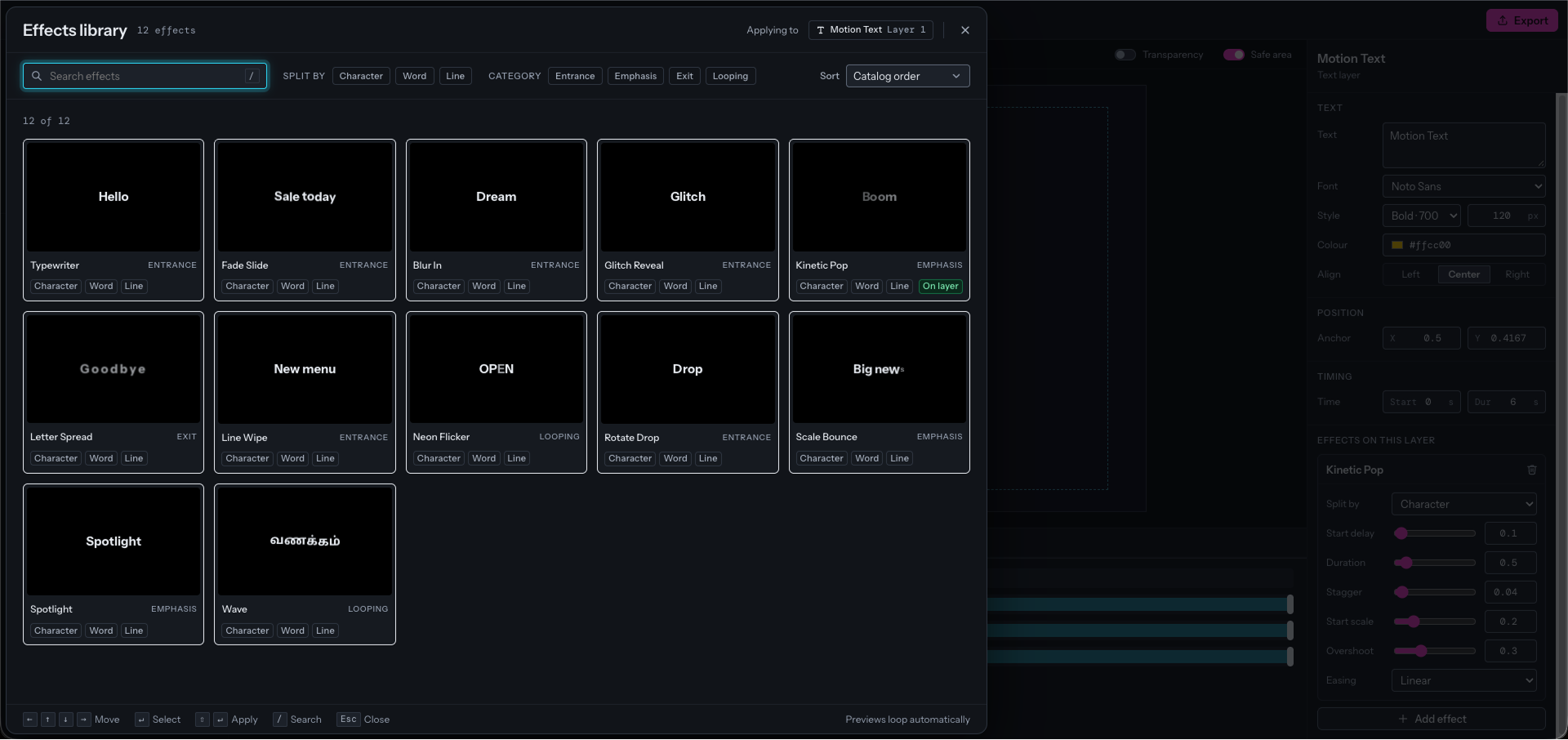
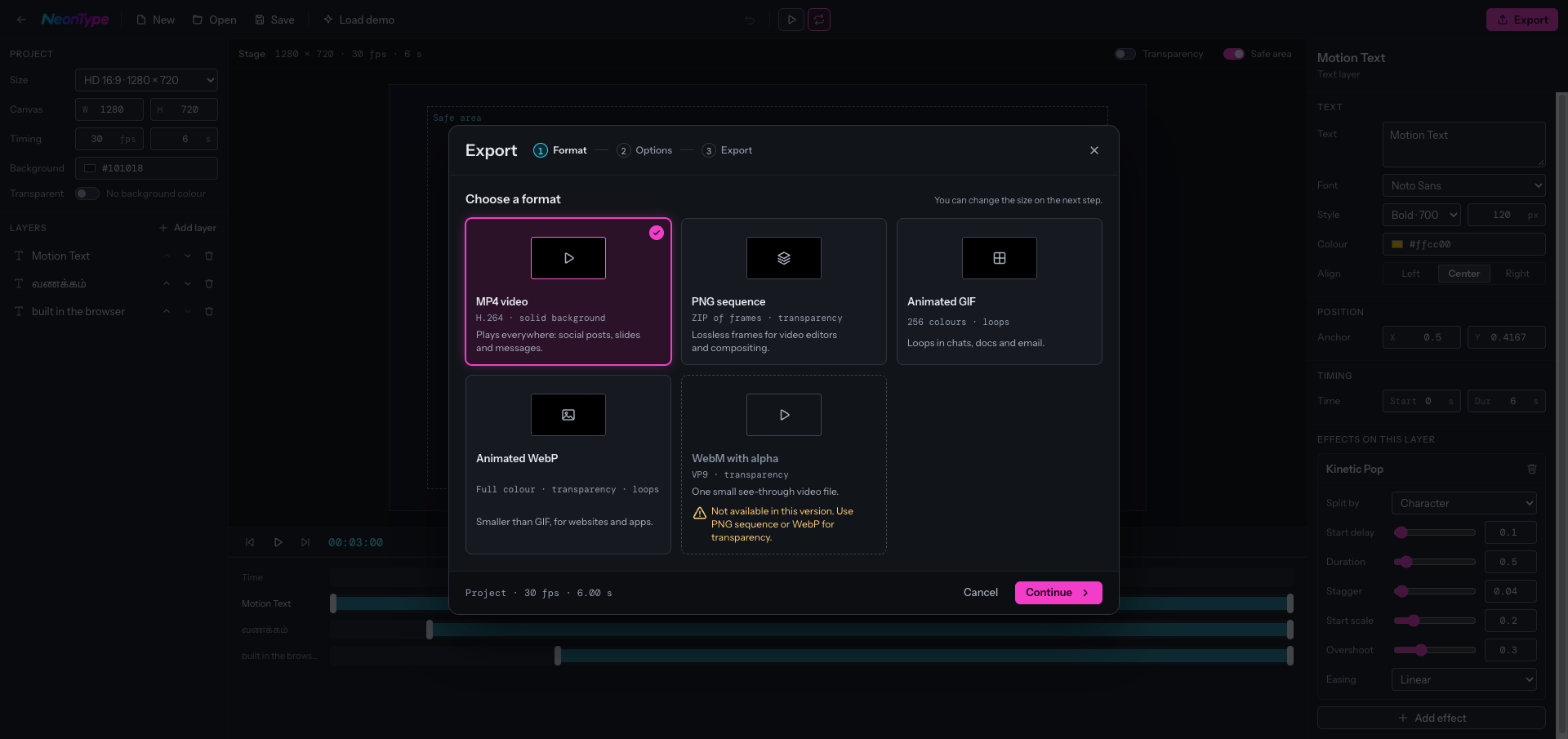
A browser-based motion-text studio. Add text layers (font, size, weight, colour, alignment, position, timing), apply any of 12 effects (typewriter, fade-slide, blur-in, glitch reveal, kinetic pop, letter spread, line wipe, neon flicker, rotate drop, scale bounce, spotlight, wave), preview it live, and export MP4, a PNG sequence or an animated GIF. Latin and Tamil text are supported, with the same animations applied to both. Projects save and open as validated JSON files. Everything runs on your machine; nothing is uploaded.
How we built it
Spec-driven with Kiro, in four specs: engine-core, effect-presets, exporters and studio (requirements, design and tasks each), plus steering docs and agent hooks, all in /.kiro.
- Engine: a pure, deterministic frame function (project and time in, frame state out) with a canvas painter. Lint rules ban
Math.random,Date.nowandperformance.nowin the engine, so the same project always produces the same frames. - Exporters: a WebCodecs MP4 pipeline with a worker bridge, PNG-sequence ZIP and GIF encoders, and a deterministic blur so exports match across browsers.
- Studio: React and Vite. The preview renders through the exact same path as the export, and a parity test checks it.
- Property-based testing (fast-check) guards the engine, effects and exporters. It caught real bugs, including a validator that rejected valid aspect ratios and an effect that broke at its completion boundary.
- Strict CSP in production: no inline scripts or styles, no eval.
Challenges
- Determinism across browsers. Native canvas blur differs between engines, so we built a deterministic blur and tested it against golden images.
- Fonts and workers. Canvas text measurement needs the real font loaded, and workers don't share the page's fonts. We found this through the parity tests and fixed it at the exporter level.
- A strict CSP with a dependency (Zod) that probes for
eval. We allowed that one named probe and nothing else. - Scope. WebM-with-alpha and animated WebP were cut after we found VP9 alpha unsupported in tested Chrome configurations.
Accomplishments
- A single frame function powers the preview and all three exports, with tested parity.
- Hundreds of automated tests (unit, property-based, Playwright and visual goldens).
- Tamil text supported alongside Latin.
What we learned
Writing the specs first and letting property tests argue with the code found problems much earlier than manual testing would have.
What's next
A timeline editor, audio, undo/redo, and a <motion-text> web component for embedding animations.
Built With
- client-zip
- fast-check
- gifenc
- html5
- kiro
- mp4-muxer
- playwright
- pnpm
- react
- typescript
- vercel
- vite
- vitest
- web-workers
- webcodecs
- zod
