-
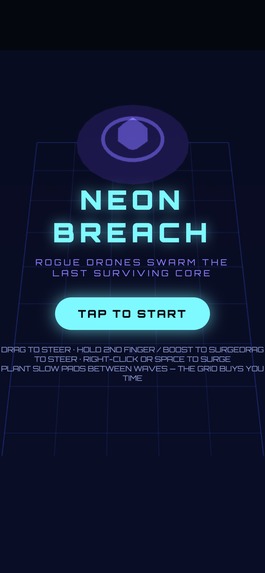
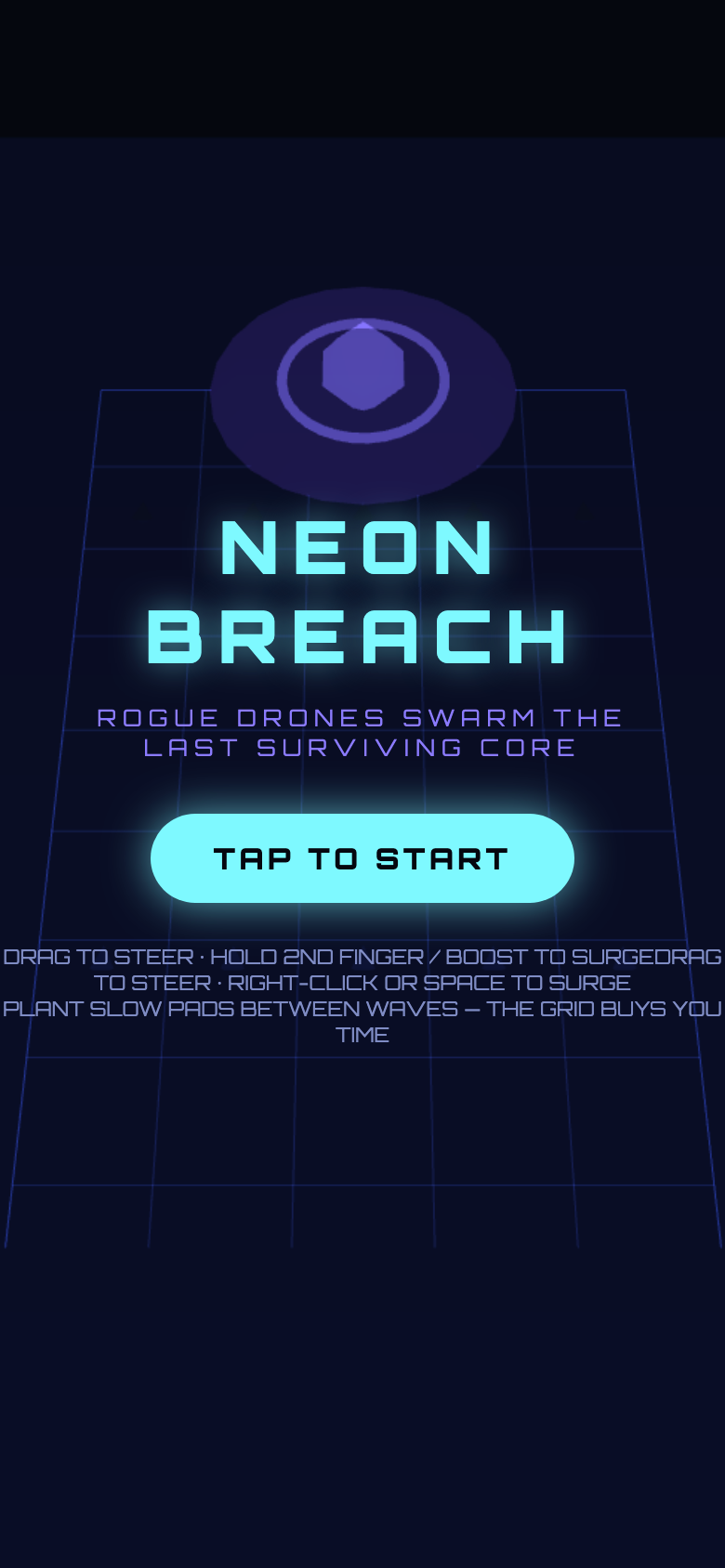
Title
-
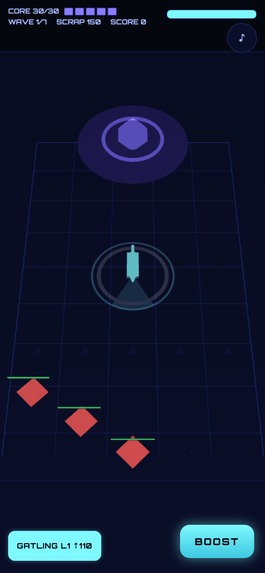
Gameplay
-
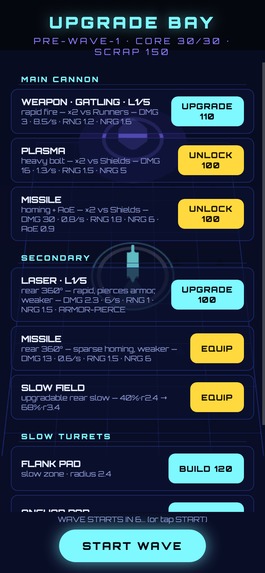
Shop
Inspiration
NEON BREACH was born from a simple question: What if you didn’t build towers, but instead WERE the tower?
Traditional Tower Defense games rely on passive placement along static paths. We wanted to fuse strategic field control with the dynamic mobility of an arcade shooter. The core concept centers around a player-controlled hoverboard that acts as a mobile weapon platform—allowing you to swap weapons and reposition your primary firepower on the fly, supported by stationary slow-field emplacements placed on fixed pads across the field.
What it does
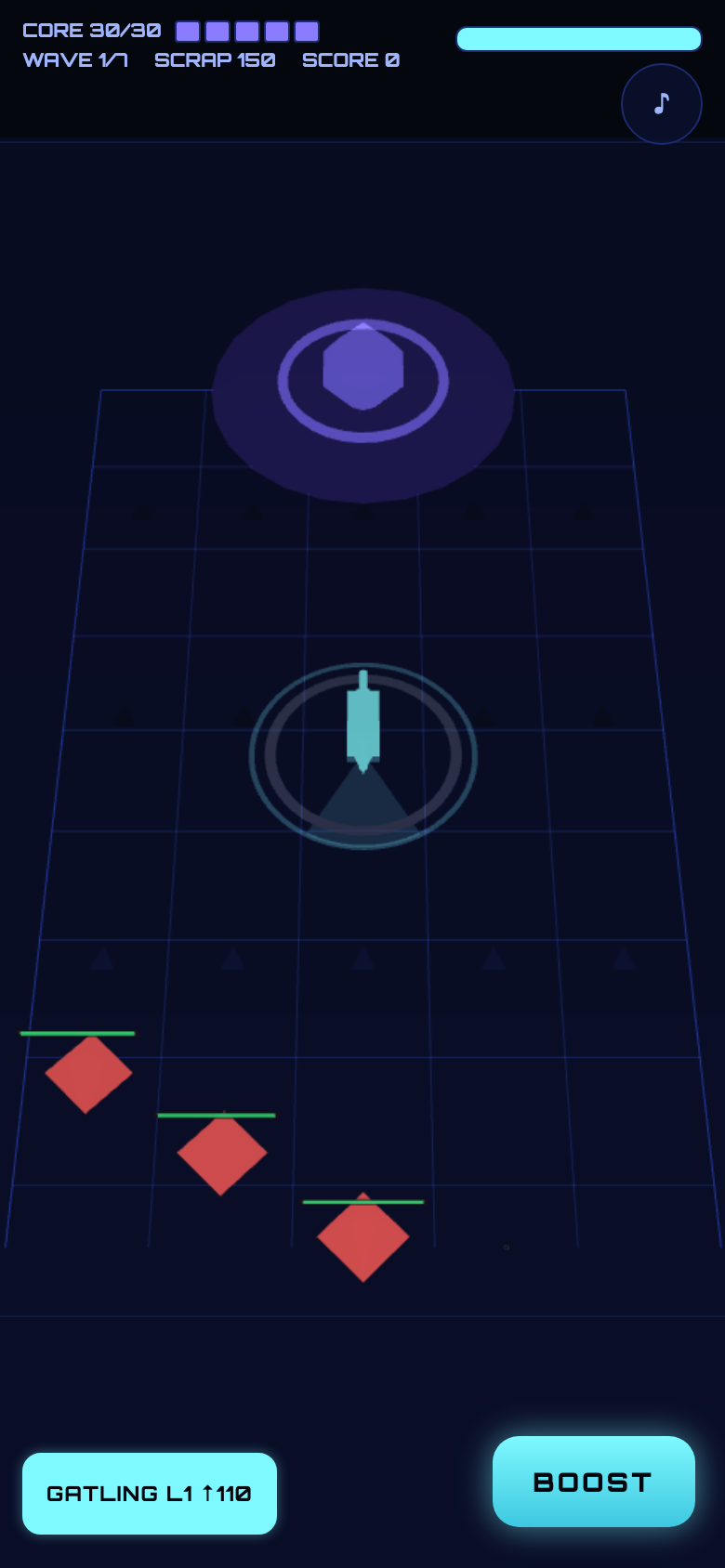
NEON BREACH is a mobile-first, single-player arcade Tower Defense hybrid where you control a high-speed hoverboard defending a central Core against drone waves across 5 narrow lanes.
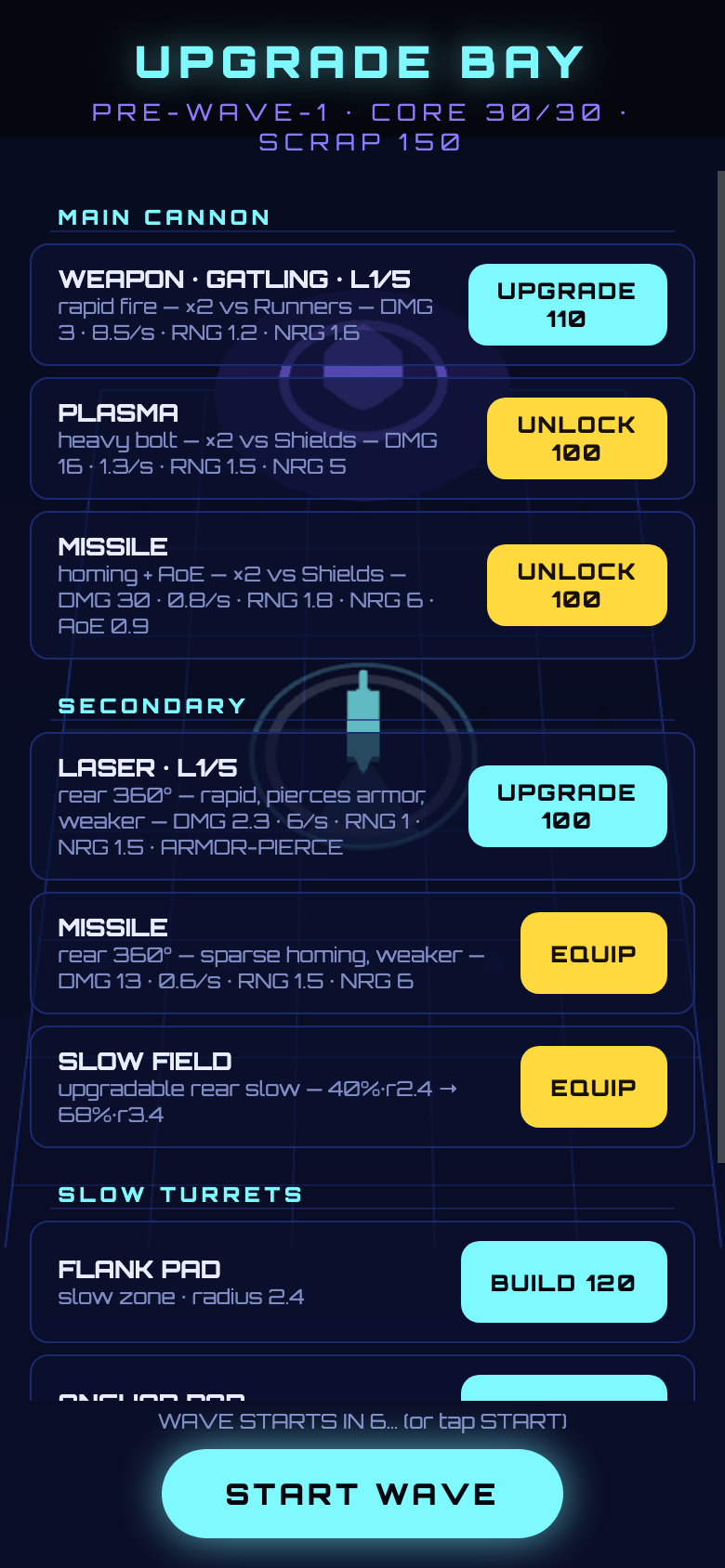
Active Positioning: The player deals the primary damage by steering the hoverboard directly into threatened lanes to fire front-directional weapons (Gatling, Plasma, Laser, Missile).
Support Emplacements: Between waves, players deploy fixed support pads that project localized slow-fields. These pads do not deal damage; they buy crucial transit time in lanes the player cannot immediately cover.
Coverage Triage: With 5 active lanes and only 1 player board, you can never be everywhere at once. In-canvas critical leak timers highlight which lane will breach next, forcing non-stop tactical decision-making.
How we built it
The project was engineered as a zero-dependency, single-file offline web app optimized for mobile portrait view.
- Tech Stack: HTML5, Three.js (r185), Vite, and procedural WebAudio (zero external audio files).
- Self-Contained Architecture: Bundled into a single unminified index.html file using esbuild, fully compliant with offline submission rules.
- Deterministic Wave Balance: To ensure wave scaling remains winnable without relying on random luck, wave damage budgets were calculated using a aggregate coverage model
Challenges we ran into
The biggest hurdle during development was bridging the gap between initial design concepts and actual playfeel.
Our initial prototype featured 3 wide highway lanes. On paper and in early renders, it looked sleek and high-octane. However, playtesting revealed a fatal flaw: it wasn’t fun. Because the field was wide and weapon ranges were too forgiving, positioning felt meaningless—you could park in the center lane and cover almost the entire field. World-unit scaling, target sizes, and camera tilt foreshortening did not align with the strategic tension we had envisioned.
Accomplishments that we're proud of
- Zero-Asset Audio Engine: Built a full procedural WebAudio synthesizer generating all sound effects and a dynamic 112 BPM synthwave music track on the fly.
- Responsive Performance: Achieved a rock-solid 60 FPS on mobile devices through pre-allocated object pooling and flat additive ground rendering instead of costly volumetric fog shaders.
- Successful Design Pivot: Turned a broken 3-lane prototype into a tight, strategic 5-lane coverage puzzle within strict hackathon constraints.
What we learned
- Kill Your Darlings Early: Recognizing that our initial 3-lane prototype failed the "fun test" forced us to execute a complete overhaul rather than polishing a flawed core.
- Implementation vs. Vision: Ideas documented in a specification often deviate drastically once rendered in interactive 3D space. Spatial constraints require real physical testing rather than theoretical planning.
What's next for Neon Breach
- Multi-Zone Maps: Introducing branching paths and environmental hazards.
- Chassis Upgrades: Unlockable hoverboards with distinct weapon slot layouts and battery profiles.
- Aerial Drones: Special flying enemy types that bypass ground slow-fields to force immediate player interception.
Built With
- deepseek
- opencode
- three.js
- webstorm
