-
-
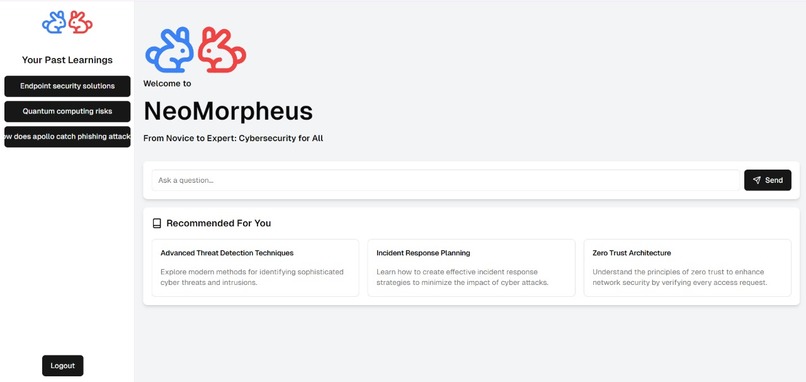
NeoMorpheus
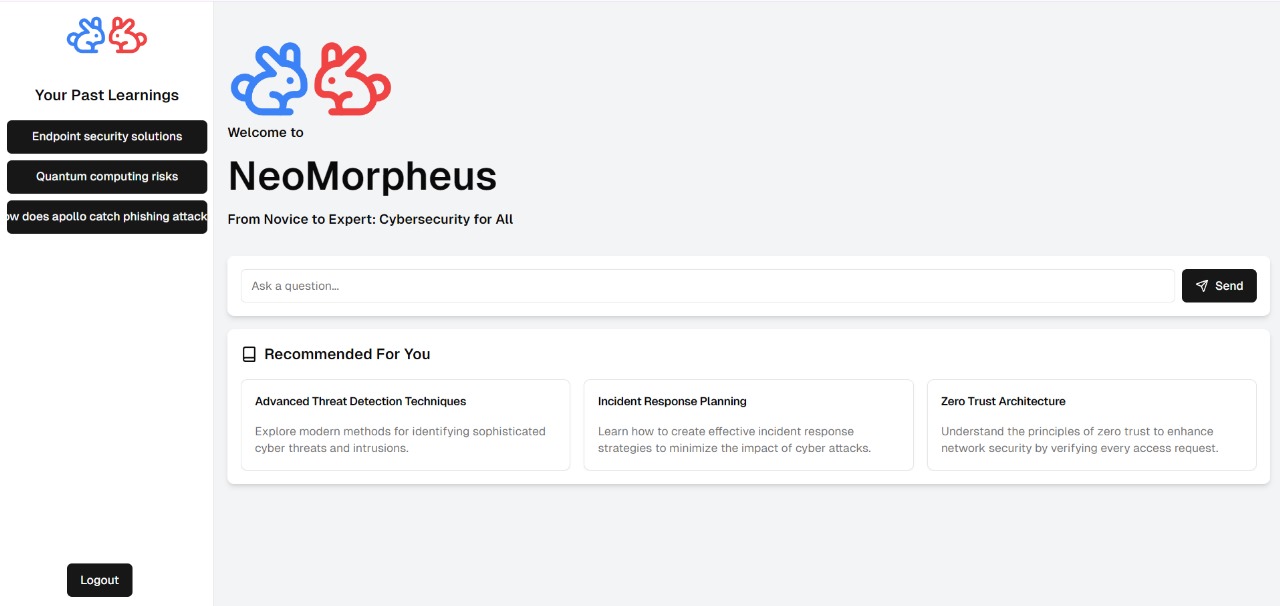
NeoMorpheus Project Overview
Inspiration
Everyone's lives nowadays are lived, at least in part, through the internet, and with the rise of cyber threats, educating the general public about cybersecurity has become more crucial than ever. For cybersecurity professionals, staying up-to-date with the latest research and trends is essential. NeoMorpheus is designed to cater to both audiences, providing engaging and user-friendly courses personalized to their needs.
The name NeoMorpheus draws inspiration from the world of The Matrix, specifically the character Morpheus, who serves as a guide to Neo. In our project, we aim to be a guiding force in the realm of cybersecurity education. The name also references White RabbitNeo, a model heavily utilized in our project for curating cybersecurity content. The exponential growth of Large Language Models (LLMs) has motivated us to create a platform that personalizes cybersecurity courses for users of all ages and expertise levels.
What it does
NeoMorpheus is designed to generate and personalize cybersecurity courses tailored to the needs of both the general public and cybersecurity professionals. For the general public, we provide engaging, user-friendly courses that raise awareness about cybersecurity. For professionals, we generate content from research papers, making complex topics more accessible and comprehensible.
How we built it
We leveraged a combination of cutting-edge generative AI technologies and methodologies. Our project utilizes LLM model chaining, taking advantage of:
- WhiteRabbitNeo for its specialized knowledge in cybersecurity.
- Kindo AI APIs to access various models, including GPT-4o and GPT-4o mini.
- Hugging Face Stable Diffusion models for image generation, where prompts are generated using GPT-4o mini.
- Retrieval-Augmented Generation (RAG) with LlamaIndex, allowing us to scrape and store research papers in a vector database, facilitating course curation based on user prompts.
To enhance interactivity, we generate quizzes and allow users to ask questions regarding the generated courses. We also address accessibility by providing narration for each slide in generated presentations.
Challenges we ran into
We faced several challenges during the development of NeoMorpheus:
- Prompt engineering: Fine-tuning prompts to suit the various models used in our project.
- Structured outputs: Ensuring consistent, structured outputs from different models.
- Model limitations: No single model excels at every task; for instance, GPT-4o is censored, while WhiteRabbitNeo is not, leading to a trade-off between reasoning and content control.
- Image generation issues: Encountering garbled text and unexpected outputs in generated images.
- High latency: Chaining multiple models resulted in increased latency, complicating real-time interactions.
- Resource limitations: Financial constraints limited our ability to run certain high-cost models like Hugging Face for image generation, leading to occasional errors.
Accomplishments that we're proud of
We take pride in several key achievements:
- Successfully combining multiple AI models to leverage their strengths in a cohesive product.
- Utilizing diverse technologies such as Retrieval-Augmented Generation and complex function simulation to create an all-in-one platform that generates real-time courses, interactive quizzes, and chat functionalities.
- Developing a functional frontend within a limited timeframe, showcasing the capabilities of our application.
- Implementing a course history feature in the database, allowing users to easily access their course history during the hackathon.
What we learned
Throughout this project, we gained invaluable insights:
- Expanded our understanding of the vast possibilities offered by generative AI models.
- Learned how to effectively chain models together to capitalize on their strengths.
- Discovered new tools, like Kindo AI, which enhance our capabilities.
- Gained experience with the ups and downs associated with generative models.
- Familiarized ourselves with frameworks such as LlamaIndex.
What's next for NeoMorpheus
Looking ahead, we have ambitious plans for NeoMorpheus:
- Initially, we considered creating custom JavaScript-based games using LLMs but chose to focus on a quiz feature due to time constraints.
- Our vision includes generating tailored tracks for each user course, with various formats such as detailed articles or presentations.
- We aim to produce video content featuring narrators and dynamic illustrations based on the prompts generated.
- Our plans also involve generating a wider variety of images, including technical or scientific illustrations related to the courses.
- Users will have the ability to delve deeper into topics of interest and access more personalized content.
- We intend to maintain a history of courses taken by users, including common mistakes and interests.
- Lastly, we envision the possibility of monetizing the general public's cybersecurity course creator as a SaaS offering through a subscription model.


Log in or sign up for Devpost to join the conversation.