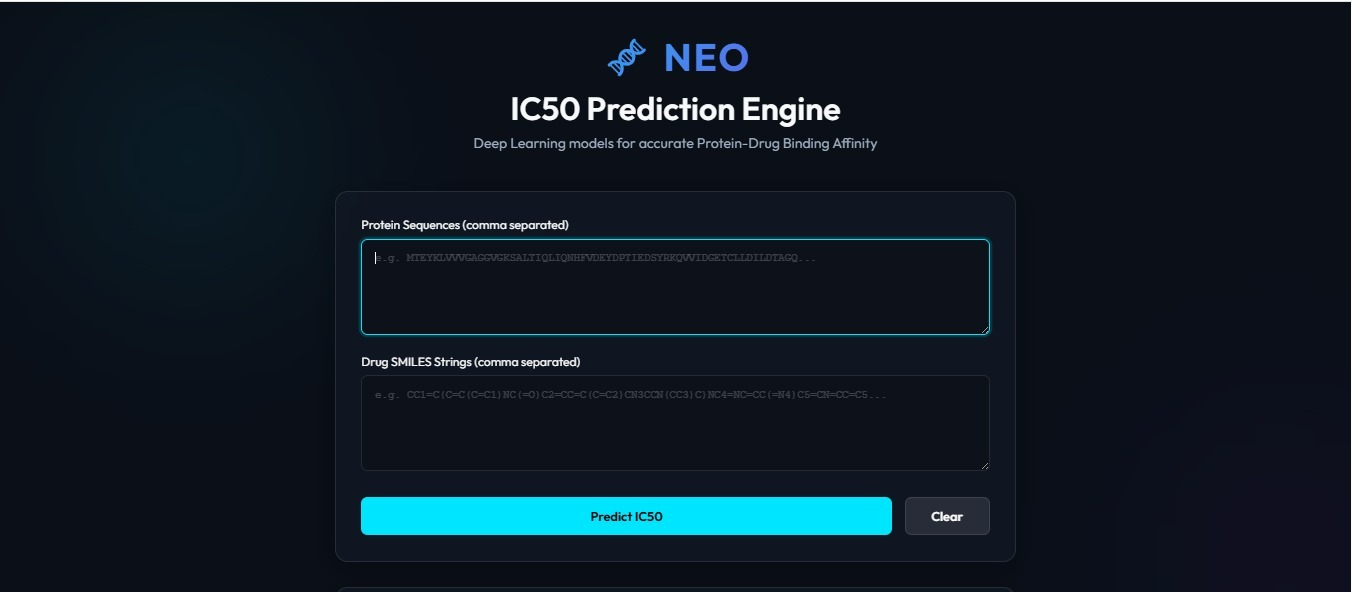
the document 123NEO_Hackathon_Pitch(3).pptx, here is an analysis of the project categorized by the typical hackathon submission criteria: Inspiration
The Efficiency Gap: The team was inspired by the fact that drug discovery is currently "broken," costing an average of $2.6 billion and taking 15 years to bring a single drug to market.

Untapped Potential: They recognized that millions of promising molecules are never discovered simply because physical testing is too slow and expensive for researchers to feasibly test every drug-protein pair.

The Power of Prediction: The core inspiration was the question: "What if we could predict how effective a drug is... in under a second — without stepping into a lab?".
What it does
Instant IC50 Prediction: NEO is a web-based AI platform that predicts the Half Maximal Inhibitory Concentration (IC50)—the gold standard for measuring drug potency—instantly via a browser.

Virtual Screening: It allows researchers to perform computational screening of millions of drug candidates at near-zero cost compared to $500–$5,000 per lab assay.

Drug Repurposing: The tool is designed to screen existing FDA-approved drugs against new targets, potentially finding new treatments for diseases like COVID-19 or cancer in hours.
How we built it
Deep Learning Architecture: The core is a 4-layer Fully Connected Neural Network (FCNN) built with PyTorch, featuring Batch Normalization, ReLU activation, and Dropout layers.

Dual-Model Strategy: To ensure robustness, the team implemented both a Deep Learning model and a Random Forest baseline, with the system auto-selecting the best model at runtime based on Mean Squared Error (MSE).

Full-Stack Development: The backend was built using Flask and Flask-CORS, while the frontend utilizes HTML5 and Vanilla CSS for a responsive dark-mode UI.

Data Pipeline: They trained the models on a dataset of 30,000 drug-protein pairs sourced from BindingDB, UniProt, and RefSeq, encoding them into a 3072-dimensional feature vector.
Challenges we ran into
Modeling Biological Complexity: The team noted that capturing non-linear biological relationships is difficult, which is why the FCNN was chosen to outperform simpler models like Random Forest.

Data Limitations: They identified that current encoding uses simplified character-level features and acknowledged that IC50 values are condition-dependent, varying based on cell types and assay methods.

Scalability: Ensuring the platform could scale to millions of compounds required GPU acceleration via CUDA to prevent hardware bottlenecks.
Accomplishments that we're proud of
End-to-End Integration: They successfully built a fully integrated pipeline that moves from a raw amino acid sequence to a web result with no manual steps.

High Performance: Their FCNN model consistently outperformed the Random Forest baseline on complex biological data.

Accessibility: They moved beyond a simple Jupyter notebook to create a live web app that provides "democratized access" to any researcher worldwide with a browser.
What we learned
Metric Selection: The team learned that IC50 is more effective for modeling than other metrics like Ki or Kd because it has a tighter statistical distribution in databases like BindingDB.

Model Robustness: They discovered that an ensemble-style approach—comparing a Deep Learning model against a traditional ML baseline—is more robust than relying on a single model.
What's next for NEO
Advanced Encoding: They plan to swap current encoding methods for ESM-2 (Meta’s protein Large Language Model) and RDKit molecular fingerprinting for higher accuracy.

Expanded Predictions: The roadmap includes adding ADMET prediction to assess drug toxicity, absorption, distribution, metabolism, and excretion.

Global Deployment: They aim to deploy the platform on HuggingFace Spaces to reach a wider global audience.

Log in or sign up for Devpost to join the conversation.