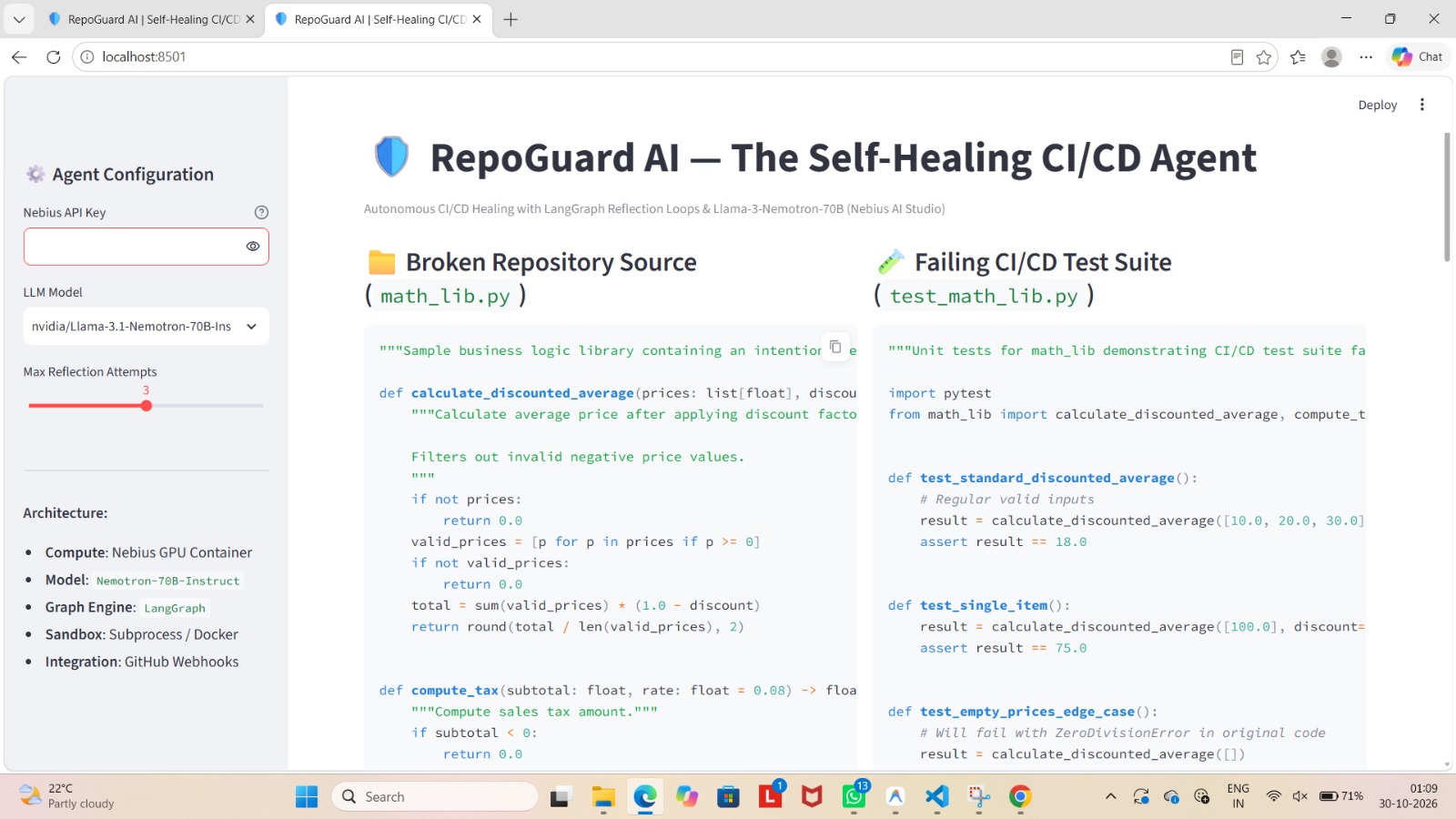
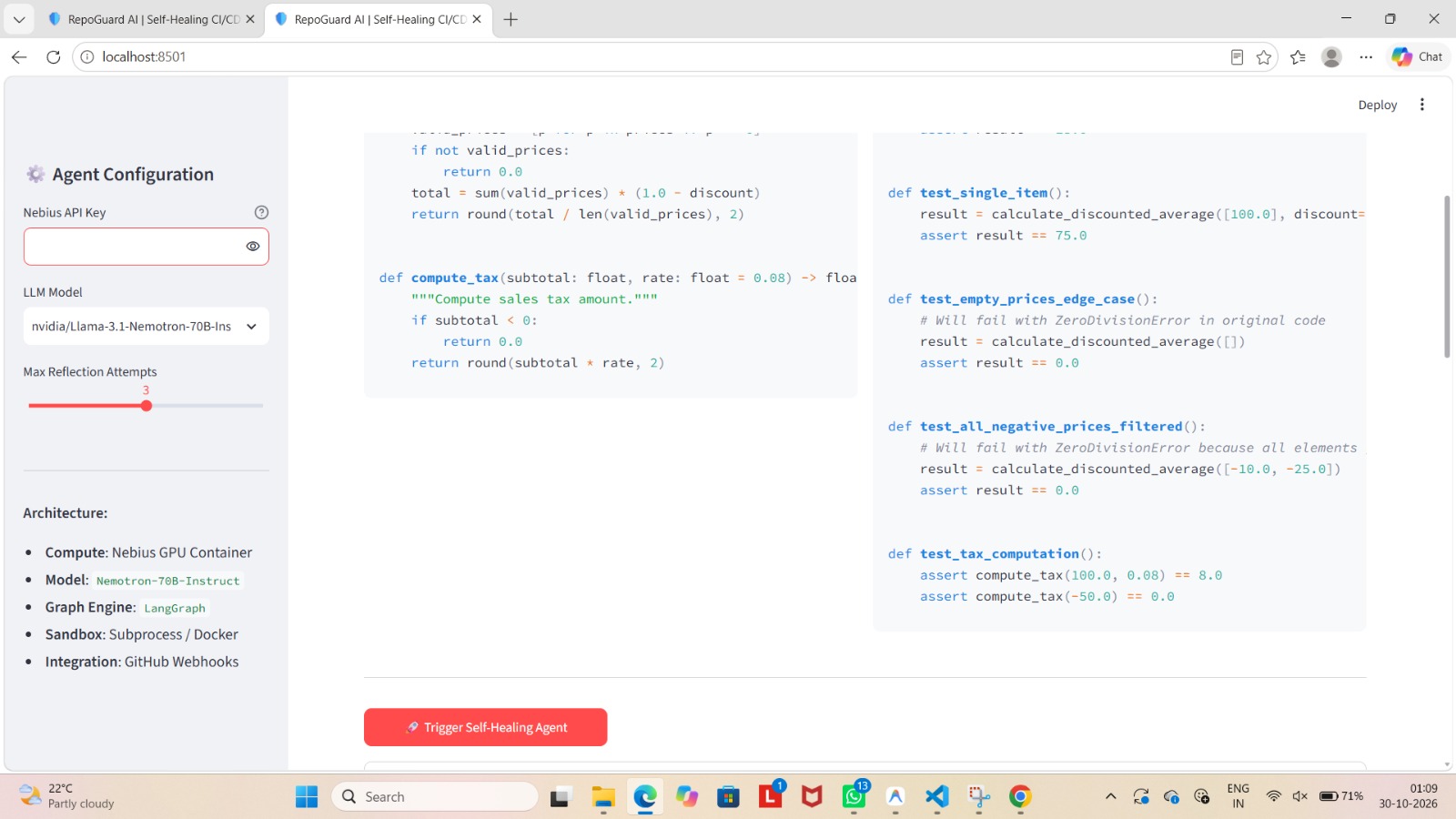
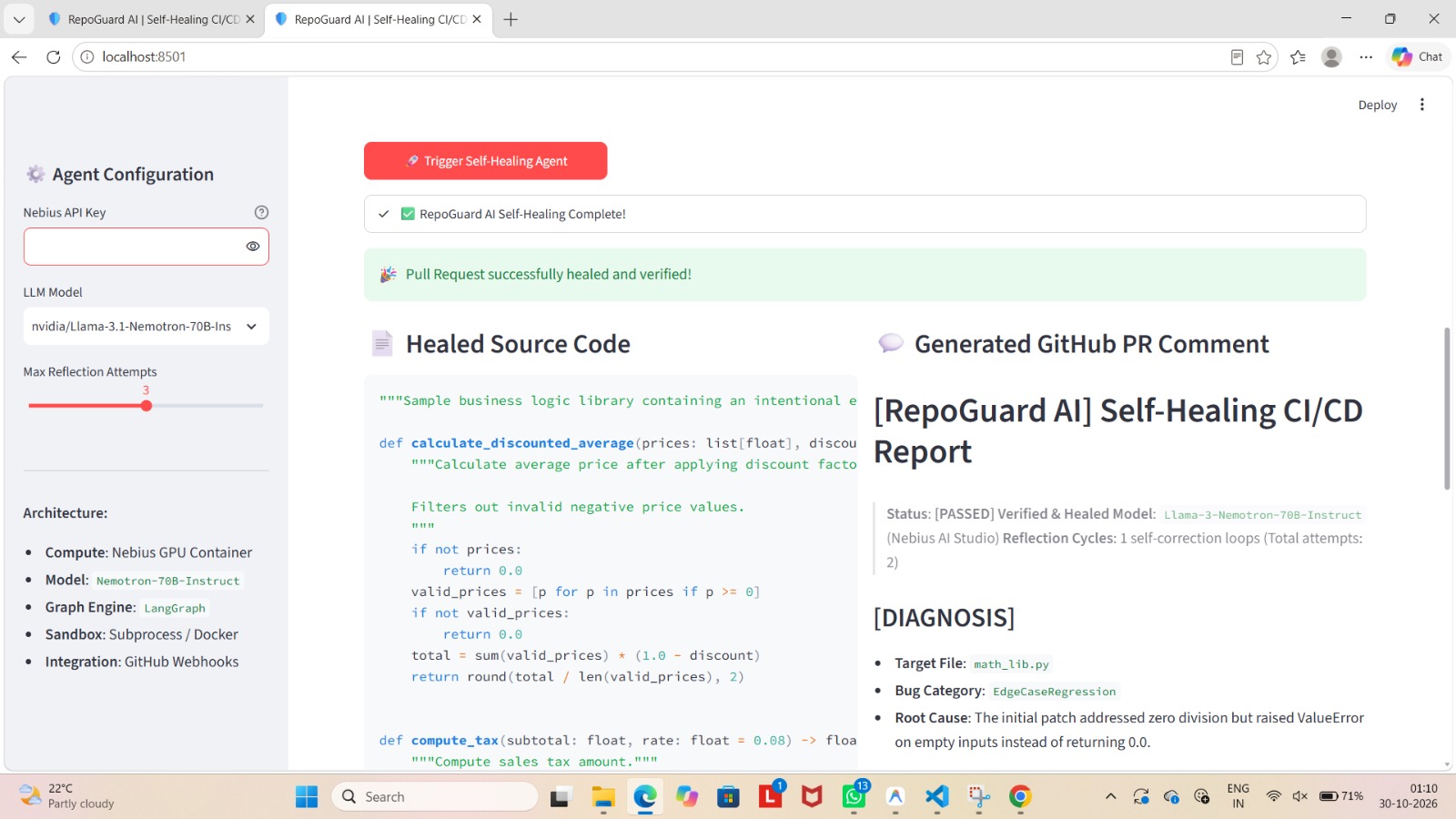
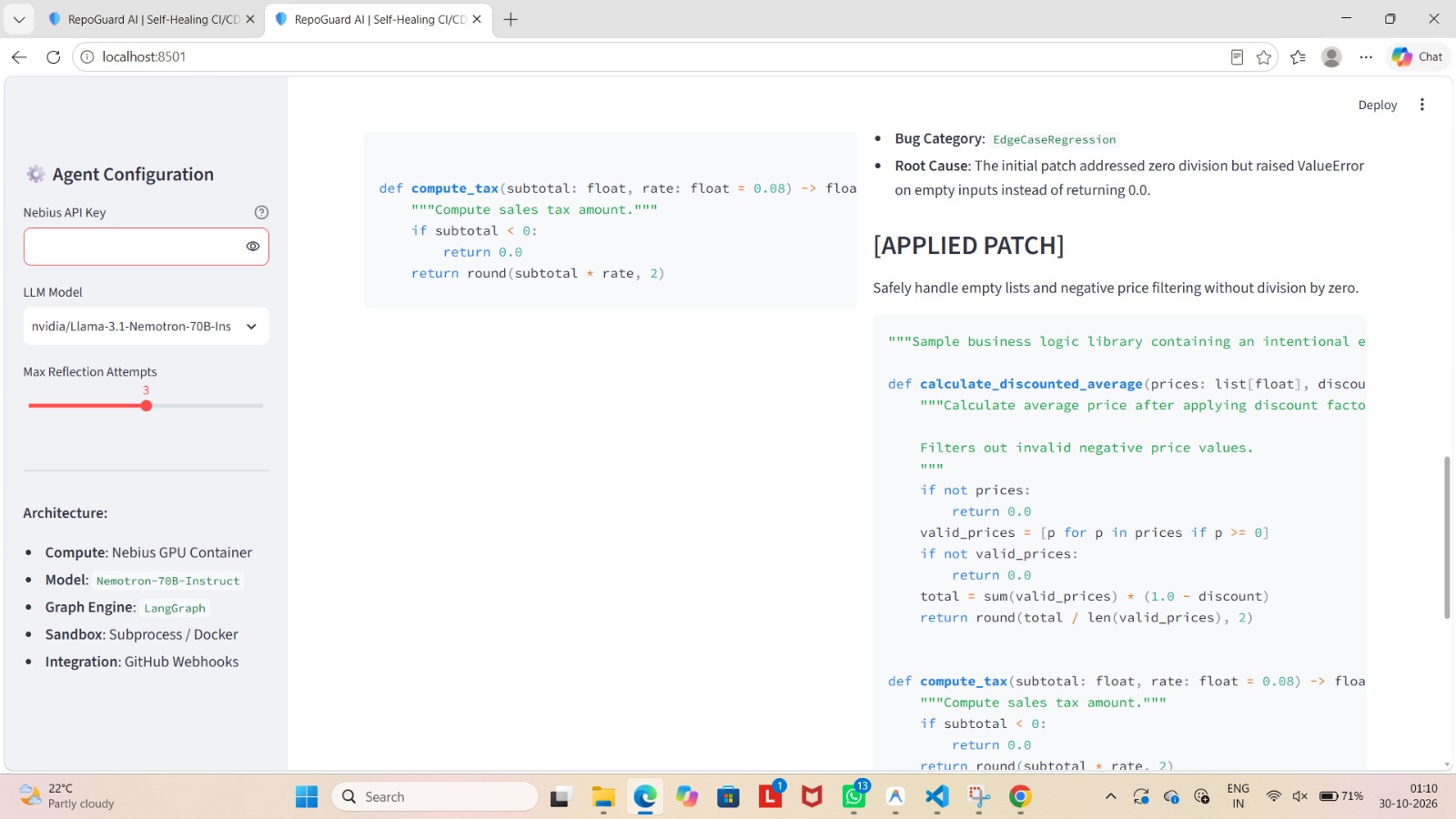
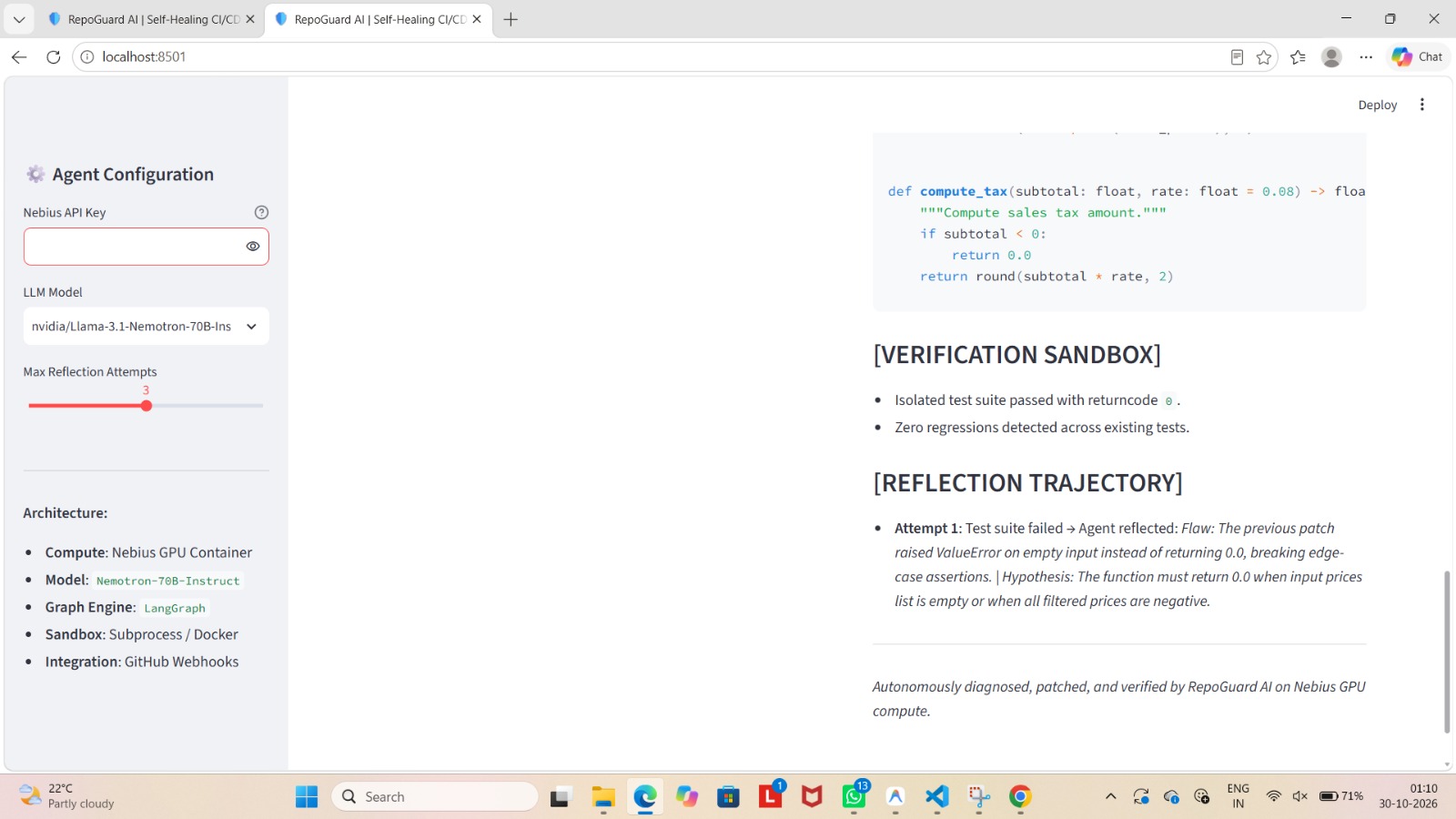
Inspiration CI/CD failures are one of the most frustrating bottlenecks in software development. A single broken test or lint error can block a pull request, forcing developers to context-switch, check logs, write a fix, commit, and wait all over again. We wanted to eliminate this friction entirely by building an autonomous agent that catches test failures, diagnoses the root cause, generates a verified patch, and pushes the fix back to GitHub without human intervention. What it does RepoGuard AI is an autonomous, self-healing CI/CD agent designed to monitor, detect, and fix code repository failures automatically.
Webhook Integration: Listens to GitHub webhook events (such as workflow or test failures) via a dedicated webhook server.
Sandboxed Execution: Safely runs and verifies tests inside an isolated sandbox environment (repoguard/sandbox/runner.py).
Autonomous Agent Loop (LangGraph): Uses a specialized multi-node state graph (repoguard/agent/graph.py) comprising:
Diagnostic Node: Analyzes error logs and stack traces.
Patcher Node: Generates code patches using LLMs (powered by Nebius AI clients).
Verifier Node: Re-runs tests in the sandbox to validate the fix. Reflection & Committer Nodes: Refines failed attempts and commits/pushes the successful fix back to the repository.
Dashboard & CLI: Includes a built-in Streamlit/Dash web dashboard (repoguard/dashboard/app.py) and a command-line interface (repoguard/cli.py) to monitor agent activity and manage autonomous runs.
How we built it
We structured RepoGuard AI as a robust Python package with a clean modular architecture:
Core Agent Logic: Built using state-driven agent workflows (repoguard/agent/) with custom prompt engineering (repoguard/agent/prompts.py) to guide the LLM through diagnosis, patching, and verification steps.
LLM Integration: Integrated high-performance models via nebius_client.py to handle intelligent code refactoring and error explanation.
Environment & Safety: Utilized Docker and isolated execution runners to ensure safe code modification and testing.
Integrations: Connected GitHub APIs and webhook servers (repoguard/integrations/) to seamlessly bridge repository events with the agent workflow.
Challenges we ran into
Handling Complex Failures: Ensuring the LLM didn't just write syntactic patches, but understood semantic test logic, required iterative prompt tuning and a robust Reflection node loop.
Sandbox Security & Isolation: Safely executing arbitrary test suites in a controlled environment required careful process management and containerization via Docker.
State Management: Managing multi-step asynchronous workflows between webhook triggers, diagnostic analysis, patching, and git commits required a clean state schema (repoguard/agent/state.py).
Accomplishments that we're proud of
Successfully building an end-to-end self-healing loop that goes from CI failure notification $\rightarrow$ automated diagnosis $\rightarrow$ patch generation $\rightarrow$ sandbox verification $\rightarrow$ git push without human touch.
Designing a clean, modular architecture that separates concerns between CLI tools, dashboard monitoring, LLM clients, and sandboxed runners.
What we learned Autonomous software engineering agents require rigorous verification steps (like our Verifier Node) to prevent hallucinated or incomplete code fixes from breaking repositories further. Structured state graphs (using LangGraph paradigms) make managing complex, multi-turn agent decision paths much more predictable and maintainable.
What's next for RepoGuard AI Expanding support for more CI/CD providers beyond GitHub Actions (e.g., GitLab CI, Bitbucket Pipelines). Adding multi-file repository refactoring capabilities for broader architectural bug fixes. Enhancing the real-time web dashboard with deeper analytics on common failure patterns and agent success rates.


Log in or sign up for Devpost to join the conversation.