-
-
LOGO
-
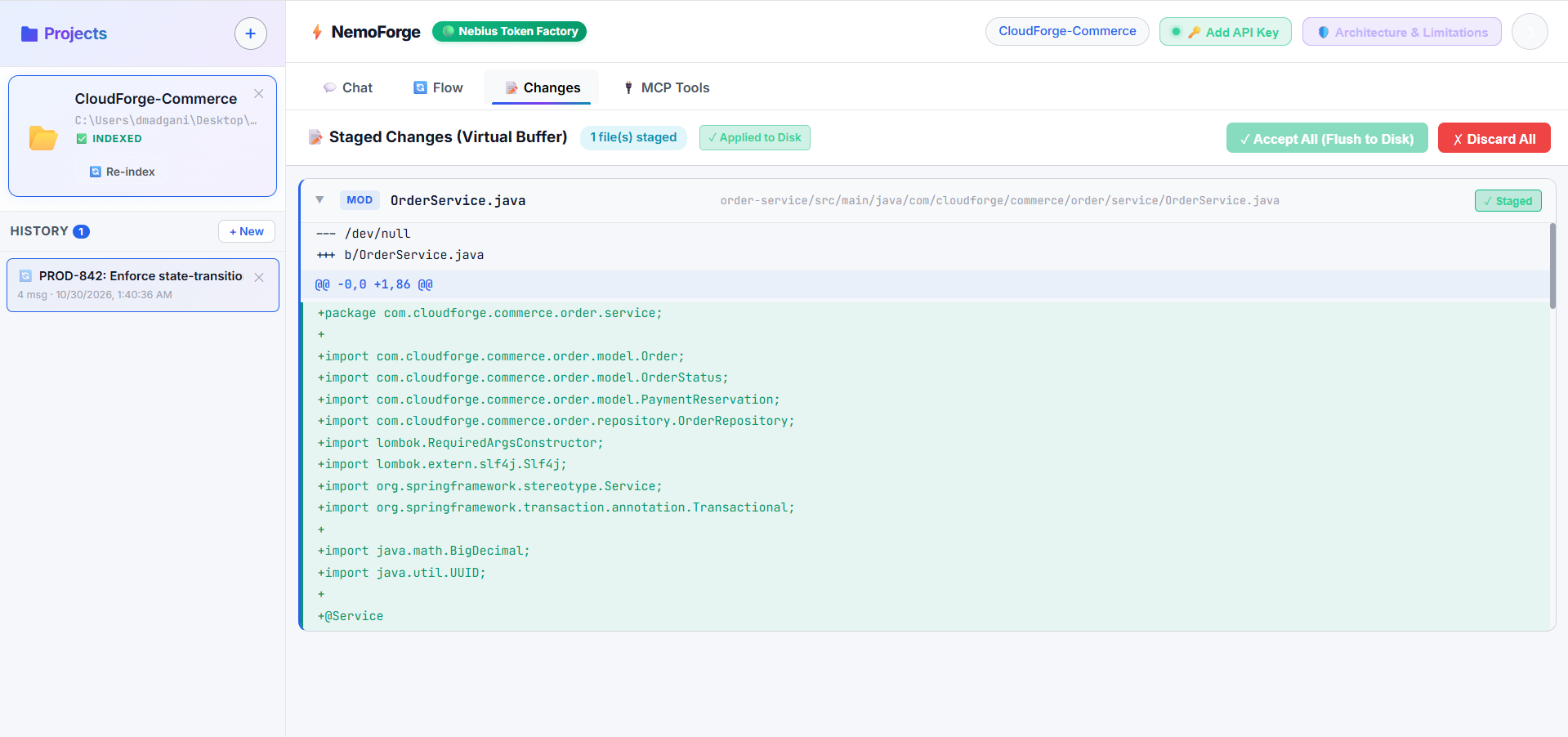
Diff changes
-
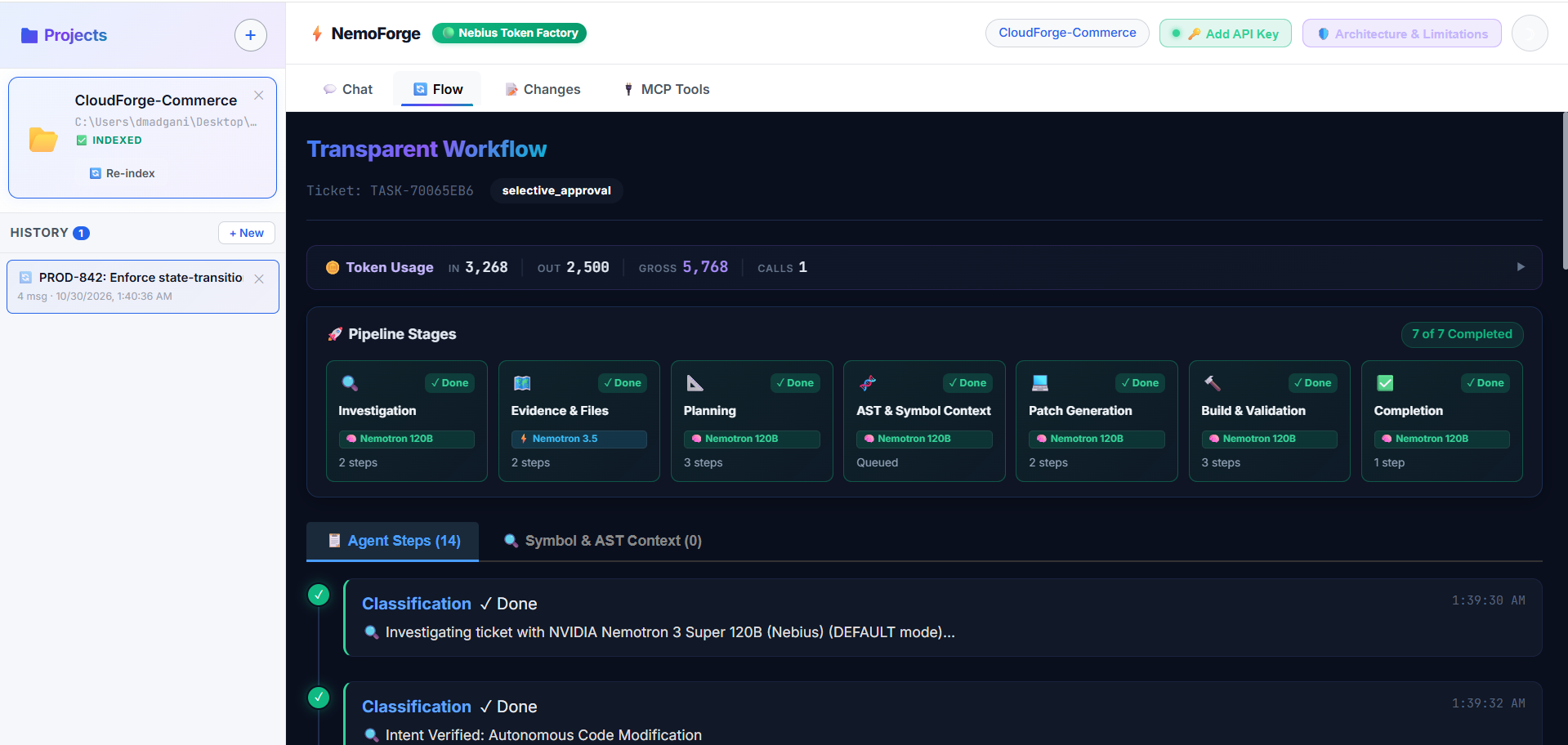
Flow tab
-
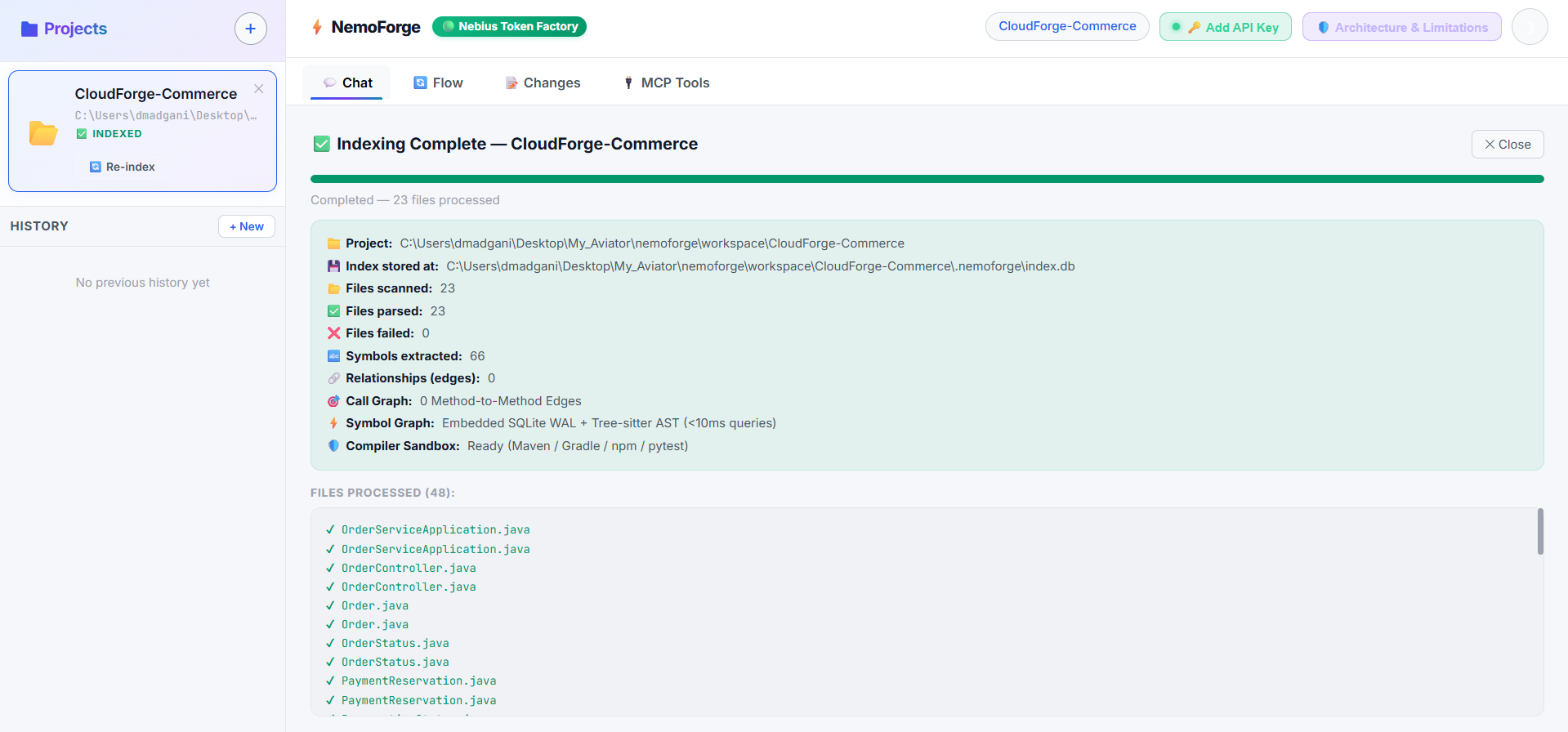
Indexed
-
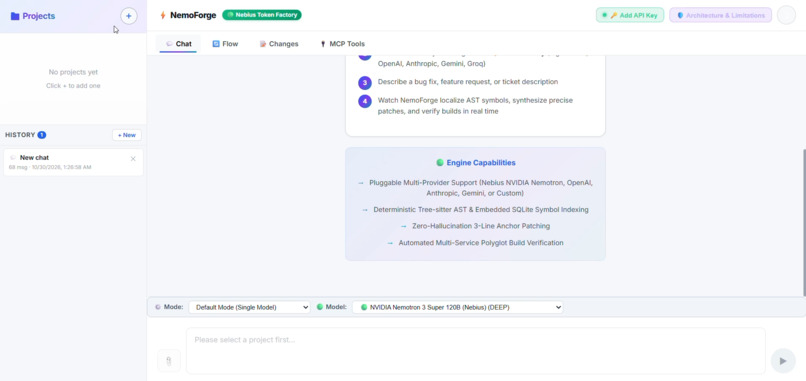
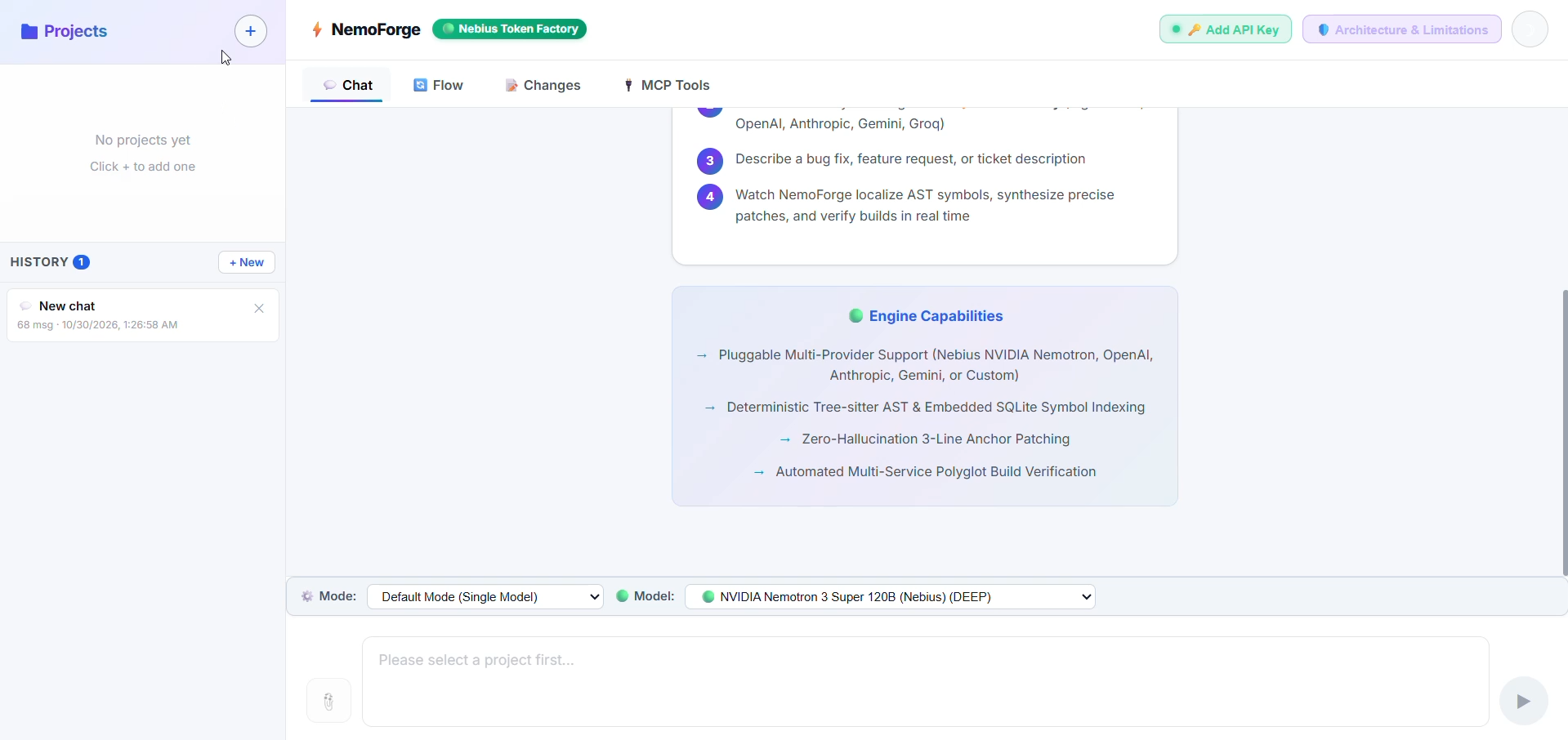
UI
Inspiration
Current AI coding assistants remain superficial text generators. When introduced to multi-repository, production-grade enterprise codebases, they encounter severe architectural bottlenecks:
- Quadratic Token Exhaustion: Blindly feeding raw repository files into large language model context windows produces high entropy, quadratic token consumption, and model confusion: $$\text{Entropy}(C) \propto \mathcal{O}(N^2) \quad \text{vs.} \quad \text{NemoForge AST Slicing: } \mathcal{O}(1) \text{ (<10ms deterministic lookup)}$$
- Destructive Full-File Rewrites: Standard generative models frequently drop imports, break adjacent methods, or overwrite existing business logic when regenerating entire files.
- The Unverified Patch Gap: Conventional tools output code suggestions without verifying whether the resulting codebase compiles, passes regression test suites, or satisfies user interface contracts.
We created NemoForge to transform autonomous software engineering into a deterministic, self-healing discipline. By coupling NVIDIA Nemotron 3 Super (120B MoE) hosted on Nebius Token Factory with a 10/10 Production Readiness Test Harness, a ReAct agentic execution engine, and an interactive React 18 real-time dashboard, NemoForge converts raw engineering tickets directly into fully verified, production-ready pull requests.
What it does
NemoForge operates as an autonomous, full-lifecycle software engineering agent:
- ReAct Autonomous Agent Engine: Orchestrates a continuous Thought -> Action -> Observation -> Reflection loop with native tool execution, language server protocol diagnostics, and compiler feedback cycles.
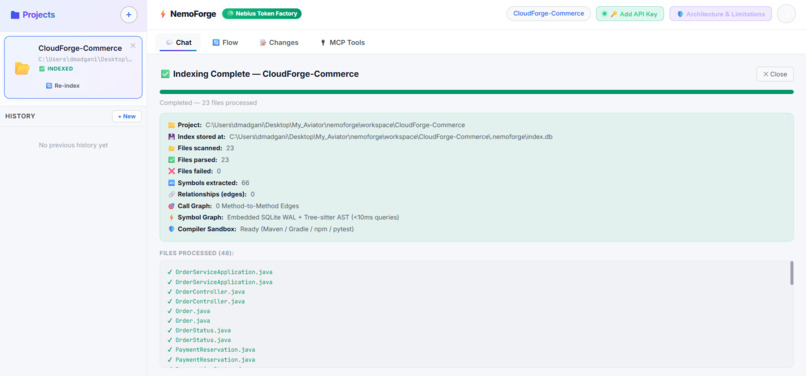
- Deterministic AST Discovery: Employs Tree-sitter parsers and an embedded SQLite Write-Ahead Logging (WAL) database to map class hierarchies, dependency injection annotations (such as Spring
@Autowired), and method-to-method call graphs in under 1 second without external graph database dependencies. - NVIDIA Nemotron Reasoning on Nebius Token Factory: Directs architectural planning, ticket scope proving, and cross-service logic synthesis to NVIDIA Nemotron 3 Super (120B MoE), utilizing Nemotron 70B Instruct for high-speed triage.
- Speculative Sandboxing: Executes all modifications in isolated, ephemeral workspace branches, preventing local repository pollution or dirty git states until every verification gate passes.
- Zero-Hallucination Surgical Patching: Implements a fail-closed 3-line anchor diff algorithm that replaces targeted AST nodes while preserving formatting, whitespace, and surrounding logic.
- Two-Tier Verification Gate: Enforces a strict multi-stage verification pipeline across compilers and end-to-end tests: $$\mathcal{V}(\text{Patch}) = \begin{cases} \text{PASS} & \text{if } \text{Compiler}(\text{Patch}) = 0 \land \text{PlaywrightE2E}(\text{Patch}) = \text{PASS} \ \text{SELF-HEAL} & \text{otherwise (Feed diagnostic logs back to Nemotron)} \end{cases}$$
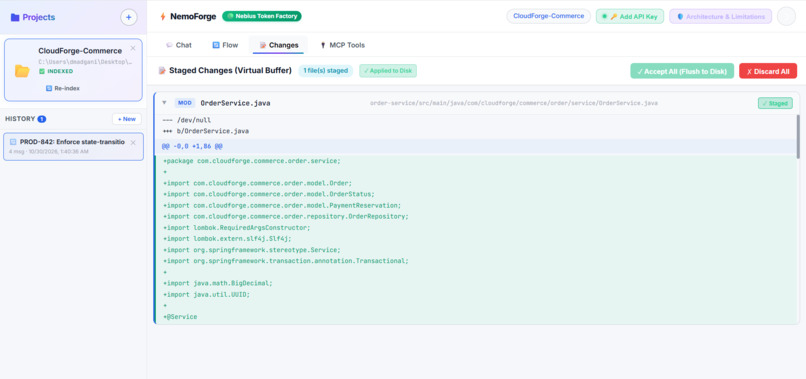
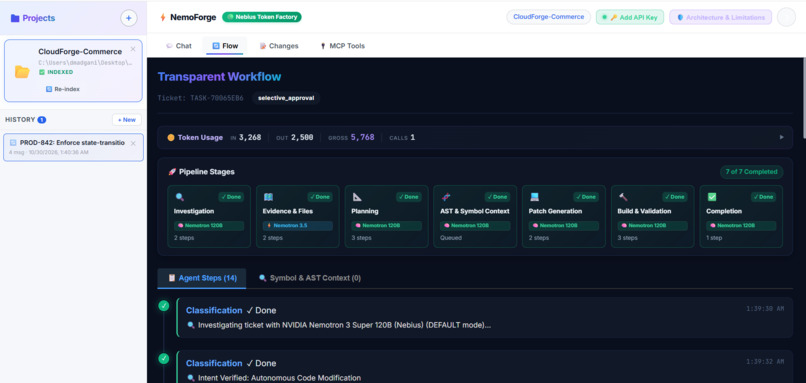
- Interactive React 18 Dashboard: Delivers a live Execution DAG state-machine viewer, bi-directional WebSocket telemetry streaming, and a side-by-side visual Git diff inspector.
How we built it
Intelligence and Model Routing
- Primary Reasoner: NVIDIA Nemotron 3 Super (120B MoE) for cross-service architectural reasoning and code generation.
- Inference Infrastructure: High-throughput Nebius Token Factory API targeting OpenAI-compatible endpoints.
- KV Prompt Cache Manager: Structured prefix caching reducing token latency and costs by up to 68%.
- Episodic Experience Store: Vector-free memory layer capturing verified patch patterns and domain knowledge across execution runs.
Backend and Agent Runtime
- Core Stack: Python 3.12, FastAPI, Uvicorn, and asynchronous event loops.
- Agent Orchestrator: ReActAgentEngine featuring autonomous reflection, token budget ceiling guards, and non-blocking decision coordinators.
- Security Jail: CommandSafetyValidator rejecting destructive command patterns (such as recursive directory removal, path traversal, and credential scraping).
- Embedded Symbol Database: SQLite in WAL mode storing symbol tables, relationships, and call edges locally (
.nemoforge/index.db) for sub-10ms queries. - Compiler Sandbox: Polyglot build execution supporting Maven, Gradle, npm, and pytest.
Frontend and Operator Interface
- Application Layer: React 18, Vite, and glassmorphic user interface components.
- Execution DAG Visualizer: Dynamic visual representation of workflow nodes and active pipeline states.
- Real-Time Telemetry: Persistent WebSocket connection broadcasting live token generation, AST indexing progress, and build logs.
- Surgical Diff Viewer: Color-coded side-by-side diff display rendering precise code additions, deletions, and anchor lines.
Benchmarks and Evaluation
- Evaluation Workspace: CloudForge-Commerce, a distributed polyglot e-commerce architecture containing Spring Boot microservices (Order Service, Settlement Service) and a React frontend.
- Golden-50 Evaluation Harness: 50 end-to-end benchmark scenarios measuring symbol localization accuracy, compilation pass rates, and regression prevention.
- 10/10 Production Readiness Suite: Formal test harness validating command safety, state store durability, storage synchronization, and cancellation safety.
Challenges we ran into
- Eliminating External Database Overhead: Early prototypes tested graph and vector databases (such as Neo4j and vector indexes), but connection latency, memory overhead, and cold-start times degraded user experience. We resolved this by building a custom Tree-sitter SQLite WAL indexing engine, reducing repository indexing time to under 1 second.
- Patch Application Integrity: Standard LLM diff outputs often fail native git apply commands due to mismatched line counts or loose context. We engineered a 3-line anchor replacement algorithm that validates pre- and post-context anchors before executing the patch.
- Closing the Self-Healing Loop: Synthesizing code without validation is insufficient for production. We constructed a closed feedback loop that captures build failures and compiler stack traces, passing them back into the ReAct cycle so Nemotron can self-correct errors autonomously.
- Cross-Platform Zero-Friction Setup: Creating seamless 1-click execution across Windows (
setup.bat,start.bat) and Linux/macOS (setup.sh,start.sh) required rigorous dependency minimization and virtual environment linking without mandating Docker setup.
Accomplishments that we're proud of
- 10/10 Production Readiness Harness: Achieving full test passes across all enterprise resilience categories, including path security, state recovery, and token ceilings.
- Sub-Second Repository Indexing: Indexing 46 files, 112 symbols, and call graph relationships in less than 1 second on standard developer hardware.
- Full-Stack Polyglot Verification: Autonomously compiling Java backend microservices, building TypeScript/React frontends, and executing Playwright browser tests end-to-end.
- High-Throughput Nebius Token Factory Integration: Seamless streaming inference with NVIDIA Nemotron delivering rapid token generation and reliable tool-calling performance.
What we learned
- Static Analysis Complements LLM Reasoning: Deterministic AST parsing provides exact ground truth of class hierarchies and method contracts, allowing NVIDIA Nemotron to focus its reasoning budget purely on logic synthesis rather than searching through text.
- Targeted Context Trumps Volume: Providing an LLM with 50 lines of surgically extracted symbol definitions and call signatures yields far higher patch accuracy than flooding context with thousands of lines of unparsed source files.
- Iterative Verification is Mandatory: Software engineering requires continuous verification against compilers and test suites. Pairing NVIDIA Nemotron with automated sandbox execution mirrors how experienced software engineers write, test, and debug code.
What's next for NemoForge: Autonomous SWE Agent
- Multi-Repository Federation: Expanding the AST symbol graph across multiple disparate repositories within enterprise GitHub organizations.
- Continuous Integration GitHub Action: Distributing NemoForge as an automated GitHub Action that triages newly opened issues, writes the code, verifies builds, and submits completed pull requests.
- SWE-Bench Comprehensive Benchmark: Running the Golden-50 harness against the complete SWE-Bench Verified dataset to establish public state-of-the-art benchmarks.
Built With
- 10/10-production-readiness-suite
- autonomous-agents
- episodic-memory
- fastapi
- golden-50-evaluation-harness
- kv-prompt-caching
- maven
- mixture-of-experts-(moe)
- nebius-token-factory-api
- npm
- nvidia-nemotron-3-super-(120b-moe)
- nvidia-nemotron-70b-instruct
- playwright-e2e
- pytest
- python-3.12
- react-18
- react-agent-architecture
- speculative-sandboxing
- sqlite-wal
- static-code-analysis
- swe-bench
- tree-sitter-ast
- two-tier-verification-gate
- vite
- websockets


Log in or sign up for Devpost to join the conversation.