Inspiration
GPU compute is turning into a priced commodity. CME and ICE announced GPU futures in 2026, and H100 rental prices swing from $2.31 to $4.95 across providers—that's over 100% in two months. Yet data-center operators still schedule maintenance ASAP, during business hours, without looking at what those GPU-hours are worth that day. Meanwhile, 57% of operators report their last outage cost over $100K, most GPU cloud capacity is pre-sold with SLA penalties for missed hours, and a real failure mode sits waiting: two cooling units in neighboring zones both go down for maintenance, lose backup cooling, and both zones overheat.
What it does
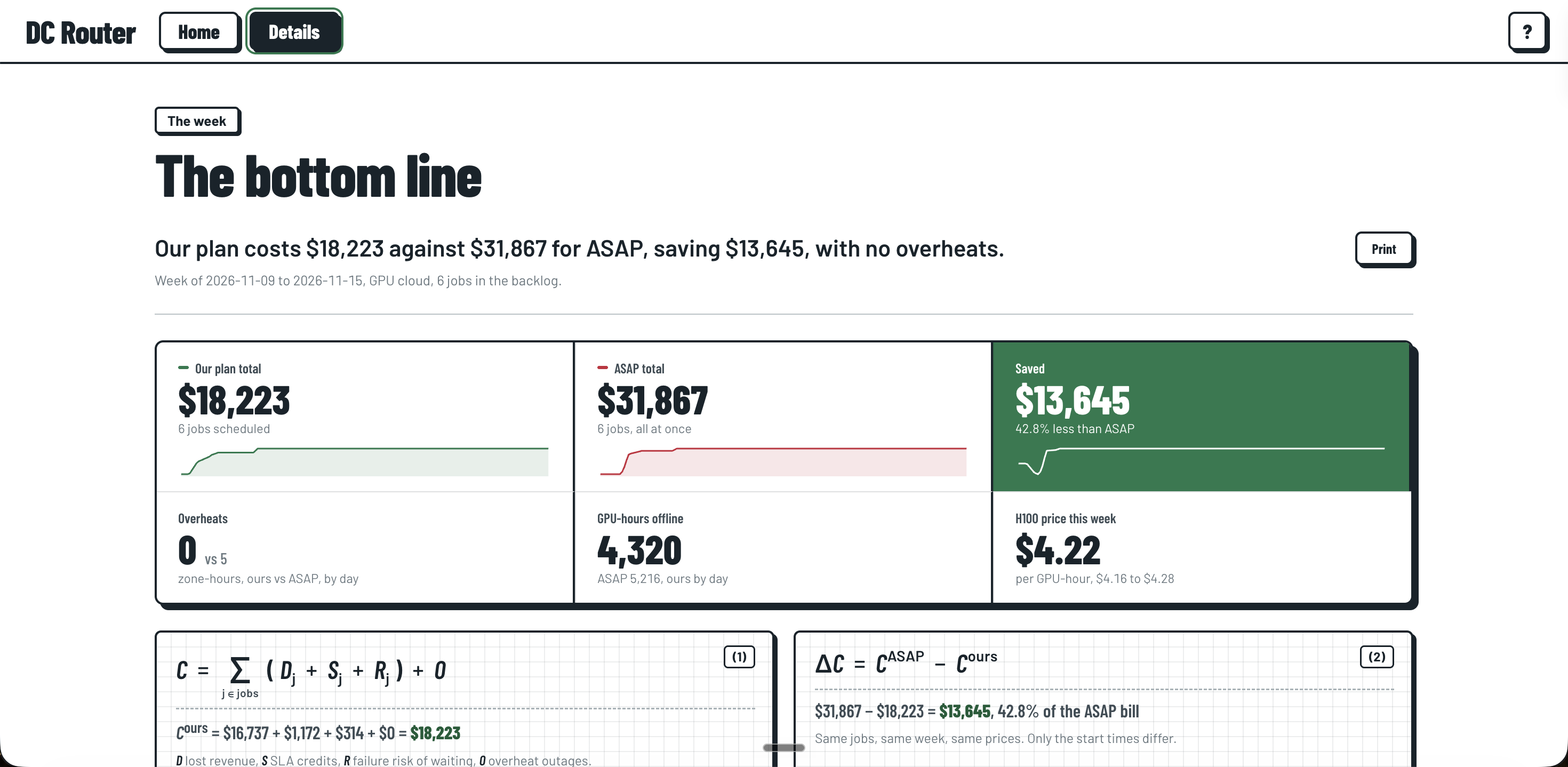
The planner takes a week's maintenance backlog (CRAC replacement, PDU breakers, firmware, UPS test, fiber, coolant flush) and prices every hour of downtime in real H100 market dollars using a weekly forecast built from GetDeploying data. It optimizes when each task runs, respecting vendor windows and cooling-zone conflicts, and checks every candidate schedule against a thermal simulator. The result: seeded week, optimized plan costs $18,222.79 with zero overheats; ASAP costs $31,867.40 with five overheat violations, a $13,644.61 savings (42.8%).
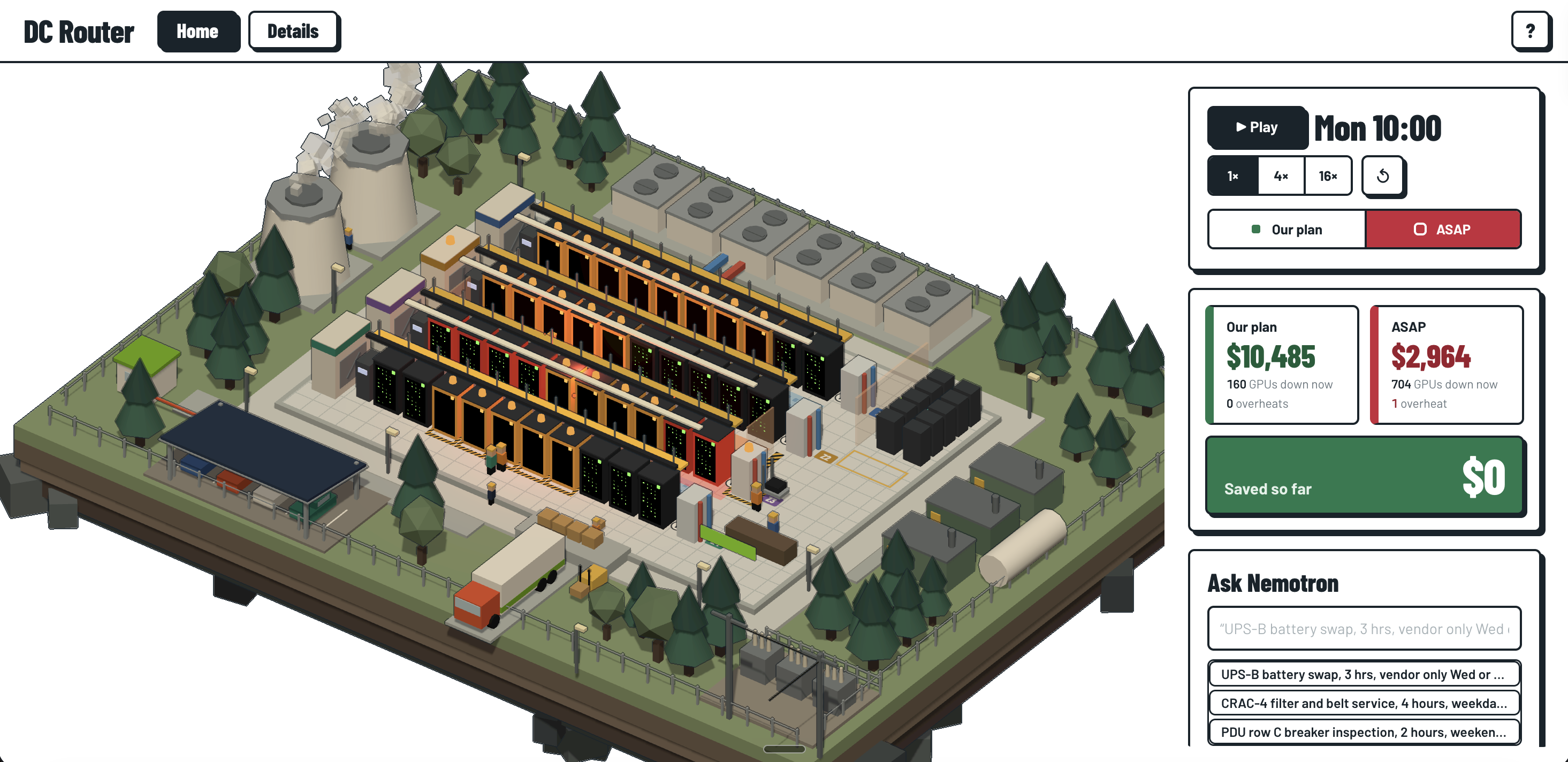
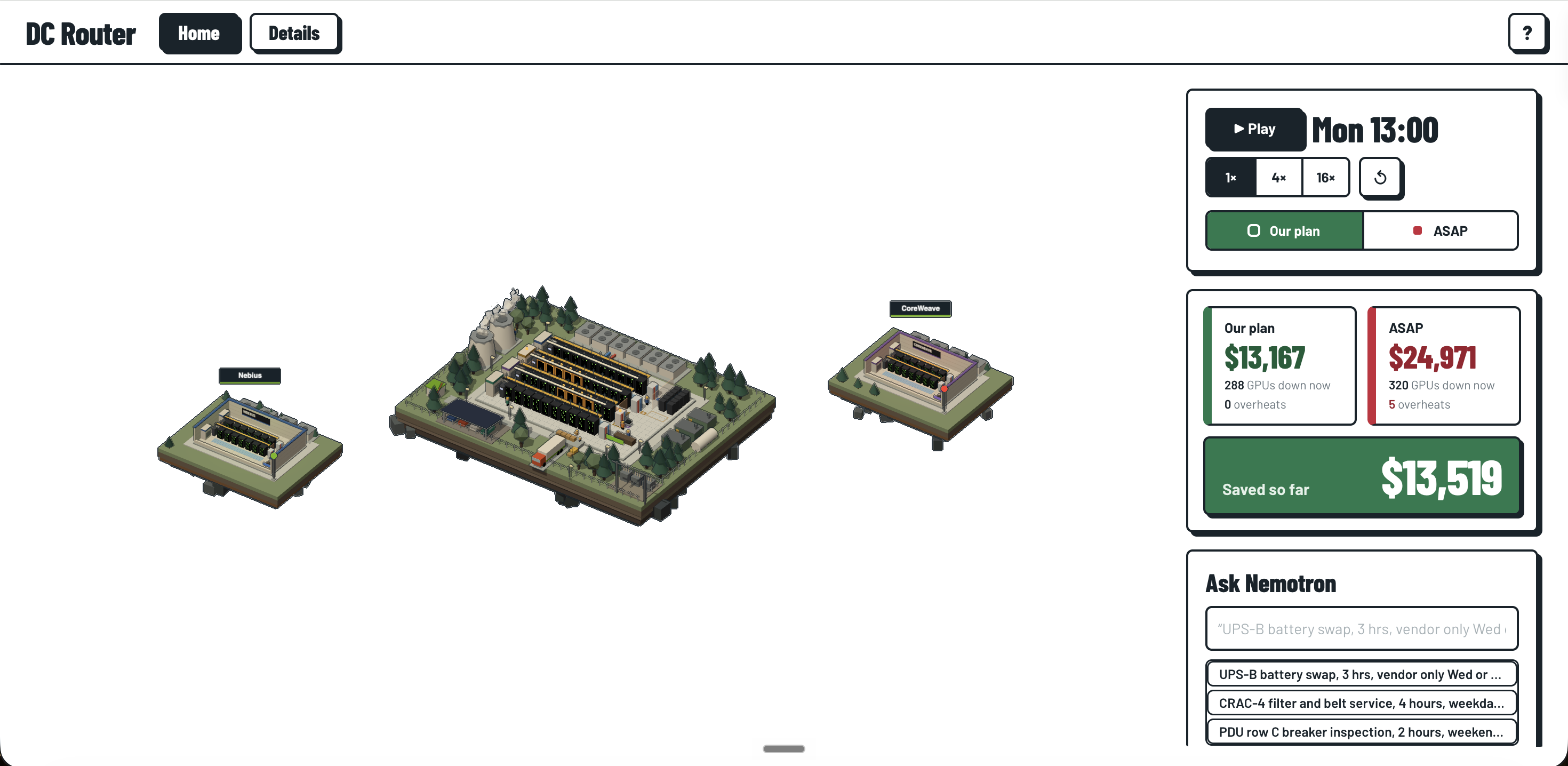
A 3D hall plays the week forward hour by hour, showing racks going dark and zone temperatures changing, with a live $ counter comparing both plans. When a new request comes in—"UPS-B battery swap, 3 hours, vendor only Wed or Fri"—Nemotron doesn't chat. It parses the request into a structured task, then calls our tools in sequence: lookup equipment, convert days to hours, add the task, price every candidate slot, run the optimizer, simulate the result, and explain the plan using only numbers the code returned.
How we built it
The backend is Python + FastAPI with shared Pydantic contracts, so three people could build in parallel. The optimizer uses a greedy strategy (most urgent task first, cheapest open slot) with local improvement; every candidate slot is checked against the thermal simulator to ensure no zone exceeds 32 °C. The simulator runs hour by hour, tracking racks offline and zone temperatures with thermal inertia, and flags conflicts, overheats, and window violations.
Nemotron 3.5 Lightning from build.nvidia.com calls nine tools via function calling (lookup_equipment, day_windows, add_task, compare_slots, choose_slot, make_plan, simulate_plan, handoff, procure); our guardrails prevent it from setting a price or picking an unsafe plan. The frontend is Three.js, rendering a pixel-art cut-away of the GPU hall with LEDs, cooling units, day/night lighting and week playback. Everything is deterministic: the same seeded backlog produces the same plan and the same dollar figures on every run (SEED=42).
Challenges we ran into
The hardest problem was keeping the LLM away from arithmetic. Every price, cost, schedule, and temperature had to come from code; Nemotron makes the decisions: which slot, and which trade-off. Code does every calculation and refuses unsafe picks. Any explanation containing a number the tools didn't return gets replaced. Any explanation containing a number the tools didn't produce got replaced by the code-built text. The second-hardest challenge was making "never overheats" true by design: the optimizer runs the hourly thermal sim on every candidate slot (40+ slots per task, 6 tasks), which still only takes about 17 milliseconds per complete plan.
We also had to balance greedy optimization with failure-risk growth, so the planner can't just push every job to the cheapest day; waiting longer raises the risk an urgent repair can't wait anymore. Finally, for a demo that gives the same answer every time, we seeded the entire system: random numbers, the hall state, the backlog, the price curve—everything came from one RNG with a fixed seed.
Accomplishments that we're proud of
Past NMC² winners built ticketing and routing tools; we took a different angle: pricing data-center operations in GPU compute market dollars. The simulator caught a real failure mode: the naive "earliest hour" approach schedules CRAC-2 and CDU-3 (two cooling units) down at the same time in neighboring zones, knocking out backup cooling and overheating both zones. Our optimized plan avoids this and costs $13,644.61 less (42.8%) with zero overheats instead of five.
Nemotron doesn't just parse requests; it orchestrates a multi-step planning workflow and chooses between options (cheapest safe, earliest, ASAP, wait a day), each priced as a full week plan with a hall simulation. Every number in the demo comes from code, never from the model—even when judges interrupt with unscripted requests, the same guarantee holds.
What we learned
GPU market prices move fast and far—a 40% rise in one-year H100 rentals from Oct 2025 to Mar 2026 means scheduling around price isn't theoretical, it's real. We learned that thermal constraints are physical: two cooling outages in neighboring zones cascade, and the overheat line (32 °C, ASHRAE A1) is where you have to stop. We also learned the right split of labor: agents decide (choosing between options), code computes (prices, temps, schedules), and people approve (the operator clicks Accept or Decline).
Lastly, determinism matters for demos. With 100 judges watching, "let me run it again" doesn't cut it. Seeding the RNG and all state means the same backlog produces identical output, building confidence and letting you rehearse without surprises.
What's next
Real telemetry would replace the simulated hall: live temperatures from the facility, real utilization curves, and actual vendor calendars. A live price feed would swap the weekly snapshot for intra-day pricing from Silicon Data, Ornn, or GetDeploying refreshed hourly. We'd fine-tune a smaller, faster Nemotron on maintenance tickets so it runs locally and doesn't hit rate limits. For bigger backlogs (a month or more), the greedy optimizer would give way to OR-Tools or a constraint solver. And when an incident fires, escalation would include a call or text to the on-call technician, so the agent's decision reaches the human who can act on it.
Built With
- build.nvidia.com
- fastapi
- html
- javascript
- nvidia-nemotron
- openai-python
- pydantic
- pytest
- python
- three.js
- uvicorn


