-
-
-
Time reduction with Nema
-
Nema in action
Inspiration
Most of what we know we learned on the web, one page at a time: a blog post about browning meat, a chapter about syscalls, a course on pan sauces. None of those pages know each other, and none of them know us. Every site starts from zero, and nothing we did on one page survives on the next.
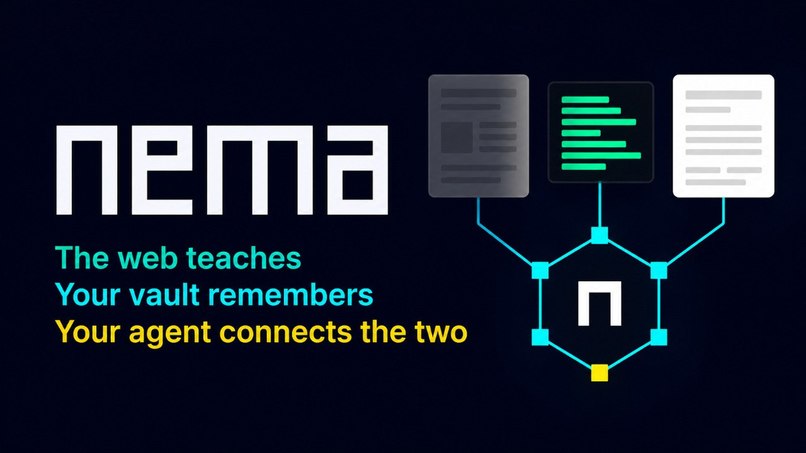
WebMCP changes the shape of the problem. A page can declare what it can do as tools, and an agent in the browser can call them. So we asked: what if a page could declare what it teaches, ask a reader's own vault what they already know, and hand back a signed note of what they did? That is nema: your learning state, everywhere.
What it does
A vault you own. The vault is your own record of what you have learned: signed receipts of work you actually did, issued by the sites where you did it. From those receipts it derives your state: a band per concept and per ability (recognise, retrieve, explain, apply, transfer, discriminate), a memory schedule, and a list of what to learn next. It lives with you, in your browser or on your disk, not on any site, and there is no account. The demo vault is at https://nema-vault.migarci2.dev.

A protocol a site installs in a minute. Two tags on any page.

That page now exposes six WebMCP tools: it describes what it teaches, asks the vault about three prerequisites, adapts, and signs a receipt when the reader passes a check. No backend needed.
A learner model with a source. The vault follows the principles of learning fast that Justin Skycak writes up at justinmath.com and that Kris Abdelmessih collects in "The Principles of Learning Fast" (https://moontowermeta.com/the-principles-of-learning-fast/). Passing something advanced credits every prerequisite under it at a fraction and pushes its review date out, which Math Academy calls Fractional Implicit Repetition. The vault asks for a concept only when its prerequisites are held, and otherwise names the weakest prerequisite and the goal it is blocking. A session interleaves rather than drilling one concept, and keeps confusable concepts apart unless telling them apart is the point.
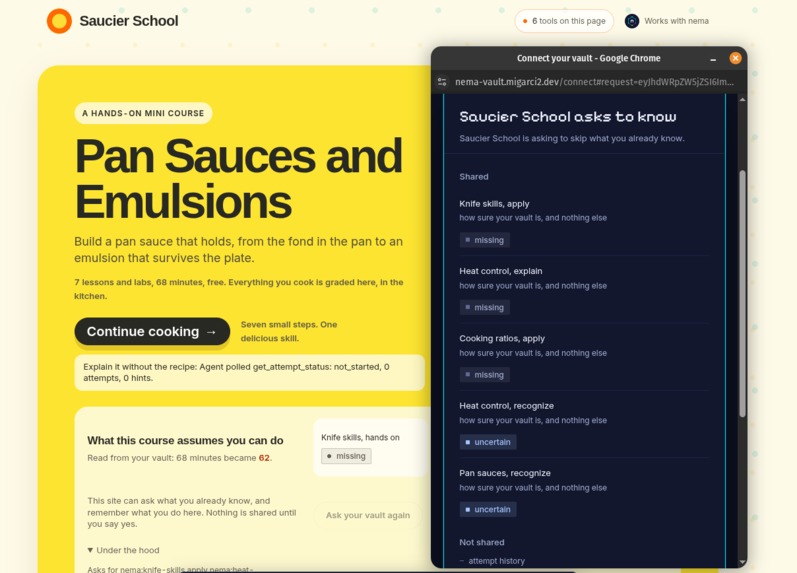
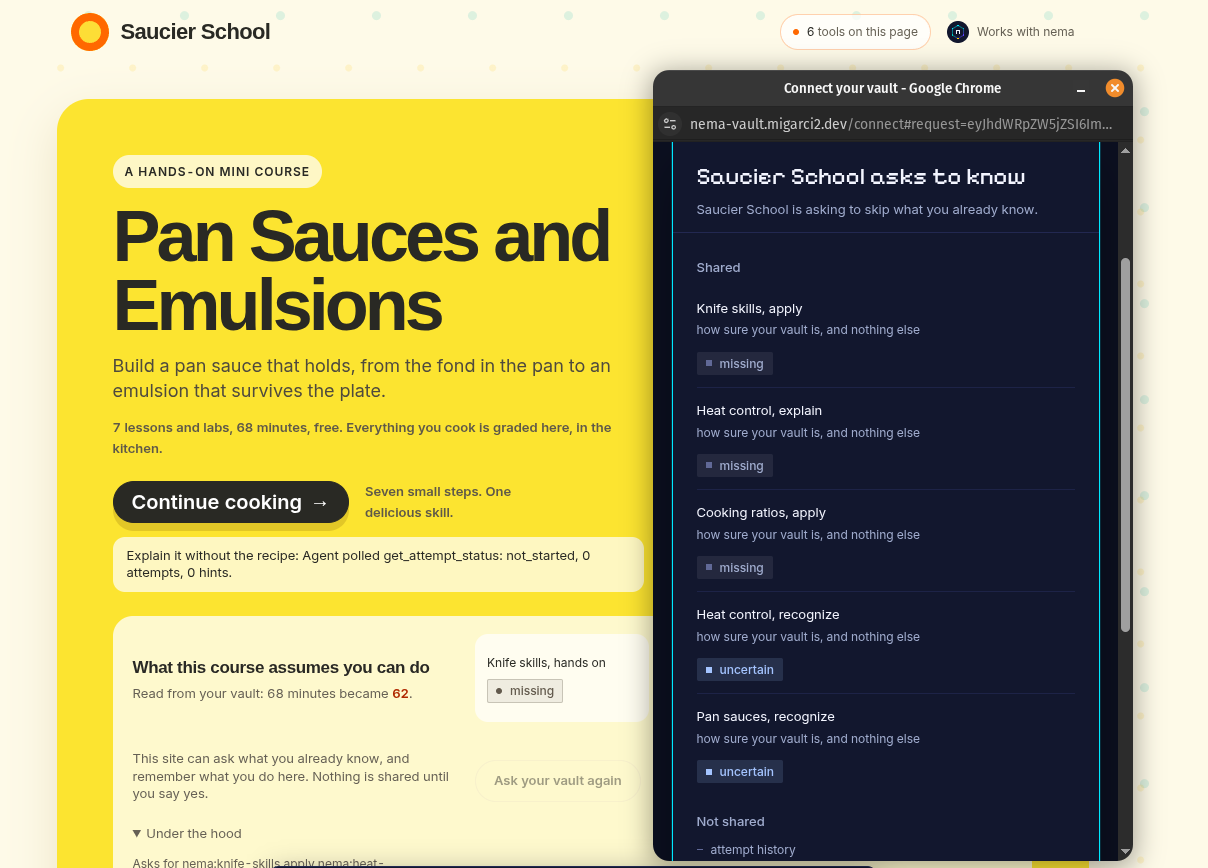
Consent you can see. A site never reads the vault. It asks one question, and the vault shows a modal: what will be shared (three status bands), what will not (history, scores, other subjects), for which site, for how long. You approve. The answer is a signed token bound to that one site, valid thirty minutes.


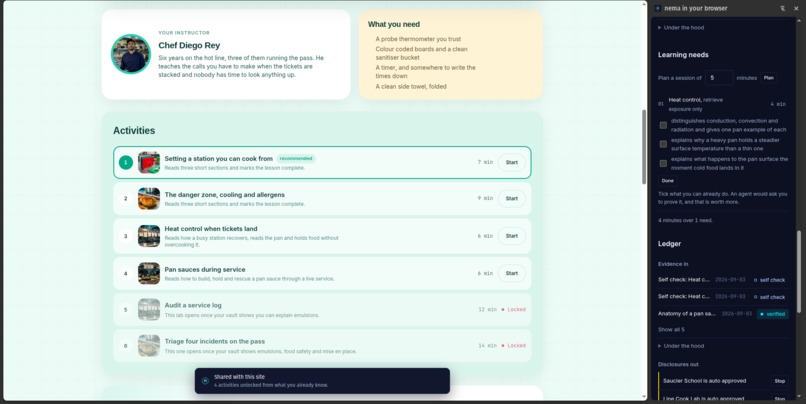
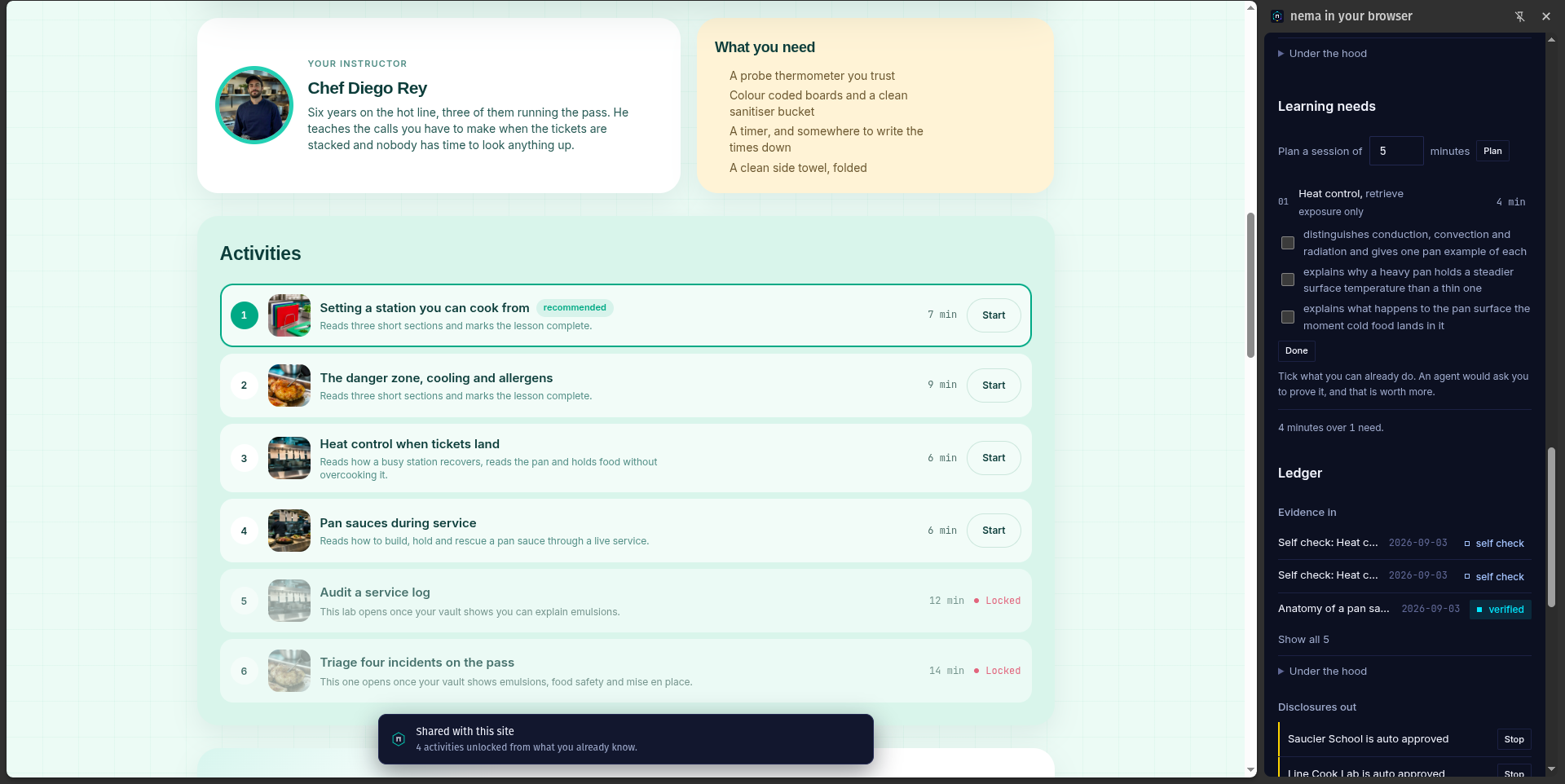
Two example cooking courses that look nothing like nema. Saucier School (pan sauces) asks your vault three things and turns 68 minutes of lessons into 21. Line Cook Lab (food safety on the pass) has never spoken to Saucier School, but recognises what you did there and unlocks its advanced lessons.

Two real articles, with and without nema. We mirrored a CC BY-SA article on AES-GCM and an MIT chapter of "Putting the You in CPU", added retrieval questions inside the text, and put the original and the nema version side by side with the exact diff as the headline.


Any agent. ChatGPT desktop and Chrome 149 call the tools on the page.
Claude Code and Codex reach the same vault over MCP (packages/nema-mcp, the
same eleven tools, same schemas). The agent is a commodity; the vault is the
infrastructure.

nema in your browser. A Chrome extension puts the vault in the side panel and does the boring transport with no model: a bar appears on any site that works with nema, one click shares your bands, and receipts are collected automatically when you pass something.

Sites that speak their own names. A site can use its own concept ids. An agent proposes what they mean, you confirm once, and the vault translates at its edges. Who translated a name never changes how much a receipt is worth; who signed it does.

How we built it
- Plain HTML, CSS and ES modules. No framework, no bundler. Every page loads
the Chrome Labs WebMCP polyfill and registers tools with
document.modelContext.registerTool, exactly as Chrome documents it, so the same code runs natively in Chrome 149+ and ChatGPT desktop and degrades gracefully elsewhere. - The protocol is six objects (LearningManifest, ReadinessRequest,
ReadinessAssertion, EvidenceReceipt, LearningNeed, ConceptAlignment) carried
as compact tokens:
nema1.<payload>.<signature>, ECDSA P-256 over the exact payload bytes via the Web Crypto API, in browsers, Workers and Node alike. - Trust has three tiers. Registered issuers (the courses, whose keys never
leave a Cloudflare Worker), origin published keys (
/.well-known/nema-issuer.json), and self certified receipts (a blog with no backend signs with a key it made in the reader's browser; the vault caps that evidence at self report weight). - Learner state is never stored. It is derived from the ledger on every read with an explainable scoring model (grader weight, result, recency, a spacing schedule), so a better estimator later never invalidates evidence.
- Seven origins on Cloudflare Workers: the hub, the vault, two courses, a blog,
two mirrored articles. A site talks to the vault through a popup handshake
(
connect.htmlpluspostMessage), the way "Sign in with" works, because third party iframes do not share storage. packages/nema-mcpboots the browser vault inside Node with four shims (a file backed localStorage, an event sink, a repo backed fetch, module resolution hooks) and servestools.jsverbatim over MCP, with consent through MCP elicitation.packages/nema-extensionis Manifest V3: the vault page as the side panel, a MAIN world bridge that is the only code touchingdocument.modelContext, and a service worker that relays tool calls per tab.- Verification: 237 unit tests, and native end to end scripts that drive Chrome for Testing 154 over the DevTools Protocol against the live origins: the golden path, the connect handshake, the extension, replay and tampering rejections, wrong audience, expired tokens.

Challenges we ran into
- Native WebMCP differs from the polyfill in two ways that only show up in a
real Chrome:
executeToolwants a JSON string and returns one, anddocument.modelContextrefuses to run onchrome-extension://documents. We found both by testing on Chrome for Testing canary, not by reading docs. - Tokens are long. Agents mangle thousand character strings. We moved every
handoff off the agent's transcript: popups,
postMessage, the extension's bridge, and hand delivery links, so an agent carries meaning, not bytes. - Concept identity across sites. A closed registry is honest but limiting, so we let sites use local names and made alignment a first class, reviewable claim: proposed by the site or an agent, confirmed by the person.
- We built and then removed an in house chat agent. It contradicted the thesis (the agent is whichever you already use) and needed a model budget judges would exhaust. The extension does the transport with no model at all.
- Keeping the demo learner's numbers stable across three weeks of judging with a real spacing model meant designing the seed ledger against the formulas, not around them.
Accomplishments that we're proud of
- The consent modal. A site asks for three things; the learner sees exactly those three, and what will never leave. Everything else in the project exists so that this moment is true.
- 68 minutes to 27 to 21, on a site that has no account, then a second site that recognises the first, with zero partnership between them.
- Two real articles from other authors, republished under their licences, gaining retrieval practice and portable evidence with about a hundred added lines, and the diff shown to prove it.
- The same eleven vault tools reachable from ChatGPT, Chrome, Claude Code,
Codex and a Chrome extension, from one
tools.js. - Everything checkable: every claim in this text has a test that drives a real browser against the live URL.
What we learned
- WebMCP works best when a tool changes something on screen. Judges and learners trust what they can watch happen, so every tool here moves the page.
- Evidence beats mastery. Storing what happened, signed, and deriving state from it is simpler and more honest than storing a score, and it makes the learner model recomputable.
- Human in the loop had to be built into the tool surface rather than promised in a description. Two things have no tool at all, on purpose: answering an activity and approving a disclosure.
- The pages got better every time we removed a panel, a pill or a number.
What's next for nema
- A published
nema-provider.json a CDN, awell-knownkey helper, and a WordPress and Astro integration so the one tag install is one click. - Alignment sharing between learners: once someone confirms that a site's "browning science" is Maillard, the next learner's agent can propose it with that provenance.
- The extension in the Chrome Web Store, with vault sync through a file the learner owns.
- Providers that issue evidence for the open web's best teachers: recorded lectures, interactive explainers, documentation with exercises.
Why WebMCP, in the four required answers
Why WebMCP suits this. Learning happens on many sites that will never share a database. WebMCP lets each page expose what it can do, on the page, with the human present, and lets the learner's own vault expose a minimal, consented answer. No API keys, no accounts, no scraping: the page is the API, and the person is in the loop by construction.
How it improves the user experience. You never start from zero. A course asks three questions, your vault answers with three words, and 68 minutes become 27. A second site recognises the first. A blog post you read leaves you with proof you understood it. And you never copy a token or read a key: the extension or the popup handshake do the transport, and cryptography stays under the hood.
What collaboration between people and agents becomes possible. The agent reads manifests, asks your vault, carries signed tokens, proposes what a site's words mean, and coaches you on what is about to fade. You answer every question, approve every disclosure, and confirm every alignment. The line is drawn in the tool surface: there is no tool to answer for you and no tool to approve for you.
Implementation approach. Seven origins, each registering tools with
document.modelContext.registerTool (imperative and declarative forms), one
shared protocol module for building and verifying signed tokens, a vault that
derives state from a ledger, a popup handshake for sites, an MCP bridge for
terminal agents, and a Chrome extension that uses the same WebMCP tools from a
MAIN world bridge. Tested end to end on native WebMCP in Chrome for Testing
154 over the DevTools Protocol.


Log in or sign up for Devpost to join the conversation.