Inspiration
It is well known how financially straining college can be, leaving students with empty bank accounts and busy schedules that limit workable hours. These limitations make it difficult for students to afford basic living and academic needs while also being able to personalize their living spaces. This issue affects a majority of students, with the Hope Center’s Student Basic Needs Survey reporting that 59% of college students experience basic needs insecurity. Meanwhile, plenty of students have to discard large, unportable household items when they graduate or switch accommodation between semesters, items which often are almost as good as new and quite expensive. If none of their immediate circle of friends take these items, they often go in the trash. This ongoing challenge inspired Neighbr 2 Neighbr, whose goal is to relieve some of the struggle so many students face.
What it does
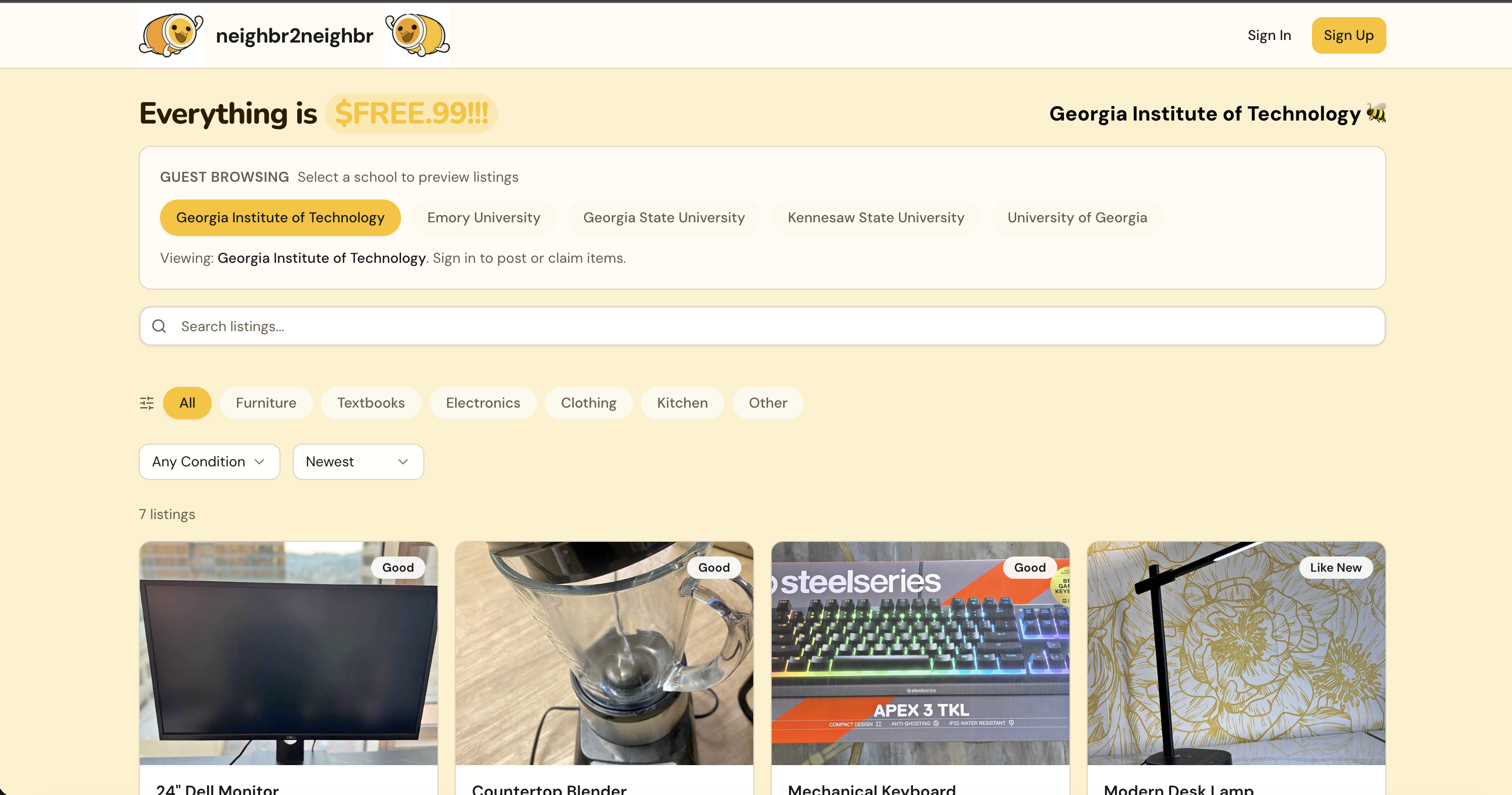
Neighbor to Neighbor is an app designed by college students, for college students. It allows students to build a community centered around the free redistribution of academic and everyday items, while also promoting an ecologically focused culture of reuse. The app functions like a marketplace for free giveaways, where students on the same campus can post items and message one another to arrange exchange of items. Campus verification: To ensure safety and relevance users are required to verify their campus affiliation before interacting with others on the platform. Product tagging: Items are organized through a tagging system allowing users to categorize listing by time type(dorm or apartment, academic supplies) as well as pick up preferences(drop off/pick up, dorm name). Making it easier for students to find what is useful for them In-app messaging: This feature that enables fast and easy communication between students to coordinate item exchanges. AI generated description: After entering a title the app can auto generate a caption that will catch the eye of other students without the extra time to type it out. Its all $Free.99!!!
How we built it
Frontend (Next.js + React): Built a responsive user interface using Next.js with a React frontend. Designed intuitive flows for browsing, posting, and requesting items within a campus community. Backend & Database: Implemented backend functionality to handle user data, item listings, and messaging. Used PostgreSQL for persistent data storage and reliable data management. APIs & Integrations: Integrated a Gemini LLM API to support live search and recommendation functionality. Used a SendGrid API for secure email verification and user authentication. Deployment: Deployed the application using Railway for scalable and efficient hosting. Configured backend services to support production use and future expansion.
Challenges we ran into
One challenge was implementing campus verification in a way that accurately associates users with their campuses while preserving a smooth onboarding experience. To ensure only .edu emails could register, we implemented an email verification system using SendGrid
Another challenge involved building a semantic search system that returns relevant results beyond exact keyword matches. While trigram matching provided partial improvements, it struggled with true semantic differences. Incorporating an LLM into the search pipeline significantly improved synonym recognition and overall search accuracy.
Accomplishments that we're proud of
What we learned
We learnt a lot about the challenges of developing a robust, interconnected and well planned system. Gained experience thinking about how to market a product to real users Built a full-stack application intended for real-world deployment Developed skills in collaborating on a shared codebase, working with teammates of varying technical backgrounds, and managing version control
What's next for Neighbr2Neighbr
Although the LLM based search greatly enhanced the robustness of the search algorithm, it is unfeasible for a production/deployed system as real time queries at any significant volume is slow and expensive. To improve this, we eventually aim to deploy a robust search ranking system powered by a candidate ranking ml pipeline. Such a system would leverage indexed databases for candidate retrieval, a feature store and user data pipeline. We also aim to improve the user verification feature by using a two-factor authentication/single sign on system API, to improve security even further.
Built With
- gemini
- next
- postgresql
- railway
- react
- sendgrid

Log in or sign up for Devpost to join the conversation.