Inspiration
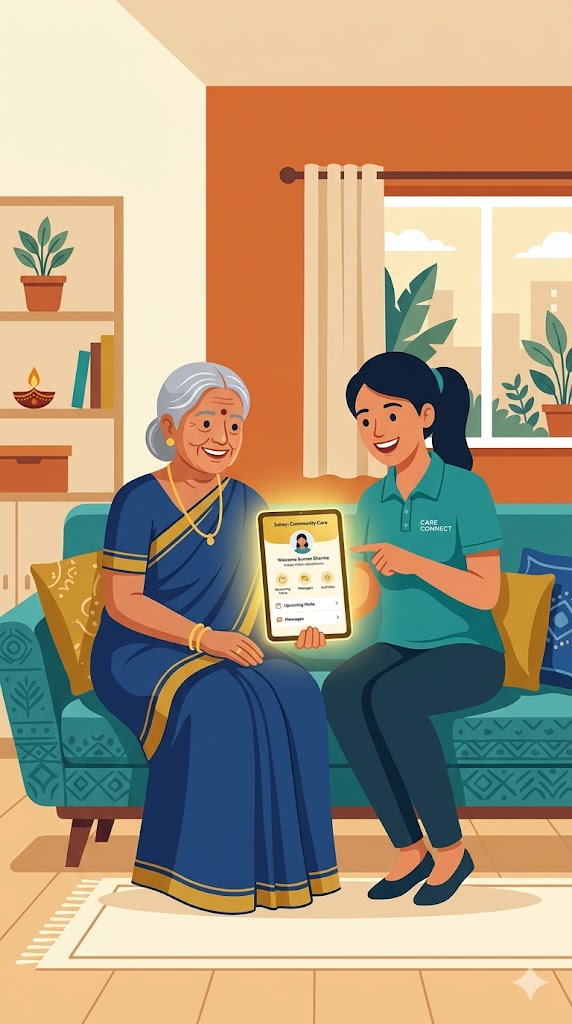
India is home to over 140 million senior citizens, millions of whom live independently while their children work in other cities or abroad. When a senior faces a minor daily struggle—like a dropped Wi-Fi router, a heavy grocery bag, or a confusing digital utility bill—they do not need an expensive commercial technician. They just need a helpful neighbor for five minutes. Unfortunately, there is a complete lack of digital infrastructure connecting our isolated silver generation with local youth eager to give back. Existing social platforms are either too complex for elders to navigate or are completely flooded with commercial spam. I have built NeighborHelp India to serve as a hyper-local, AI-secured companion network that bridges this generational divide.
What it does
NeighborHelp India is a decentralized micro-volunteering ecosystem split into two seamless interfaces managed by a unified application core: 1)The Seeker Dashboard (adult.html): Specifically designed for elderly users, featuring a Live Community Pulse bar displaying real-time local hub activity. With a single click, users can toggle Elder Mode, which overrides standard web styling to present massive text, high-contrast interfaces, and enlarged tap targets to eliminate technical friction. 2)The Helper Dashboard (helper.html): A gamified hub for local youth to view neighborhood requests. Claiming and completing tasks rewards volunteers with Mitra Coins, allowing them to climb local leaderboards and unlock real-world community incentives. The Gemini AI Shield: Elders often type requests in informal Hindi or Hinglish. Our integrated Gemini 1.5 Flash engine intercepts submissions to automatically filter out commercial spam, ads, or scams, and instantly translates/refines conversational regional phrases into crisp English tasks for volunteers.
How we built it
I engineered NeighborHelp India using a highly efficient, lightweight frontend stack comprising index.html, adult.html, helper.html, styles.css, and a centralized logic file, app.js. To maintain high performance and avoid server-side latency during live presentations, I used web-native architectures: Serverless LLM Orchestration: I integrated the Gemini 1.5 Flash API directly client-side, designing an advanced system prompt that handles real-time content m
Challenges we ran into
The original architecture included a browser-based Web Speech API to allow elders to voice-type their requests. However, we hit severe browser-level security blocks and microphone permission restrictions inherent to running local project files (file:/// protocols). Recognizing the strict timeline, I made a strategic product pivot. I was completely stripped out the unstable voice API to avoid live-demo bugs. Instead, we reallocated our final hours to perfecting the Elder Mode UI contrast rules and sharpening our Gemini AI content filters to handle messy, real-world conversational Hinglish inputs flawlessly.
Accomplishments that we're proud of
1)A Zero-Brake Demo: Delivering a completely operational, multi-role web prototype that safely synchronizes data without crashing. 2)True Accessibility: Building a functional Elder Mode that addresses the real physiological barriers seniors face when interacting with mobile and desktop software. 3)Cost-Effective AI Integration: Successfully deploying Gemini 1.5 Flash to execute multi-turn logic (simultaneous safety filtering and cross-lingual translation) instantly and efficiently.
What we learned
I learned that designing for the silver generation requires extreme empathy and a "less is more" UI philosophy. Most importantly, this taught me the value of engineering resilience. When a specific browser API fails under strict security constraints, the best path forward isn't to force a broken feature, but to pivot cleanly and double down on making your core AI and user experience completely bulletproof.
What's next for NeighbourHelp-India
1)Native Voice Integration (Phase 2): Re-introducing our voice-typing feature by wrapping the application into a native mobile framework (like Flutter or React Native). This will completely bypass browser-level microphone restrictions and give elders a hands-free, voice-first experience. 2)Aadhaar KYC Verification: Integrating DigiLocker and Aadhaar APIs to run instant background checks on volunteers. This ensures absolute safety and accountability before any helper can view an elder's location or accept a task. 3)CSR Reward Partnerships: Expanding the Mitra Coins ecosystem by partnering directly with local metro authorities and pharmacy chains, allowing corporate social responsibility (CSR) budgets to fund the physical rewards for our young volunteers.

Log in or sign up for Devpost to join the conversation.