-
-
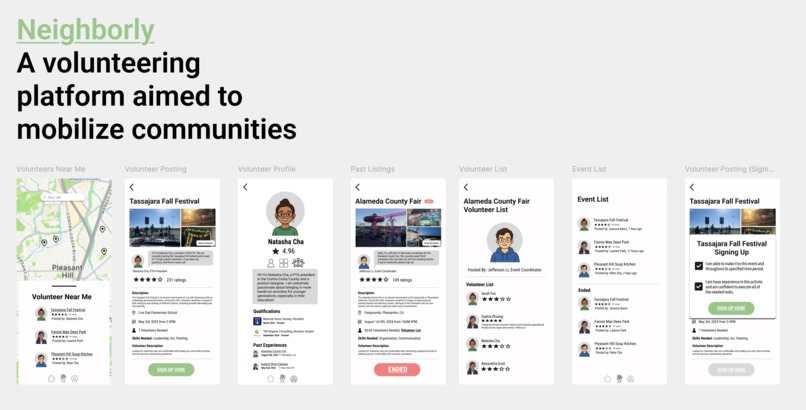
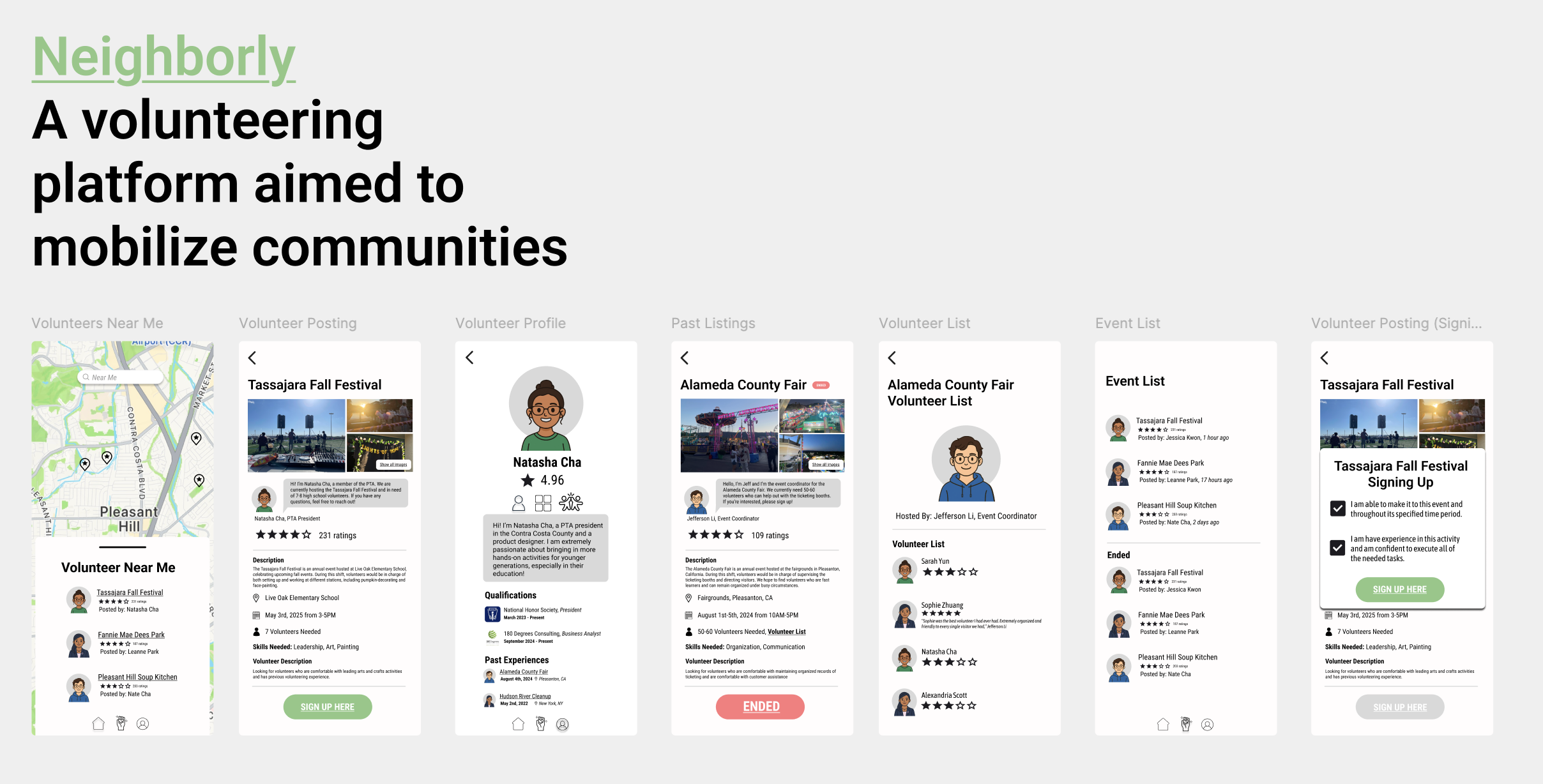
A display of Neighborly's key features/pages
Project Overview
Neighborly is a centralized volunteer platform designed for people who want to give back to their communities but don’t know where to start. Instead of relying on scattered event listings, flyers, or word-of-mouth, Neighborly brings together a wide range of local opportunities and social service projects into one easy-to-use app. Users can explore nearby volunteer activities through a personalized map or listing view, filtering by cause area, date, location, or required skills. When signing up, volunteers can input their profiles that include qualifications and past experiences to mitigate the threat of fake users, and after participating, users can rate the experience and event hosts, helping improve quality and trust across the platform. By making it simple to access and evaluate meaningful opportunities, Neighborly allows community members to easily reach out to volunteers and lowers the barriers that often prevent individuals from getting involved, turning good intentions into tangible impact.
Research Process
In designing Neighborly, we conducted multi-source research combining user interviews and academic insights.
As a starting point, we first spoke with our friends and our past volunteer leads, gauging a sense of how we can address the lack of community mobilization. By speaking with people across different age groups and diverse backgrounds, we gradually understood their barriers to community engagement, especially through volunteering, and recruiting qualified volunteers for help as well. For instance, talking briefly to a volunteer lead at a local Korean school, she mentioned that she does “not know where to look for volunteers. Many of the teacher’s assistants [at the Korean school] are simply people [she knows] rather than being able to reach a more diverse audience and crowd.”
Academic and industry research further reinforced these struggles. Specifically, about 47% of nonprofits face the challenge of finding volunteers that align with their requirements (Do Good Institute). And in order to address this issue, the National Council of Nonprofits emphasized the need for clear communication and personalized matching tools to significantly improve volunteer retention and satisfaction.
With this, we began popular and pre-existing volunteer and job platforms, including LinkedIn, VolunteerMatch, and Idealist. For the volunteering platforms, they offer broad listings but often lack robust filtering, skill-based matching, or post-event feedback systems, making it harder for volunteers to engage confidently on pre-existing volunteering platforms. And through LinkedIn, we realized that having a more social and interactive app where users can share their own volunteering experiences would help with user engagement and retention.
These combined insights revealed that people want a centralized, trustworthy hub that makes it easy to discover, assess, and sign up for meaningful volunteer opportunities, improving both user experience and organizational outcomes.
Key Design Decisions
Our research directly informed Neighborly’s key features and priorities to intersect digital technology with social impact. Through Neighborly, we aim to promote social sustainability, specifically community mobilization.
Our first impactful decision was prioritizing centralized discovery. As noted in interviews and personal experiences, past volunteers expressed frustration about scattered, disorganized listings. We designed a clear map and listing view where they can filter by cause, date, location, and required skills.
We then implemented skill and qualification matching. Like LinkedIn, which uses qualifications to match jobs, Neighborly allows volunteers to input their skills and experiences when signing up. Charities that invest in screening and matching volunteers to suitable tasks experience higher retention rates, enriching the volunteer experience and encouraging long-term engagement (Urban Institute). This feature helps volunteer leads assign tasks effectively and reach a more diverse audience.
We realized that a lack of verification was a key challenge for Neighborly and addressed it by adding a post-event feedback system. This allows both volunteers and volunteer leads to rate each other, verify the quality of the experience, and improve overall platform trust and accountability. Finally, we emphasized simplicity and social connection; interviewees wanted easy sign-ups, minimal paperwork, and opportunities to join with friends. We designed a streamlined signup flow and built-in social sharing tools, making it easy to coordinate group volunteering.
Our key performance indicator is user retention, ensuring individuals see volunteering not as a one-time task but as an ongoing opportunity to meet new people and give back to their community. Overall, Neighborly lowers key barriers to volunteering and fosters long-term community mobilization — critical elements of social sustainability. It drives sustained engagement across environmental, cultural, and social causes, directly aligning with best practices from both user research and nonprofit sector insights.
Built With
- figma

Log in or sign up for Devpost to join the conversation.