-
-

Architecture
-
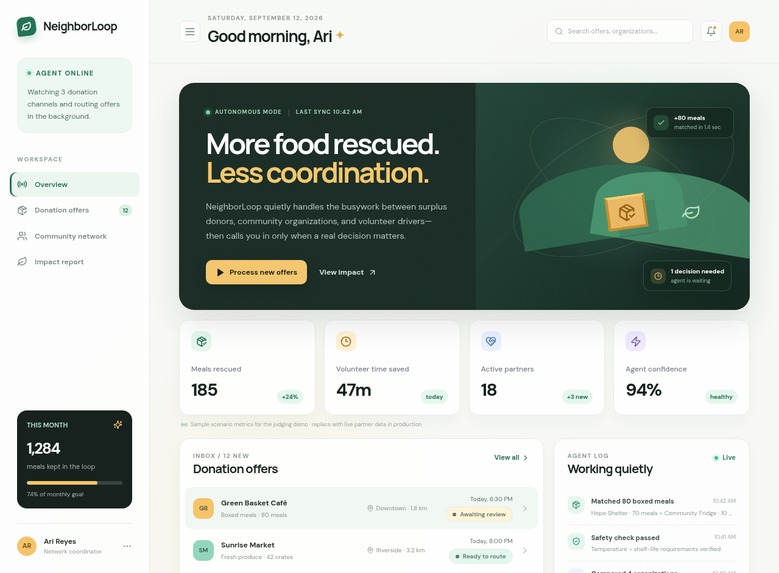
Dashboard with benchstats

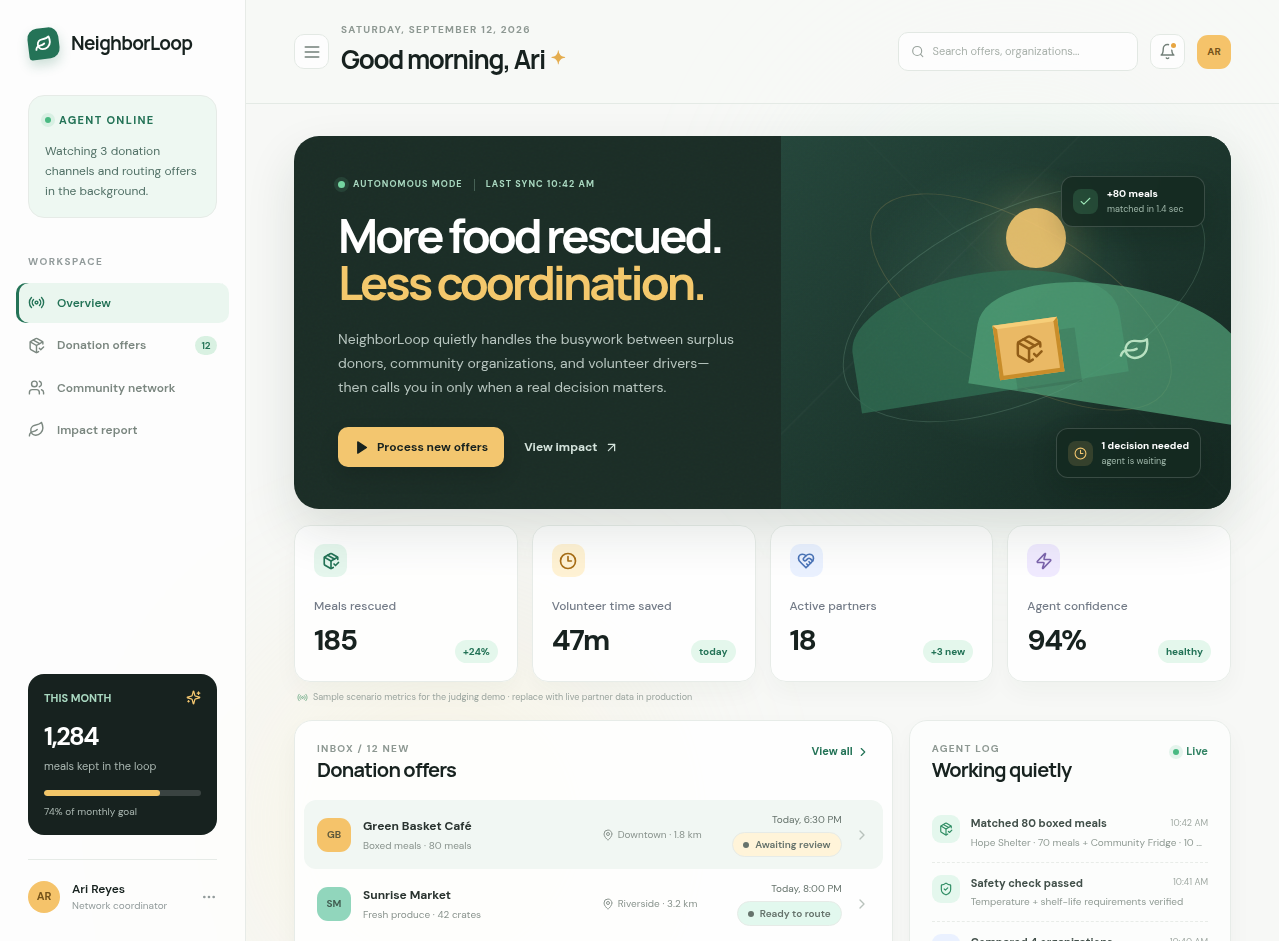
NeighborLoop — From surplus to support, automatically.
Inspiration
A café can have 80 boxed meals ready today, but those meals can still end up wasted because the coordination chain is too slow. Someone must read the offer, extract the details, check safety information, compare nonprofit capacity, find a driver, and coordinate confirmations before the deadline.
Food rescue is often limited by coordination rather than supply. NeighborLoop was inspired by the idea that an autonomous agent could quietly handle this repetitive work while keeping people in control of meaningful decisions.
What NeighborLoop does
NeighborLoop is a background food-rescue coordination agent for food banks, shelters, community kitchens, neighborhood pantries, schools, and local volunteers.
It can:
- Extract food type, quantity, allergens, location, and deadline from donation offers.
- Check whether the required safety information is available.
- Search community organizations for compatible capacity.
- Score matches using capacity, distance, cold-chain requirements, dietary compatibility, and urgency.
- Create a split pickup plan when multiple organizations are needed.
- Surface a concise human approval request before consequential confirmations are sent.
- Record an auditable trail of the trigger, tools, guardrails, and outcome.
For example, NeighborLoop can route 80 boxed meals from Green Basket Café to Hope Shelter and Community Fridge, then ask a coordinator to approve the pickup plan before sending confirmations.
Why this is a Good Neighbor Agent
Most productivity agents optimize one person's task list. NeighborLoop coordinates a network of people and organizations with different capacities, constraints, and deadlines.
The agent works quietly in the background. It does not interrupt a coordinator for routine extraction or matching. It pauses when safety information is missing, capacity is insufficient, or a decision is ambiguous.
The design principle is simple:
Automate the busywork, not accountability.
How we built it
The frontend is a React and TypeScript operator dashboard with Tailwind CSS and Lucide icons.
The agent reference implementation uses the Strands Agents SDK for Python and is designed for Amazon Bedrock. It exposes focused tools for:
- Donation extraction.
- Food-safety validation.
- Recipient organization search.
- Match scoring.
- Pickup-plan creation.
- Human approval.
The repository also includes deterministic matching logic, a seeded replay benchmark, an architecture diagram, automated tests, setup instructions, and an MIT license.
The live demo uses deterministic fixtures so the workflow remains reliable during judging without requiring cloud credentials. The agent/ directory contains the runnable Strands coordinator reference for a model-backed deployment.
Responsible automation
NeighborLoop does not silently guess.
If allergen information is missing for baked goods, the agent escalates to a human. If available partner capacity cannot cover the full donation, the plan is marked incomplete instead of being presented as successful.
Before production use, the system should connect to authenticated donation intake, live partner capacity, volunteer-driver availability, messaging, and a durable event store. Production deployment should also add idempotent approval handling, bounded retries, rate limits, and persistent audit logs.
Evaluation evidence
The dashboard includes a seeded replay benchmark covering 20 representative donation offers.
The current synthetic benchmark shows:
- 18 offers routed automatically.
- 2 offers escalated to a human.
- 0 unsafe automatic actions.
These are explicitly labeled as synthetic benchmark values, not live deployment claims. The benchmark makes the evaluation workflow reproducible and provides a structure for replacing the fixtures with real pilot data.
What we learned
We learned that an agent demo is much stronger when it shows the complete operational loop instead of only showing a chatbot response.
The most important parts of NeighborLoop are not just extraction and matching. They are:
- Knowing when the agent has enough information.
- Making the agent's actions visible.
- Showing why a match was selected.
- Escalating uncertain or consequential decisions.
- Measuring automatic success and human intervention separately.
We also learned that a polished interface must be supported by reproducible technical evidence. That is why the repository includes a runnable Strands reference, deterministic tests, an architecture diagram, and explicit limitations.
Challenges
The main challenge was balancing autonomy with safety.
A fully automatic system could make unsafe assumptions about allergens, capacity, or pickup logistics. A system that asks for approval at every step would not save meaningful time. NeighborLoop addresses this by automating routine work and interrupting only when information is missing or the consequences are ambiguous.
Another challenge was making the agentic workflow understandable to a technical reviewer. We solved this with an audit trail that shows the trigger, tool sequence, guardrail, and final outcome.
Future direction
The next version would connect:
- Authenticated email and form intake.
- Live partner capacity.
- Volunteer-driver availability.
- Confirmation messaging.
- A durable event store.
- Amazon Bedrock AgentCore for long-running, observable workflows.
NeighborLoop's long-term goal is to become a quiet operations layer that helps communities rescue more food while returning volunteer time to direct service.
Try it
The live demo shows the complete workflow from donation offer to human-approved pickup plan.
Built With
- agentic
- agents
- ai
- amazon-web-services
- application
- artificial
- automation
- design
- food
- human-in-the-loop
- impact
- intelligence
- open
- python
- react
- rescue
- responsive
- sdk
- social
- strands
- tailwind
- typescript
- web

Log in or sign up for Devpost to join the conversation.