-
neighborlift-my-activity.png
-
neighborlift-offer-support.png
-
neighborlift-live-map.png
-
neighborlift-community-board.png
-
neighborlift-home.png
Inspiration
We noticed a simple problem: people often need help, while other people nearby are willing to help—but the two sides don't know how to find each other.
Someone might need groceries, a ride, tutoring, translation, or accessibility support. At the same time, another neighbor may have exactly the right skills, time, or resources to help. The problem isn't always a lack of kindness; sometimes it's simply a lack of connection.
We wanted to build something that could turn that gap into an opportunity for community.
That idea became NeighborLift — a kinder way to ask for help, offer support, and find the right neighbor.
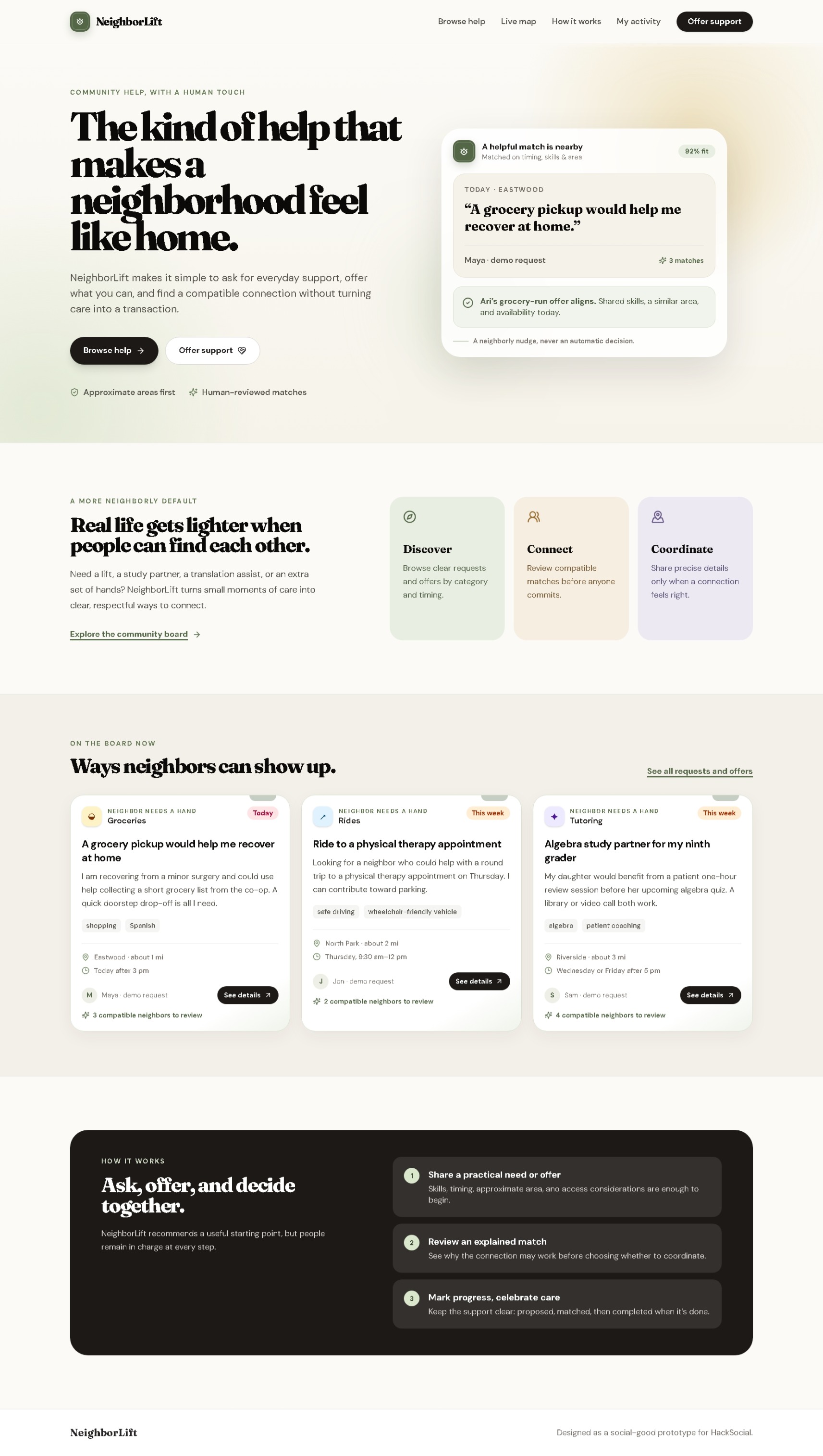
Rather than creating another transactional marketplace, we wanted the experience to feel human-first. People can describe what they need or what they can offer, discover nearby community activity, and review an AI-assisted suggestion before deciding whether to connect.
Most importantly, we didn't want AI making decisions about people.
AI should help people make better decisions, not replace their judgment.
What it does
NeighborLift connects people who need help with neighbors who can offer it.
Users can:
- 🛒 Request or offer help with groceries
- 🚗 Find or offer rides
- 📚 Request or offer tutoring
- 🌐 Get translation assistance
- ♿ Share optional accessibility-related needs
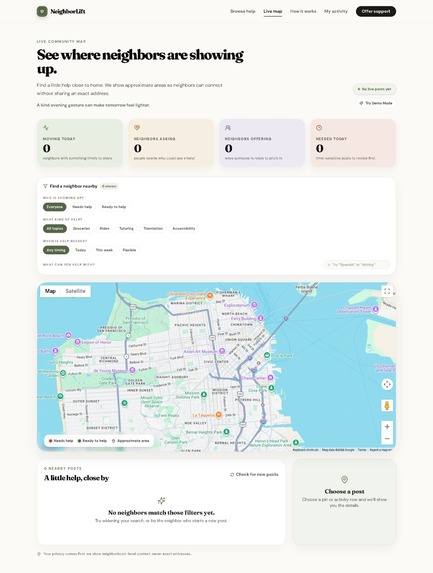
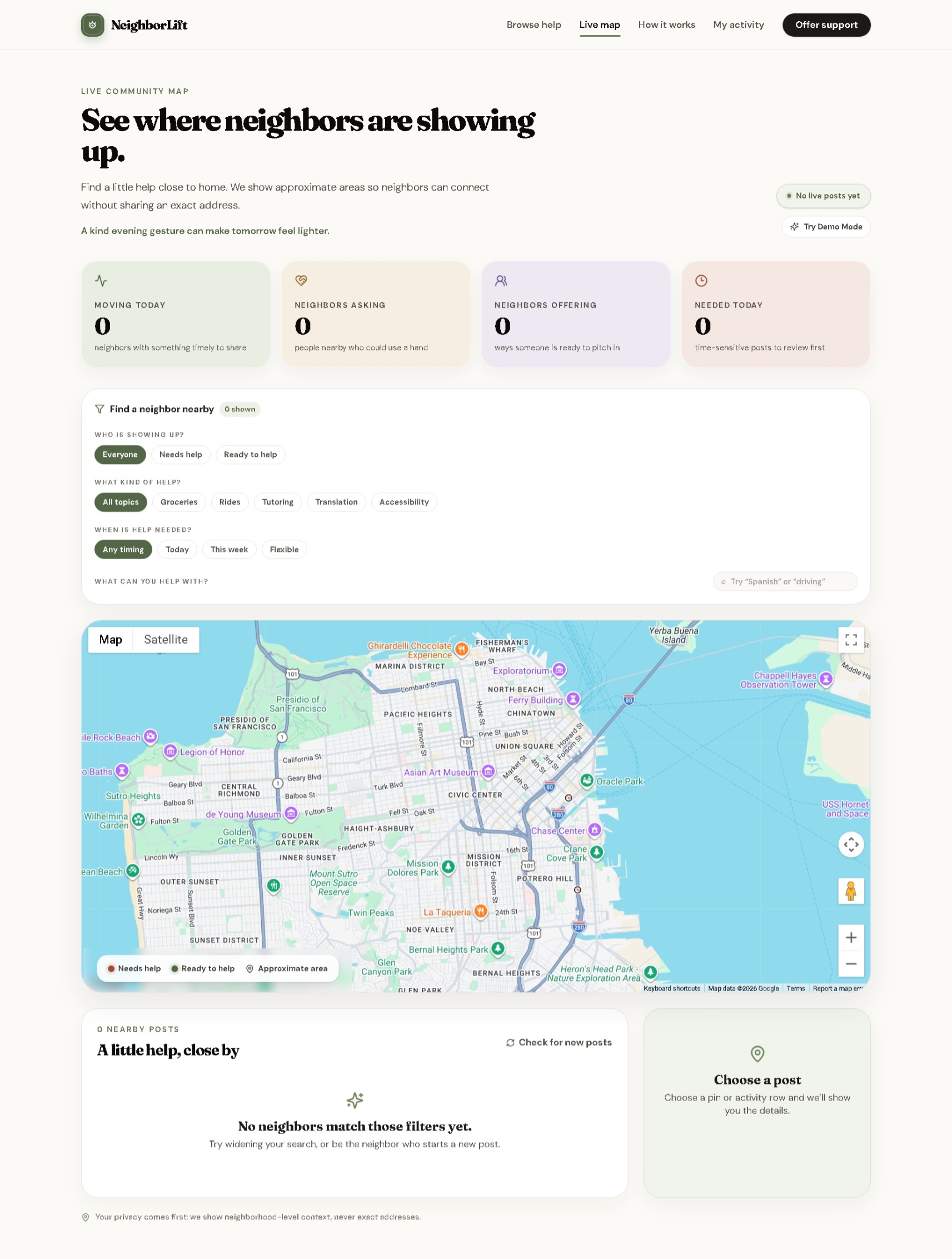
- 🗺️ Discover nearby community activity through a privacy-safe map
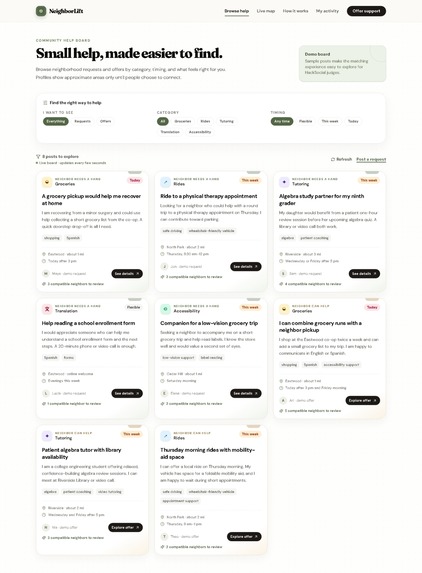
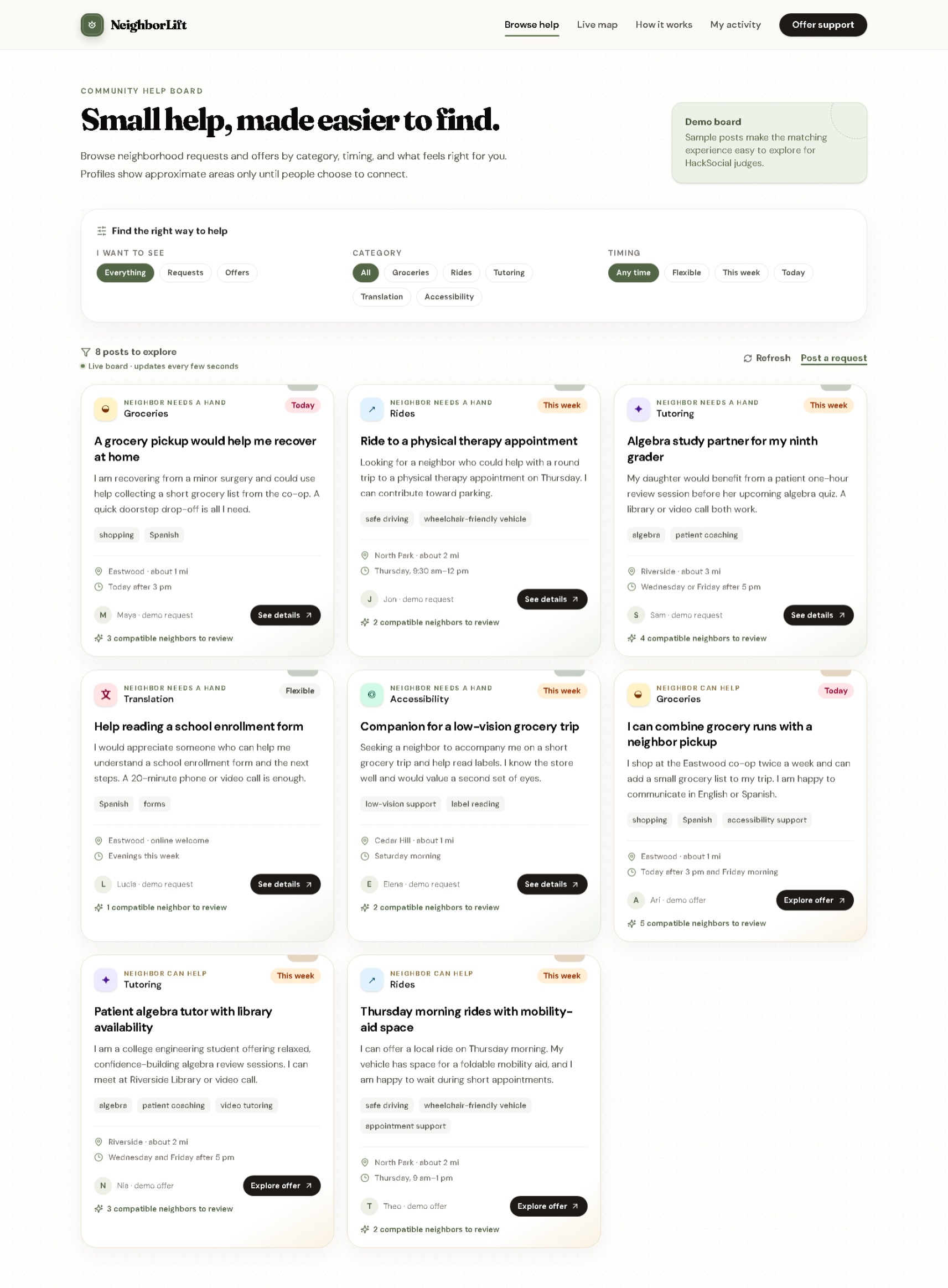
- 🔎 Filter requests and offers by category, urgency, skill, and other criteria
- 🤝 Review explainable compatibility suggestions
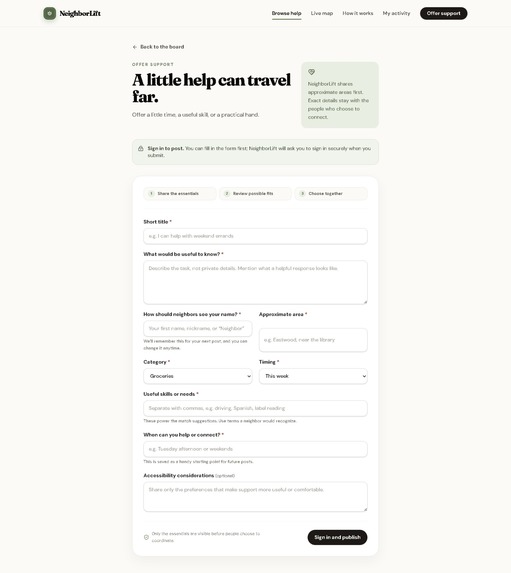
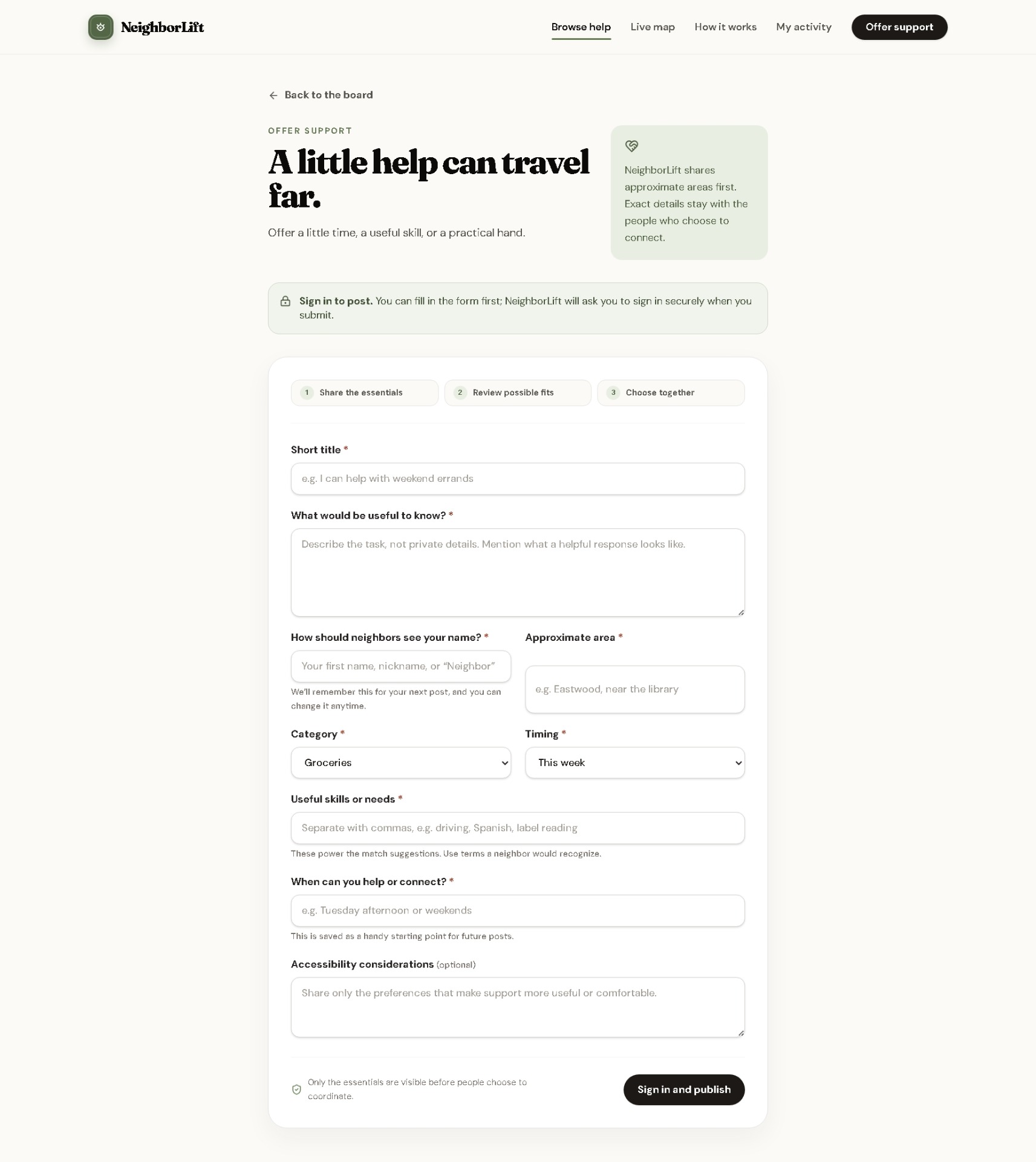
- 📝 Publish their own requests or offers
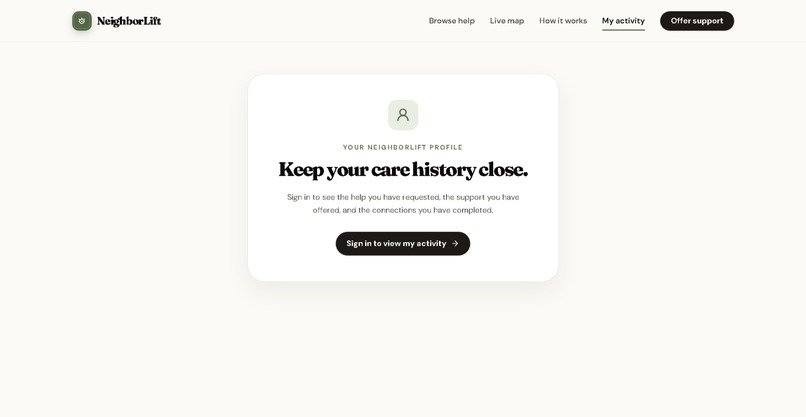
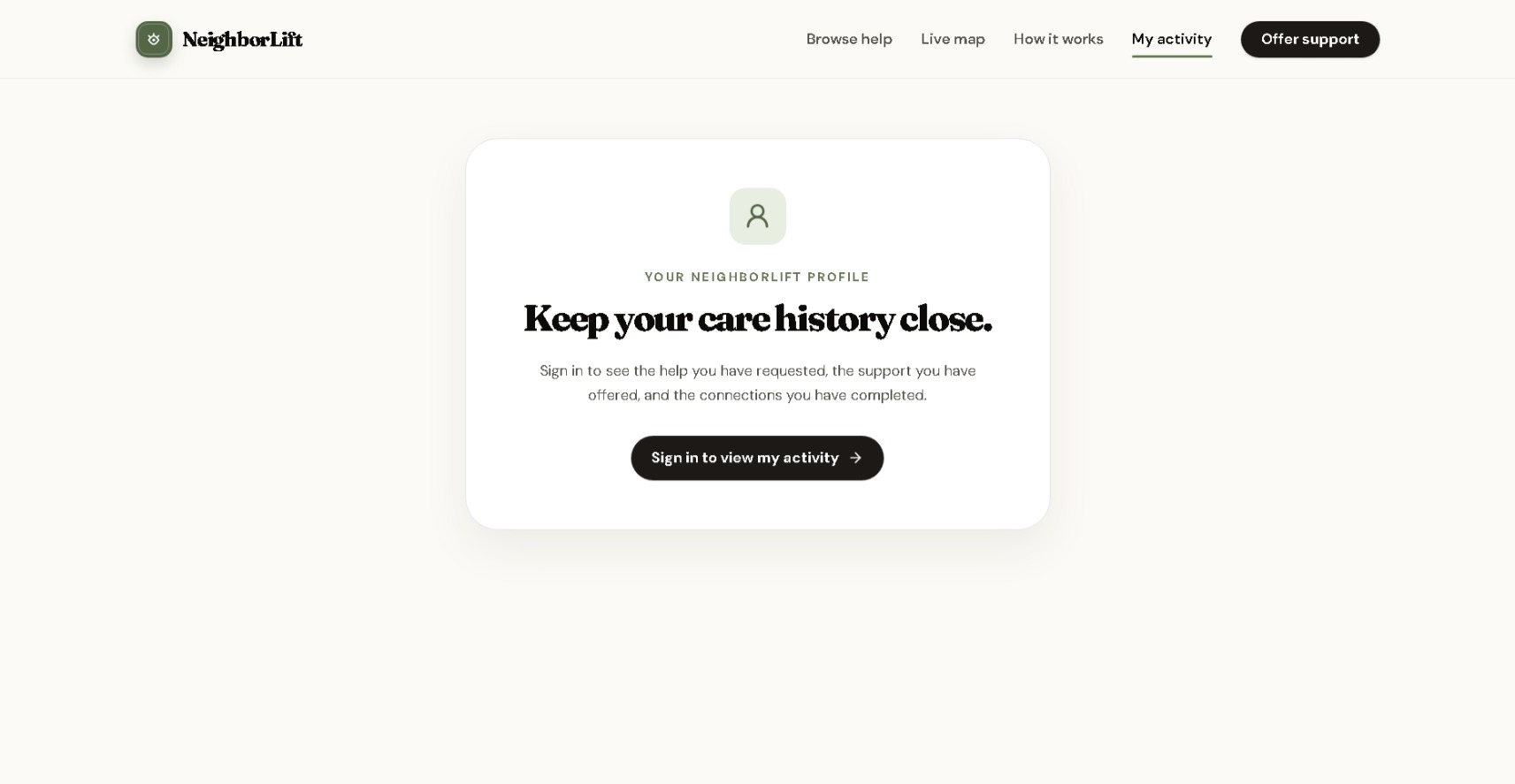
- 👤 Track their personal activity and connections
The matching system considers factors such as skills, timing, approximate location, urgency, and accessibility considerations.
Instead of presenting an unexplained AI score, NeighborLift provides a plain-language explanation of why a connection may be compatible.
And because helping someone shouldn't require exposing their exact location, NeighborLift deliberately uses approximate neighborhood-level locations rather than exact addresses.
How we built it
We built NeighborLift as a full-stack web application.
Frontend
- React 19
- TypeScript
- Tailwind CSS 4
- Wouter
- Lucide icons
Backend & Data
- Node.js
- Express
- tRPC
- MySQL/TiDB
- Drizzle ORM
AI & Matching
The matching system uses a hybrid approach.
First, deterministic server-side logic evaluates structured compatibility signals such as:
- Skills
- Timing
- Approximate area
- Urgency
- Accessibility considerations
Then a server-side language model turns those signals into a short explanation that a person can understand.
This separation was intentional. The system determines compatibility using structured signals, while AI explains the reasoning in human-friendly language.
The final connection remains a suggestion for the user to review rather than an automatic decision.
We also integrated the Google Maps JavaScript SDK through the configured proxy and built periodic live activity refresh with cache invalidation after relevant changes.
Challenges we ran into
One of the biggest challenges was figuring out how to use AI responsibly in something as personal as community support.
A matching system can easily become an opaque algorithm that simply says, "These people match." We didn't want that.
A person should understand why a suggestion appeared and still have complete control over whether they want to connect.
Privacy
Location is extremely useful for matching neighbors, but displaying someone's exact address creates unnecessary risk.
We therefore designed the map around approximate neighborhood-level locations, with posts still remaining available in the activity list when a usable area isn't provided.
Demo data
We also had to think carefully about demo data.
We wanted the map to feel populated during evaluation without pretending that fictional activity was real community usage. That's why we built an explicit Demo Mode with clearly labeled sample posts.
Accomplishments that we're proud of
We're proud that NeighborLift became more than just a concept or UI mockup—it became a working end-to-end prototype.
We built:
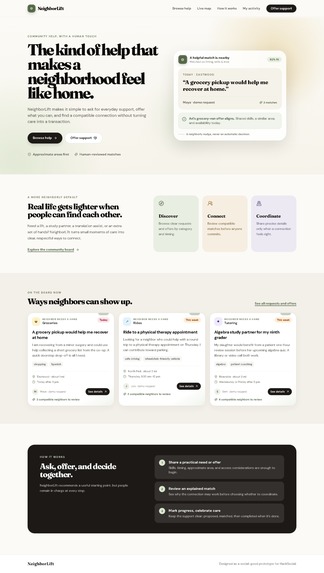
- 🧭 A community board with filtering and live-refresh states
- 🗺️ A privacy-safe neighborhood map
- 🤝 Explainable compatibility matching
- 🔐 Authenticated request and offer creation
- 👤 Personal activity history
- ♿ Accessibility-aware matching considerations
- 🧪 Demo Mode for safe demonstrations
- ⚙️ A complete full-stack architecture
- ✅ Automated tests and production validation
The current verified project state includes 29 passing Vitest tests, clean TypeScript validation, and a successful production build.
We're especially proud of the design principle behind the matching system:
The AI doesn't decide who should help whom. It helps people understand a potentially useful connection.
That distinction shaped many of our technical and product decisions.
What we learned
We learned that building a useful AI product isn't only about making the model more capable.
It's also about deciding where AI should stop.
For NeighborLift, we learned that AI can be valuable when it explains, assists, and reduces friction—but the human should remain in control of the final decision.
We also learned that privacy is part of UX, not something that should be added at the end.
Approximate locations, optional information, clear fallbacks, and understandable explanations can make an experience feel safer before a person ever interacts with another user.
Finally, keeping the matching, filtering, map, and interaction contracts consistent across the stack made it much easier to iterate quickly without losing reliability.
What's next for NeighborLift
NeighborLift is currently a prototype, so the next step isn't simply adding more features—it's learning how the product works with real communities.
Our next priorities are:
- 🤝 User research with real community organizations
- 🛡️ Moderation and reporting workflows
- 🔔 Opt-in notifications
- 🌍 Multilingual support
- 📊 Measuring real community impact
- ♿ Further accessibility improvements
- 🔐 Continued privacy and safety improvements
We deliberately don't want to invent success metrics, testimonials, or claims about real-world usage before people actually use the product.
The next stage is therefore about putting NeighborLift in the hands of real participants, learning from them, and improving the system responsibly.
The bigger idea
NeighborLift started with a simple question:
What if technology didn't just help us find information, but helped us find each other?
That's what we're trying to build—a system where technology makes it easier for people to ask, offer, connect, and help.
Built With
- accessibility
- ai
- css
- drizzle
- express.js
- gpt-5
- learning
- machine
- maps
- mysql
- node.js
- oauth
- orm
- react
- tailwind
- trpc
- typescript


Log in or sign up for Devpost to join the conversation.