Inspiration
In spite (and perhaps, because) of the amount of information overload we have in the current times, we often do not know what's happening in and around us. Most Americans neglect their responsibilities as consistent voters and well-informed citizens, but in our defense, the electoral system, government policies, and the day-to-day of governance -- how laws or new developments can affect us -- aren't communicated well. In the recent midterm primary election last year, California had a 16% voter turnout, which is very concerning!
What NeighborhoodGovernance Does
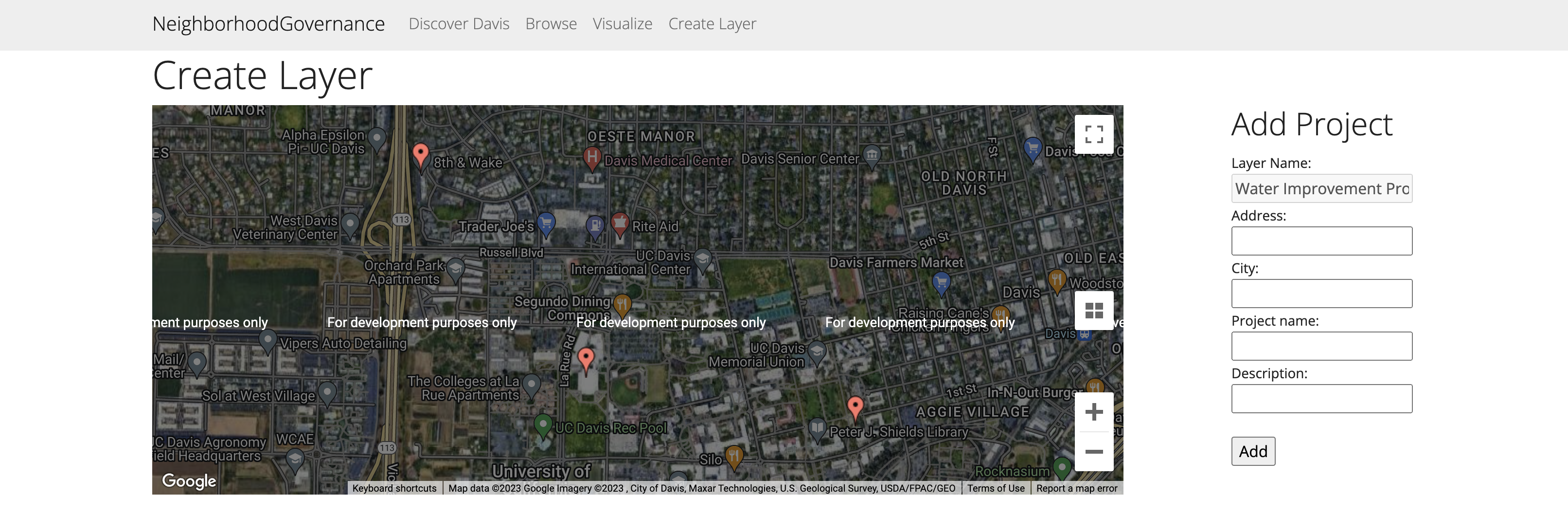
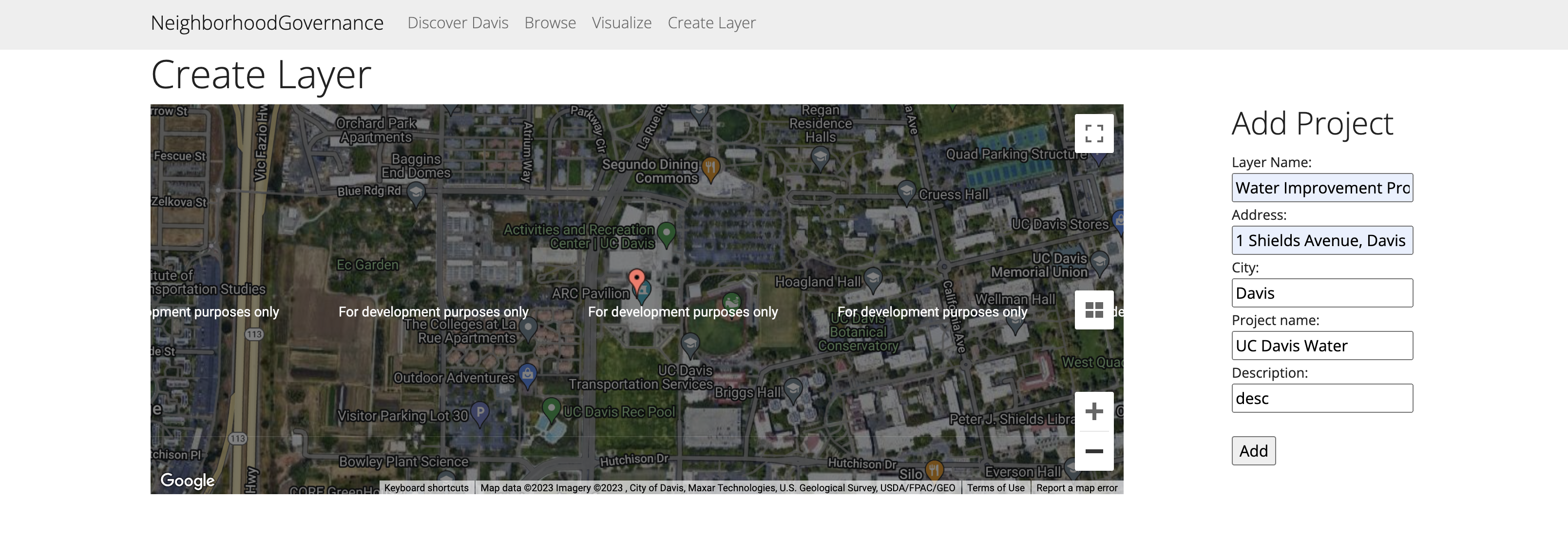
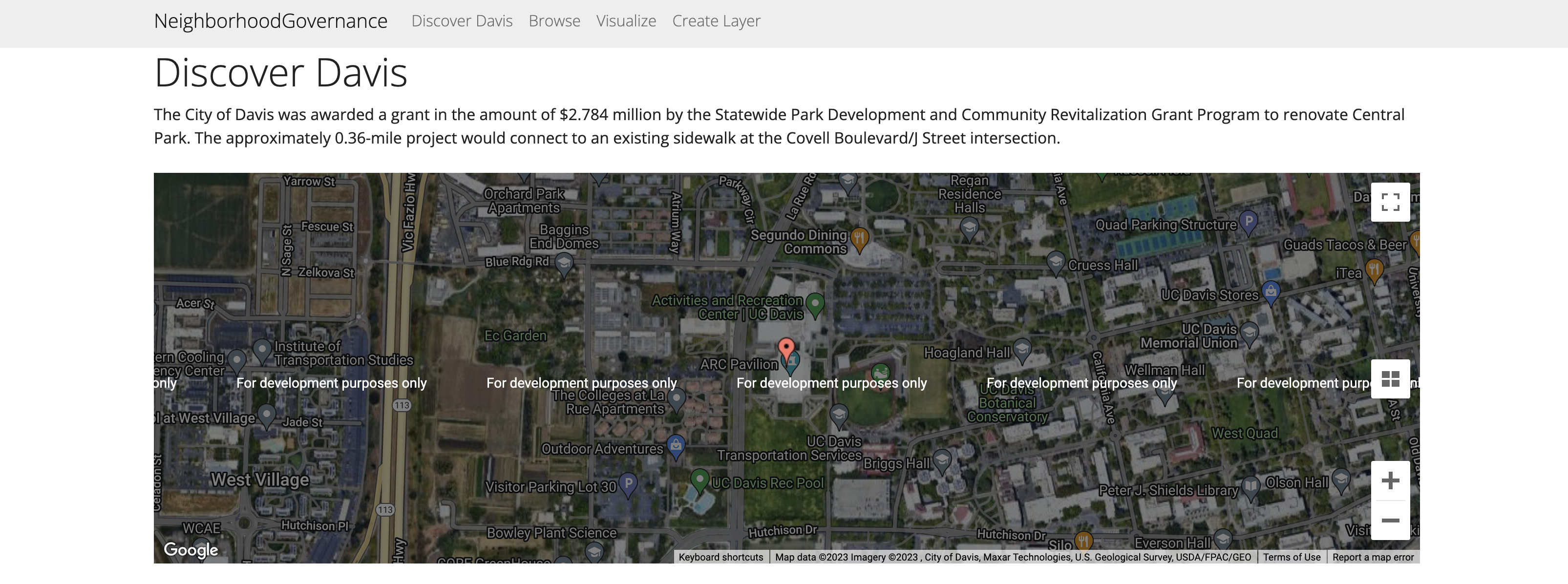
This initiative brings together administrators and citizens to create a community of constant feedback, thereby making local policy more comprehensible and of interest to a resident of a particular locale. There are two roles in this initiative, one is a 'city official' and the other is a 'concerned citizen'. The 'city official' can create policies. For example: currently the 'East Covell Bike Path Project' is being undertaken by the city of Davis.
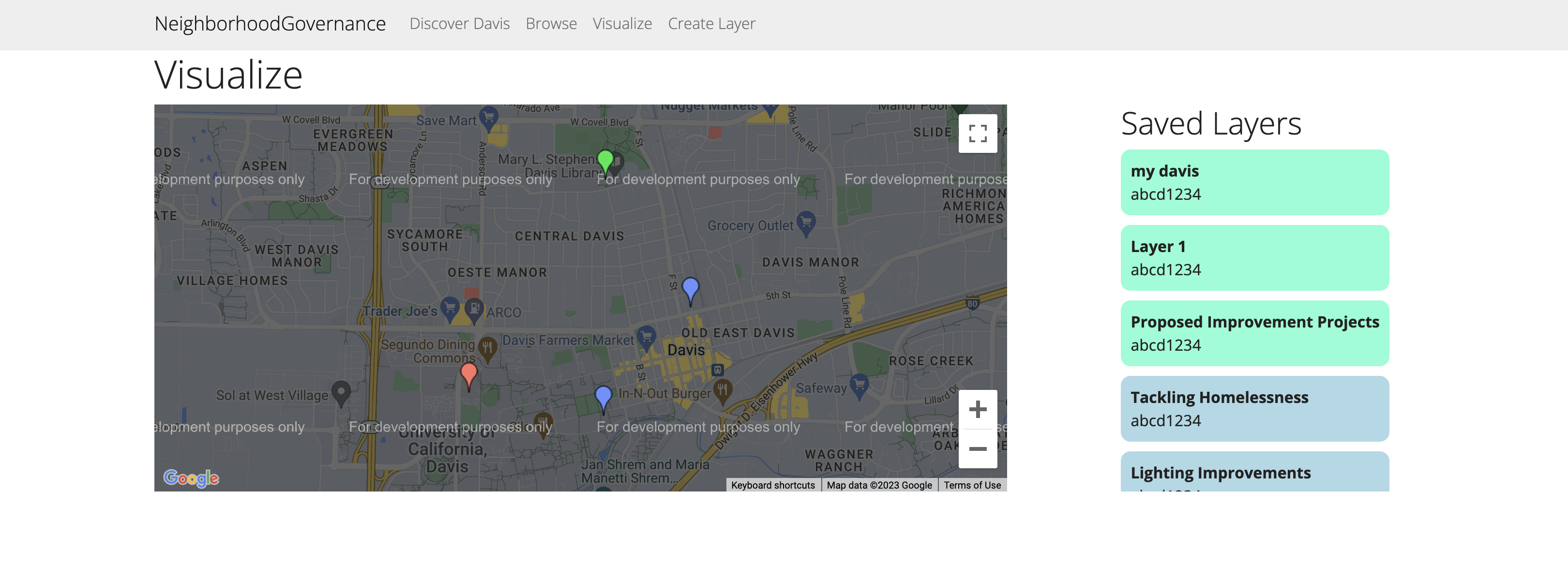
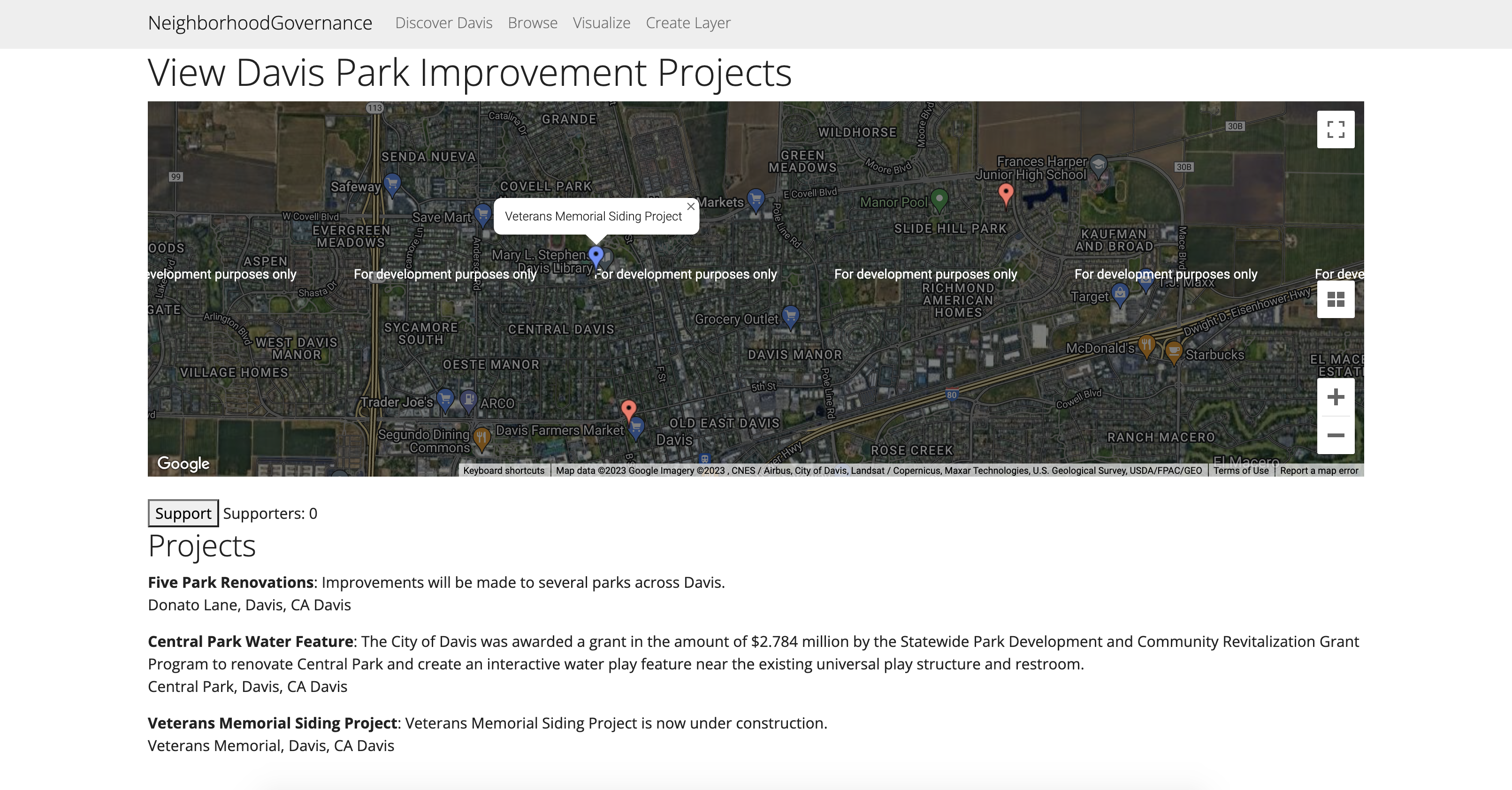
If Davis onboarded to our website, a city official would be able to create and manage the status of this project through a form -- whether it is ongoing, who has been contracted for construction, how much money has been budgeted towards this goal, and whether it is on track to completion. We add this information to an interactive map of the city! Multiple projects can be added to one map. Every local resident using the website would be able to save or view the map to understand how improvement projects might affect their day-to-day lives, whether elected officials are keeping their promises, and provide support to longer-term threads that tie projects together into a map -- in one, centralized application.
Functionality Details
We have been able to build a fully functional prototype. The back-end is built in Flask/Python which uses Atlas MongoDB as a NoSQL database. The front-end is built in React and uses Google Maps API to create an interactive map. Users create 'projects' and add them to a 'layer'. A 'layer' consists of multiple projects part of the same initiative. Other users can 'support' layers that they like and also 'save' them for future reference. We use REST APIs to perform CRUD operations.
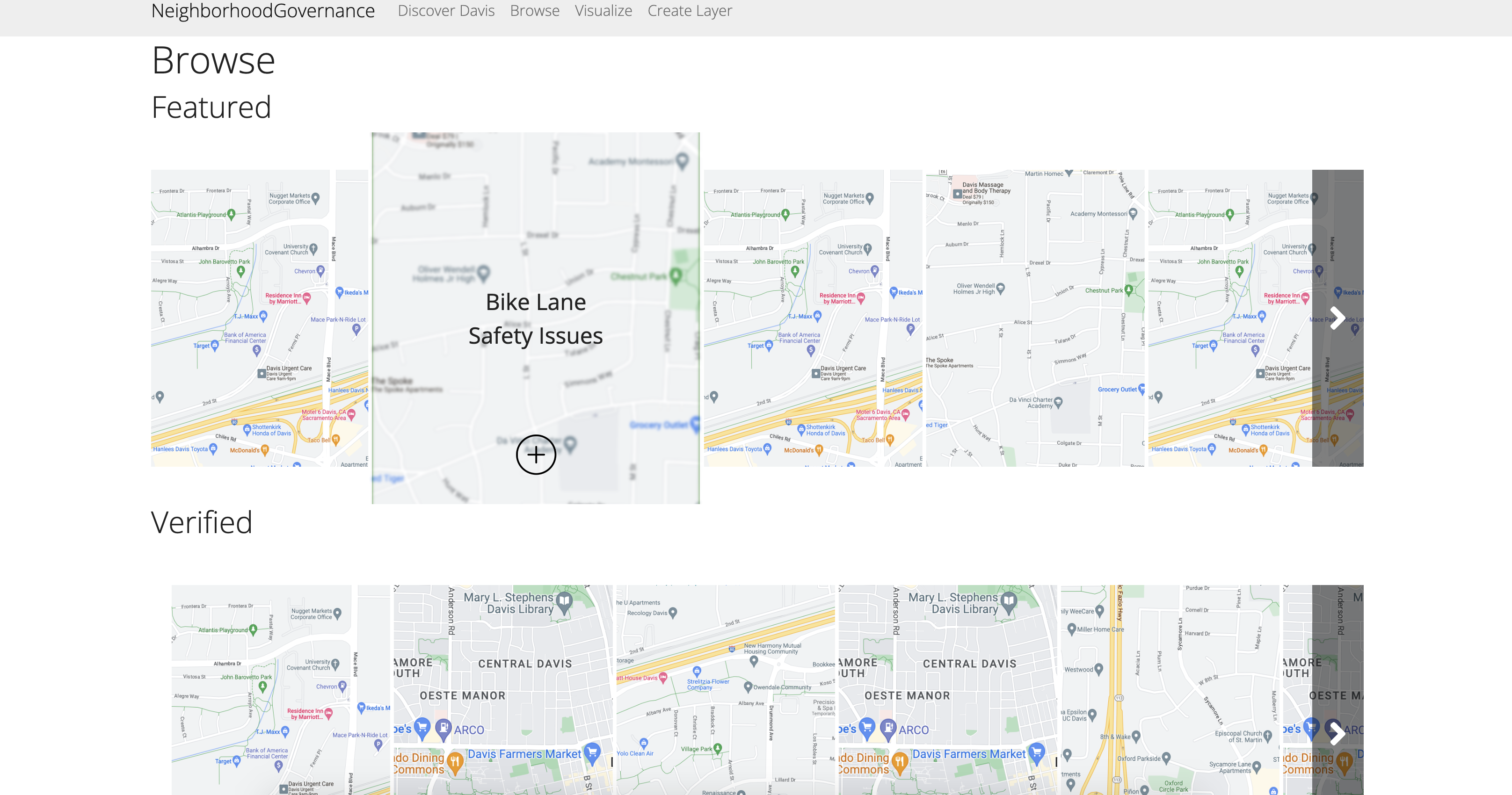
We also have other integration for converting addresses to (latitude, longitude), finding coordinates in a given radius and NLP text-summarization for providing projects tl;dr's! We also implemented a scoring algorithm to create a featured pick-list for users, so they aren't overwhelmed with maps and proposed projects -- initiatives with a lot of support filter to the top of the rankings.
Challenges
It was very challenging to find projects around a particular location considering the number of projects that can be present. It was also our first time doing text-summary, and had to jump a bunch of hoops to get it to work.
'Layers' and 'Projects' are tightly coupled logically and therefore decoupling them for particular APIs needed some problem solving.
Accomplishments that we're proud of
- A fully functional website, with complete back-end integration for CRUD operations
- Integrations with cutting edge technology to provide a better user experience
- Tackles a very overlooked problem in our society
What we learned
- geospatial encoding and operation on them.
- REST APIs with flask/python
- NLP as a service
- Communication and teamwork
What's Next for NeighborhoodGovernance : A Davis Collective
This particular project has a very broad scope, as it can evolve into a collective effort in fostering better understanding of local policies. This would require support from various government agencies involved in the decision making process.
- The first step towards will be to communicate this idea to the city representative and collect their opinions.
- We could also add functionalities to comment on initiatives (on top of indicating support via upvotes), allowing officials to easily determine the pulse of the public.
- We could collect data on how long projects have been running or where budget is allocated to better understand the effectiveness of the administration.

Log in or sign up for Devpost to join the conversation.