Inspiration
Did you know that during their lifetime, the average person leaves $1M on the table simply because they don't negotiate? With over 50% of U.S. workers failing to negotiate their starting salary, many leave significant money on the table. That is exactly why we built NegotiateAI, a full-stack, AI-powered salary negotiation coach designed to help candidates know their worth, practice their pitch, and generate a customized negotiation script.
What we built and how we built it
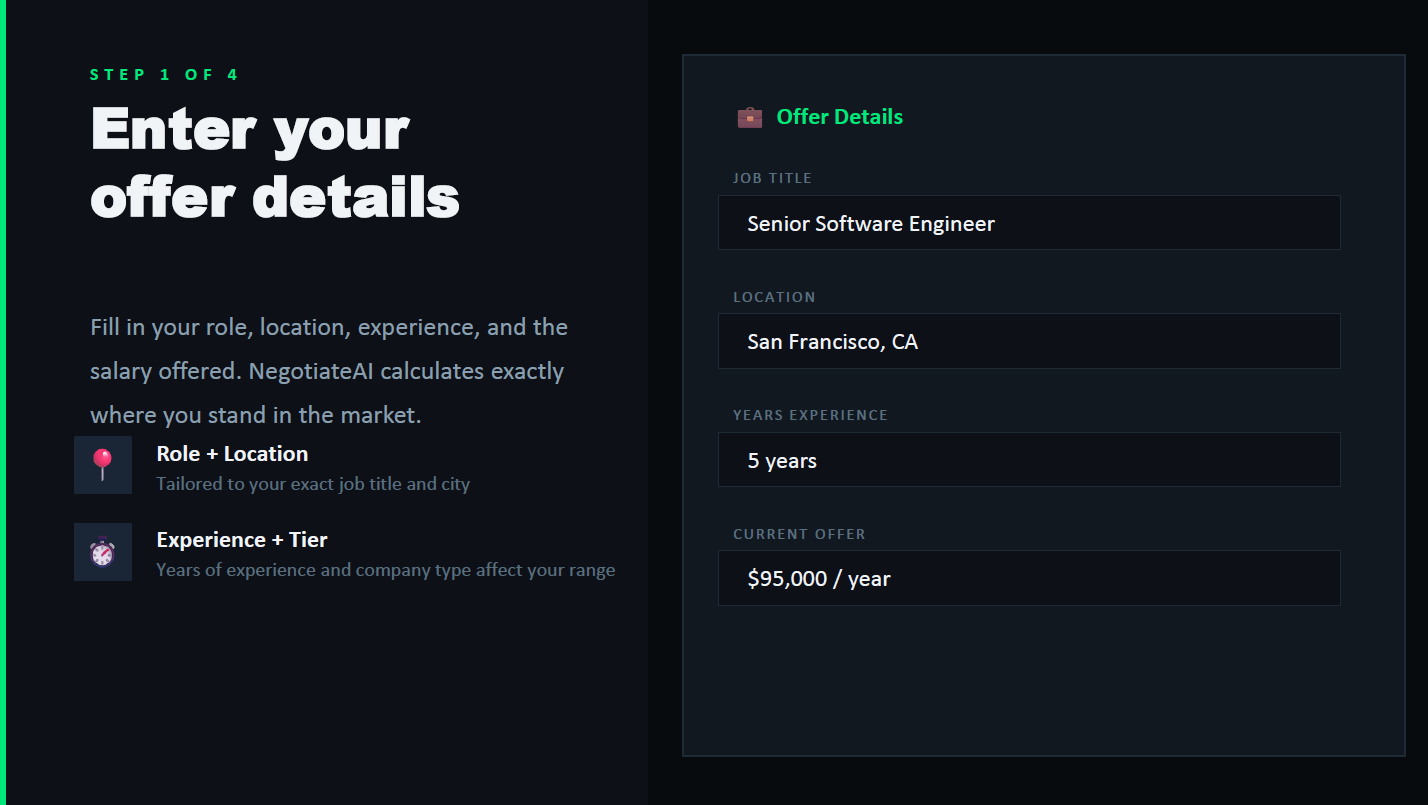
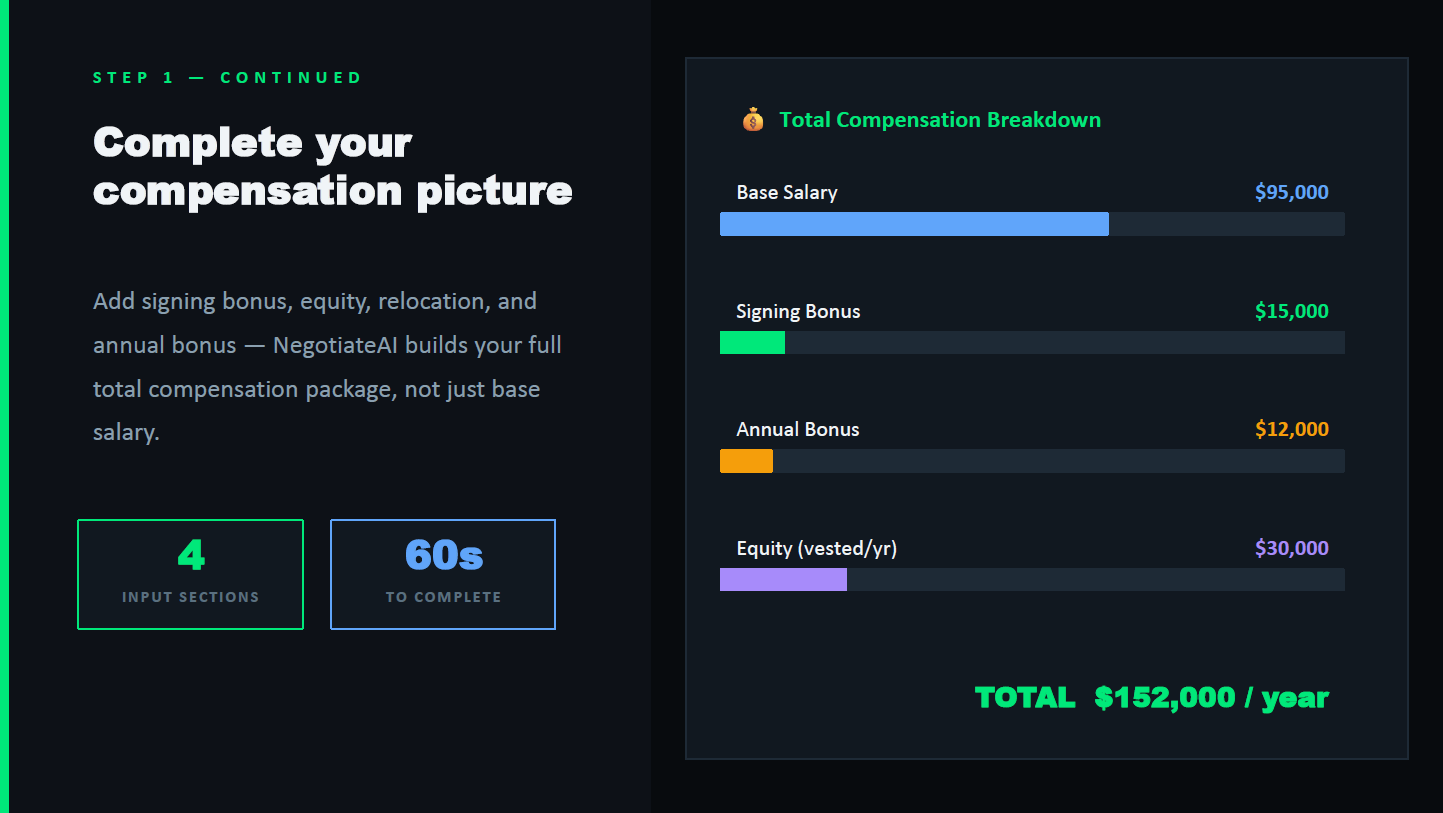
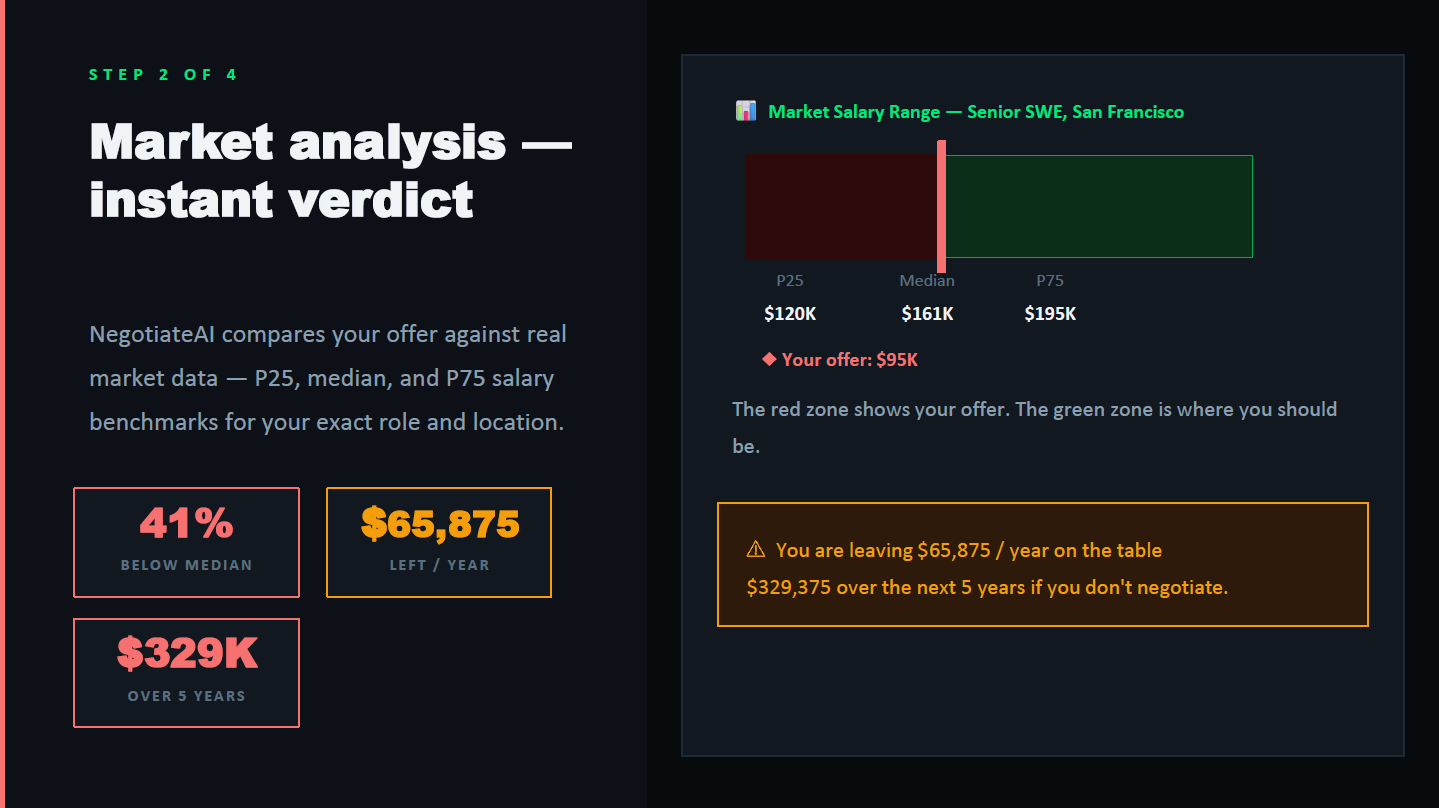
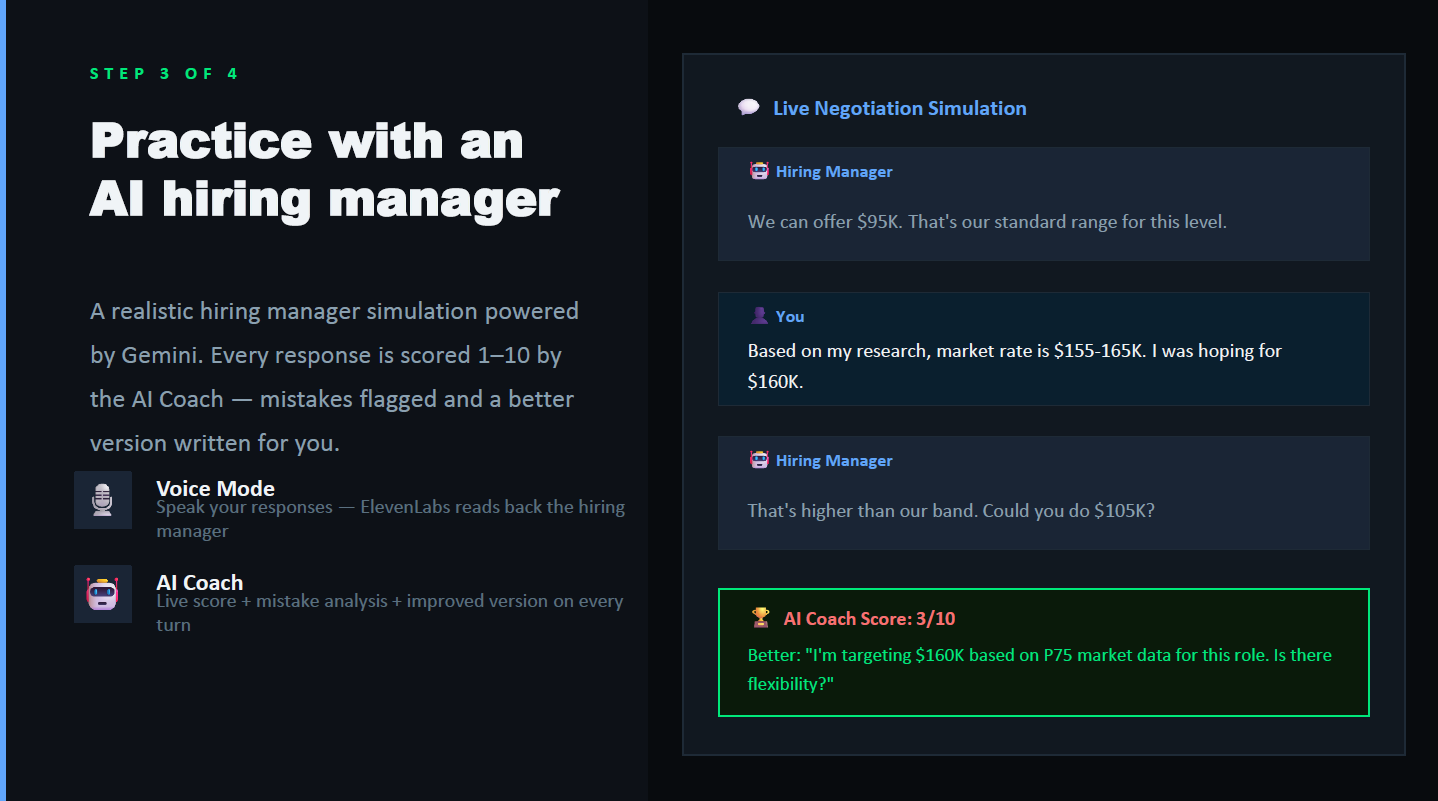
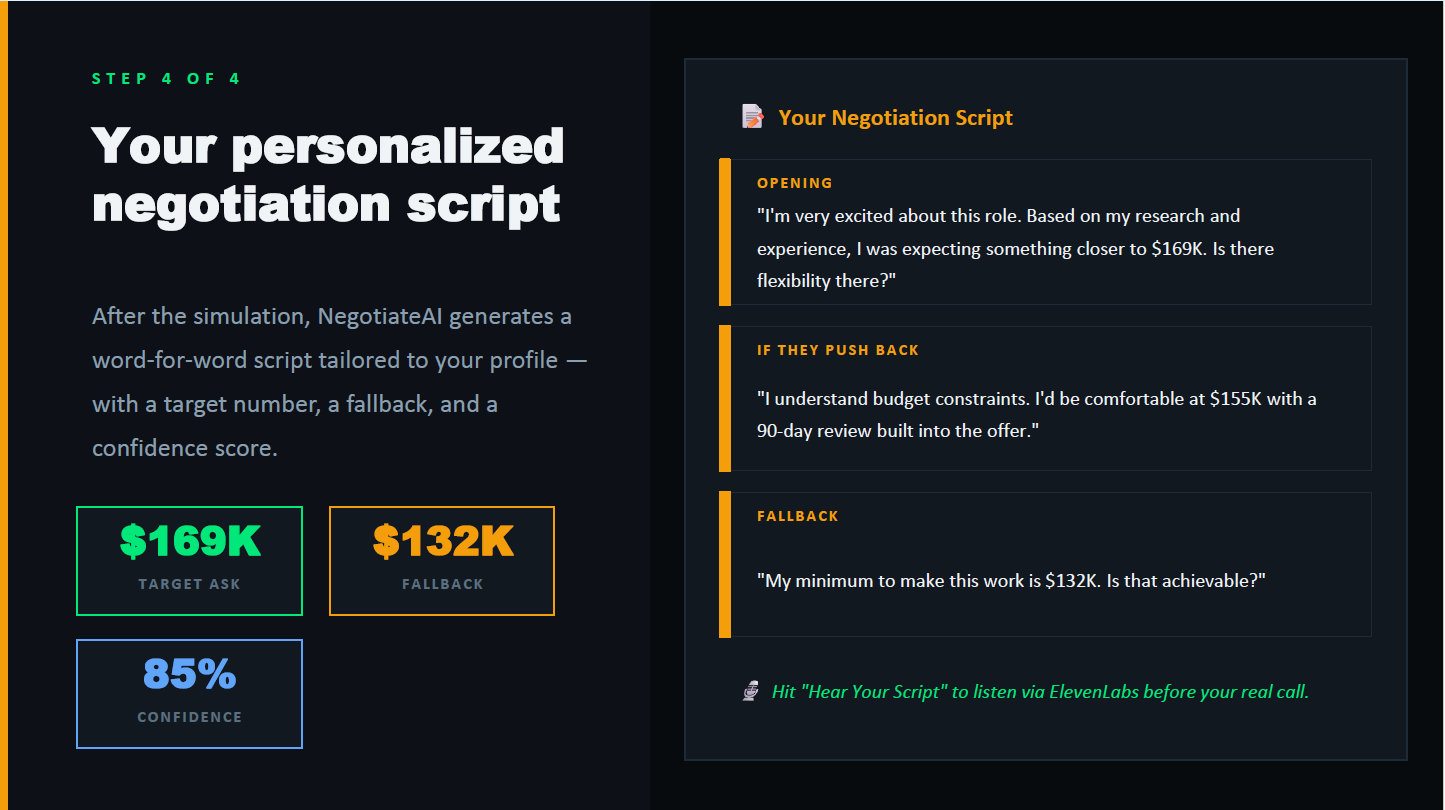
We developed a comprehensive four-step platform consisting of Profile Input, Market Analysis, a Live Negotiation Simulation, and a personalized Script Generator. Users input their offer details and background, and our system compares them against market data, adjusting for location and company tier, to show exactly how much money they might be leaving on the table. Then, they enter a live, multi-turn negotiation simulation where they practice bargaining against an AI hiring manager, receiving real-time tactical coaching on every single message they send. Finally, the system reviews the practice transcript to generate a customized, word-for-word negotiation script with specific opening statements, target numbers, and fallback pivots.
What makes our project novel
Our approach stands out because of the strict realism and architecture of our AI engines. Our Negotiation Engine uses a dynamic state-machine that transitions from exploring to negotiating, converging, and finally closing. We built strict acceptance gating into the AI, ensuring that conditional statements like "I'll accept if I get X" are properly treated as counter-offers rather than premature deal closures.
Additionally, our real-time coaching system is highly novel. We implemented a three-layer architecture: a pre-screener that instantly catches dismissive or profane inputs, a rule-based fallback, and a highly calibrated Gemini LLM evaluator. The coach uses a strict 1-10 scoring rubric that penalizes passive language and rewards strategic anchoring, specific data citation, and confident value framing.
The tools we used and why
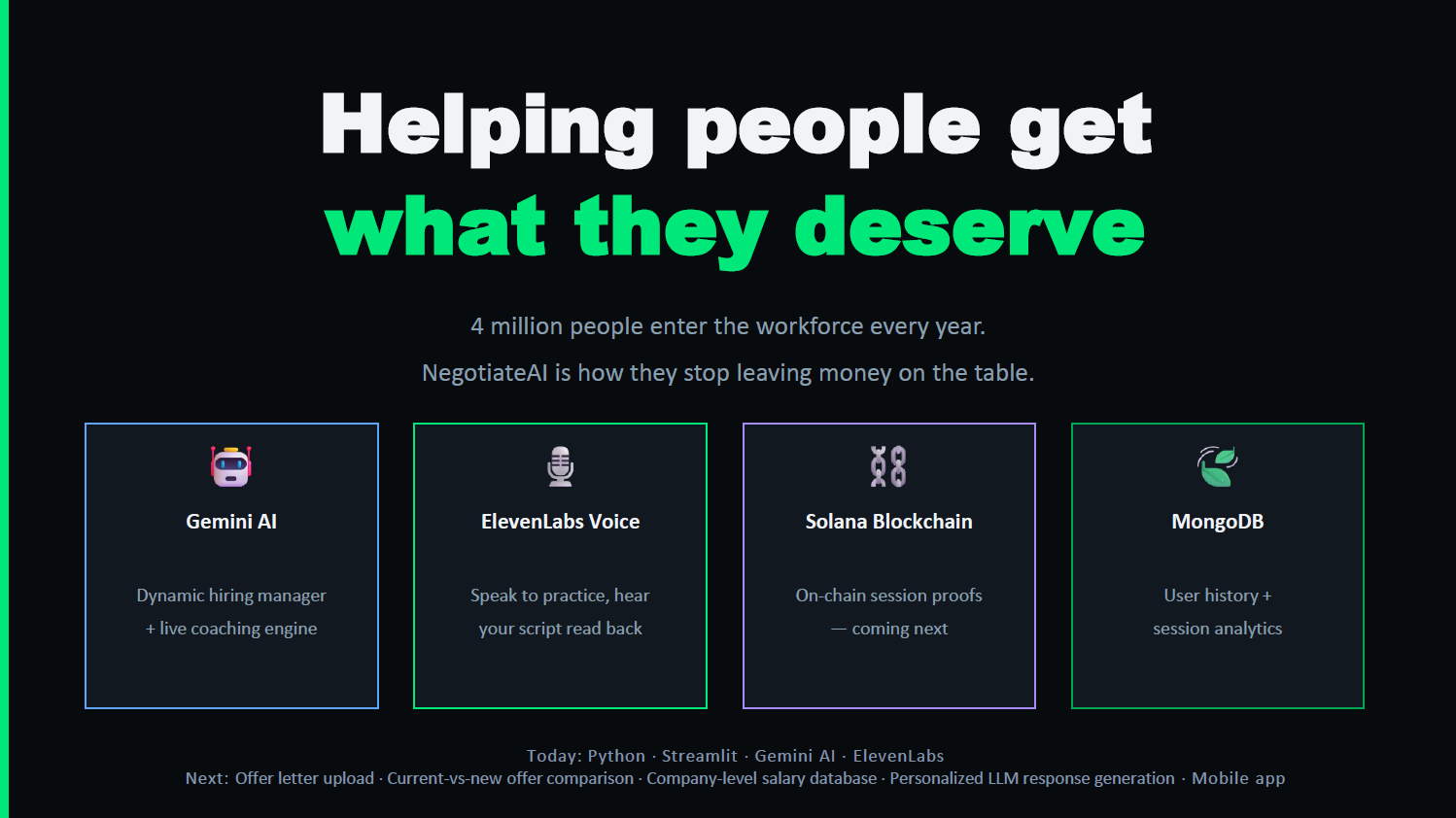
- Streamlit & Plotly: We used these to rapidly build a sleek, responsive frontend with live state tracking and progress indicators.
- Google Gemini API: Gemini powers the core intelligence, driving the context-aware hiring manager roleplay, the strict semantic coaching analysis, and the personalized script generation.
- ElevenLabs: To make the simulation incredibly immersive, we integrated ElevenLabs for two-way voice capabilities, utilizing Text-to-Speech for the hiring manager's responses and Speech-to-Text for the user's microphone input.
- MongoDB: We used MongoDB on the backend to reliably save negotiation sessions, cache salary data, and compute aggregate outcome statistics.
- Solana Blockchain: Finally, we used the Solders library to connect to the Solana devnet, allowing us to generate hashes and store anonymized negotiation outcomes on-chain as a novel "proof of salary data".
The challenges we faced
One of our biggest hurdles was taming the LLM to behave like a realistic, strict hiring manager. We had to engineer very specific hard rules to ensure the AI never revealed its maximum budget, didn't repeat its arguments, and remained professional even if the candidate used profanity. Furthermore, to ensure high reliability, we had to build complex fallback mechanisms, such as template-based scripts and rule-based coaching, in case the primary LLM layers failed or timed out.
Future Work
Looking ahead, our next steps include upgrading our market value estimation engine from static mock data to live API feeds. The platform will support automated offer letter upload to replace manual input, enable direct comparison between current and new job offers, incorporate a company-level salary database instead of generalized company tiers, and extend the LLM from a coaching role to generating fully personalized negotiation responses.


Log in or sign up for Devpost to join the conversation.