Inspiration
Every day, perfectly usable food, clothing, school supplies, and essential resources are thrown away while shelters, food banks, schools, and nonprofits struggle to find enough donations. The problem isn't a lack of generosity—it's a lack of communication. Current donation systems are fragmented. Organizations rely on outdated wish lists, social media posts, and donation drives that often fail to reach the right people at the right time. Meanwhile, donors have resources they want to give away but don't know who needs them most. We asked ourselves one question: What if donating was as easy as ordering food online? That became NeedLink—an intelligent donation network that proactively connects donors, organizations, businesses, volunteers, and communities before resources go to waste.
What it does
NeedLink is an AI-powered community resource platform that helps donations reach the people who need them most.
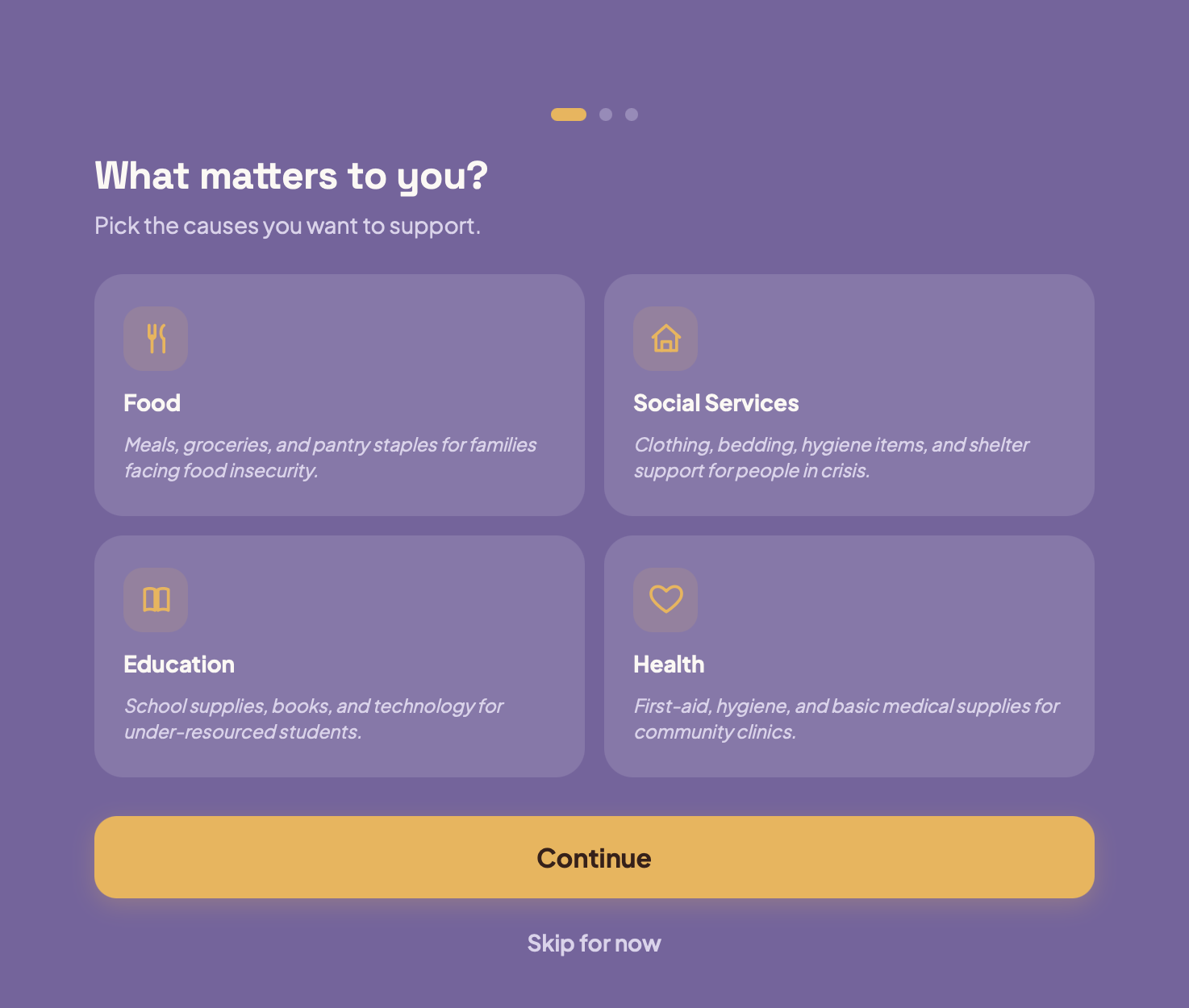
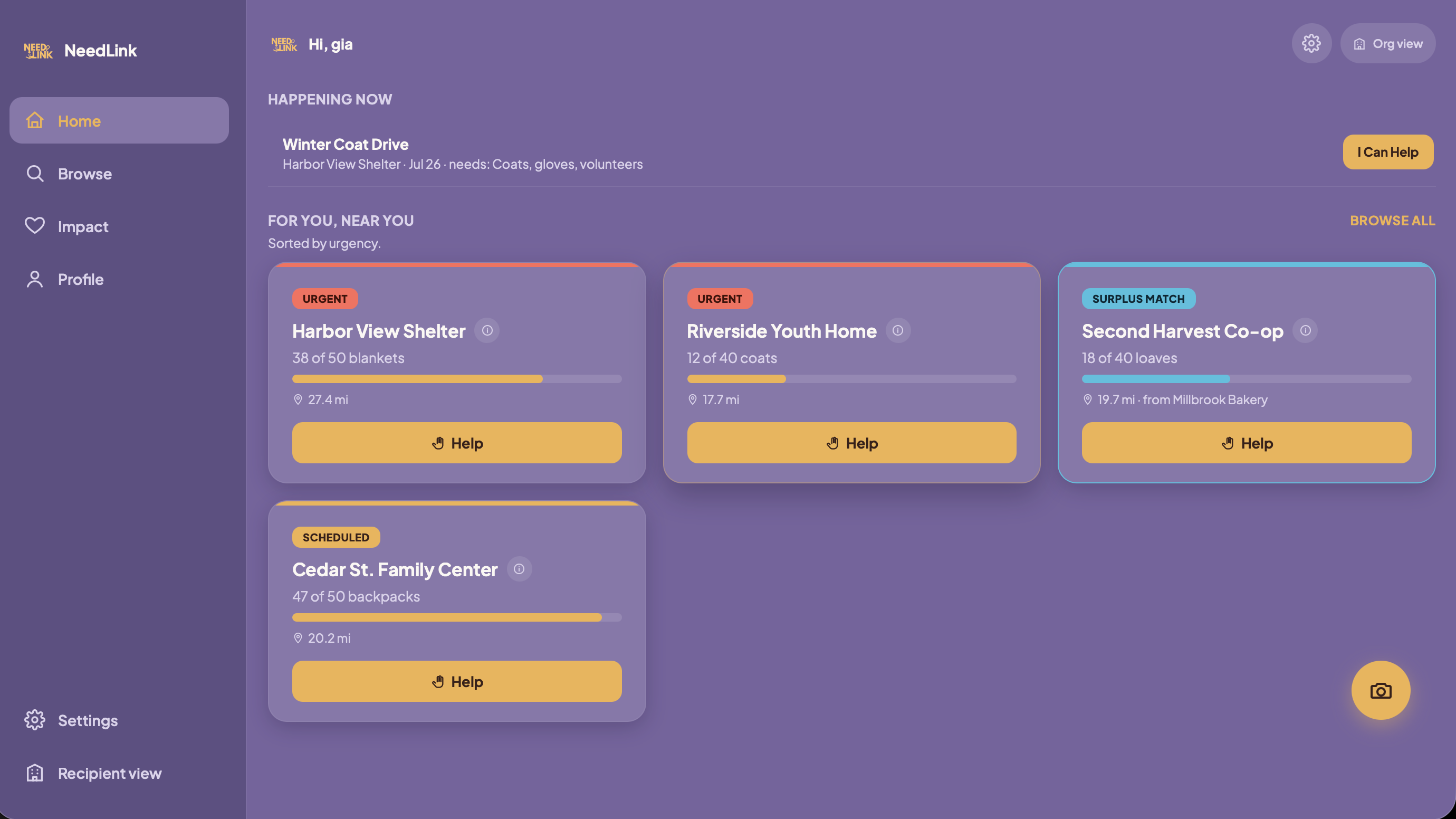
For donors, NeedLink automatically recommends nearby organizations based on location, urgency, and community needs. Users can browse donation requests, volunteer opportunities, community events, and donation drives through one streamlined interface.
One of our favorite features is AI Donation Scanning. Instead of manually entering donated items, users simply take a picture. Our computer vision system identifies the items, estimates quantities, and adds them to the donor's inventory before matching those resources with organizations requesting them. Organizations can easily post requests by specifying:
- items needed
- quantity
- urgency
- pickup information
- additional details
NeedLink then automatically distributes those requests to nearby donors, volunteers, schools, businesses, and nonprofits.
We also introduced Community Alerts & Events, allowing organizations to advertise donation drives, volunteer events, fundraisers, and emergency requests. Nearby users receive personalized alerts based on their interests and location, creating a real-time community response network.
Perhaps our most innovative feature is Surplus Sensing, which predicts excess inventory from businesses before it becomes waste. Rather than waiting for organizations to ask, NeedLink proactively recommends where surplus food or supplies should go using predictive AI.
How we built it
NeedLink combines modern web technologies with an intelligent multi-agent AI architecture. Our frontend was designed around one philosophy: every page should have one obvious next action. We created a clean, minimal interface with progressive disclosure so users never feel overwhelmed while still having access to powerful features.
Behind that simple interface is a network of specialized AI agents working together:
- Forecasting Agent predicts organizational needs before requests are posted.
- Donor Matching Agent recommends the highest-impact donation opportunities.
- Surplus Sensing Agent detects excess resources from businesses.
- Capacity Agent ensures organizations can realistically receive donations.
- Fraud Verification Agent validates requests before they are recommended.
- Notification Governor intelligently prioritizes alerts to avoid overwhelming users.
- Reconciliation Agent combines every agent's output into one optimized recommendation.
Our AI donation scanner uses computer vision to identify donated items and estimate quantities directly from an uploaded image. Those detected items are then matched against live community requests using location, urgency, organizational capacity, and predicted impact.
The platform also includes interactive maps, dynamic filters, community messaging, organization profiles, and a reasoning trace that explains exactly how our AI arrived at each recommendation.
Challenges we ran into
Our biggest challenge was balancing technical sophistication with usability. Building a true multi-agent architecture meant coordinating several independent decision-makers while still presenting users with one clear recommendation. We spent significant time refining how agents communicate, resolve conflicts, and prioritize requests.
Another challenge was simplifying the interface. During testing, we realized our original dashboard contained too much information at once. We redesigned the experience with cleaner layouts, better visual hierarchy, expandable details, professional iconography, and fewer distractions so users always know what to do next.
Designing meaningful AI explanations without overwhelming users was another obstacle. We condensed our reasoning trace into concise summaries while still providing transparency into the recommendation process.
Finally, creating an intuitive donation flow—from scanning an item to matching it with nearby organizations—required multiple iterations to ensure the process felt effortless.
Accomplishments that we're proud of
We're proud that NeedLink goes far beyond being another donation marketplace. Some of our favorite accomplishments include: 📷 AI-powered donation scanning from a single photo 🧠 Multi-agent AI recommendation engine 📍 Intelligent location-based matching 📢 Community Alerts & Events system 🗺️ Interactive donation map with urgency visualization 🤝 Organization profiles with mission statements and social links 💬 Built-in messaging between donors and organizations 📦 Surplus prediction and proactive resource allocation 🔍 Dynamic filtering and search 🧭 A polished, accessible interface that keeps complex AI hidden behind a simple experience
Most importantly, we built a system that doesn't just react to requests—it predicts community needs before resources are wasted.
What we learned
This project taught us that great AI isn't just about building smarter models—it's about creating better user experiences.
We learned that people are far more likely to contribute when donating is simple, transparent, and personalized.
We also gained valuable experience designing multi-agent systems where specialized models collaborate rather than relying on a single monolithic AI. Building communication between independent agents gave us a deeper appreciation for orchestration, decision-making, and explainable AI.
Finally, we discovered that thoughtful UI design can be just as impactful as sophisticated machine learning. Even the smartest recommendation engine won't matter if users feel overwhelmed.
What's next for NeedLink
We're excited to continue expanding NeedLink into a complete community resource network. Our roadmap includes:
- Real-time computer vision that recognizes donated items and quantities directly from a live camera feed.
- Business integrations with grocery stores, retailers, restaurants, and warehouses to automatically detect surplus inventory.
- Secure monetary donations for organizations alongside physical donations.
- Smarter predictive models using historical donation and seasonal demand data.
- Expanded Community Alerts with real-time push notifications, geofenced events, and volunteer coordination.
- AI-generated executive summaries explaining why recommendations were made.
- Partnerships with schools, businesses, and nonprofits to build regional donation ecosystems.
- Live inventory synchronization for organizations.
- Route optimization for pickups and deliveries.
- Mobile applications and public APIs that allow community organizations to integrate directly with NeedLink.
Ultimately, our vision is to make NeedLink the operating system for community generosity—connecting people, organizations, businesses, and AI to ensure valuable resources reach those who need them before they ever become waste.
Built With
- html5
- javascript
- vscode

Log in or sign up for Devpost to join the conversation.