-
-
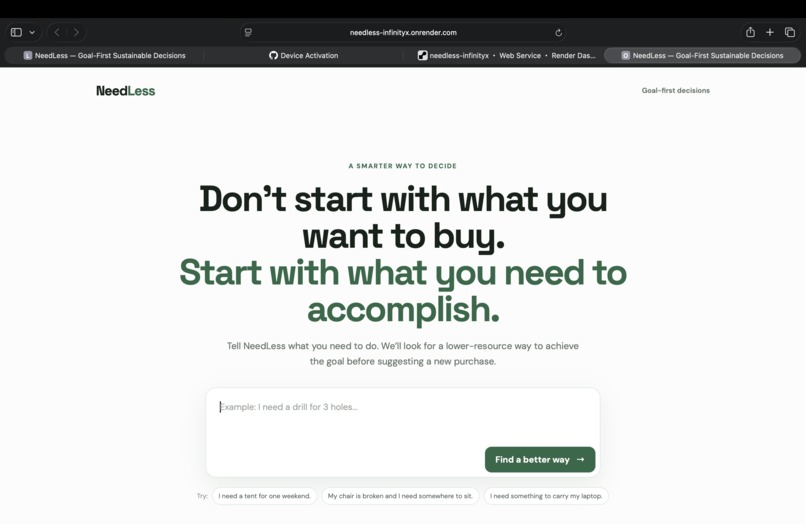
Home screen
-
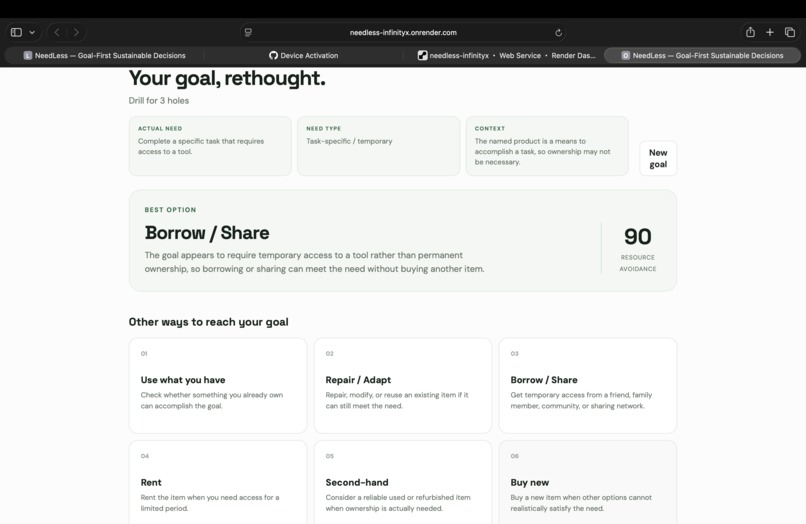
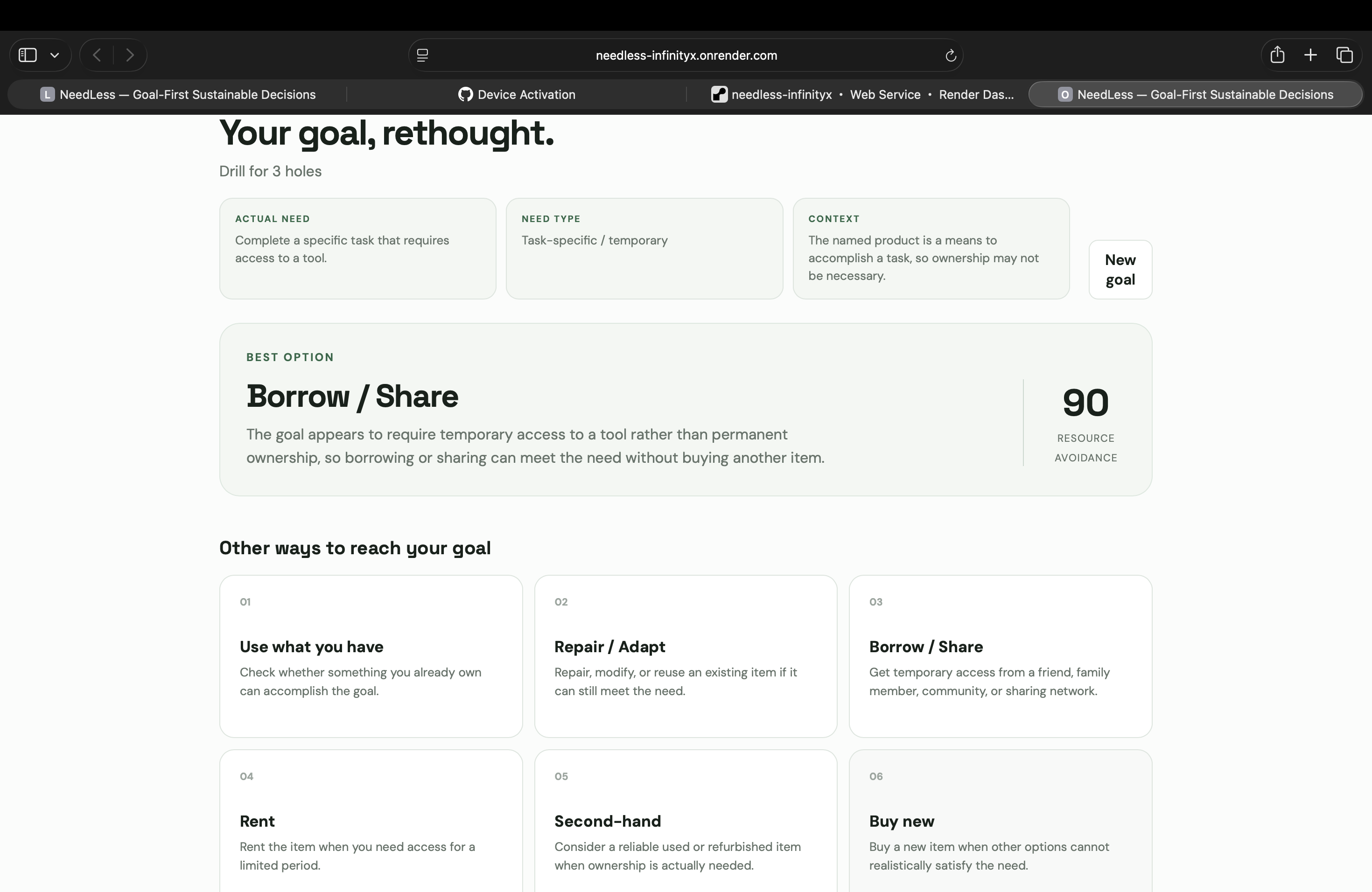
Drill result
-
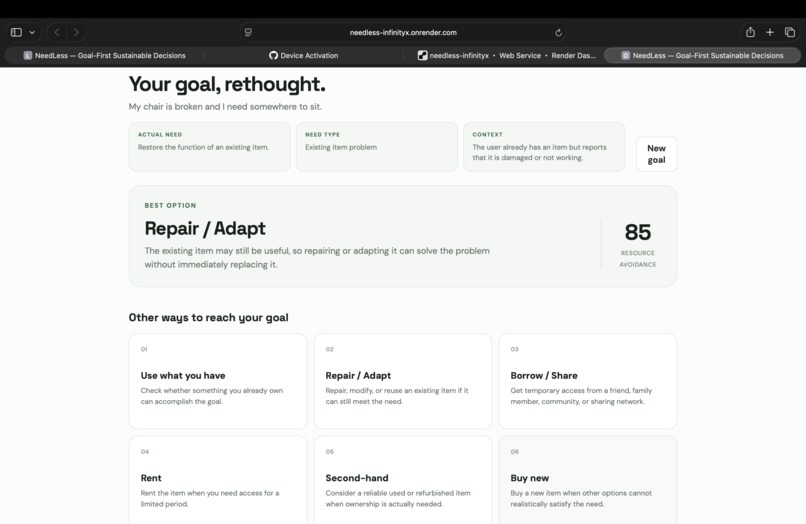
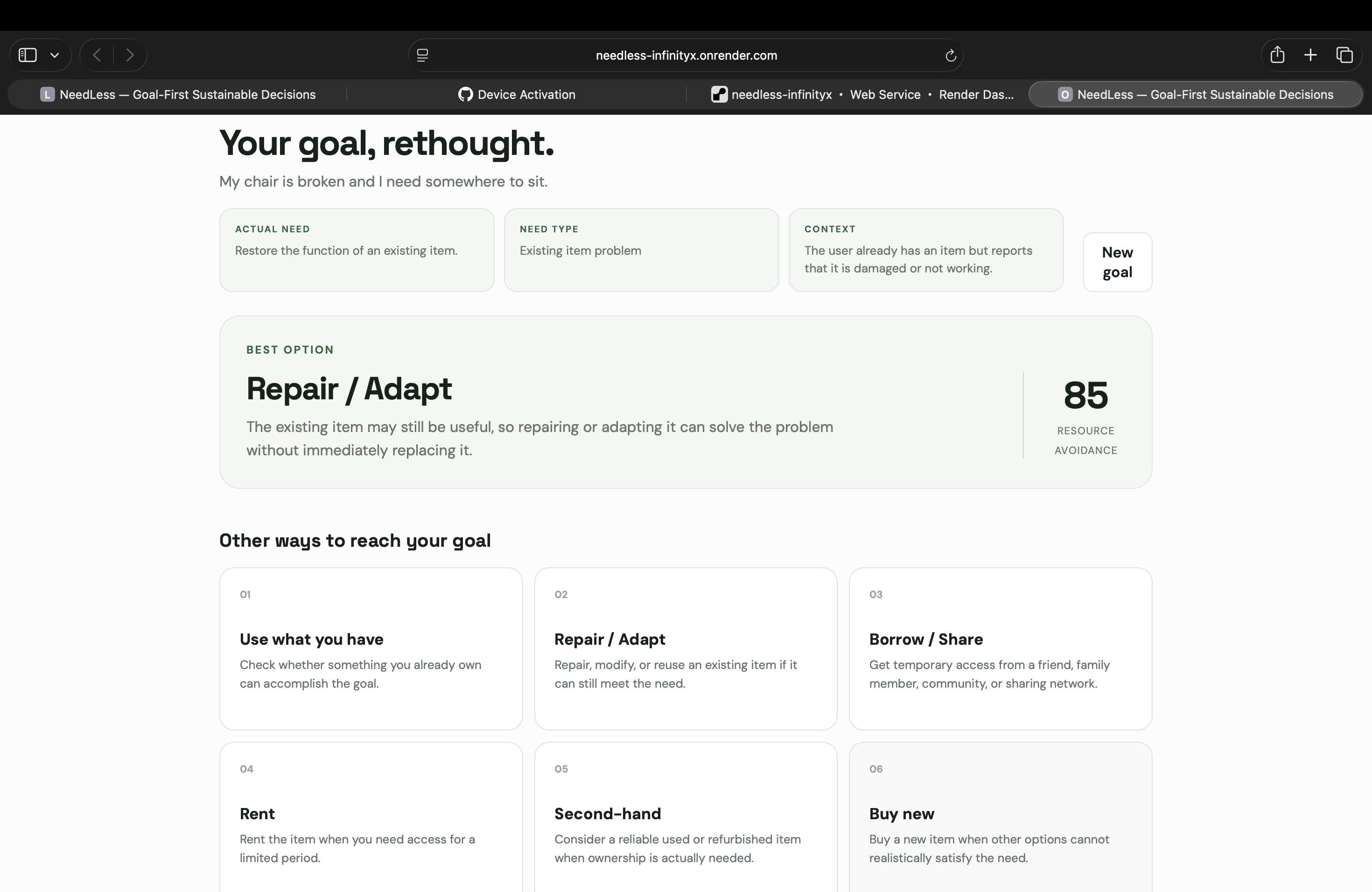
Broken chair result
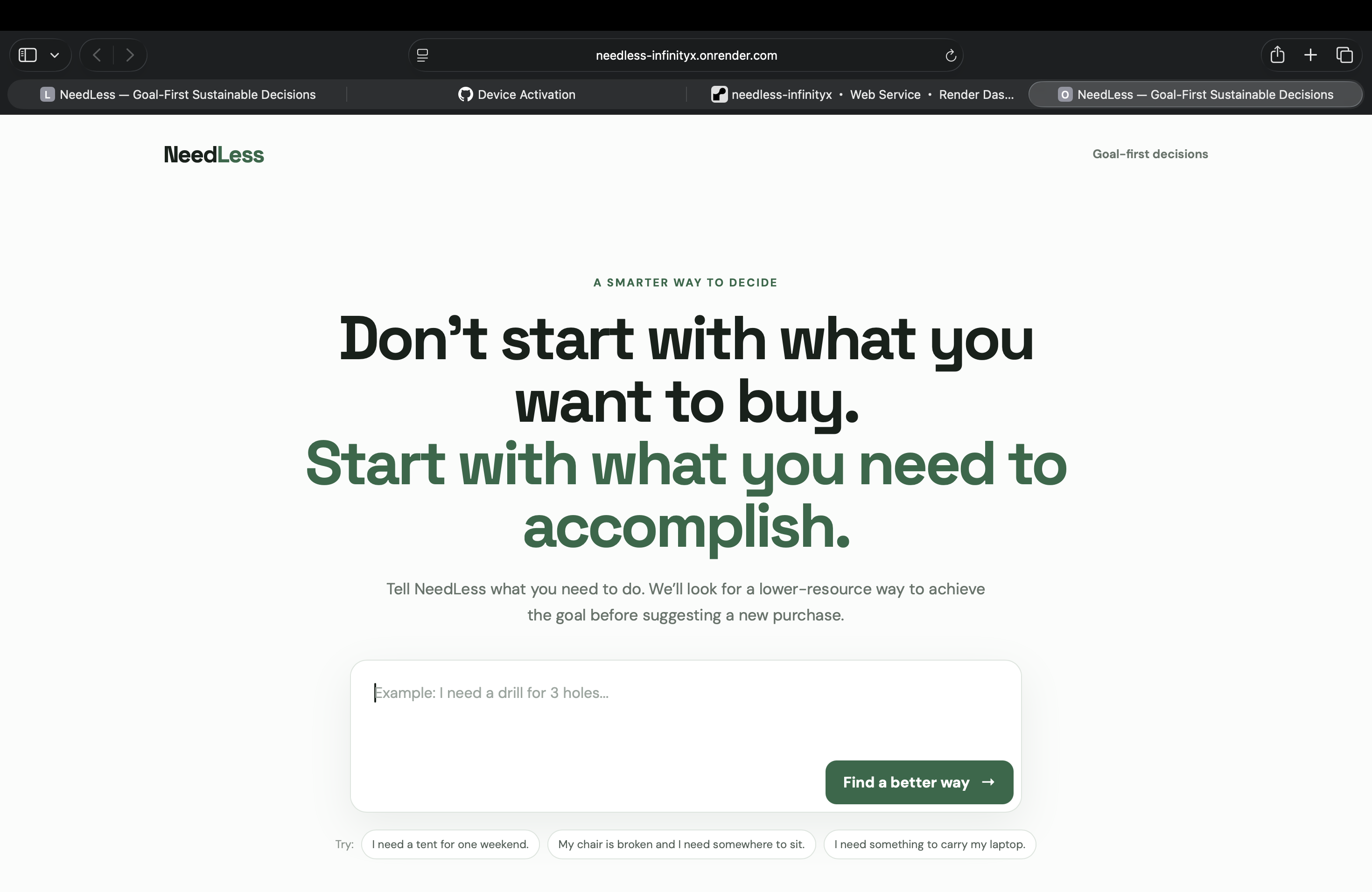
What is NeedLess?
NeedLess is a goal-first sustainable decision engine designed to help people think about what they actually need before deciding what to buy.
Instead of starting with a product, the user starts with a goal — for example, needing a drill to make a few holes, a tent for a weekend, or a solution for a broken chair.
NeedLess analyzes the goal and suggests ways to accomplish it while considering lower-resource alternatives first:
- Use what you already have
- Repair or adapt an existing item
- Borrow or share
- Rent
- Consider second-hand or refurbished options
- Buy new when it is actually needed
Why we built it
Many everyday decisions begin with a product: "I need a drill" or "I need a tent."
But sometimes the real need is simply the task that the product helps accomplish.
We wanted to explore a different decision flow: start with the goal, understand the actual need, and then consider how to accomplish it without automatically assuming that buying something new is necessary.
How it works
The user describes their goal in natural language.
NeedLess uses AI to understand:
- The user's actual need
- Whether the need is temporary, occasional, or longer-term
- Whether the user already has an existing item
- Whether repair or adaptation may be relevant
- Whether borrowing, sharing, or renting could work
- Whether second-hand or refurbished options could be considered
- Whether buying new may be necessary
The system then presents a recommended option, an explanation, and alternative ways to achieve the goal.
The Resource Avoidance Score shown in the prototype is a decision-support indicator used to communicate the result. It is not intended to be a scientifically validated environmental measurement.
How we built it
NeedLess was developed as a solo project using:
- HTML
- CSS
- JavaScript
- Node.js
- Express
- Google Gemini API
- GitHub
- Render for deployment
The frontend provides the goal-first interface, while the backend sends the user's goal to the AI model and converts the response into a structured decision.
We also added deterministic decision rules to make common cases more consistent, such as temporary tool needs, broken items, and one-time tasks.
What we learned
Building NeedLess helped us learn how to turn a broad sustainability idea into a focused, usable product.
A major learning was that AI recommendations become more useful when the problem is structured around the user's actual goal rather than simply asking an AI to recommend a product.
We also learned about connecting a frontend to an AI-powered backend, handling structured AI responses, deploying a Node.js application, and testing the system with different real-world scenarios.
Challenges
One challenge was making the AI response useful instead of generic. We addressed this by defining a structured decision process and combining AI reasoning with deterministic rules.
Another challenge was keeping the project practical. Instead of trying to build a complete marketplace or sharing platform, we focused the MVP on the decision-making layer first.
Future possibilities
Future versions could integrate local borrowing and rental options, repair resources, second-hand/refurbished listings, personal inventory, image-based item recognition, location-aware recommendations, and more detailed environmental impact data.
NeedLess is currently a prototype exploring how a goal-first approach can change the way people think about everyday consumption decisions.

Log in or sign up for Devpost to join the conversation.