-
-
Thumbnail
-
Architecture
-
Results
Inspiration 🎯
Search engines assume you already know what you want. Shopping almost never works like that. You know roughly what you're after — "something warm, not too formal, I'll know it when I see it" — and you figure out the rest by talking it through with someone who actually listens.
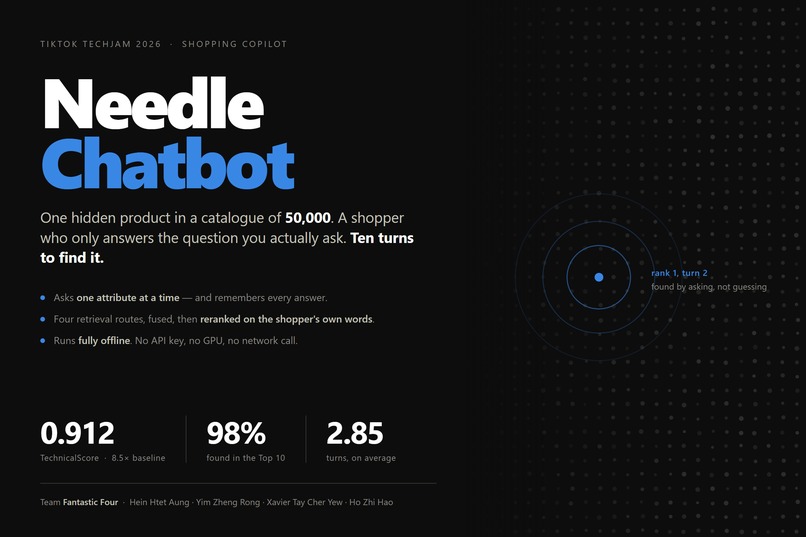
So the TechJam Shopping Copilot brief hit a nerve: there's a hidden target product inside a 50,000-item catalog, a simulated customer who only tells you what you specifically ask about, and ten turns to find it. It's Twenty Questions where the answer is one item out of fifty thousand. 🕵️
Hence the name. Needle is the classic needle-in-a-haystack problem, except you're allowed to talk to the haystack — and the whole trick is knowing what to ask it. 🪡
The starter kit scored 0.107. It was completely stateless — every turn it took the incoming message, ran one keyword search, and forgot everything. A customer who said "a key requirement is: cotton" on turn 1 got the same answer on turn 5. We wanted to know how far a genuinely conversational agent could go. 🚀
What it does 💡
Needle holds a real conversation to narrow 50,000 products down to one. Every turn it asks about exactly one attribute, absorbs the answer into persistent session state, and re-ranks the entire catalog against everything the customer has said so far — not just their latest message. The session ends the moment the target product appears in its top ten.
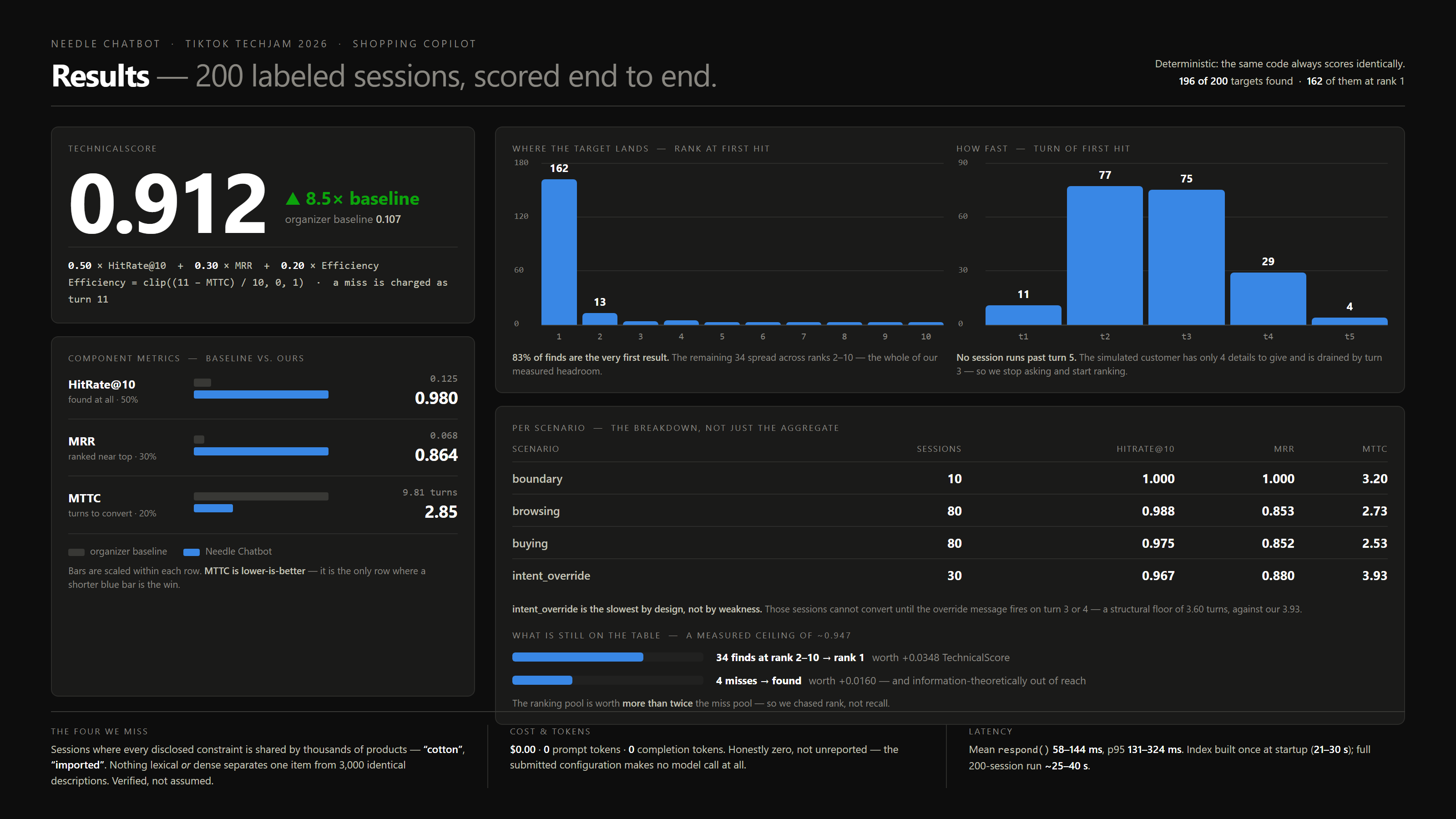
| Metric | Starter kit | Needle | Improvement |
|---|---|---|---|
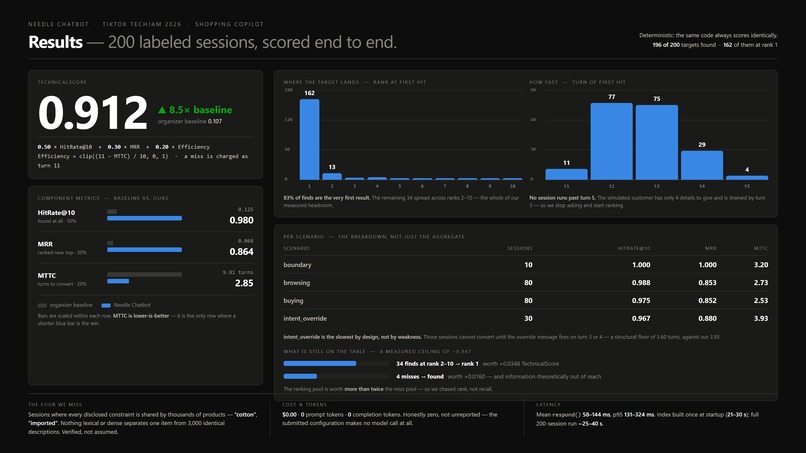
| HitRate@10 — did we find it at all? | 0.125 | 0.980 | 7.8× 📈 |
| MRR — how near the top? | 0.068 | 0.864 | 12.7× 🔝 |
| MTTC — turns taken (of 10 allowed) | 9.81 | 2.85 | 3.4× faster ⚡ |
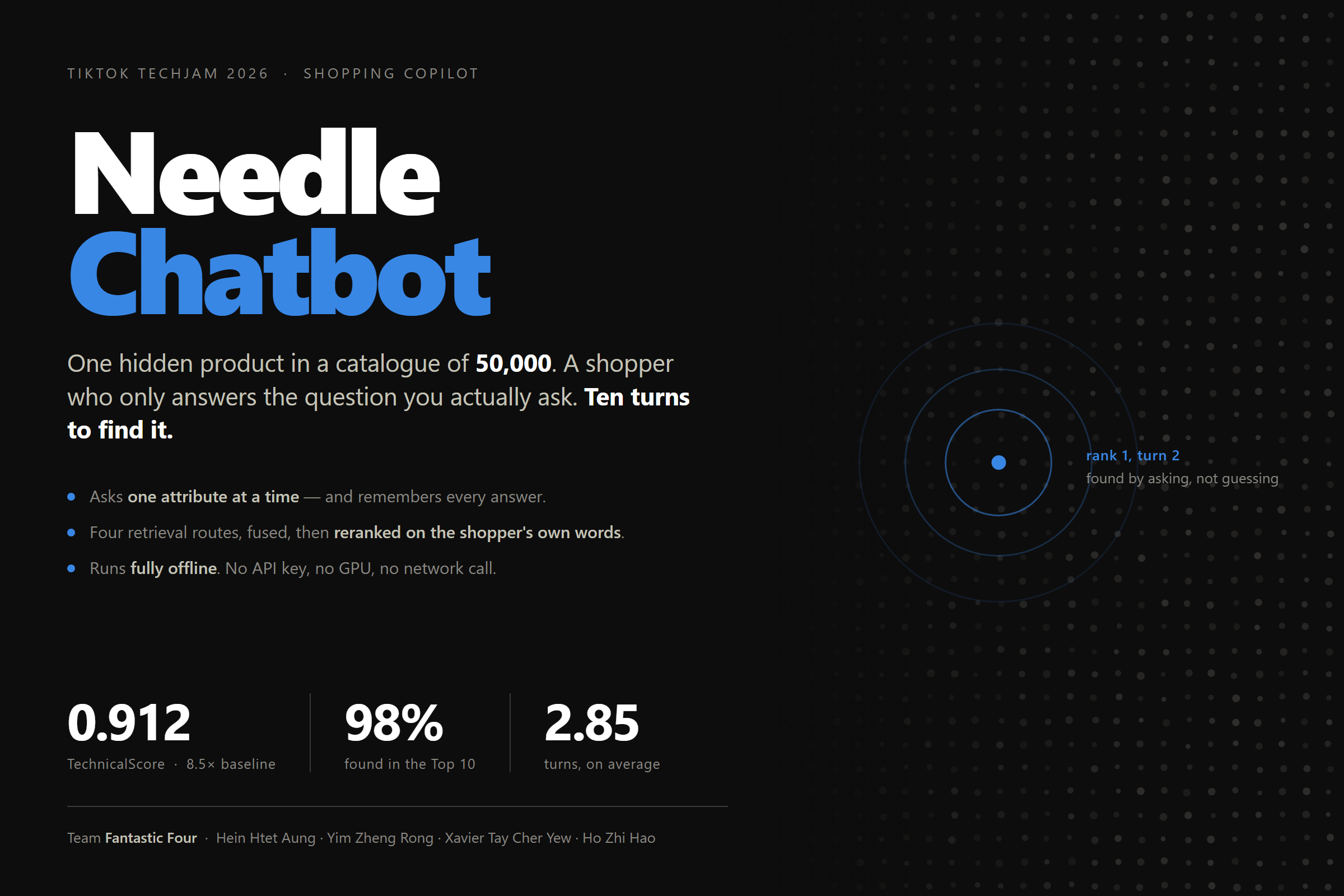
| TechnicalScore (official) | 0.10671 | 0.912205 | 8.5× 🏆 |
196 of 200 conversations solved, usually within three turns — and in 162 of those the right product is sitting at position 1.
Per-scenario HitRate@10: boundary 1.00 · browsing 0.9875 · buying 0.975 ·
intent_override 0.9667. No scenario is being carried by another. ✅
And it runs entirely offline. No LLM call, no API key, no network access, no pretrained weights
on disk. Retrieval is an in-memory SQLite FTS5 index plus LSA embeddings computed at startup from
the catalog itself. Reported token usage is an honest 0, not an unreported one. Cost: $0.00.
That was a deliberate call — judging may run with the network disabled, so we made the offline path
the primary one instead of a fallback.
How we built it 🛠️
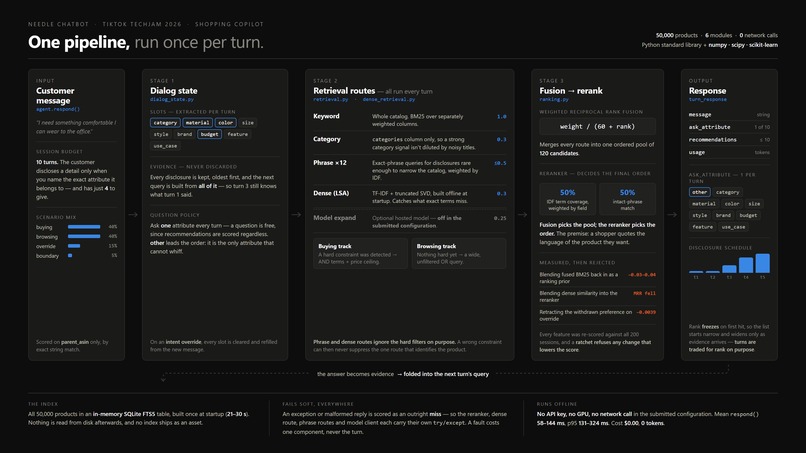
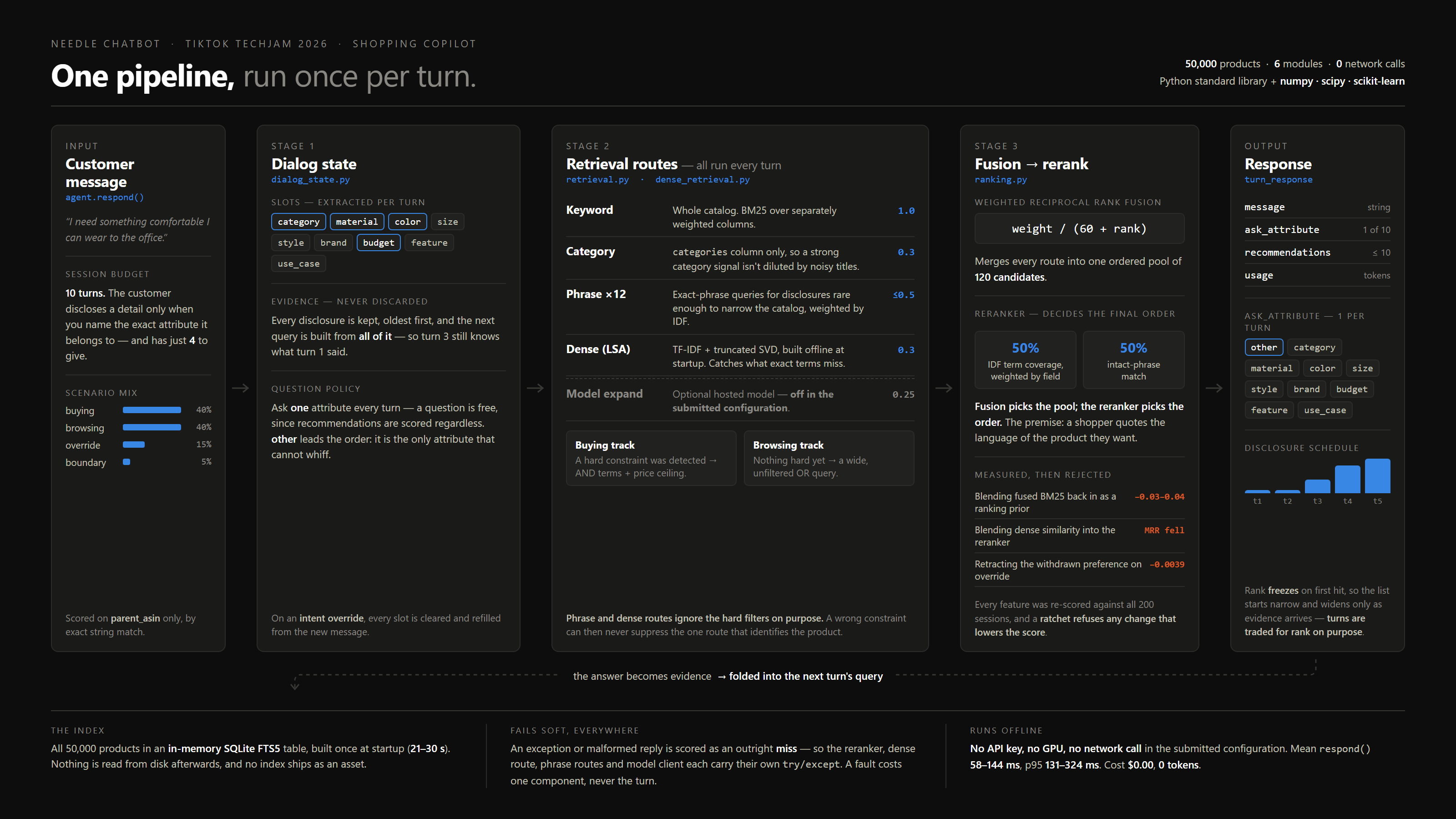
Needle runs the same pipeline on every turn of a conversation:
- Dialog state. It scrapes structured constraints out of what the customer said — colour, material, price ceiling — and keeps every disclosure from every previous turn, oldest first. Retrieving on the latest message alone throws away the product category you learned on turn one.
- Dual-track routing. If a hard constraint has been disclosed, the session is buying:
constraints become hard
ANDfilters plus a price filter. If not, it's browsing: a wide, unfiltered query that casts for the category instead. - Multi-route retrieval and fusion. Up to four searches run per turn — a keyword search over the whole catalog, a category-column-only search so a strong category signal isn't diluted by noisy titles, up to twelve exact-phrase searches for disclosures rare enough to identify a product on their own, and a dense semantic route over offline LSA embeddings. Their rankings are merged with weighted Reciprocal Rank Fusion. The phrase and dense routes deliberately skip the hard filters, so one bad constraint can never suppress the one route that would have found the product.
- Reranking. Fusion doesn't decide the answer; it nominates 120 candidates. A reranker then reorders them on IDF-weighted term coverage and intact-phrase matching, on the premise that a shopper quotes the language of the product they actually want.
- Clarification. It asks about exactly one attribute per turn, chosen to narrow the pool most, and retires attributes the customer says they have no opinion about.
- Deliberate withholding. On turns 1 and 2 it returns a single recommendation. That is not a bug — see Challenges.
Six modules, ~1,800 lines, and numpy/scipy/scikit-learn as the only third-party dependencies:
agent.py            orchestration + the official reset()/respond() contract
retrieval.py        FTS5 index, query routes, weighted RRF fusion
dialog_state.py     per-session slots, evidence accumulation, question policy
ranking.py          IDF coverage + phrase reranking over the fused pool
dense_retrieval.py  offline LSA (TF-IDF + Truncated SVD) embeddings
facets.py           generic attribute facets — free-form input only
Everything fails soft. A raised exception or malformed output is scored as an outright miss, so
the reranker, the dense route, the phrase routes and the optional model each carry their own
try/except. A fault costs that component only, never the turn. 🪂
Challenges we ran into 🙂↕️
We read the evaluator, and it told us our dialog strategy was already capped. The simulated customer's intent card holds at most four constraints, and it discloses at most two per turn. Two well-chosen questions therefore drain the customer completely by turn 3 — after which no further question can extract a fifth fact, because there isn't one. That killed a whole category of planned work (smarter question ordering, deeper interrogation) and reframed the project: given complete evidence by turn 3, the only remaining lever in the entire system is ranking quality. Better to learn that from the source in week one than from a flat delta table in week three.
Showing fewer results scores higher. The evaluator freezes the target's rank the instant it appears anywhere in the top ten and ends the session. So surfacing the product early at rank 8 is a permanent cost — you can never improve it. Working through the scoring weights, one turn of delay costs 0.0001 of TechnicalScore while one unit of reciprocal rank is worth 0.0015, so deferring pays off whenever it buys more than ~0.067 RR. We built a disclosure schedule that deliberately runs sessions a turn or two longer to buy rank. It moved MRR from 0.652 to 0.852. Every instinct said "show more results"; the arithmetic said the opposite.
Our hybrid dense retrieval shipped flat, and we published that. LSA embeddings were supposed to
be a clear win. Blended into the reranker they regressed MRR monotonically at every nonzero weight
we tried; shipped as a fusion route they moved TechnicalScore by −0.0005, inside the noise floor. We
kept the route for private-set robustness and wrote the negative result up in full. Same for
personalization: we measured every field of the anonymized user_profile across all 200 sessions
and found it degenerate — two fields are constant, two are perfectly correlated with each other, and
the one that varies appears in over half the sessions. A signal present in 80% of sessions cannot
separate one product from 50,000. Documented, closed, moved on.
A smaller candidate set is worthless if you can't order it. We built a conjunction route that narrowed 50,000 products to 100 — and it rescued zero of the three sessions it was designed for, and lost another. RRF scores an item by its rank within a route, not by how small the route is, so our target sat ~50th of 100 near-identical robes and contributed almost nothing. Elegant idea, measured, deleted. 🪦
Four sessions are information-theoretically unreachable. One target's entire disclosed evidence is "cotton" (shared with 9,775 products), "100% Cotton" (3,770), "Imported" (15,300) and "Button closure" (2,391). We verified this rather than assuming it: even after narrowing to 100 candidates we still couldn't order them, and one target moves from rank 15 to rank 14 when the hard filter is removed entirely. No retriever, sparse or dense, separates a target from its clones when the evidence is identical across all of them. Knowing when to stop optimizing was its own challenge.
Judging may run with the network disabled. So we proved the offline path instead of asserting it: a full 200-session run with the optional model configured and every socket raising produces a results file that is byte-identical to our score of record, sessions array included.
Accomplishments that we're proud of 🎯
- TechnicalScore 0.912205 against a 0.10671 baseline — 98% hit rate, MRR 0.864, and the target found in 2.85 turns on average out of ten allowed. Every one of the four scenario types clears 96%.
- It runs entirely offline, calls no LLM, and costs $0.00. Token usage is reported as an honest zero rather than left unreported. Nothing downloaded, no pretrained weights on disk.
- Fast enough to feel instant: a 25–144 ms mean turn depending on hardware, against a one-time index build at startup and a ~25 s full 200-session run.
- Bit-for-bit reproducible. Identical code always produces an identical score, so a changed number always means a changed agent — never run-to-run noise. That made every measurement trustworthy.
- "Byte-identical" as our standard, not "flat." When we say a change cost nothing, we mean the entire 38,523-byte results file — all 200 sessions, not just the headline average — is unchanged down to the byte. Six of our sixteen features shipped at exactly the same score on purpose: they're robustness insurance, not score chasing. 🔒
- A score ratchet that mechanically refuses regressions. It exits non-zero if TechnicalScore fell, and distinguishes byte-identical from merely score-equal — because offsetting session movements can hide a regression that an 800-session private set would not forgive.
- An isolation invariant that is asserted, not just commented. Our human-input handling (negation, corrections, free-form prose) is provably unreachable while scoring: a full run makes 566 simulator-path calls and 0 human-path calls, and the test suite checks it on every run.
- 186 automated checks across two gate scripts that need neither network nor credentials, both exiting non-zero on any regression.
- Sixteen feature documents, each with a measured delta table — including the flat and negative results. A regression documented in two minutes stops a teammate re-attempting the same idea on the final day.
What we learned 🏫
- Read the harness before optimizing against it. Most of our early wins came from the evaluator source, not from model choice. The four-constraint ceiling, the rank-freezing early exit, the override guard — each one redirected days of work.
- Measure everything, and publish the failures. A third of our features were flat or negative. Writing them up cost minutes and saved the team from re-litigating settled ground.
- Define your noise floor first. At 200 sessions, one session is ±0.005. Deciding up front that sub-0.01 deltas are noise stopped us celebrating three separate non-results.
- Instrument before theorising. One feature was scoped as "add dense embeddings"; an hour of instrumentation instead found three real bugs in constraint extraction. We'd have built an entire embedding stack that could not have helped.
- Flat on your test set is not the same as safe. One variant scored byte-identical and silently discarded 19 identifying search routes across 16 sessions, several unique to a single product. Flat here, a miss waiting to happen on a hidden set four times the size.
- The ceiling was information, not model size. Once the customer is drained by turn 3, no amount of LLM solves it. The remaining points live in ranking precision — specifically in penalizing sprawling listings that happen to contain the customer's terms among forty others.
What's next for Needle 😊
- A precision term in the relevance score. Our coverage score measures how much of the customer's evidence is in a product, but never how much of the product is the customer's evidence — so a 40-feature listing that happens to mention "100% Cotton" scores like a focused one. The 34 hits landing at ranks 2–10 are worth +0.035 TechnicalScore, more than double the entire remaining miss pool. That's the one open lever with a real mechanism behind it.
- Point it at a catalog that isn't clothing. 🪡 Most of this work is already done by accident: the FTS5 index, the IDF term weighting and the LSA embeddings are all fitted at startup from whatever catalog you hand it — none carry hard-coded product knowledge. Swap the catalog for electronics or home goods and the retrieval stack simply re-fits. Two pieces are apparel-flavoured and need generalizing: the material vocabulary, and the curated facet groups (which we want mined from the catalog anyway). Needle isn't a clothing bot we hope generalizes — it's a general shopping agent currently pointed at a clothing catalog.
- Free-form conversation with real shoppers. The dialog rules are shaped for the simulated customer. An optional hosted-model route already handles human prose — negation ("not fully polyester"), corrections, colours like "a deep wine shade" — and it's off by default so the scored configuration stays deterministic and offline.
- Broader fault isolation in the top-level contract handler, as insurance against a stricter hidden harness.


Log in or sign up for Devpost to join the conversation.