-
-
Project Magic
-
Transfusion Cycle Predictor
Inspiration
A meaningful personal experience sparked the idea behind this project. During the period of 2021–2022, one of our teammates needed medical attention, which led him to visit the hospital frequently. While waiting to be checked by the doctor, he would often see a poster fixed opposite him that had a difficult term—one that was even hard to pronounce. He would glance at it occasionally and then forget about it. One day, he decided to look it up. That was the first time he typed this term with his own hands—the core of this hackathon: Thalassemia After learning about this condition, he was initially confused about how the concept of regular transfusions could fit into someone’s daily life. He worried about how it might shatter a person’s dreams. That thought eventually faded over time. Nearly three years later, his college competitions dashboard listed hundreds of ongoing hackathons and competitions. After going through many of them, his eyes were drawn to one called AI FOR GOOD. It brought back those memories, and he realized he could finally do something that could make a real difference in the lives of the people he once worried about.
What it does
Our goal was simple, yet powerful: To support thalassemia patients by making their care more manageable, more efficient, and less isolating—using the power of AI.
“Need for Care” is an AI-powered Thalassemia management platform designed to connect patients, doctors, donors, and an admin to manage the transfusion process efficiently.
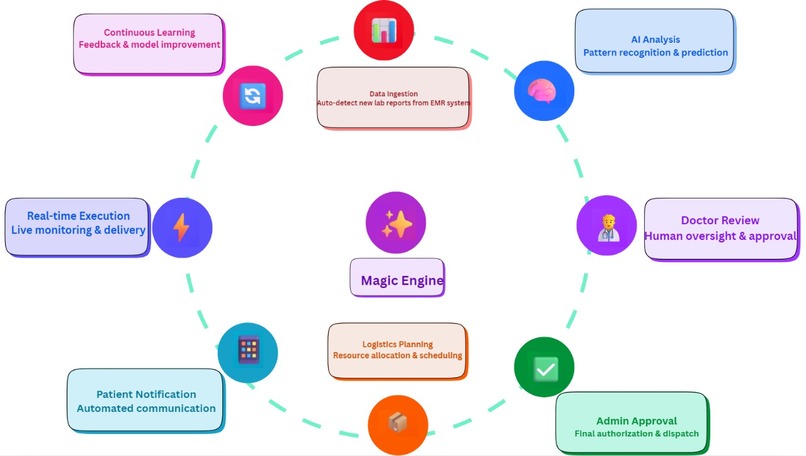
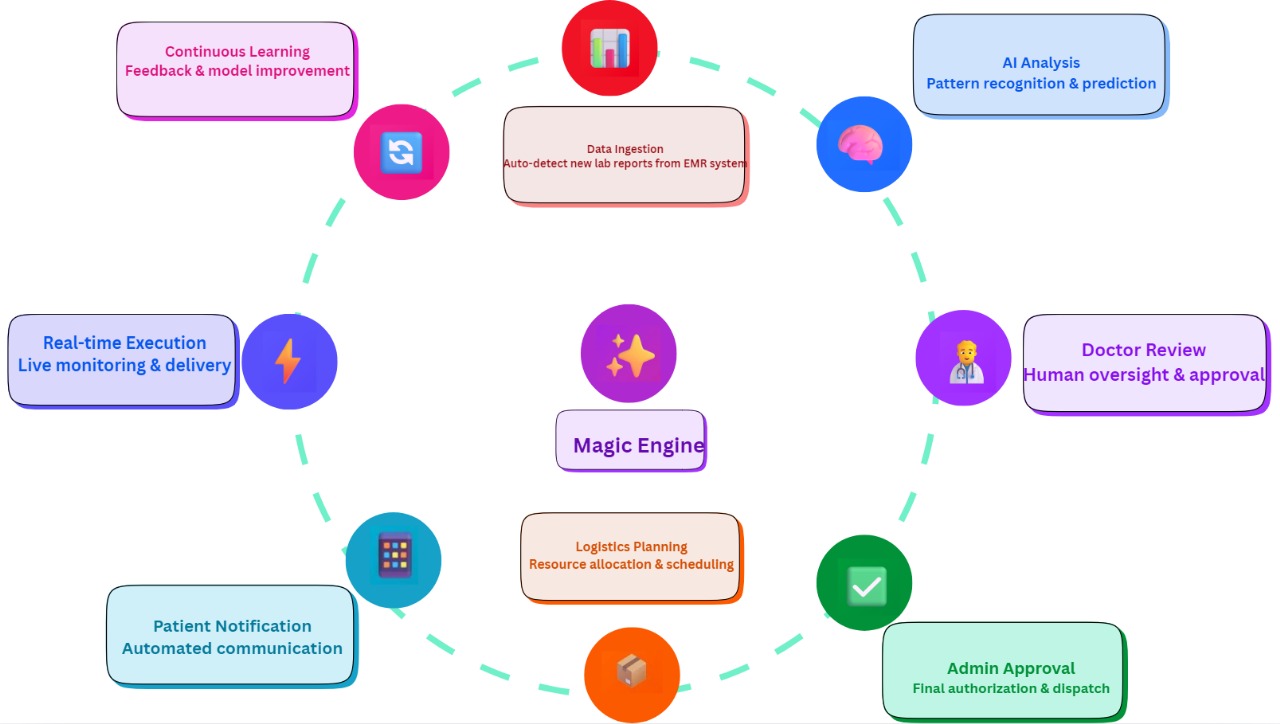
The platform's core innovation is “Project Magic”, an autonomous AI agent that functions as a "Personal Health Guardian" for every patient. This engine is responsible for the complete automation of the transfusion cycle. It intelligently adapts to each patient's unique, doctor-prescribed needs through four distinct stages: a tranquil Recovery Room phase post-transfusion, where data is gathered and the patient is supported; a Proactive Wellness phase with personalized AI-driven advice; a focused Action Center where a completed plan is presented for simple confirmation; and a Live Command Center for real-time monitoring of the transfusion process.
For Doctors
- The app works like an AI assistant that helps doctors by reducing their paperwork and supporting their medical decisions.
- It can read and understand lab reports and patient history, then give a short summary (called a "Patient Briefing") that points out important changes and suggests the best date for the next transfusion.
- This saves doctors a lot of time they would usually spend checking reports manually.
- The AI also gives a suggested transfusion schedule, which doctors can accept, change, or adjust—so they always stay in full control.
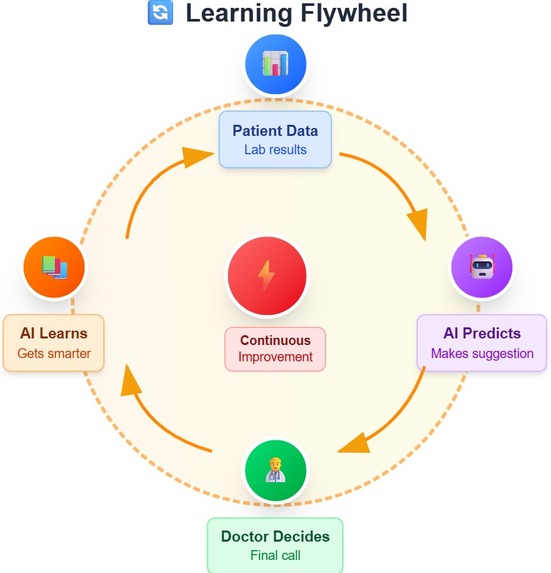
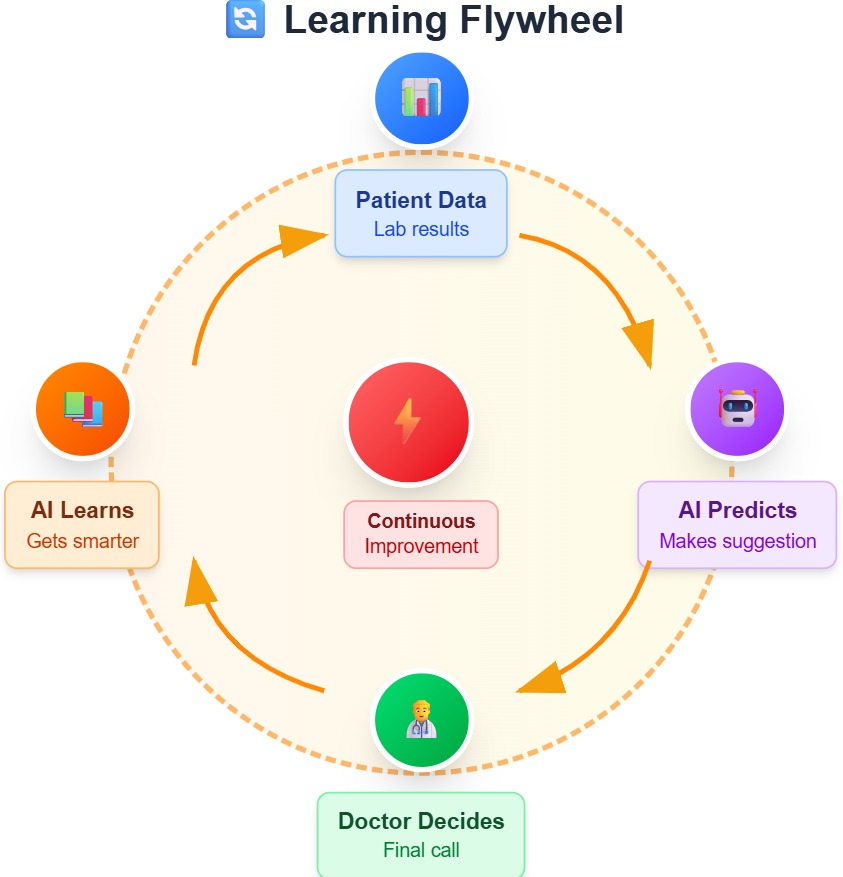
- The more the doctor interacts with the system, the more the AI learns, improving its accuracy and usefulness over time.
- This makes the AI a more helpful partner for doctors with each patient they treat.
For Donors
- The system is built to help keep donors involved and appreciate their efforts.
- Donors get smart reminders based on the actual needs of patients at that moment.
- A special model called the Predictive Donor Index (PDI) uses AI (Random Forest Classifier) to decide which donors are most reliable and should be contacted first.
- It looks at the donor’s past activity—like how often they donated, cancelled, or responded—to create a reliability score.
- Donors have access to their own "Hero’s Hub", a personal page that shows:
- How many lives they’ve helped save
- Their reliability score
- This helps donors feel proud of their impact and encourages them to stay active for the long term.
For Patients and Families
- The platform helps make the whole treatment process less stressful and more organized for patients and their families.
- Patients receive custom diet plans, created by the AI and checked by their doctor.
- They get just one simple message confirming that everything is arranged for their next transfusion—saving them from making many phone calls and messages.
- If there’s a problem, like a donor cancelling at the last minute, the AI’s Crisis Management system:
- Automatically switches to a backup plan
- Notifies the family with the solution, not the problem
- This way, families stay calm and care continues without delays.
How we built it
The frontend was developed using Next.js with TypeScript , resulting in a clean, responsive, and empathetic interface for patients, clinicians, and donors. The design is adaptive, tailoring the user experience to the specific role and current needs of the user, ensuring that the information presented is always relevant and easy to comprehend. On the backend, a suite of AI-driven modules was developed using Python to address the specific challenges of Thalassemia care. This architecture is composed of a synergistic suite of AI models where the output of one model often informs the strategy of another:
Transfusion Cycle Prediction:
A Gradient Boosting Regressor was employed to predict the optimal timing for a patient's next transfusion. This model analyzes complex clinical data, including laboratory results and health history, to provide a highly accurate forecast that continuously learns from clinician feedback. Its ability to capture non-linear relationships in the data is critical for personalization.
Donor Matching Engine
A Random Forest model (Predictive Donor Index) was implemented to identify the most suitable donors. This model's analysis extends beyond blood type and location to include historical reliability data, which dramatically reduces the incidence of failed plans. The model's "feature importance" output also provides valuable insights into what makes a donor reliable.
##Emergency Contingency Selector A classification model was designed to intelligently select between Plan A (a verified blood bank unit) and Plan B (AI-guided donor outreach). This decision is based on real-time data from blood bank APIs and our donor network, ensuring minimal delay in emergencies.
Diet Optimization
A combination of Multi-output Regression and rules-based filtering was used to generate personalized, culturally appropriate diet plans from medical records. The system was integrated with e-Raktkosh (via API) to access real-time blood bank data. A human-in-the-loop validation process was embedded at every critical step; every AI suggestion is reviewed and approved by a doctor or Care Coordinator, ensuring the system is not only intelligent but also safe, ethical, and trustworthy.
Challenges we ran into
- Data availability and standardization: Finding clean, structured, and relevant medical data—especially for transfusion cycles and donor behavior - was difficult and time-consuming.
- Integrating AI into real medical workflows: Making sure our AI suggestions were practical, safe, and adaptable to real-life medical practices took several rounds of testing and feedback.
- Human-in-the-loop implementation: Building a system where doctors can review, approve, or override AI decisions—while also using their input to improve the model - added both technical and ethical challenges.
- Balancing accuracy with urgency: In healthcare, even small mistakes can have serious effects. We had to make sure our predictions were both fast and reliable, especially when recommending emergency donors.
- Connecting the end-to-end pipeline: While we built individual machine learning models successfully, combining them into one smooth and reliable system is still a work in progress.
- Designing for different users: Creating a mobile-first interface in React Native that works well for patients, doctors, donors, and administrators—with all their unique needs—was more challenging than we expected.
Accomplishments that we're proud of
- Developed 4 core AI models: Built machine learning models for transfusion cycle prediction, donor selection, diet planning, and emergency handling—each specifically designed for thalassemia care.
- Doctor-in-the-loop system: Created an AI workflow that learns from doctor feedback, making the system more accurate and clinically trustworthy.
- Multi-role architecture: Designed the app with separate logins and features for patients, doctors, donors, and admins—so each user gets a tailored experience.
- Connected care ecosystem: Enabled real-time communication between patients, doctors, and donors to support timely and coordinated care.
- Frontend with Next.js + TypeScript: Built a responsive and scalable web interface using modern frameworks and best coding practices.
- Real-world inspiration into tech: Transformed a personal experience into a meaningful healthcare project aimed at supporting people living with thalassemia.
What we learned
Building this application has been one of the most insightful journeys we've taken—not just as developers or data scientists, but as human beings trying to solve a real-world problem that matters.
From a technical standpoint, we gained hands-on experience working with clinical data, learning how to extract meaningful insights from patient records and transform them into actionable predictions. We built and trained machine learning models like Gradient Boosting Regressor and Random Forest classifier to power critical features such as transfusion cycle prediction and donor matching.
But what truly stood out was this: in healthcare, it's not just about building smart systems—it's about building safe ones.
We learned how important it is to keep doctors in the loop, allowing AI to assist but never override their expertise. That blend of automation and human decision-making—what we now know as a human-in-the-loop system - became a core principle in our design. It taught us to respect the limits of AI, especially when lives are involved.
We also learned how to think modularly—building components that could work independently, yet come together in a reliable, maintainable pipeline. And we explored how to design fail-safes, like fallback plans for emergency blood shortages, because in healthcare, every second counts.
Most importantly, this project helped us realize that technology isn’t just a tool—it’s a responsibility. The responsibility to reduce the burden on patients, to support doctors where they need it most, and to ensure better access to care, especially in places where resources are limited.
This wasn’t just about coding or training models. It was about using what we know to make a difference—and learning, every step of the way, how to do that better.
What's next for Need for Care: An AI-Powered System for Thalassemia Support
We’ve taken meaningful steps toward building something that could truly support thalassemia patients but we know we still have a long way to go.
Right now, we’ve built individual machine learning models for different parts of the system such as Transfusion Cycle Prediction, Optimal Donor Matching, Diet Planning, and Emergency Contingency Handling. Each of these components works well on its own, but they aren’t yet part of a single, unified pipeline.
Creating that connected pipeline is our top priority. Once that’s done, every part of the app from predicting the next transfusion to finding the best donor will work seamlessly together, just as the people behind the scenes do in real life.
We also know that in the medical world, accuracy isn’t optional it’s everything. Reducing the margin of error in our predictions is critical, and we’re committed to refining our models until they meet clinical-grade standards. Finally, we want to build and deploy the full application, with every feature in place:
- Multi-role logins for patients, doctors, donors, and admins
- Live AI recommendations and alerts
- Real-time communication
- External integrations with blood banks like e-Raktkosh
- And of course, all the safety checks that make the system doctor-approved and patient-trusted This is more than just a technical roadmap. It’s the path to turning a heartfelt idea into a real-world impact.
Built With
- css
- drf
- e-raktkosh
- llm
- ml
- mongodb
- next.js
- python
- pytorch
- scikit-learn
- tailwind
- tensorflow
- twilio
- typescript

Log in or sign up for Devpost to join the conversation.