-
-
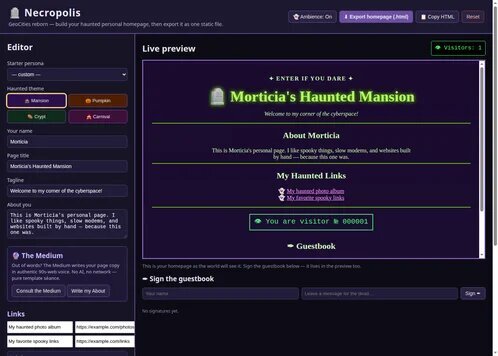
Editor default
-
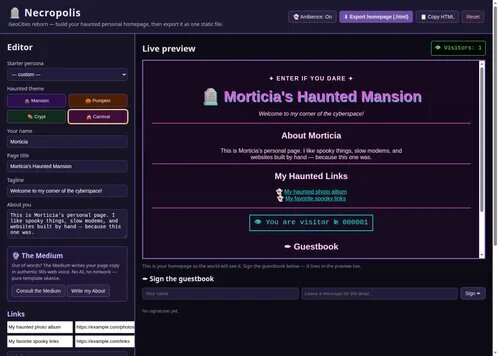
After interactions
-
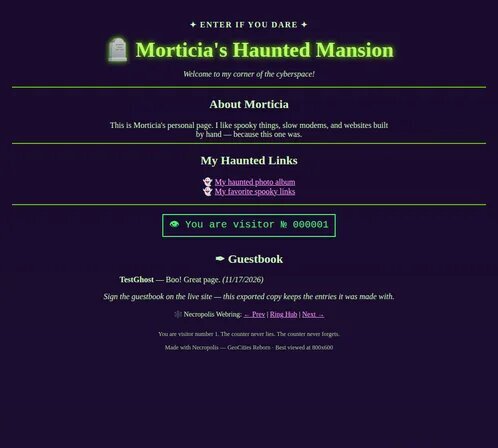
Export page
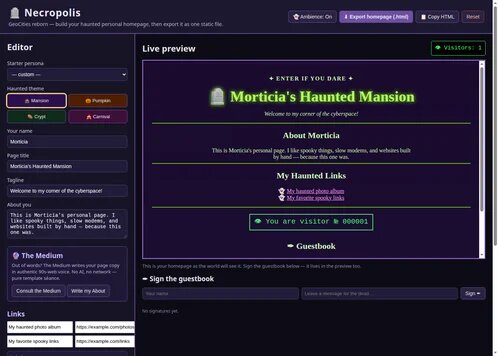
Inspiration
The personal homepage is dead. In the 90s, anyone could put a page on GeoCities — a haunted mansion, a shrine to their favorite band, a guestbook full of strangers saying hi. Then social media flattened the web into identical profiles, and that weird, personal corner of the internet died.
Necropolis resurrects it — literally. We picked the Resurrection category because we wanted to bring back a piece of web history that deserved a second life, ghosts and all.
What it does
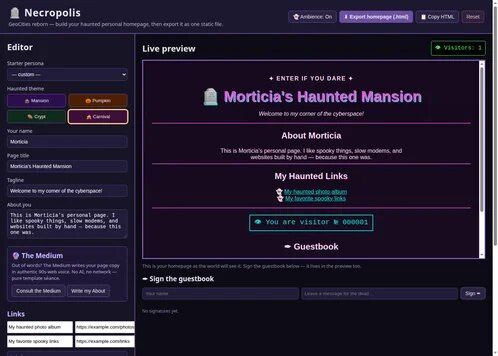
Necropolis is a visual editor for building a spooky 90s personal homepage:
- Haunted themes — pick a theme (Morticia, Pumpkin, Carnival…) and your whole page transforms
- Visual editor — edit your title, about, links, and sections with a live preview
- The Medium — a template-based generator that writes your page copy in authentic 90s-web voice
- Guestbook — visitors can sign your page, and entries persist
- Visitor counter & webring — the two sacred relics of the old web, faithfully restored
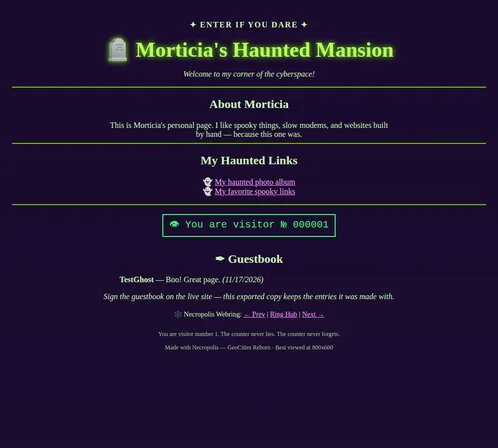
- Export — download your page as one standalone HTML file. No servers, no accounts, no tracking. Your page is yours.
How we built it
Necropolis is a static-only app — plain HTML, CSS, and JavaScript, no backend, no build step, no paid APIs. One renderPage renderer feeds both the live preview and the export, so what you see is exactly what you get. User content is stored in localStorage, and the exported file works anywhere, forever.
We built it using Kiro's spec-driven workflow:
- Specs (
.kiro/specs/necropolis/) —requirements.mddefined the seven features and acceptance criteria before any code was written,design.mdlocked in the single-renderer architecture and the four CSS-only themes, andtasks.mdtracked the implementation checklist. - Steering (
.kiro/steering/) —product.md("would this have existed on GeoCities in 1998?"),tech.md(static-only, one renderer, escape user text), andstyle.md(90s voice in generated copy, calm modern editor chrome) guided every file we wrote. - Hooks (
.kiro/hooks/hooks.json) —save-and-renderpersists every editor change and re-renders the preview, andexport-checkrequires a name and at least one link before exporting. Both are real behavior in the app, not just documentation.
We verified the app in headless Chromium: editor → live preview → guestbook sign → export, with zero console errors.
Challenges we ran into
- One renderer, two outputs. The live preview and the exported file had to be pixel-identical. Solving it with a single renderer kept them in sync, but it meant every feature had to work in both contexts from day one.
- Making it feel 90s without being unusable. The generated copy needed to sound like 1998, but the editor itself had to feel modern. The steering rules kept the two voices from bleeding into each other.
- The Medium's voice. With no model calls, the generator had to feel creative using only phrase tables — so we tuned the tables until the output read like a real GeoCities page, not a Mad Libs.
What we learned
Writing the spec first — before a single line of code — saved us from the classic trap of building features that don't fit together. And the old web had something right: when everyone owns their own little corner of the internet, the web gets weirder, funnier, and more human.
What's next
More themes, more starter personas, and a webring that actually links real exported pages together. The dead web is coming back — one homepage at a time. 👻
