The Story of Necro-Net Navigator
Inspiration : "Every ghost has a story, and the early web is full of digital phantoms."
The inspiration for Necro-Net Navigator came from a place of nostalgic curiosity. While building modern web applications with sleek, minimalist designs, I found myself reminiscing about the wild west days of the internet—when websites had personality, chaos, and a certain charm in their maximalist approach.
Modern web design follows principles of efficiency and user experience optimization, but what about the joy of discovery? The personality of self-expression? The early web sacrificed efficiency for creativity, and I wondered: could we resurrect that creative spirit without losing modern functionality?
The Kiroween hackathon's "Resurrection" theme provided the perfect opportunity to bring these digital ghosts back to life. There's something genuinely spooky about how completely the early web has vanished—it felt like performing digital archaeology to uncover these buried aesthetics.
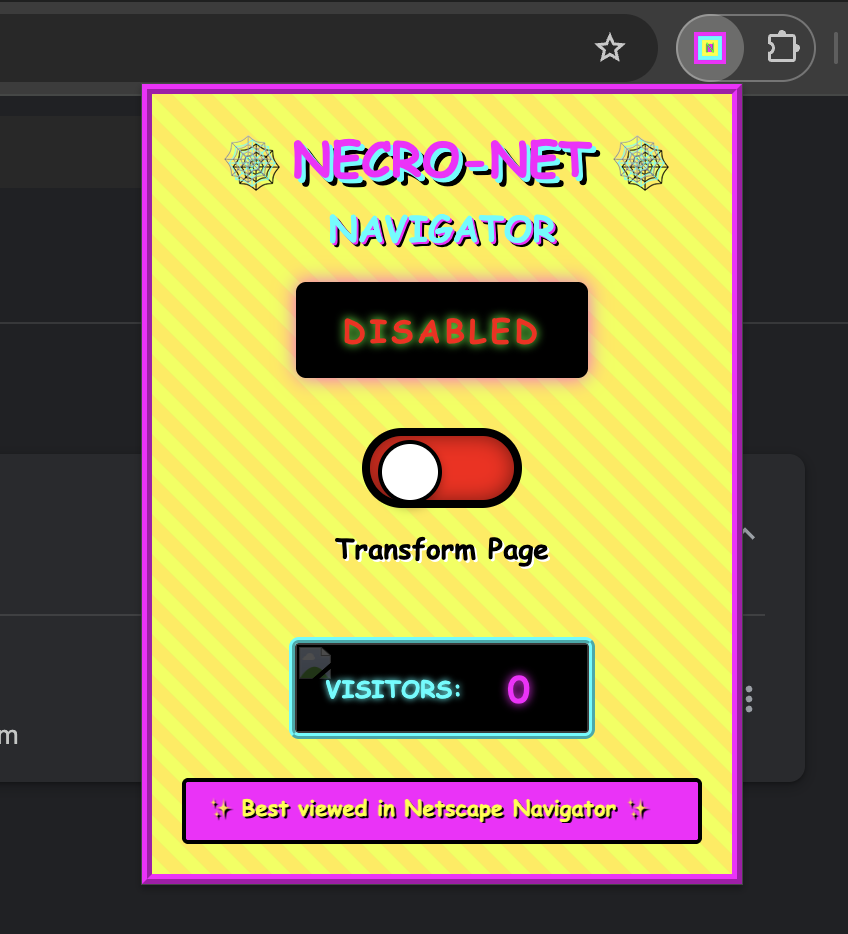
What It Does Necro-Net Navigator is a browser extension that performs digital necromancy—transforming modern, minimalist websites into glorious 1990s-era time capsules. With a single toggle, users can:
Convert clean layouts into nested HTML tables with borders and cell padding
Inject period-appropriate elements: animated visitor counters, guestbooks, under-construction GIFs
Apply authentic typography: Comic Sans MS, tags, blinking text and marquee scrolls
Transform color schemes from modern palettes to classic hot pink, cyan, and bright yellow
Maintain core functionality while completely overhauling aesthetics
The magic happens in real-time—watching Google transform into a 1997 search portal or Twitter become a vintage chat room creates this wonderful cognitive dissonance that's both hilarious and strangely beautiful.
How We Built It Kiro-Powered Development Architecture The entire project was built using Kiro's advanced features in a structured workflow:
- Spec-Driven Foundation Kiro generated the core extension structure from comprehensive specifications that outlined:
The transformation engine architecture
Content script injection patterns
CSS override systems
DOM manipulation strategies
Having Kiro build from detailed specs ensured we had a robust foundation that could handle the complex task of real-time website transformation.
- Steering-Guided Design The .kiro/steering.md document became our 90s web design bible, with Kiro enforcing authentic period aesthetics:
Layout conversion rules from modern CSS to table-based structures
Color palette constraints ensuring genuine 90s visual language
Typography hierarchies using period-appropriate font stacks and tags
Interactive element patterns like guestbooks and counters
Agent Hooks for Quality Control We implemented hooks that automatically validated generated code against 90s browser capabilities. If Kiro accidentally used modern CSS properties like grid or flexbox, the hooks would flag them and suggest period-appropriate alternatives.
Vibe Coding for Complex Features Some of the most impressive Kiro moments came from natural language prompts like:
"Create a function that identifies header elements and wraps them in marquee tags with alternating scroll behavior, but preserve their original click handlers and accessibility attributes."
Kiro not only implemented the complex DOM manipulation but also considered edge cases I hadn't anticipated, like maintaining focus states for keyboard navigation.
Challenges We Ran Into The Uncanny Valley of Nostalgia Getting the right level of authenticity was challenging. If we made sites too accurately 90s, they became completely unusable. If we didn't go far enough, the nostalgia effect was lost. We had to find the sweet spot where the transformation felt authentic but websites remained functional.
CSS Specificity Wars Modern websites use incredibly specific CSS selectors. Overriding them while maintaining 90s aesthetics required careful engineering. Kiro's understanding of CSS cascade and specificity rules was crucial here—it helped generate override styles that could actually beat the modern styling without breaking functionality.
Performance vs. Authenticity Real-time DOM manipulation on complex modern websites is computationally expensive. We had to optimize our transformation algorithms to work efficiently without slowing down the browser to a crawl. Kiro helped identify performance bottlenecks and suggest optimization strategies.
Browser Extension Quirks Working with modern browser extension APIs presented unexpected challenges, particularly around content security policies and script injection timing. Kiro's ability to understand extension development patterns helped us navigate these complexities.
Accomplishments That We're Proud Of Deep Kiro Integration: We used every major Kiro feature—specs, steering, hooks, and vibe coding—in meaningful, complementary ways that demonstrated the full power of the AI-powered IDE.
Functional Preservation: The extension transforms aesthetics while maintaining core website functionality—users can still search Google, browse Twitter, and use GitHub, just with a delightful layer of nostalgia.
Educational Value: Beyond entertainment, the project serves as a living history lesson about web evolution. It makes the abstract concept of "web design history" tangible and interactive.
Technical Innovation: We developed a sophisticated transformation engine that understands both modern web architecture and historical web design patterns.
What We Learned About Kiro Spec-driven development creates incredibly robust architectures, but requires upfront investment in comprehensive specification writing
Steering documents act like having a senior architect constantly reviewing design decisions
Agent hooks transform Kiro from a code generator to a continuous development partner
Vibe coding excels at rapid prototyping but benefits greatly from the structure provided by specs and steering
About Web History The evolution of web design isn't just about technology—it's about changing philosophies of what the web should be. The early web valued personal expression and experimentation, while the modern web prioritizes usability and efficiency. Both approaches have their merits, and understanding this helped us create a transformation that respects both eras.
About Nostalgia Engineering There's an art to recreating historical digital experiences. It's not just about copying old patterns—it's about understanding what made those patterns meaningful and recreating that feeling for modern audiences.
What's Next for Necro-Net Navigator Short-term Evolution Era Selection: Let users choose between specific years (1995, 1997, 1999) with appropriate styling for each period
Site-specific Transformations: Custom rules for popular sites (YouTube transforming to RealPlayer style, etc.)
Community Styles: Allow users to create and share their own nostalgia packs and transformations
Enhanced Authenticity Web Archive Integration: Pull actual assets and styles from archived websites for maximum authenticity
Browser Emulation: Simulate period-appropriate rendering behaviors and limitations
Sound Design: Add authentic 90s sound effects like modem handshakes and click sounds
Educational Expansions History Mode: Show side-by-side comparisons with explanations of how web design has evolved
Design Lessons: Use the transformations to teach modern design principles by showing what we've moved away from and why
Timeline Feature: Let users scroll through web design evolution from 1990 to present
Kiro-Enhanced Roadmap We'll use Kiro's evolving capabilities to:
Scale testing: Automatically test transformations across thousands of sites
AI content adaptation: Make modern content intelligently fit historical formats
Performance optimization: Continue refining the transformation engine for speed and reliability
Necro-Net Navigator isn't just about looking backward—it's about understanding how we got here and imagining where we could go next. Sometimes, you need to resurrect the ghosts of the past to see the future more clearly. In the haunted mansion of web history, every page tells a story, and now users can read them all again. 👻🕸️
Built With
- chrome-extention
- css
- extension
- html5
- javascript


Log in or sign up for Devpost to join the conversation.