-
-
NebulaPrime AI - Unlocking Next Gen Clinical Intelligence
-
NebulaPrime AI - Architecture Diagram
Project Story: NebulaPrime AI – Next-Gen Clinical Intelligence
What Inspired Us
Clinician burnout is one of the top challenges in today's healthcare. Each patient brings years of clinical records including lab results, imaging reports, admission/discharge records, surgical procedure, and treatment plan with corresponding results. Reviewing such large volume of multi-modal data quickly an making high-stake decisions adds significant cognitive load—especially under time pressure.
We imagined a system where AI agents could act like a team of junior specialists undertaking majority of the footwork and help our clinicians focus better on critical areas of treatment planning. Such Agentic systems can analyze large volume of complex, multi-modal data in parallel and detect and summarize key findings, so that clinicians wont have to look through everything. Rather, they can only validate the AI findings and probe deeper only in areas of interests.
This led to NebulaPrime AI—a prototype demonstrating how MultiAgentic AI, built using Google’s Agent Development Kit (ADK) to can deliver scalable, explainable clinical decision support system.
How We Built It
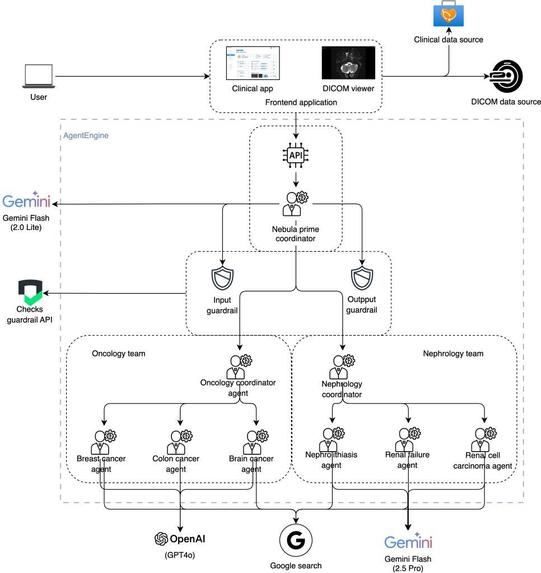
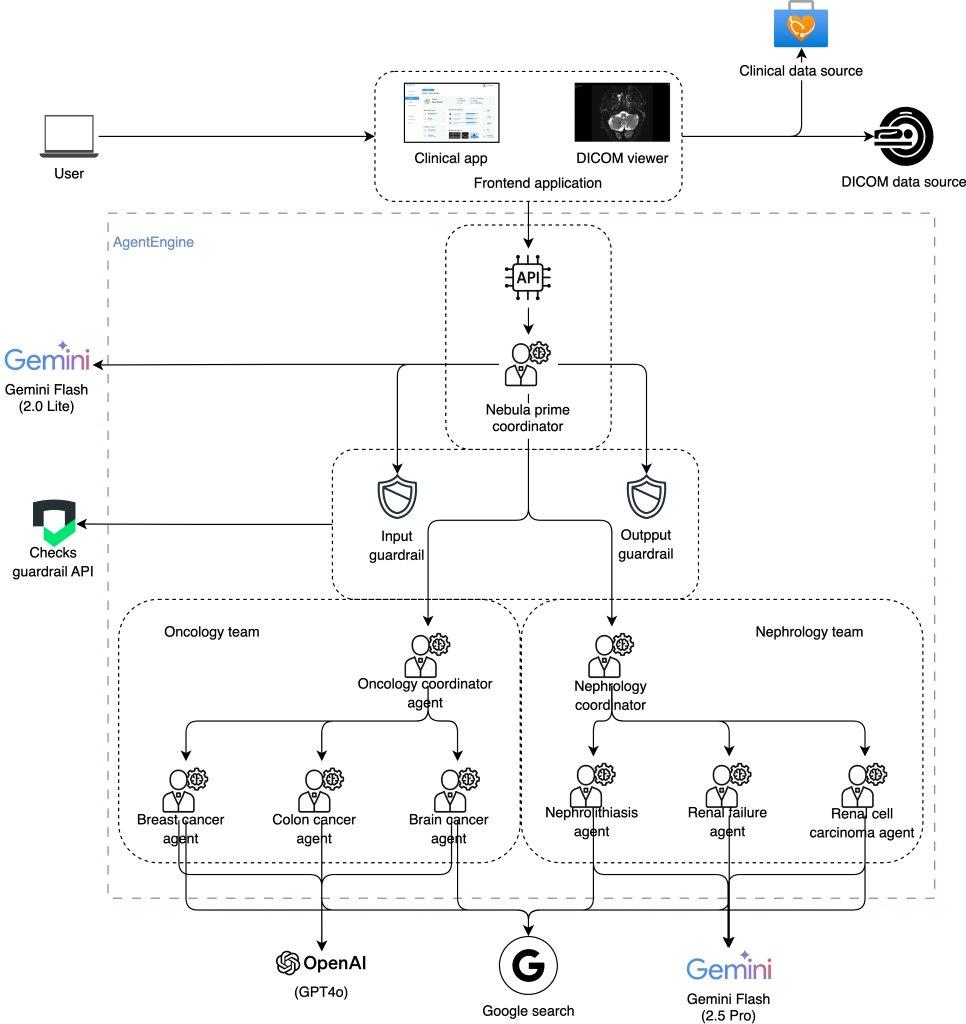
We implemented a three-tiered agent architecture using Google Cloud Platform and ADK:
1. Coordinator Agent
- Determines the clinical context (e.g., oncology or nephrology)
- Validates input data using Google Checks API for dangerous or explicit content as input guardrail
- Routes the query to a relevant specialty coordinator (like oncology or nephrology)
- Collects the Agentic output and checks the output for dangerous or profane content as output guardrail
- Returns the data to requester
2. Specialty Coordinators
- Oncology and Nephrology coordinators manage specialized disease assessment agents and runs them in parallel
- Oncology agents: Breast cancer, colon cancer, brain cancer
- Nephrology agents: Nephrolithiasis, renal failure, renal cell carcinoma
- Puts their analysis output in context
3. Disease Assessment Agents
- Each agent is focused in assessing a particular disease it is assigned
- Each agent uses structured prompts and GenAI models (GPT-4o, Gemini Flash 2.0)
- They analyze clinical reports, lab results, mammography results, biopsy results, and imaging reports
- They use the provided thought process to assess whether patient's clinical data indicates a particular prognosis or lack of one
- They use Google search tool to study further how to better detect the target disease or to understand the clinical data better
- The formulate the prognosis with a confidence score
- They also score whether the data was relevant or complete for the analysis
- They return diagnosis, confidence scores, and rationale summaries in a structured format (JSON)
The backend system integrates API layers, data orchestration, and moderation, while the (not included) frontend allows clinicians to:
- Upload patient context
- Receive quick, interpretable disease assessments with insights
What We Learned
- Agentic reasoning can mirror clinical workflows and specialist decision-making
- Trust is built through confidence scoring and explainable summaries
- Prompt engineering and data relevance filtering are core to reliable results
- Guardrails like GCP Checks API are essential for ethical AI usage in healthcare
- GenAI tools are powerful but need domain-specific constraints to be effective.
Challenges We Faced
- Checks API is in private beta: While we found it useful, we did not enable it by default (code is in our github repo) in our public code base as it is likely to cause failures
- Clinical data parsing: Free-text clinical reports required careful extraction and structuring
- Prompt design: Ensuring each disease agent had accurate, scoped prompts was critical and time-consuming
- MultiAgentic AI: Single layer of Agents loses accuracy, either loses details while working at strategical guidance or becomes too engaged in low level details an loses focus on strategic goal. MultiAgentic AI is critical in complex analysis. Performance guarantee with accuracy guarantee requires using all 3 forms of agent orchestration (free-form engagement, parallel, sequential)
- Moderation sensitivity: Balancing safety filtering with valid medical terminology can be tricky as they contain both PII and PHI
- Tool integration: Enabling live search for agents added depth but needed intelligent control and further guardrails as content from Internet can get injected now
Conclusion
NebulaPrime AI is not a production-ready clinical tool—it is a research prototype demonstrating how MultiAgentic AI can enable Next-Gen Clinical Intelligence. It shows the potential to dramatically reduce clinician prep time and cognitive load while maintaining transparency and trust.
We envision this as a foundational step toward real-world systems that ease cognitive burden, enhance diagnostic precision, and improve healthcare outcomes.
Built with Google Agent Development Kit, powered by GenAI, and driven by a mission to support the future of healthcare.
Built With
- adk
- agent-engine
- angular.js
- client-side-rendering
- cloud-run-function
- firebase
- gcp
- gemini-flash
- gemini-flash-light
- google-checks-api
- google-search-engine
- multi-agentic-ai
- node.js
- openai-gpt4o
- python
- single-page-application


Log in or sign up for Devpost to join the conversation.