-
-
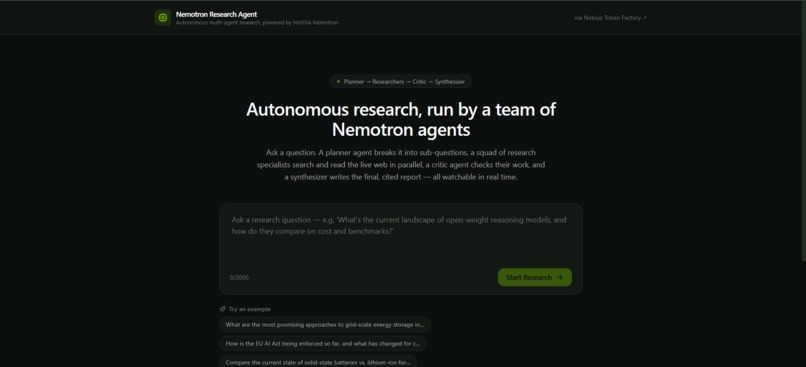
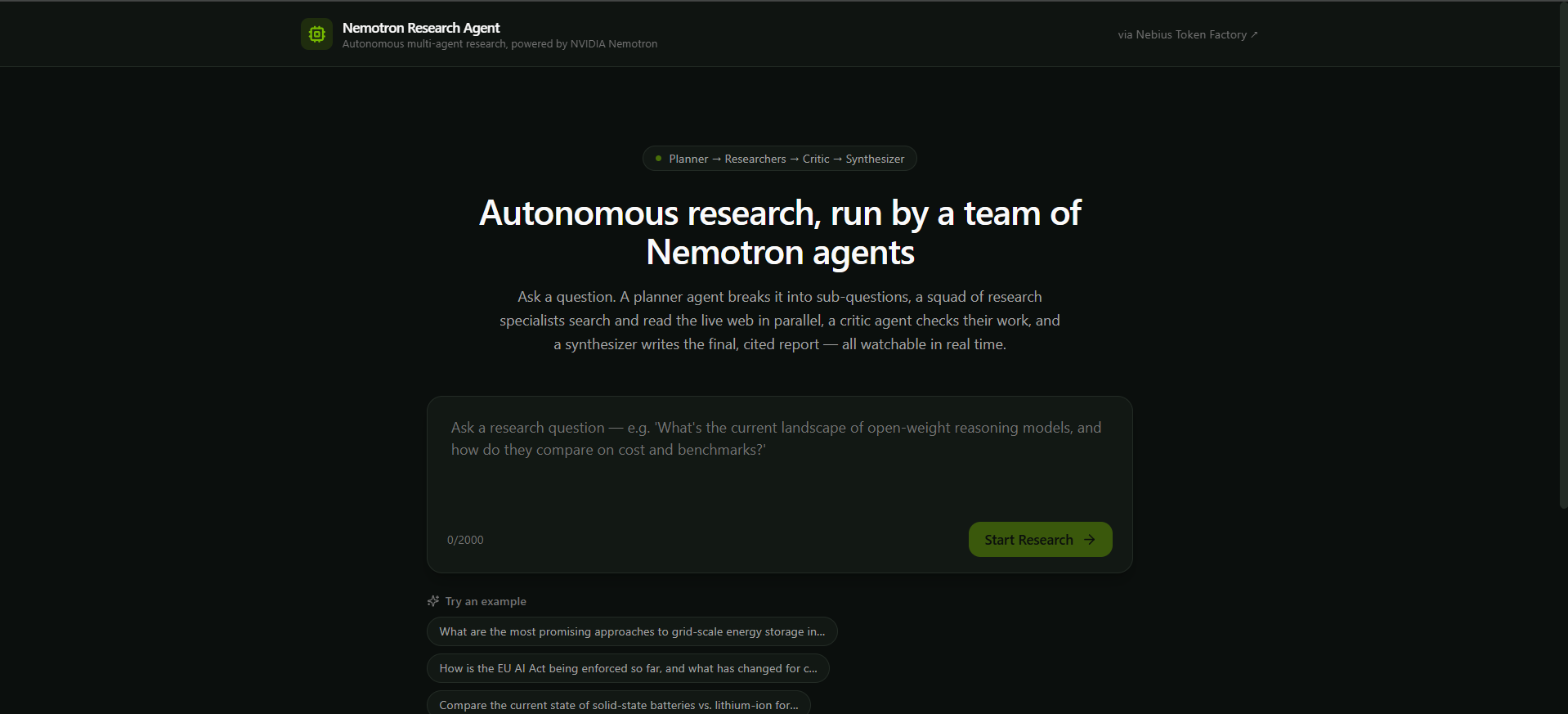
LandingView / QueryHub
-

FeatureGrid
-
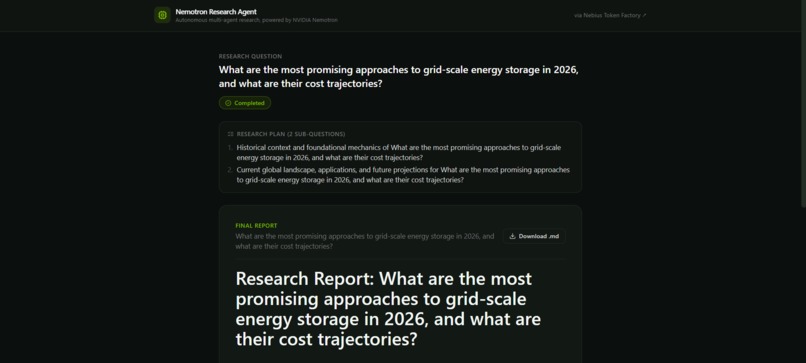
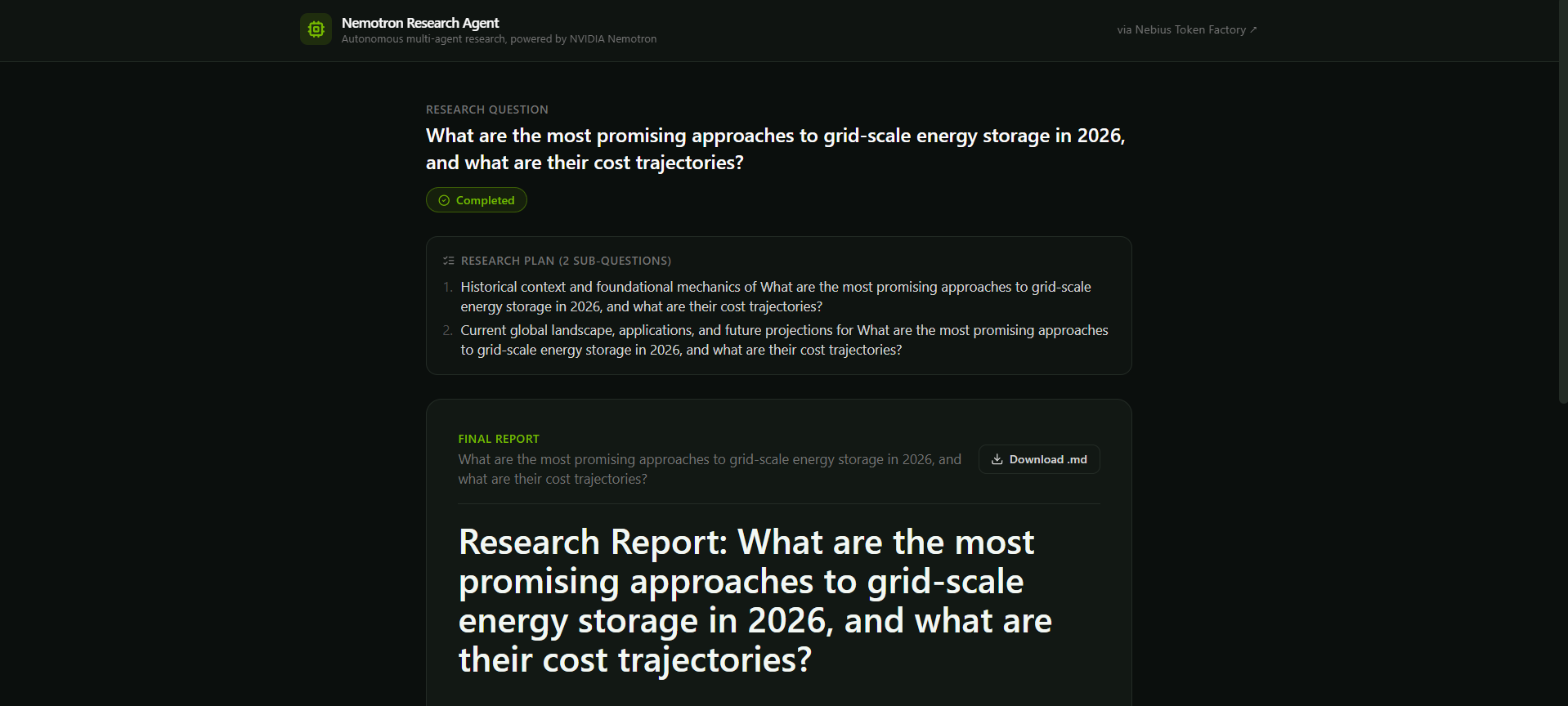
ResearchDetail

Inspiration
Building production-grade, highly reliable multi-agent systems often suffers from fragmented codebases, missing implementations, and poor integration with high-performance inference APIs. The goal was to engineer a fully realized, end-to-end multi-file application from scratch with zero placeholders, leveraging advanced NVIDIA Nemotron models on Nebius Token Factory.
What it does
The platform delivers a complete multi-agent system featuring an optimized FastAPI backend, a clean React/Tailwind CSS frontend, database schemas, and containerization setup. It utilizes intelligent model-tier routing—dispatching complex reasoning tasks to heavy Nemotron models while routing high-frequency operations to fast Nano or Super variants to maximize performance and minimize latency.
How I built it
- Backend: Built a robust FastAPI server handling core orchestration, real-time Nebius Serverless Endpoints, and asynchronous background jobs.
- Frontend: Designed a clean, responsive interface using React and Tailwind CSS for real-time agent telemetry and interaction.
- Inference Pipeline: Integrated NVIDIA Nemotron models natively with smart tier-routing logic.
- Architecture: Structured a multi-file system complete with
.env.example,docker-compose.yml, and rapid setup instructions to ensure local deployment in under five minutes.
Challenges I ran into
Ensuring that every single file was fully implemented without relying on lazy shortcuts or // TODO placeholder comments required rigorous type safety and strict modular structuring. Balancing latency with deep reasoning tiers via the Nebius API also required careful asynchronous queue handling.
What I learned
I mastered the intricacies of multi-agent architecture design, dynamic model-tier routing strategies, and structuring production-ready full-stack applications that are instantly deployable via containerization.
What's next for the platform
Expanding the multi-agent swarm capabilities to support dynamic self-healing loops, scaling asynchronous job workers across distributed clusters, and introducing persistent agent memory graphs.
Built With
- factory
- fastapi
- javascript
- nebius
- nvidia-nemotron
- python
- react
- tailwind-css
- token


Log in or sign up for Devpost to join the conversation.