Inspiration
AI coding agents are fast and confident — and confidence is exactly the problem. We kept seeing agents announce
"all tests pass" for code that was never executed, or quietly reach for eval and shell calls to make something work.
Running that code on a developer laptop to find out is a security risk in itself. We wanted an agent whose default
answer is "no" until it can show real evidence, produced somewhere safe.
What it does
Nebius CodeGuard takes a small coding task in plain English and:
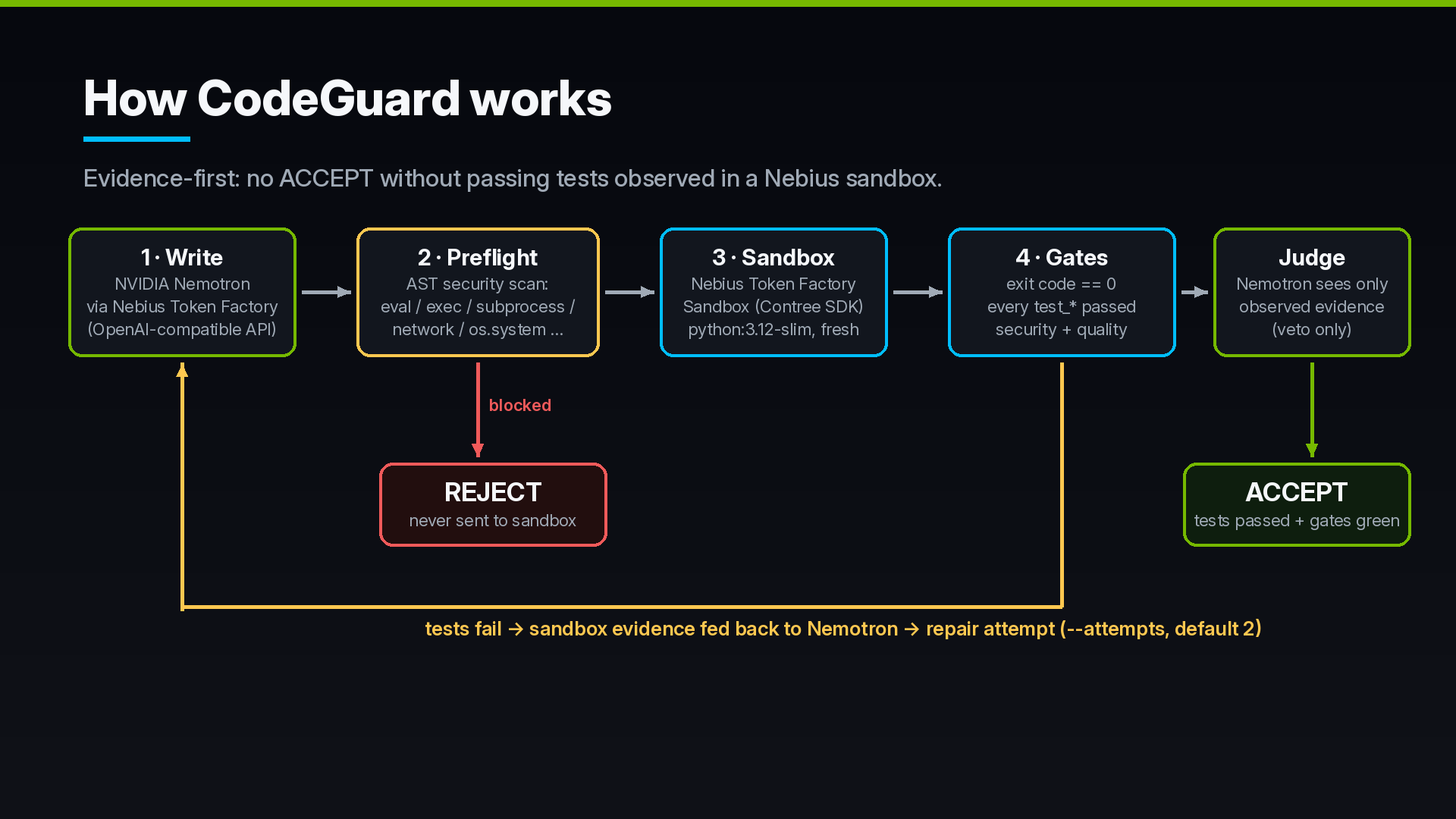
- Writes — NVIDIA Nemotron (
nvidia/NVIDIA-Nemotron-3-Nano-30B-A3B), served by Nebius Token Factory, writes a self-contained Python module and its owntest_*functions. - Preflights — an AST-based security and quality scan blocks
eval/exec/__import__,subprocess, sockets,pickle, network libraries and destructiveoscalls, as well as syntax errors and missing tests. Blocked code is never executed. - Executes — clean code is uploaded to a fresh Nebius Token Factory Sandbox (Contree,
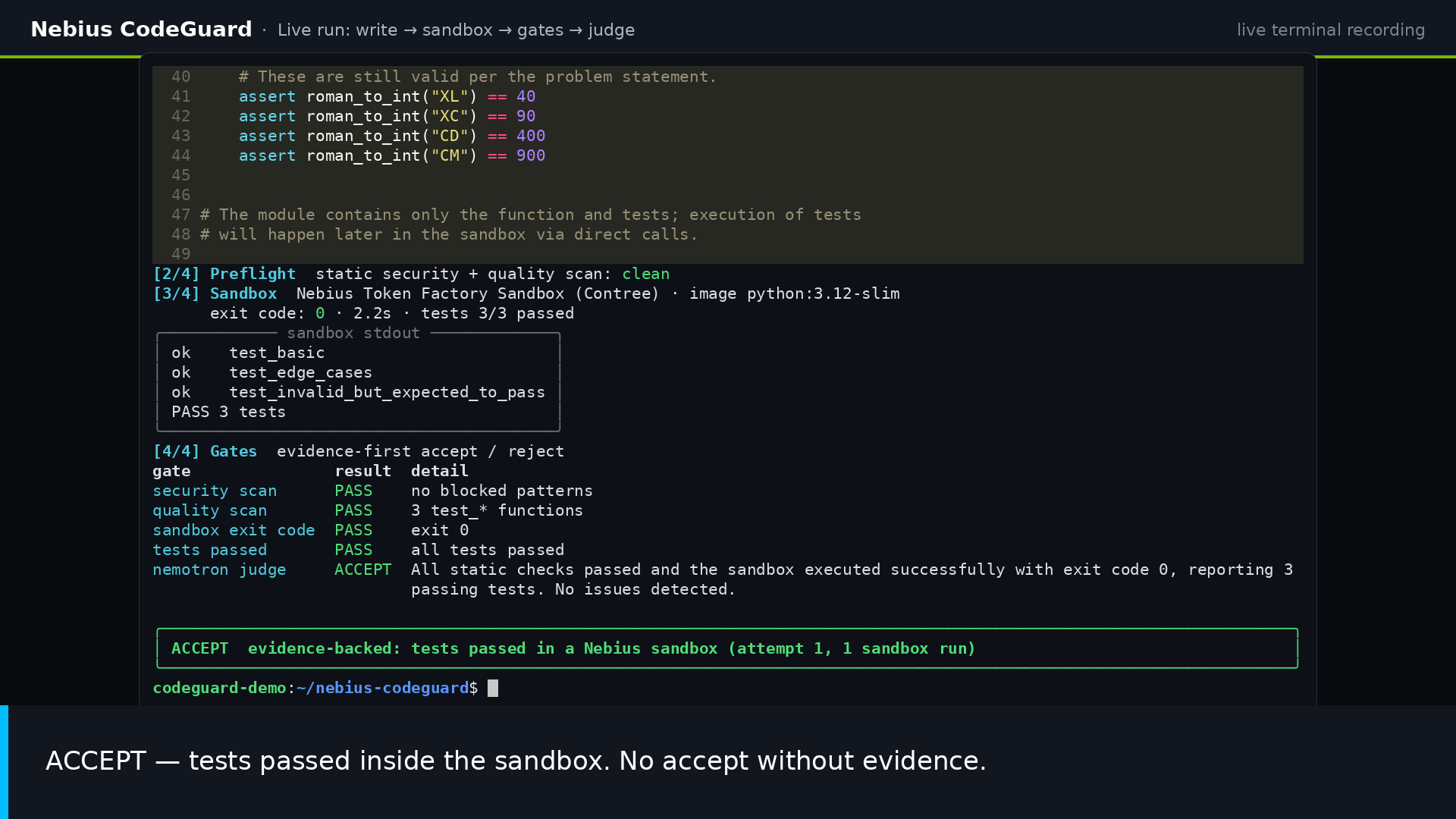
python:3.12-slim) where a small harness runs every test and reports each result. - Gates — deterministic rules: the sandbox must have run, exit code must be
0, every test must pass, scans must be clean. - Judges — a second Nemotron call sees only the observed evidence (exit code, stdout/stderr, gate results) and returns JSON. It can veto an accept but can never override a failed gate.
- Repairs — if the gates reject, the rejection reasons and sandbox stderr go back to Nemotron for another attempt.
The result is a clear ACCEPT or REJECT with the reasons printed in the terminal (codeguard run "<task>").
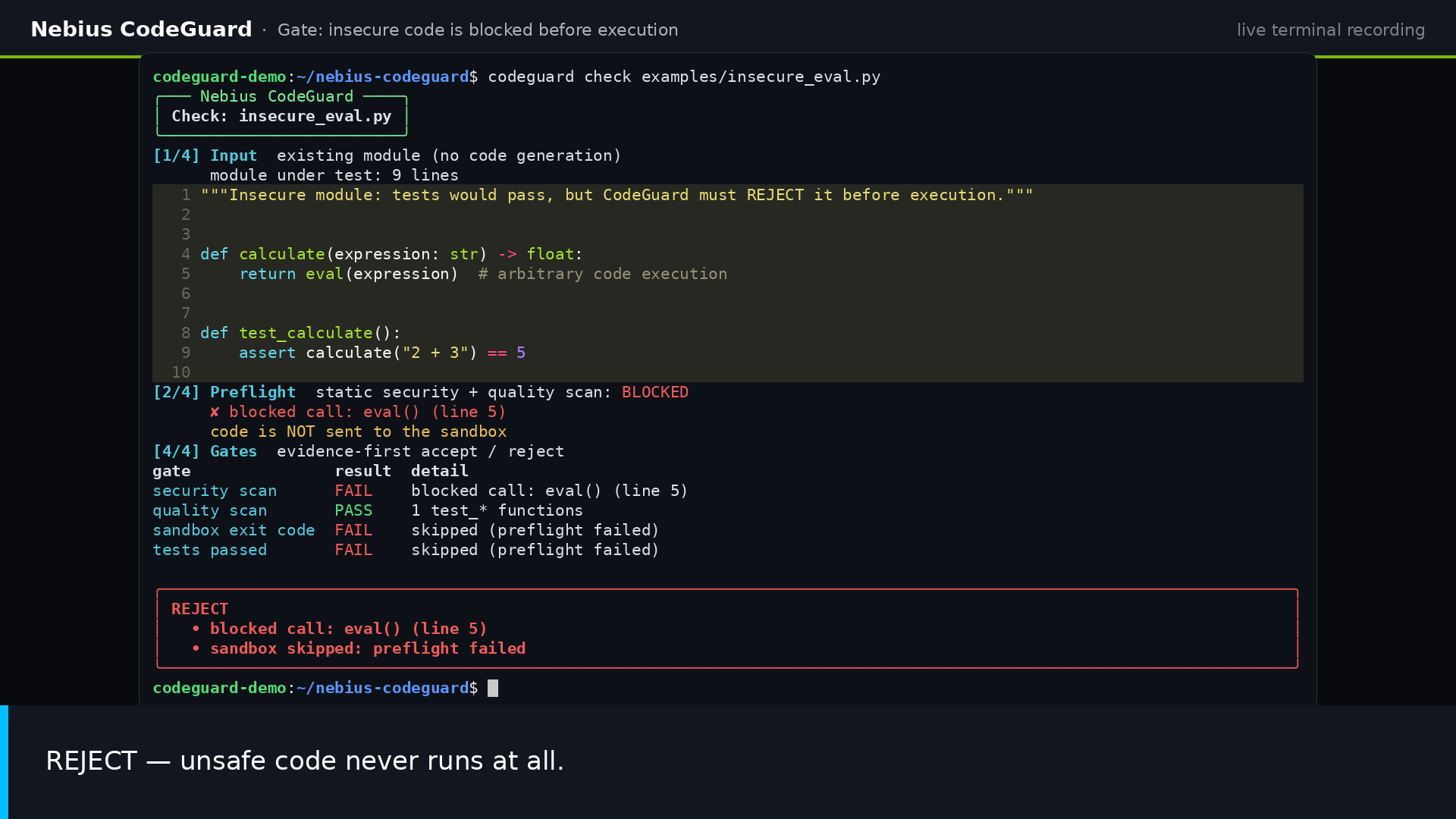
codeguard check <file> runs an existing module through the same preflight → sandbox → gates path.
In our live runs, Nemotron wrote a Roman-numeral converter that passed 3/3 tests in the sandbox and was accepted; a
slugify task failed one test in the sandbox on its first attempt ("Café-au-lait!!!"), and after receiving the
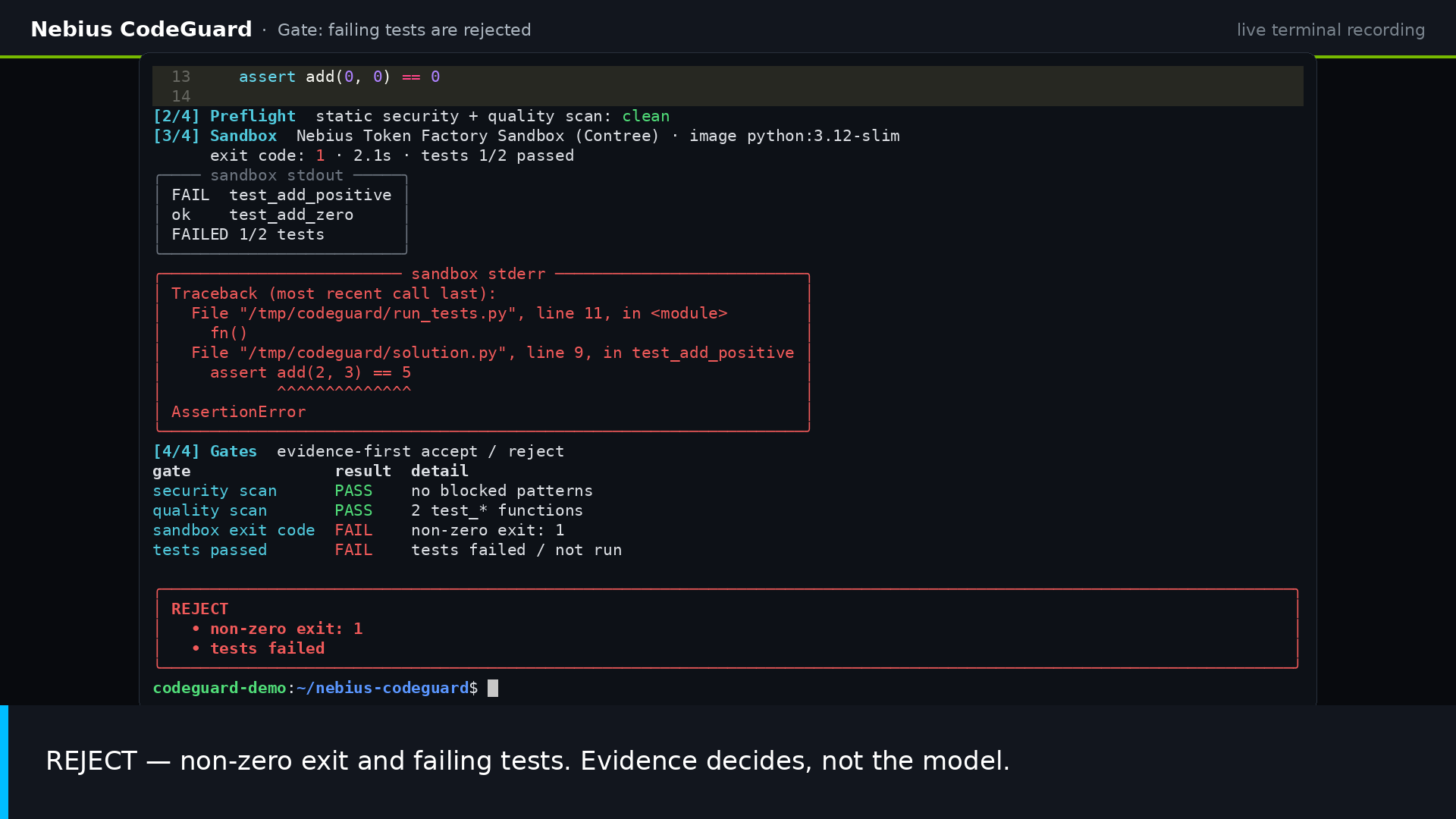
evidence Nemotron added Unicode normalisation and passed on attempt 2. A deliberately buggy add was rejected on
its failing test, and an eval-based calculator was rejected before it ever reached a sandbox.
How we built it
- Python 3.11+ CLI built with Typer and Rich.
- Nebius Token Factory OpenAI-compatible inference (
https://api.tokenfactory.nebius.com/v1) through the official OpenAI Python SDK. - NVIDIA Nemotron (
nvidia/NVIDIA-Nemotron-3-Nano-30B-A3B) as both writer and evidence-only judge, with separate system prompts and temperatures. - Nebius Token Factory Sandboxes (Contree) through
contree-sdk0.3.6:ContreeSync()→images.use("python:3.12-slim")→run("python", ["run_tests.py"], files=..., cwd=...).wait(), authenticated with the same Nebius API key and project ID. - Gates are pure, deterministic Python (
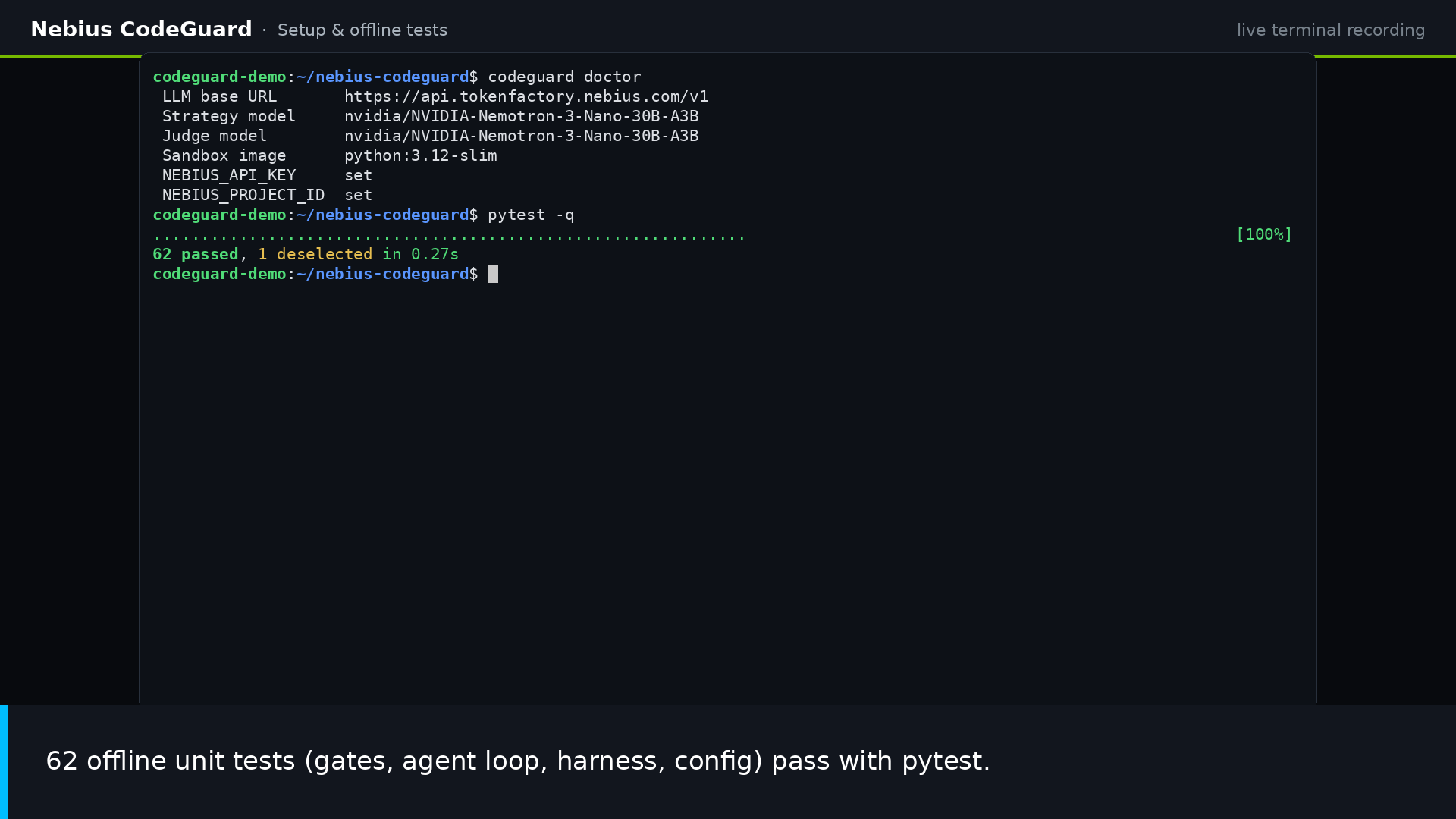
astbased) so they are easy to audit and unit-test; the agent loop takes injectablellmandsandboxcallables, so the whole pipeline is covered by 62 offline pytest tests using fakes, plus an optional-m livetest that spawns a real sandbox.
Challenges we ran into
- Wiring the Sandboxes Beta. Our first attempt used raw REST calls (image UUIDs and a heredoc shell hack to
write files). Switching to the official
contree-sdkpattern — images by tag and uploading files withfiles=— made execution reliable, but project-level Beta access came through only part-way into the hackathon. - Keeping the judge honest. An LLM judge will happily "confirm" tests it never saw. We give it only observed evidence, ask for strict JSON, and make it veto-only: it can never turn a failed gate into an accept.
- Strict but not silly security rules. A substring check for
eval(also flagsast.literal_eval. We moved to an AST-based policy that inspects actual calls and imports, with a substring fallback only for unparseable code. - Making evidence machine-readable. A custom harness prints per-test
ok/FAILlines and a finalPASS n tests/FAILED f/t testssummary with meaningful exit codes, so gates never have to guess.
Accomplishments that we're proud of
- A working end-to-end loop on Nebius infrastructure: Nemotron writes → preflight → Token Factory Sandbox executes → gates → Nemotron judge, including an evidence-driven repair that fixed a real failing test.
- No accept without evidence, enforced in code rather than in a prompt.
- Unsafe code is rejected before execution; untrusted code runs only in a disposable sandbox, never locally.
- Clean, tested, MIT-licensed codebase with a readable CLI and secrets that are never printed.
What we learned
- Separating the generator from an evidence-only judge — and giving the final word to deterministic gates — removes most "self-congratulating" false accepts.
- Sandboxes turn "should I run this?" into a non-question: every attempt gets a fresh environment in about 1–3 seconds, which makes retry loops cheap.
- Small models like Nemotron 3 Nano are very capable at writing focused modules and tests when the contract is
explicit (stdlib only, plain
assert, single code fence).
What's next for Nebius CodeGuard
- Parallel candidates using sandbox checkpoints/branches and picking the best-evidenced one.
- Coverage, property-based and mutation-testing gates so weak tests cannot pass.
- Multi-file repository patches (diffs applied to an existing project and its own test suite).
- A hosted CodeGuard API / CI integration.

Log in or sign up for Devpost to join the conversation.