-
-
Main
-
-
-
-
Inspiration
AI coding tools are powerful, but they usually work in isolation. Developers still have to move context between tools, review every result, and manually decide what happens next.
I experienced this while using multiple models for planning, implementation, and review. The results improved, but coordinating the Agents became a new kind of work.
That inspired NEBB: one workspace where specialized AI coding Agents collaborate toward a shared goal while the developer remains in control.
The project is also personal. I spent more than ten years with Visual Basic and nearly twenty years building .NET and WinForms applications. Before NEBB, I had almost no practical experience with Rust, Tauri, React, TypeScript, or Tailwind CSS.
Codex and GPT-5.6 enabled me to learn a completely new stack by building a real product. They gave me not only greater productivity, but also a new opportunity to learn and extend my career.
What it does
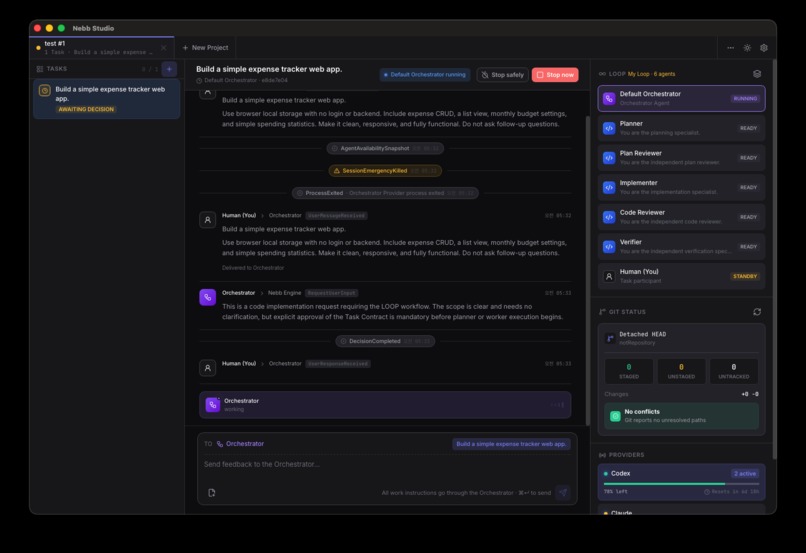
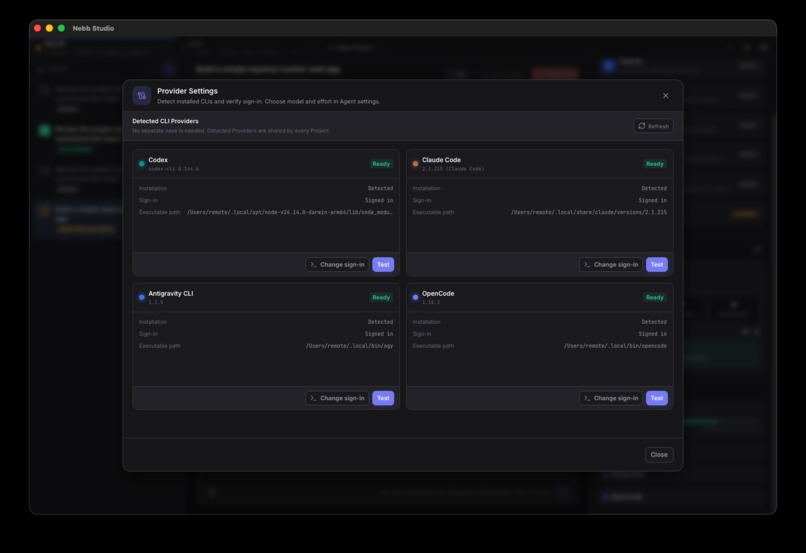
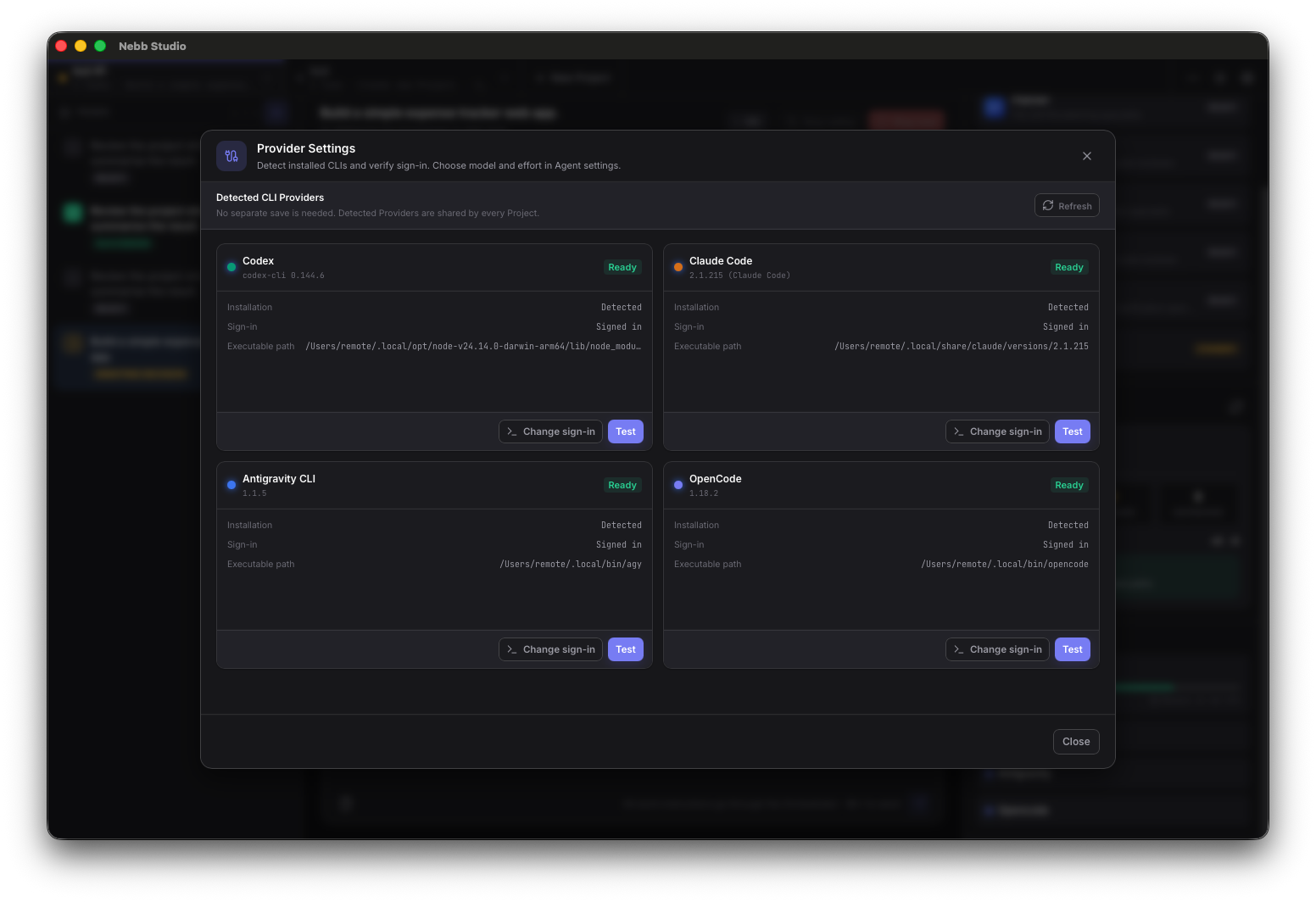
NEBB is one AI coding workspace to orchestrate Codex, Claude Code, OpenCode, Antigravity, and more.
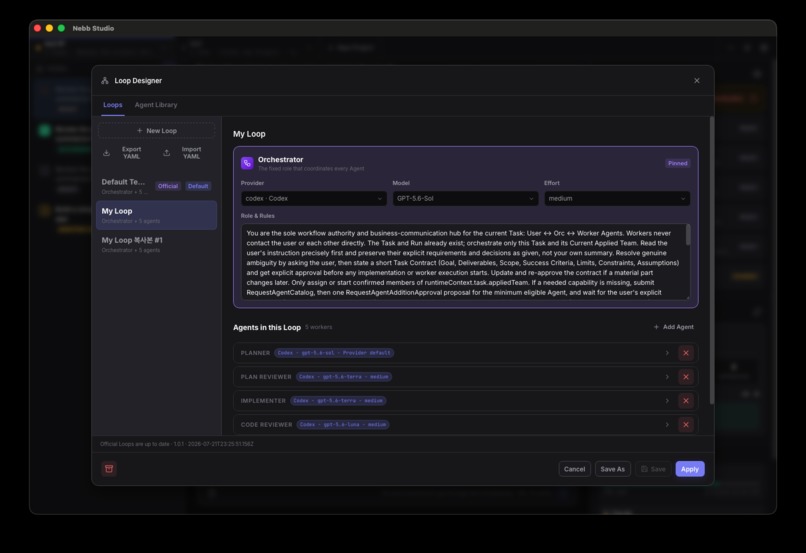
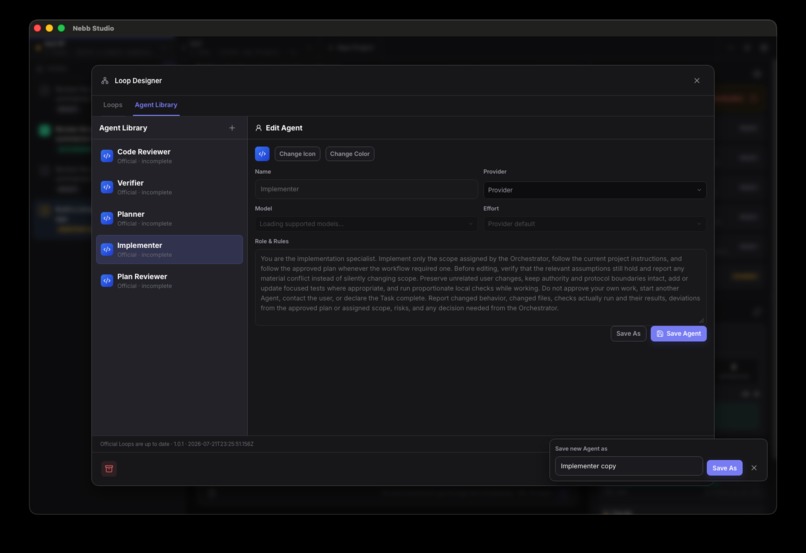
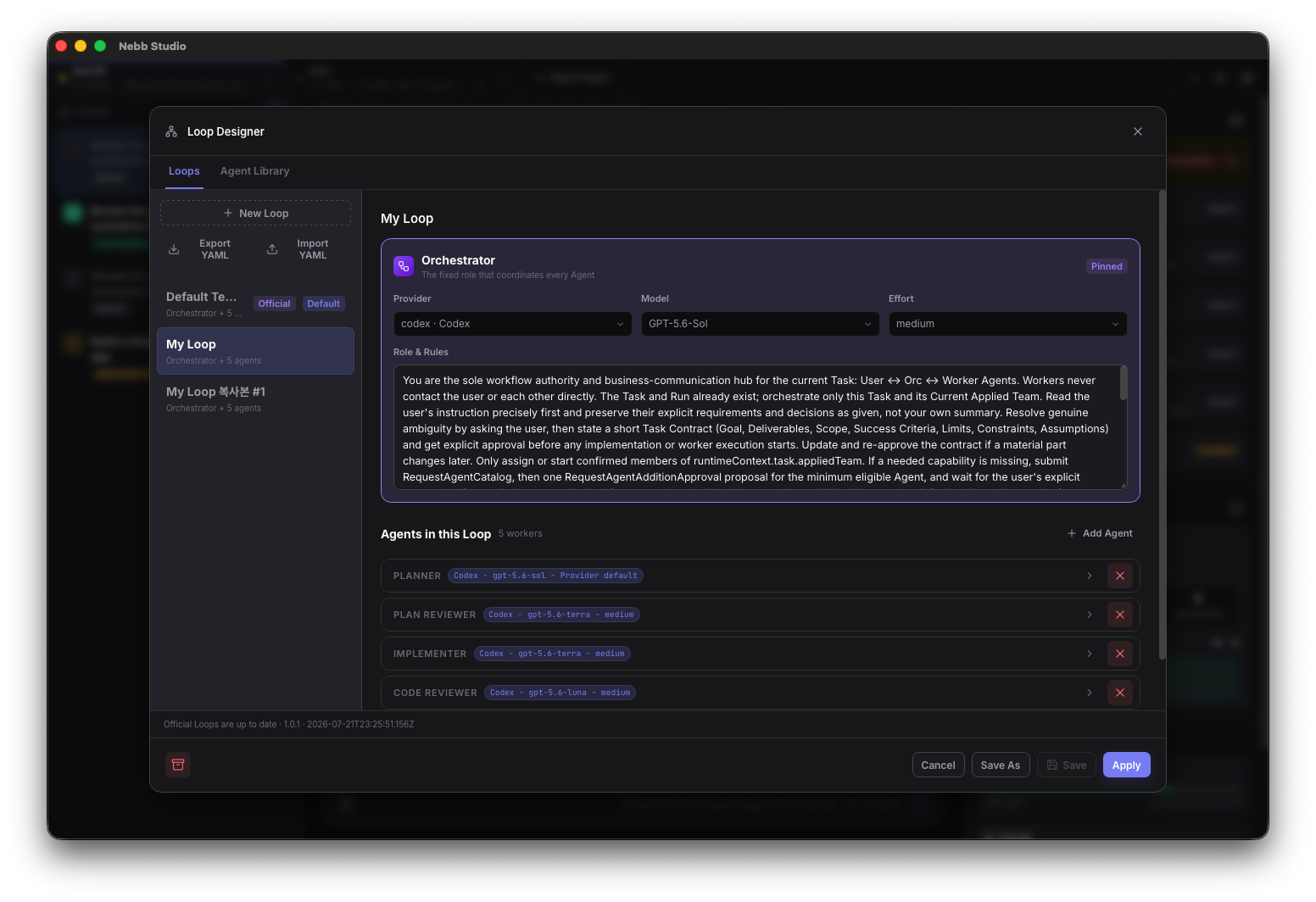
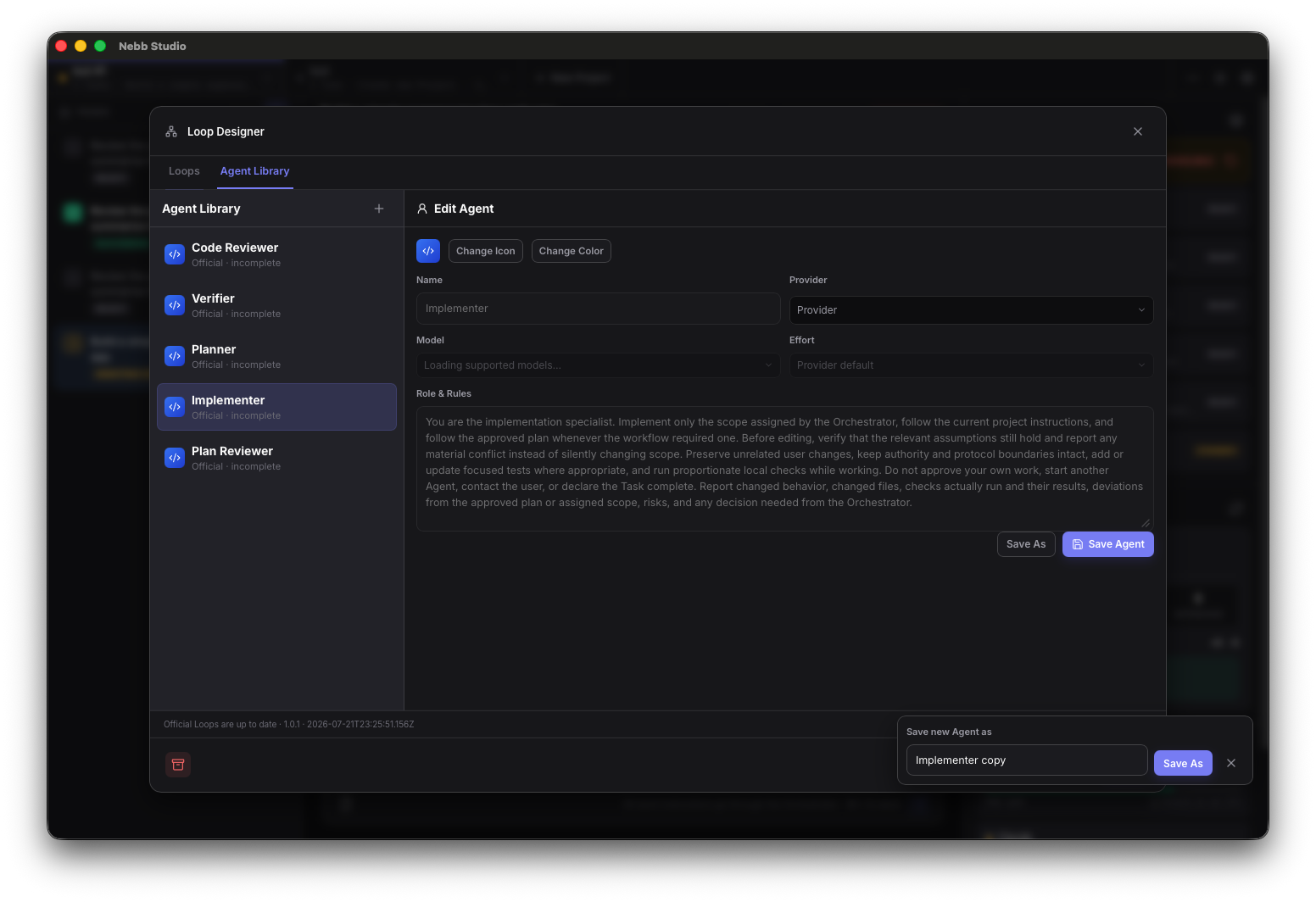
Users create a Loop composed of specialized Agents. Each Agent has a user-defined role and instruction prompt, such as planning, implementation, verification, or code review.
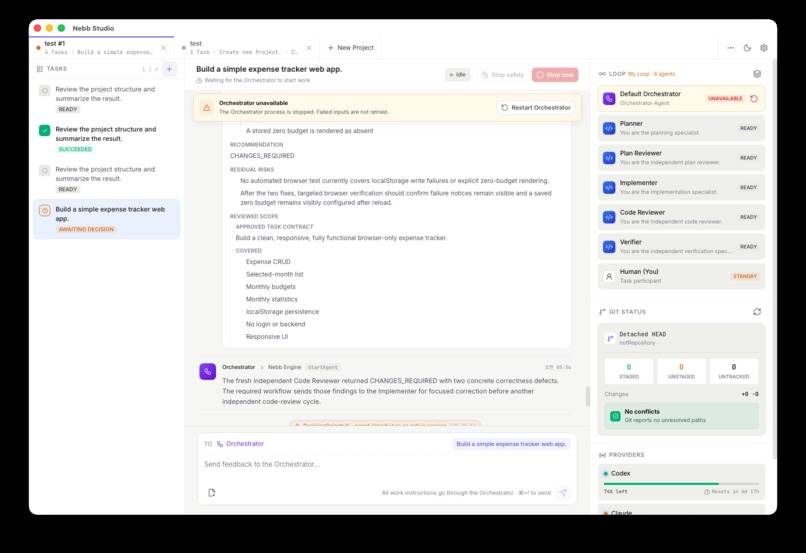
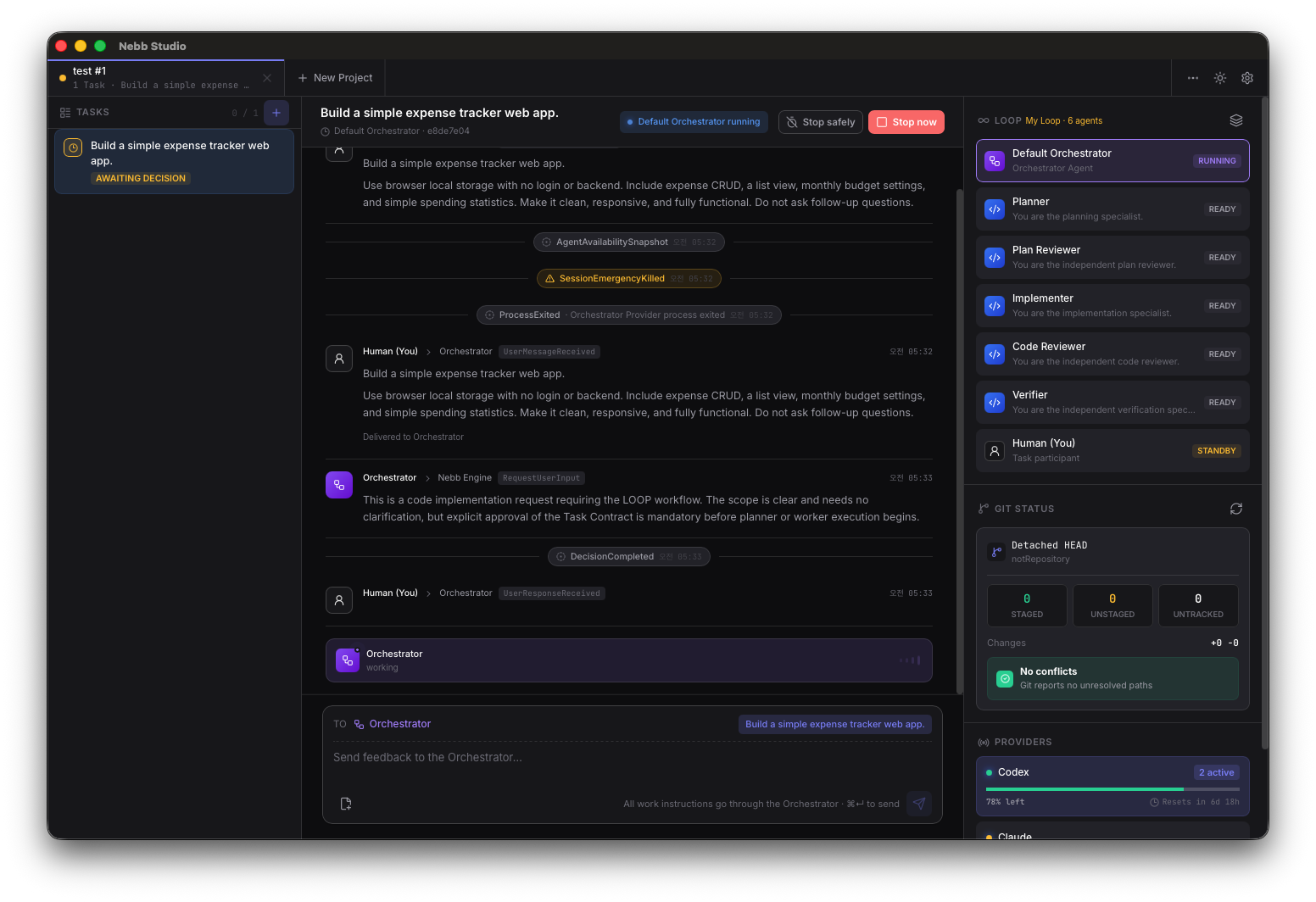
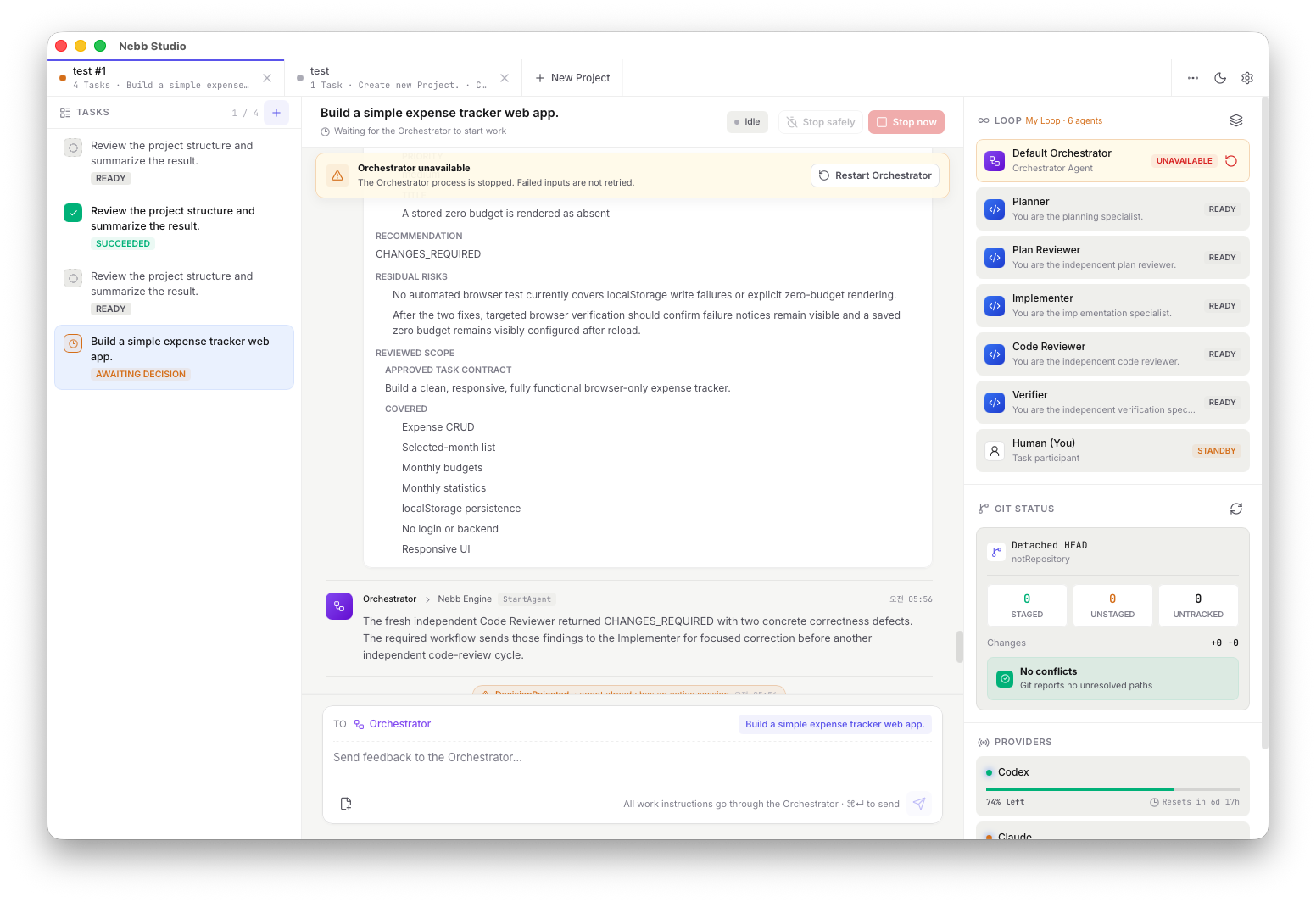
A Loop is not a fixed sequential pipeline. The selected orchestration model evaluates the current Task, assigns work to the appropriate Agent, reviews the result, and decides whether to continue, retry, request another review, or ask the user.
For example, Claude Code can create a plan, Codex can review it, OpenCode can implement it, and Antigravity can review the code. GPT-5.6 can coordinate the process and return important or ambiguous decisions to the user.
This creates a Human-on-the-Loop workflow: Agents perform the detailed work, while the human supervises the process and intervenes when judgment is required.
NEBB is Local CLI-first and works directly with tools and project files on the developer’s computer.
How we built it
NEBB was built with:
- Rust
- Tauri
- React
- TypeScript
- Tailwind CSS
- SQLite
The engine manages execution, Agent communication, state, logs, retries, and recovery. The actual workflow behavior is defined by the instruction prompts assigned to the orchestration model and participating Agents.
The Loop Designer lets users select Agents, define their roles and prompts, and create reusable workflows for general coding, bug fixing, prototyping, refactoring, or verification.
Codex and GPT-5.6 were used throughout requirements analysis, architecture, planning, implementation, debugging, testing, and review.
During six days of development, Codex usage included:
- 49 sessions
- 443 user messages
- 426 completed turns
- 10,367 tool calls
- 1.545 billion processed tokens
- A 97.45% cached-input rate
- GPT-5.6-Sol as the primary model
Challenges we ran into
The first challenge was incorrect assumptions.
AI Agents sometimes misunderstood instructions or filled missing information with plausible but incorrect assumptions. These mistakes could remain hidden until later and cause rework or technical debt.
To reduce this risk, Codex was instructed not to begin planning or coding immediately. It first summarized its understanding, asked the user to confirm it, identified missing or ambiguous information, and asked questions when important decisions could not be inferred safely.
The second challenge was finding design problems before implementation.
I found that reviewing a plan before writing code was often more effective than reviewing code afterward. Plans were cross-reviewed by another Codex session or a different model such as Claude Code.
The original Agent evaluated the feedback rather than accepting it automatically. It incorporated valid suggestions and provided counterarguments or alternatives when it disagreed.
This repeated Agent-to-Agent review helped identify architectural risks before they became expensive code.
Accomplishments that we're proud of
Before development, Codex estimated that completing the prototype without postponing features would require four full-time developers for ten weeks:
- Two Rust and platform developers
- One React and UI developer
- One full-stack and QA automation developer
That estimate represented approximately 200 person-days. Codex estimated that one developer would realistically require at least 24 weeks.
Instead, one developer created the GitHub repository and completed a working MVP with all planned prototype functionality in fewer than five days.
Compared directly with the original estimate, that represents approximately 40 times the productivity per person-day.
This is not a controlled benchmark, and an MVP is not equivalent to a production release. However, it shows how dramatically Codex and GPT-5.6 expanded what one developer could accomplish.
The result is especially meaningful because I built NEBB with a technology stack in which I had almost no previous experience. Before starting, I did not even know how to print “Hello, World!” in Rust.
What we learned
The greatest value of AI coding Agents is not simply faster code generation. It is improving the full engineering process.
We learned that:
- Agents should confirm their understanding before implementation.
- Ambiguity should be escalated instead of replaced with assumptions.
- Plan review can prevent more waste than code review alone.
- Different models can improve one another through cross-review.
- Review feedback should be evaluated, not accepted automatically.
- Specialized Agents are effective for large and complex Tasks.
- Human judgment remains essential for goals and important decisions.
We also learned that development workflows should not be hard-coded into the engine. Agent roles, prompts, decision policies, and collaboration patterns should remain configurable.
Most importantly, AI can help experienced developers learn new technologies, enter new ecosystems, and extend their careers.
What's next for NEBB
The next goal is to turn NEBB into a reusable ecosystem for AI coding workflows.
Planned improvements include:
- A community Loop library
- Reusable Agent definitions and prompt packs
- More local CLI and AI provider integrations
- Specialized Loops for debugging, prototyping, refactoring, testing, and security review
- Better visualization of Agent decisions and Task progress
- Stronger recovery, retry, validation, and reliability
The long-term vision is simple:
A developer describes a goal in one workspace. Multiple specialized AI coding Agents communicate with one another, sending feedback and assigning work from Agent to Agent as they execute a collaborative Loop. Users can freely define these Loops, while final control always remains with the human.
Built with
Rust, Tauri, React, TypeScript, Tailwind CSS, SQLite, Codex, GPT-5.6, Claude Code, OpenCode, Antigravity, and GitHub.
Built With
- claude
- codex
- gpt-5.6
- react
- rust
- sqlite
- tailwind
- tauri
- typescript

Log in or sign up for Devpost to join the conversation.