-
-
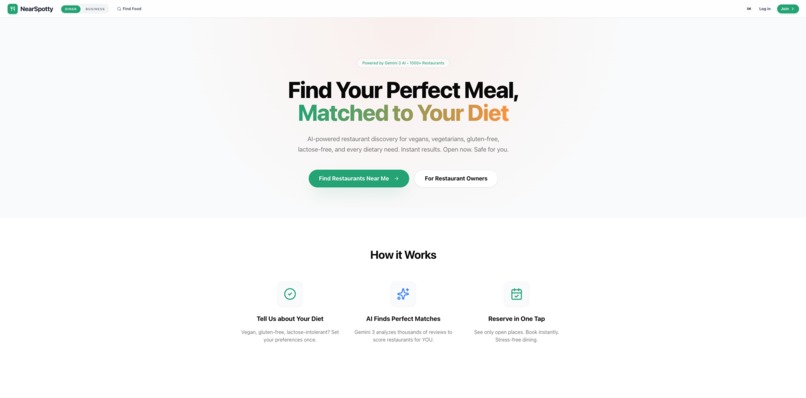
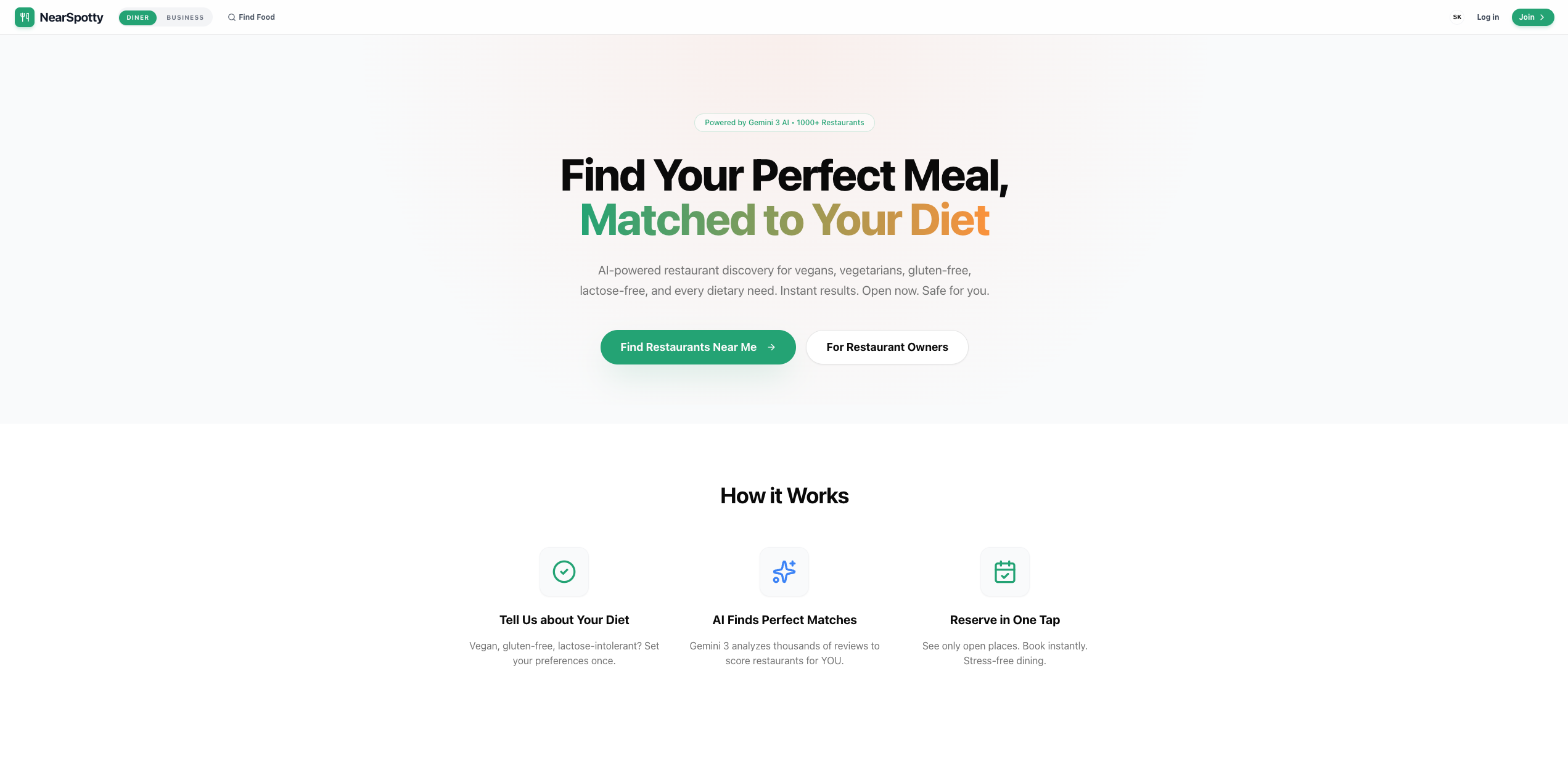
Landing page for dinner in Nearspotty website
🍴 NearSpotty: Real-time Dining Intelligence 💡 Inspiration We live in an era of "Information Paralysis." With thousands of restaurant options, choosing where to eat has become a source of anxiety for 87% of diners. Standard filters (like "Vegan" or "Gluten-Free") are often inaccurate or outdated. We built NearSpotty to provide a definitive answer to the question: "Can I actually eat here safely and enjoy it?"
🛠 How We Built It NearSpotty is a high-performance platform built for speed and reliability.
AI Core: Gemini 3 Flash. We chose this model for its incredible speed and ability to reason across large datasets (reviews and menus) with sub-second latency.
Frontend: Next / Tailwind CSS (Mobile-first design).
Backend: Node.js for seamless API integration.
Geolocation: Google Maps Platform for real-time discovery.
⚙️ How It Works: Smart Data Triangulation Instead of relying on a single source of truth, NearSpotty uses Gemini 3 Flash to cross-reference three critical data points:
Crowdsourced Reviews: Gemini scans recent customer reviews to find "hidden" details—like whether a place is truly quiet or if they are careful about cross-contamination.
Official Restaurant Settings: We take the owner's official business information as the primary baseline.
Menu Analysis: The AI parses available menu data to match specific ingredients with the user's dietary profile.
By triangulating these sources, NearSpotty provides a Match Score that is far more accurate than a simple 5-star rating.
🚧 Challenges We Faced Optimizing API Efficiency & Costs: Integrating the Google Maps and Places API presented a significant challenge. We had to find the perfect balance between providing rich, real-time location data and maintaining a cost-effective implementation. We overcame this by optimizing our API calls and leveraging Gemini 3 Flash to process and cache essential location insights more efficiently.
Finding the "North Star" (Strategic Focus): With so many potential features—from gamification to complex business analytics—it was difficult to commit to a single path. We initially struggled with "feature creep" but eventually decided to prioritize the core problem: The Match. We learned that a perfectly executed solution for dietary restrictions is more valuable than a dozen half-finished features.
Data Volume vs. Latency: Analyzing hundreds of reviews for every search query is computationally heavy. Gemini 3 Flash was the game-changer here; it allowed us to maintain a "snappy" and responsive user experience without compromising on the depth or accuracy of our semantic analysis.
Handling Ambiguity: User reviews are notoriously messy and subjective. We had to carefully fine-tune our system instructions to ensure the AI could reliably distinguish between a factual dietary warning (e.g., "shared fryers") and a purely subjective dining opinion.
🧠 What We Learned We discovered that the most valuable thing for a user isn't more information, but synthesis. Using Gemini showed us that we can turn thousands of words of "noise" (reviews) into a simple "Yes" or "No" for the user.
🚀 What's Next? Granular Menu Control: We are building a feature for restaurant owners to upload and tag their menus with extreme precision, allowing the AI to recommend specific dishes rather than just the restaurant.
Enhanced AI Consultant: Expanding the owner dashboard to provide even deeper insights into local dining trends and inventory suggestions.
Built With
- firebase
- firestore
- gemini
- google-maps
- google-places
- nextjs
- typescript

Log in or sign up for Devpost to join the conversation.