-
-
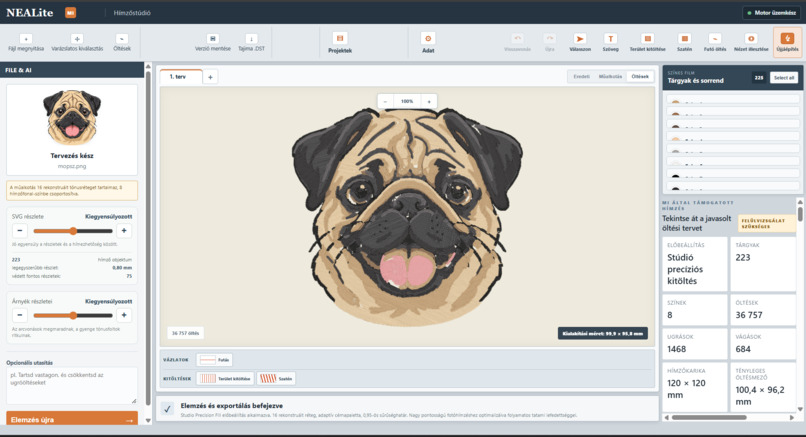
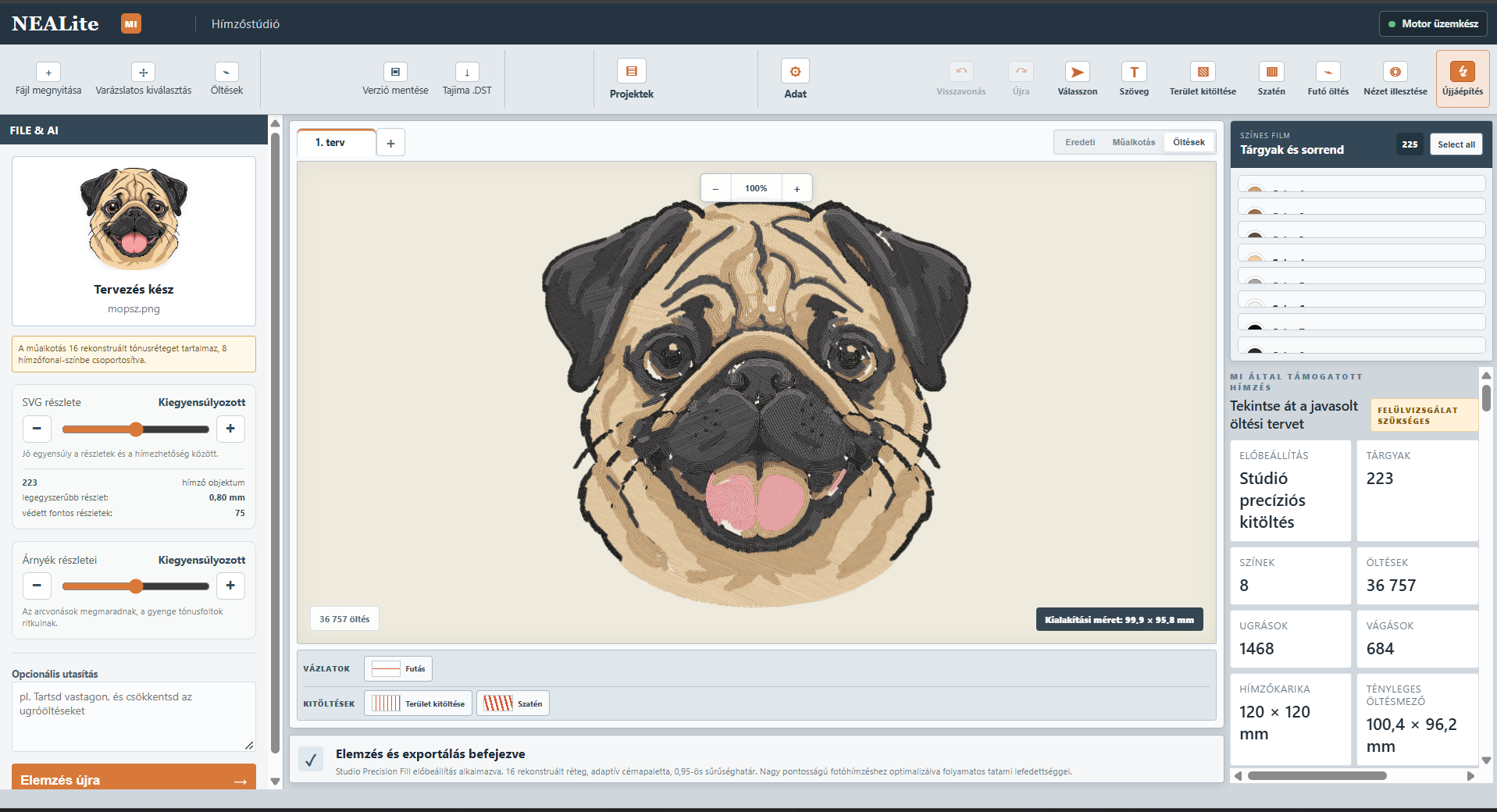
NEALite’s 8-color mixed-stitch preview, combining step/tatami, satin, and running stitches with measurable machine metrics.
-
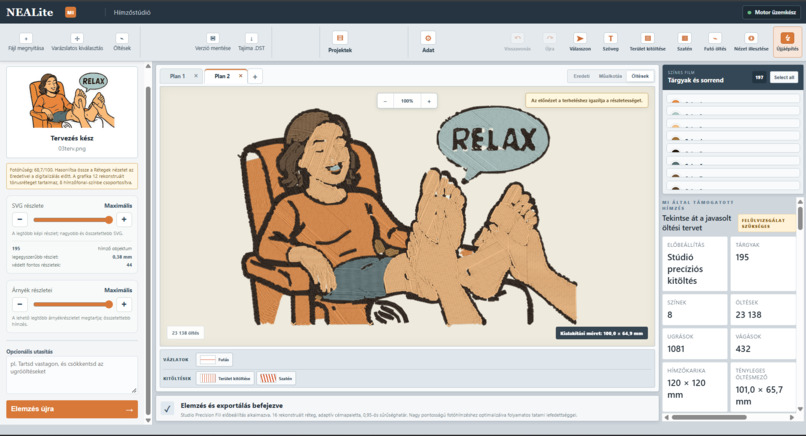
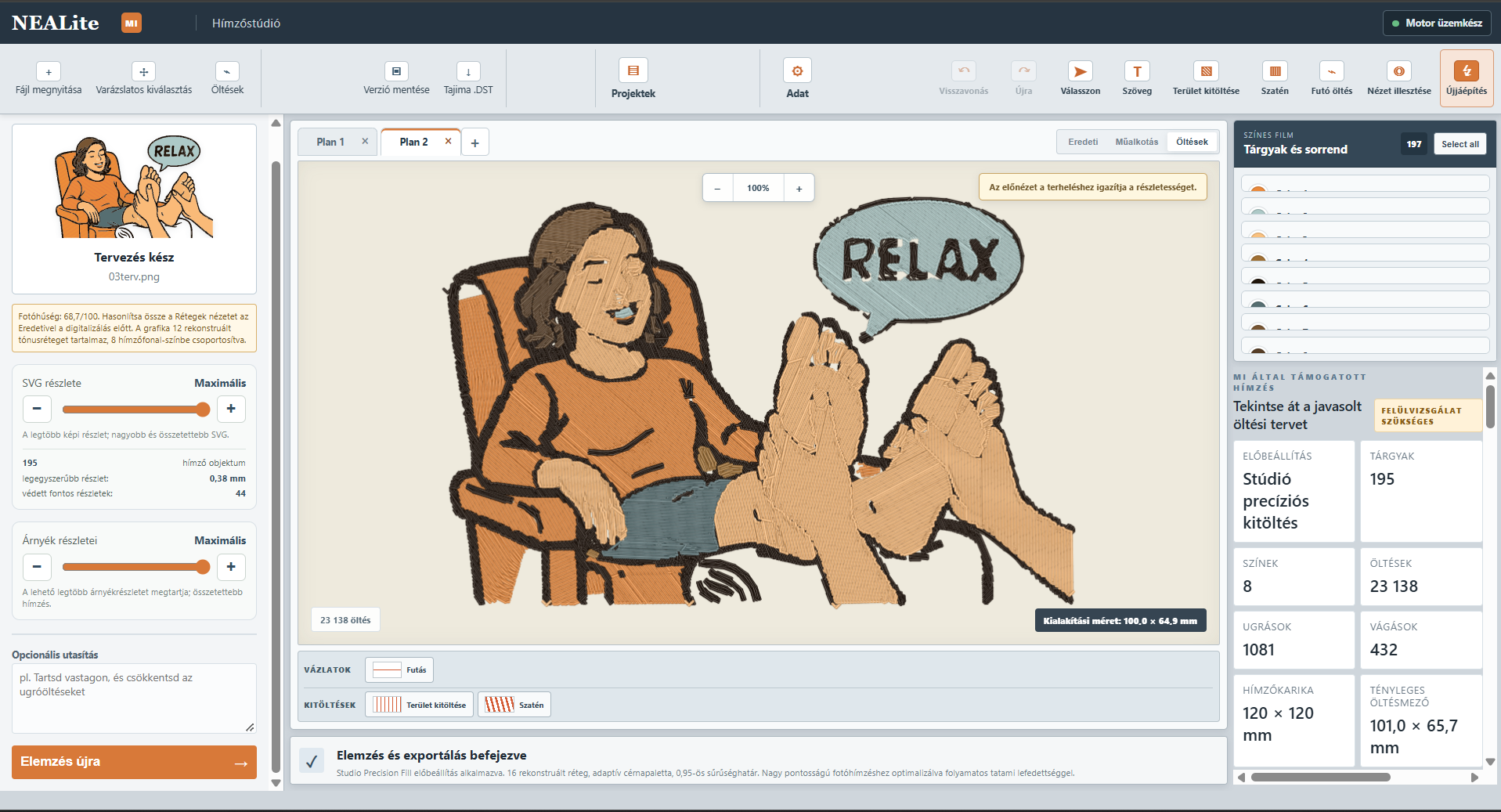
Generalization test: NEALite converts a complex human illustration with lettering into an 8-color, reviewable stitch plan.
-
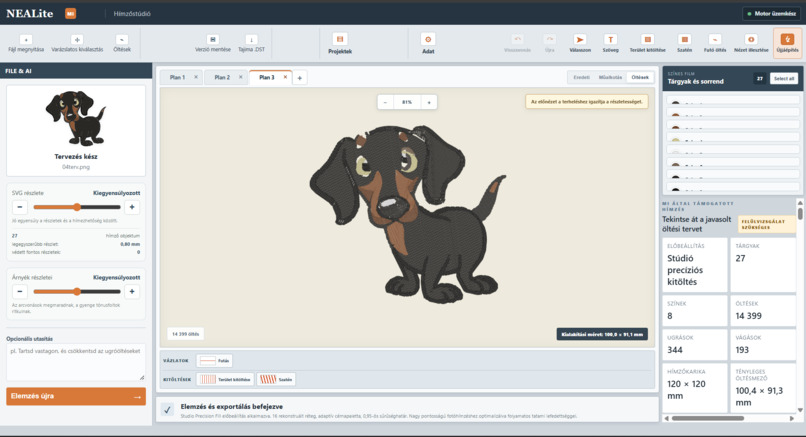
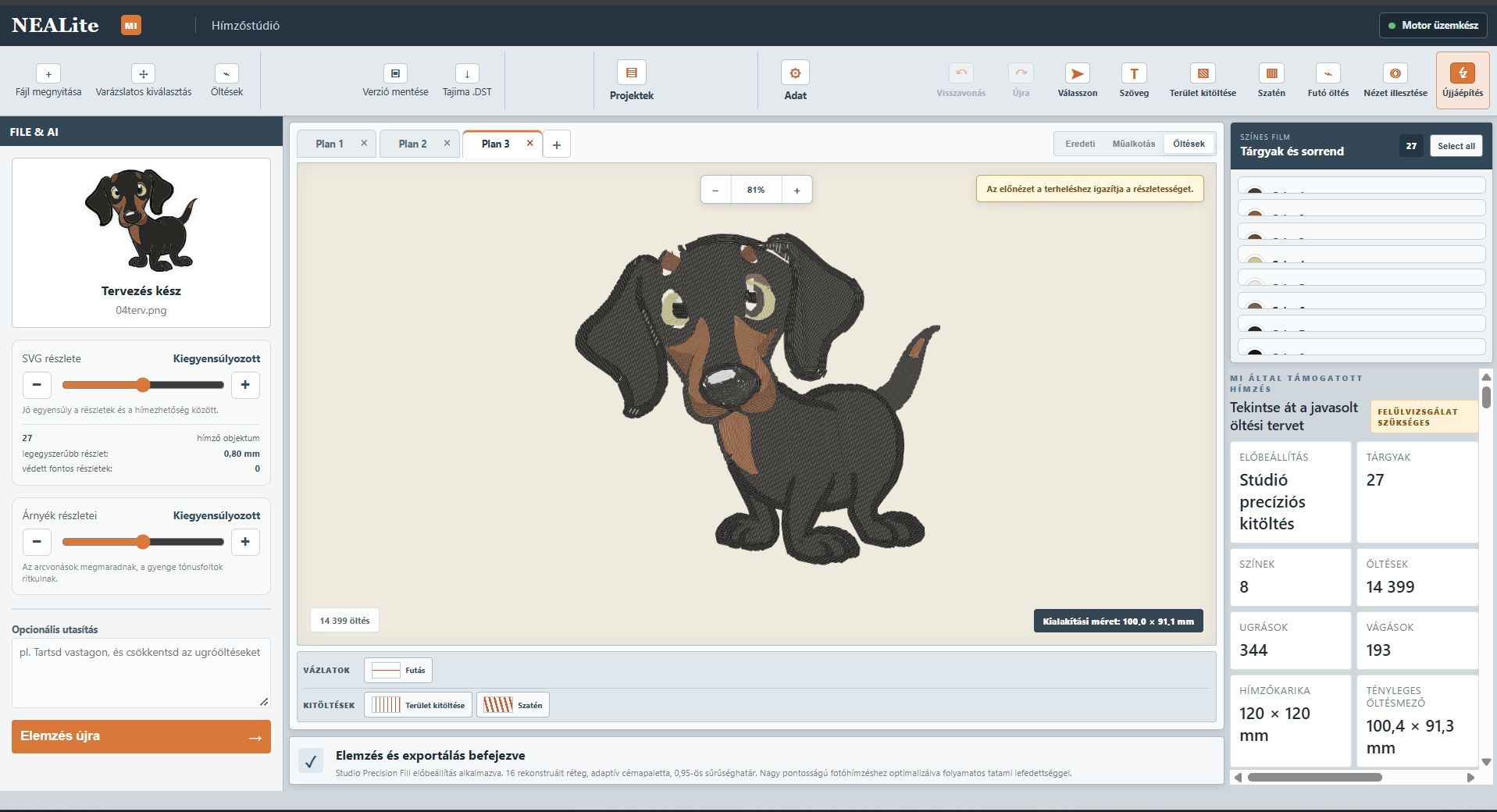
Simple-motif test: NEALite preserves the character’s geometry in a compact 8-color plan with 27 objects and 14,399 stitches.
-
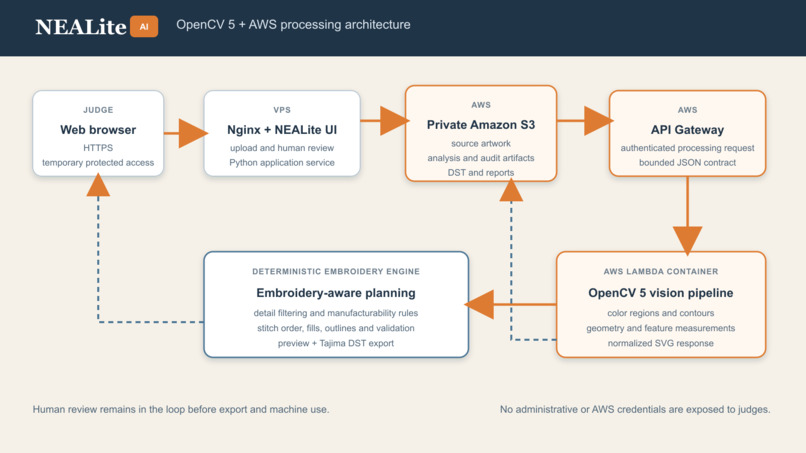
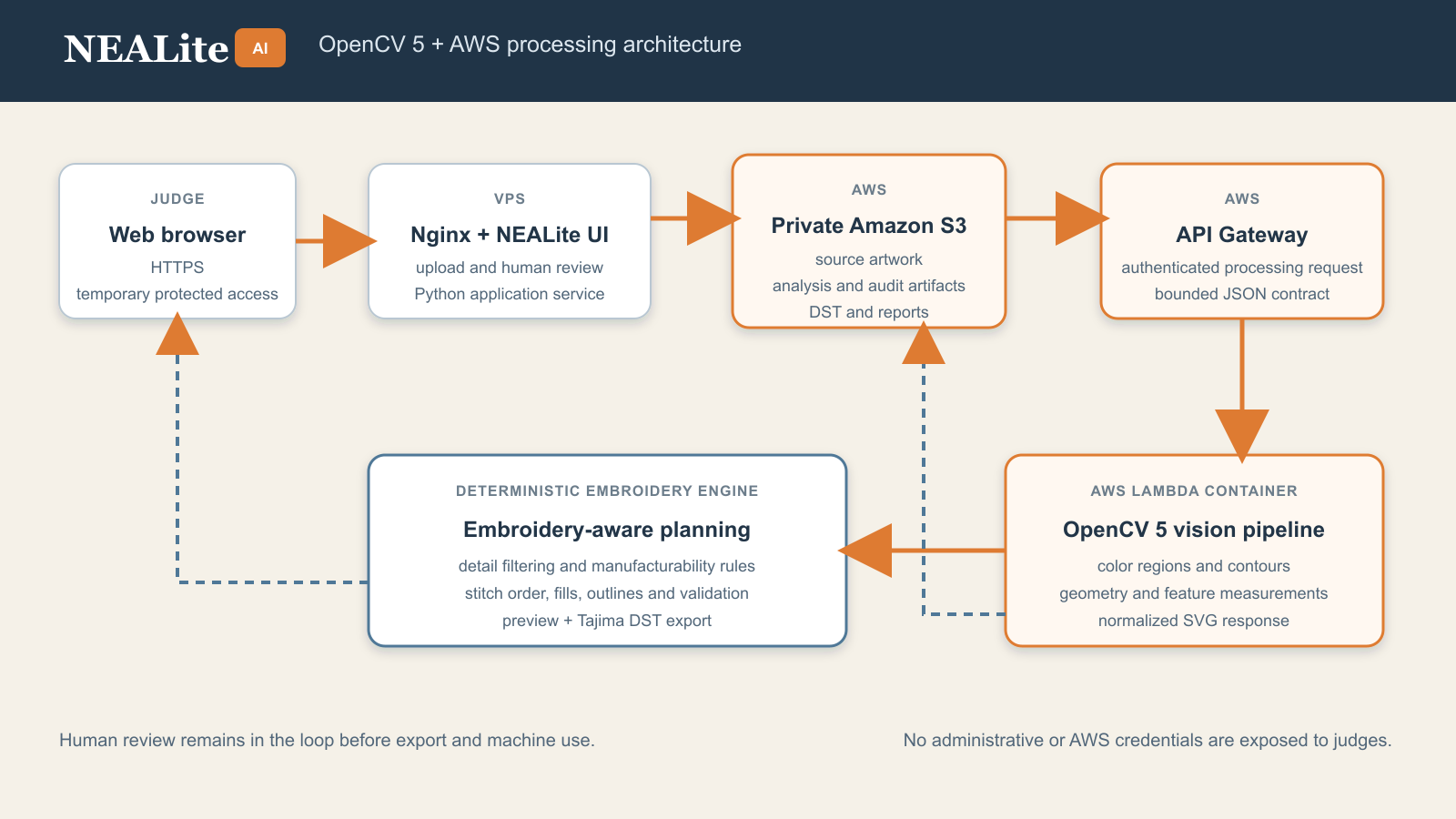
NEALite architecture: OpenCV 5 on AWS transforms uploaded artwork into vector geometry, optimized stitch plans, and Tajima DST files.
Inspiration
Raster-to-vector tools optimize how an image looks on screen. Embroidery software must also understand what can be sewn: minimum feature width, fabric behavior, density, stitch direction, overlaps, jumps, trims, and sewing order. NEALite was created to connect these two worlds. The goal is not only to redraw an image, but to explain how its visual structure can be translated into physical thread.
What it does
NEALite accepts raster artwork or SVG input and produces:
- OpenCV 5 color-region and contour analysis
- editable reconstructed vector objects
- embroidery-aware detail control based on physical feature size
- protected structural details and consolidated micro-regions
- automatic mixed step/tatami, satin, and running-stitch decisions based on measured geometry
- a reviewable stitch plan with object-level decisions
- original, artwork, and stitch views
- jump, trim, object, color, hoop, and stitch metrics
- Tajima DST export
The human user remains in control and reviews the generated plan before export or machine use.
How we built it
The web application runs behind HTTPS on a VPS. Raster inputs are uploaded to a private Amazon S3 bucket and submitted through Amazon API Gateway to a containerized AWS Lambda function. Lambda runs OpenCV 5.0.0 and returns normalized geometry plus a vision-analysis report. The NEALite backend then applies deterministic embroidery rules, builds the stitch sequence, validates hoop fit, renders a stitch preview, and exports Tajima DST.
The Adaptive Satin Detection stage evaluates local width, aspect ratio, contour smoothness, area, brightness, contrast, topology, and protected-detail metadata. Narrow, suitable columns can become shape-following satin; broad surfaces remain step/tatami; open paths remain running stitch. Compound or branched regions are handled conservatively.
OpenCV operations include Lab color analysis, Canny and Sobel edges, connected components, contour hierarchy, polygon approximation, distance transforms, morphology, and reconstruction-fidelity measurement. Results are retained in an audit trace showing which visual measurements affected downstream planning decisions.
Challenges we ran into
The most difficult issue was that visually small regions can be either noise or essential identity features. Removing every small component damaged eyes, facial contours, and highlights, while preserving all of them produced hundreds of fragmented objects and excessive machine transitions.
Our first recorded pug run produced 690 objects, 2,123 jumps, and 2,683 cuts. We preserved this as a failure case. Contrast-protected region consolidation reduced the design to 482 objects while retaining a measured structural-edge score of 0.9061. A geometry-preserving route optimizer then reduced the result to 1,398 jumps and 562 trims.
Accomplishments that we are proud of
- A working end-to-end raster → OpenCV 5 → vector → stitch plan → DST workflow
- A real AWS S3, API Gateway, Lambda, CloudWatch, and S3-results execution path
- A detail control that changes physical manufacturability thresholds rather than merely changing the preview
- Measured preservation of protected details during region consolidation
- Deterministic embroidery routing with recorded before-and-after metrics
- A conservative mixed-stitch engine that applies satin only to physically viable regions
- An online, judge-accessible application with temporary protected access
- Honest documentation of failure cases and current limitations
The frozen competition build was also exercised on three different illustration types. The generated plans used 223, 195, and 27 objects respectively, all with eight thread colors, while retaining motif-dependent geometry rather than relying on a pug-specific rule. These are software plan measurements, not claims of verified physical stitch quality.
What we learned
The best visual trace is not automatically the best embroidery plan. Image scale must be converted into millimetres before feature filtering can be meaningful. Region consolidation and route optimization must also share protection metadata: optimizing one stage without that context can destroy details preserved by another.
What's next
The next steps are controlled physical stitch-out tests, richer satin-column rail editing, improved underlay and pull compensation, more advanced SVG geometry support, interactive object correction, and broader evaluation across fabric types and design styles.
Live application
The demonstration is protected during judging. Access credentials are supplied only through the private judge instructions and are not included in public project materials.
Important limitation
NEALite generates a reviewable machine file, but the current submission does not claim production-ready physical embroidery quality without expert review and controlled stitch-out testing.
Judge access
Live application: https://nealite.hu
Username: user
Password: uSeR04S86
These temporary, evaluation-only credentials will be disabled after judging.architecture-nealite.png
Built With
- amazon
- amazon-web-services
- api
- cloudwatch
- computer
- css3
- debian
- docker
- dst
- html5
- image
- javascript
- lambda
- linux
- nginx
- numpy
- opencv
- pillow
- processing
- pyembroidery
- python
- s3
- svg
- tajima
- vision

Log in or sign up for Devpost to join the conversation.