Inspiration
Modern distributed systems — from blockchain networks to financial infrastructure — are often monitored through isolated metrics that fail to capture how coherently a system is operating as a whole. Latency, throughput, synchronization, and stability are typically observed independently, making it difficult to understand overall system health in real time. The Network Coherence Index (NCI) was inspired by the idea that complex systems behave more like organisms than machines, and that their reliability depends on how well their components operate in synchrony.
What It Does
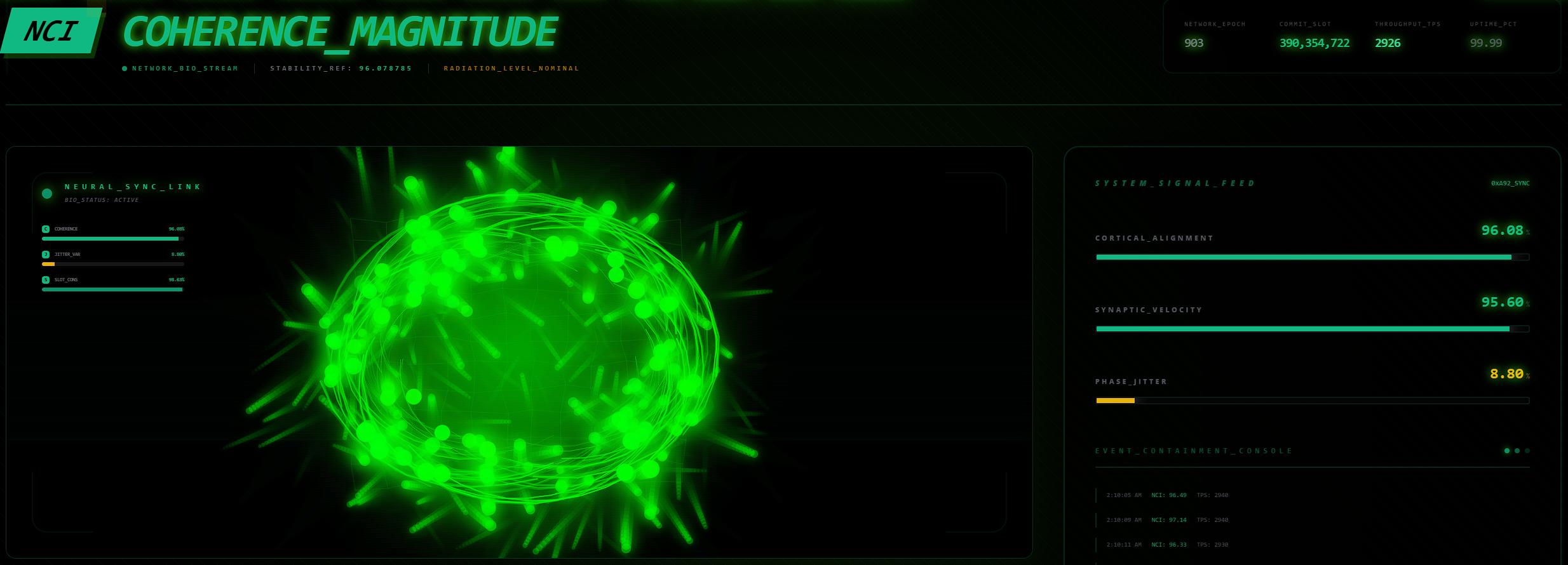
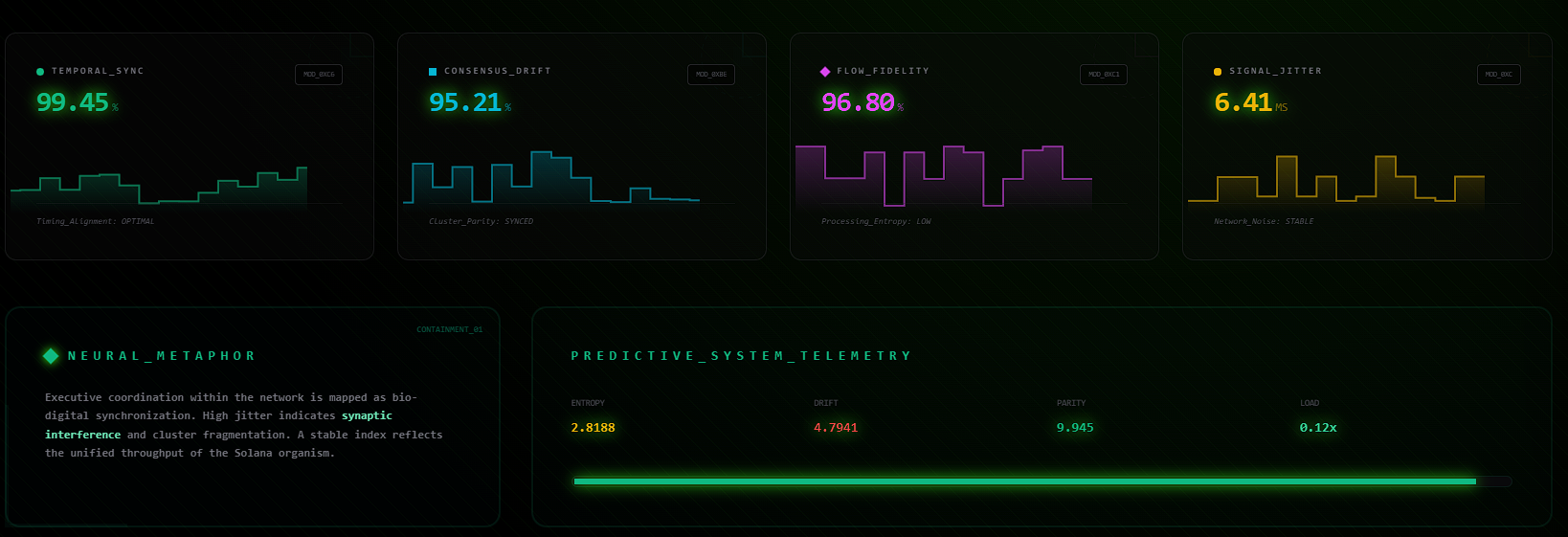
The Network Coherence Index (NCI) is a real-time system intelligence dashboard that measures and visualizes how coherently a network operates as a unified system. It combines multiple live signals — such as temporal synchronization, throughput, stability, signal jitter, and consensus behavior — into a composite coherence score. Instead of focusing on single metrics in isolation, NCI provides a holistic view of operational health, making it easier to detect instability, degradation, or emerging risk across distributed infrastructure.
How It’s Built
NCI is implemented as a desktop-based, real-time dashboard that streams live network data and transforms it into continuously updating system signals. The interface is designed to prioritize clarity, responsiveness, and interpretability, allowing operators to quickly assess system state at a glance. While the current implementation streams live blockchain network data, the underlying framework is chain-agnostic and can be applied to a wide range of edge systems, including financial and lending infrastructure where uptime, synchronization, and reliability are critical.
Relevance to Financial & Lending Infrastructure
In financial systems — including digital lending platforms, loan servicing pipelines, and settlement infrastructure — operational coherence is directly tied to reliability, risk management, and efficiency. NCI can be applied as a monitoring layer to detect synchronization drift, processing instability, or performance degradation before failures propagate. By providing a unified coherence signal, the system supports more transparent, resilient, and efficient financial operations.
Challenges & Learnings
The primary challenge was designing a composite metric that balances technical accuracy with real-time usability. Translating complex system behavior into an intuitive visual language required careful iteration to avoid information overload while preserving signal fidelity. This project reinforced the importance of system-level thinking and demonstrated how real-time visualization can significantly improve situational awareness in complex distributed environments.

Log in or sign up for Devpost to join the conversation.