-
-
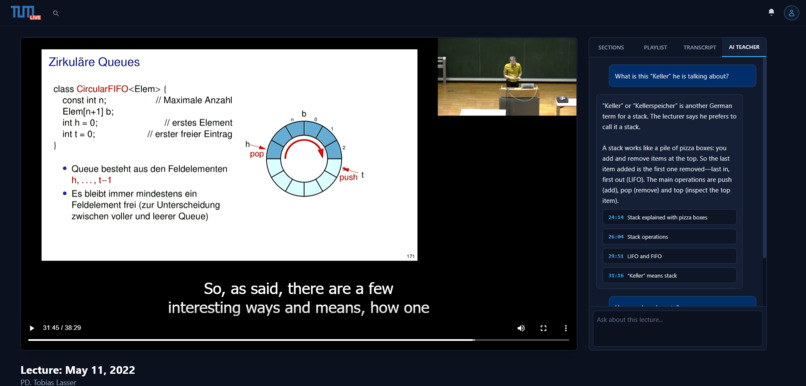
Main UI
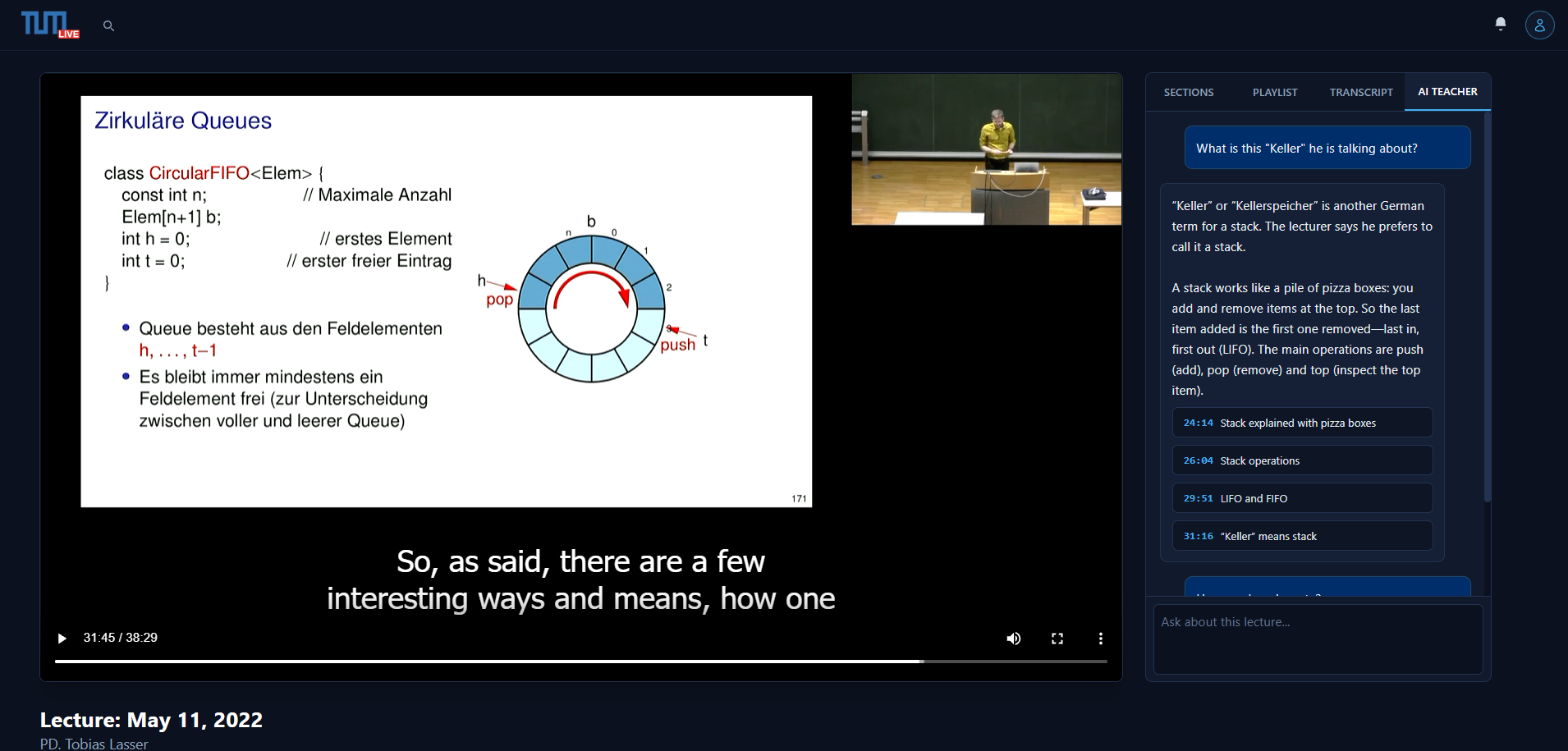
Inspiration
As TUM students, we all know and use TUMLive. It is a great tool for watching lectures, but we believe it could offer much more to support students in their learning.
We have all experienced having to rewind a lecture because we missed a single word, struggling to understand a lecturer's accent, or trying to follow a lecture in a noisy environment. Language barriers and the lack of captions also make lectures less accessible, particularly for students with hearing impairments.
We wanted to address these problems while also making it easier for students to find, revisit and understand lecture content.
What it does
Our project extends TUMLive with three main features: automatic captions, searchable transcripts, and an AI lecture assistant.
Captions make lectures easier to follow, while the searchable transcript allows students to look for specific words or passages. By clicking on a search result, they can jump directly to the corresponding moment in the video.
The AI assistant acts as a personal tutor that knows the lecture content. Students can ask questions, request simpler explanations, or clarify concepts they did not fully understand. The assistant uses both the lecture transcript and the presentation slides to help students understand what their professor taught. It also provides clickable timestamps so that students can revisit the original explanations.
How we built it
We built our application using Next.js, React, TypeScript, and Tailwind CSS. We use the VTT subtitle format for captions and the transcript.
For the AI assistant, we integrated OpenAI GPT-6.1-Terra through OpenRouter. We chose a lightweight model to keep response times and costs low while still providing helpful explanations based on the lecture material.
Challenges we ran into
A major challenge was generating real-time captions to prevent video buffering. We further had to ensure that the AI assistant stays within the scope of the lecture rather than simply relying on its general knowledge.
What we learned
We learned that captions can be much more than an accessibility feature. A timestamped transcript provides the foundation for searchable lectures, intelligent video navigation, and can be the knowledge base for a personal learning assistant.
We also discovered how much can be achieved with relatively lightweight AI models and without expensive or complicated infrastructure.
What's next
We would love to see these features become part of TUMLive and further improve transcription and synchronization accuracy.
Our goal is not to reinvent TUMLive, but to turn it into a platform that helps students not only watch lectures, but also learn with them.
