Inspiration
Legal casework often involves information scattered across statements, FIRs, reports, notes, and other documents. Connecting these pieces, reconstructing timelines, and finding contradictions can become a slow and highly manual process.
We wanted to build something beyond a generic legal chatbot — a system that could turn fragmented case evidence into structured intelligence while keeping the evidence traceable and humans in control. That idea became NayaySetu.
What it does
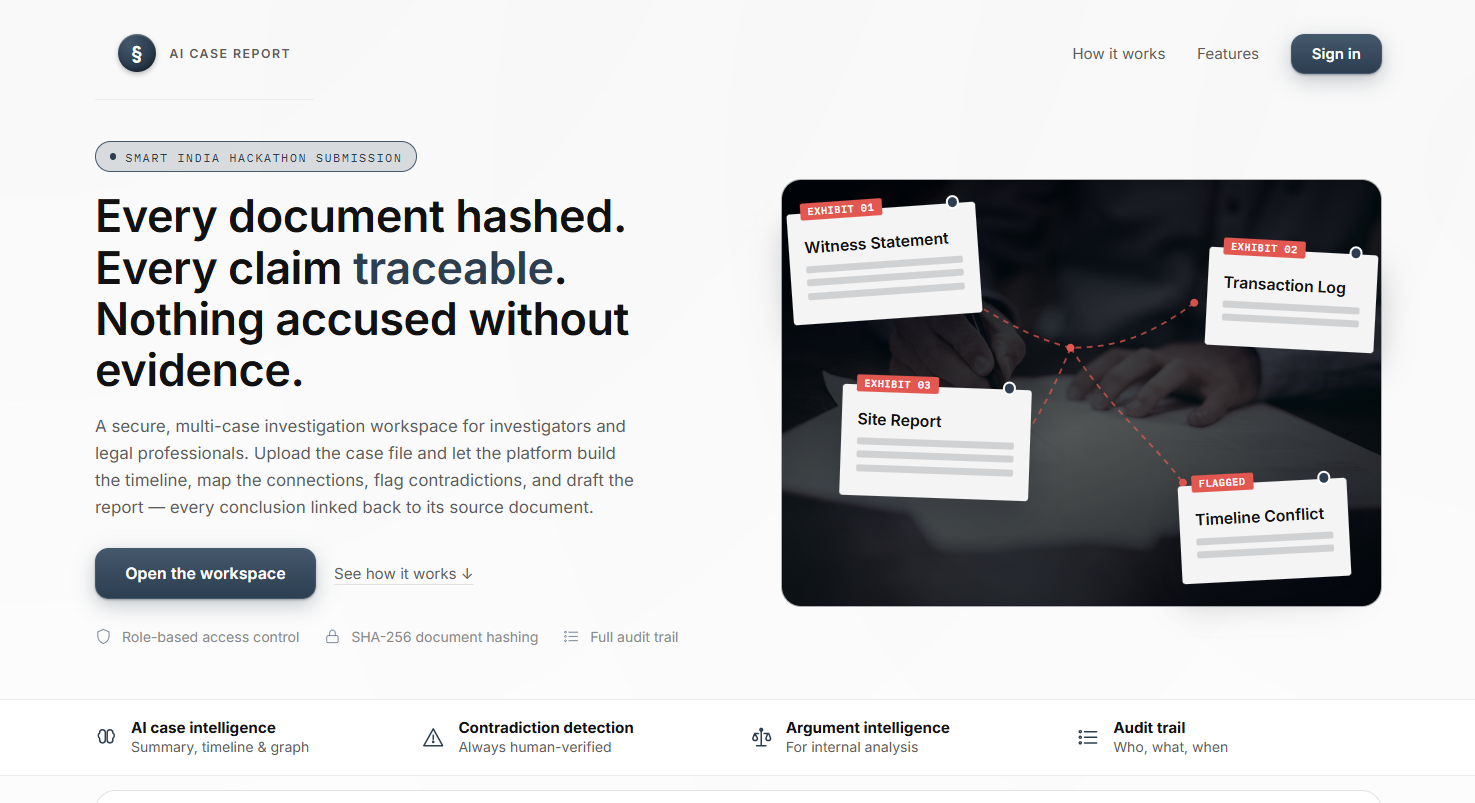
NayaySetu is an AI-powered case intelligence and evidence management platform.
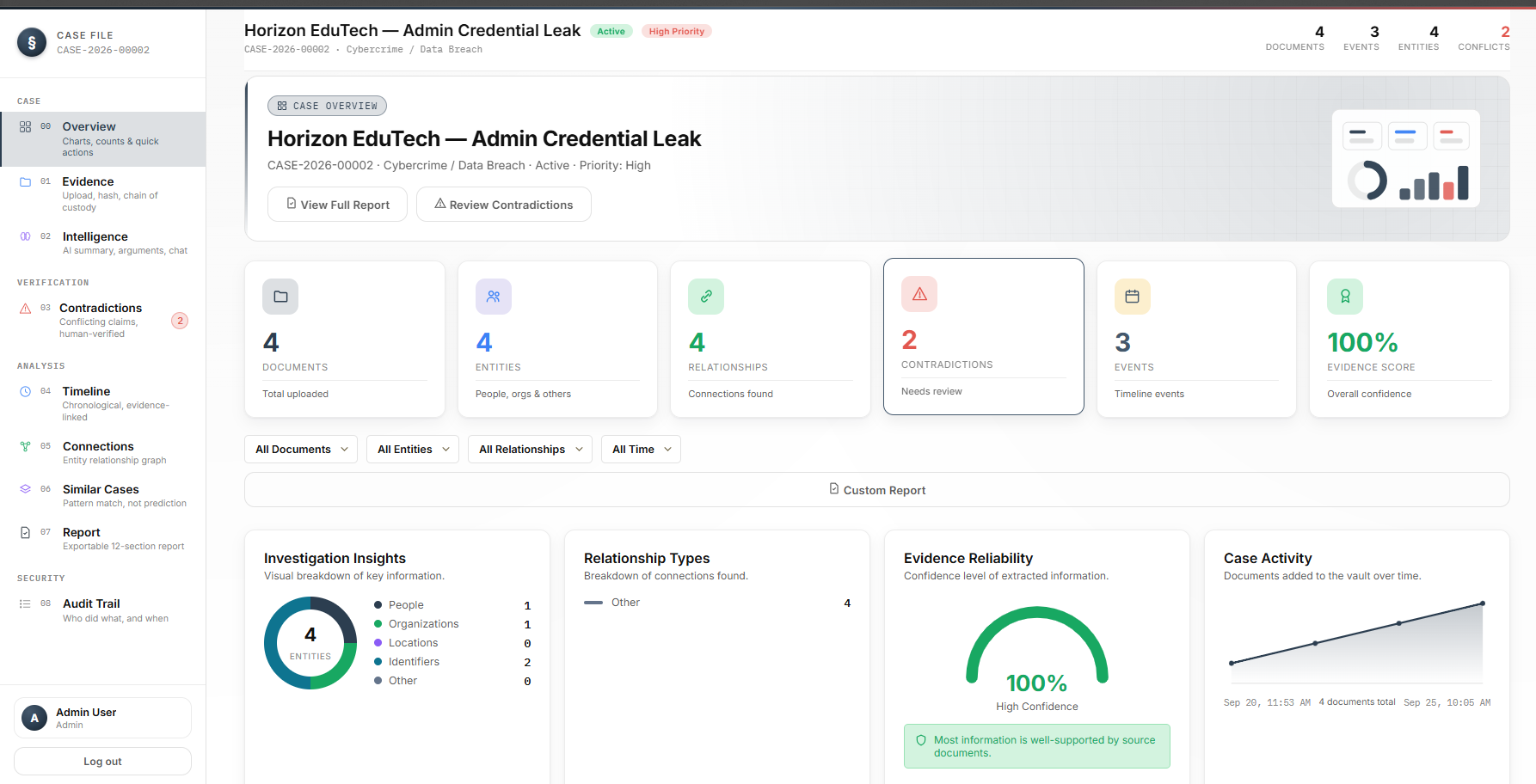
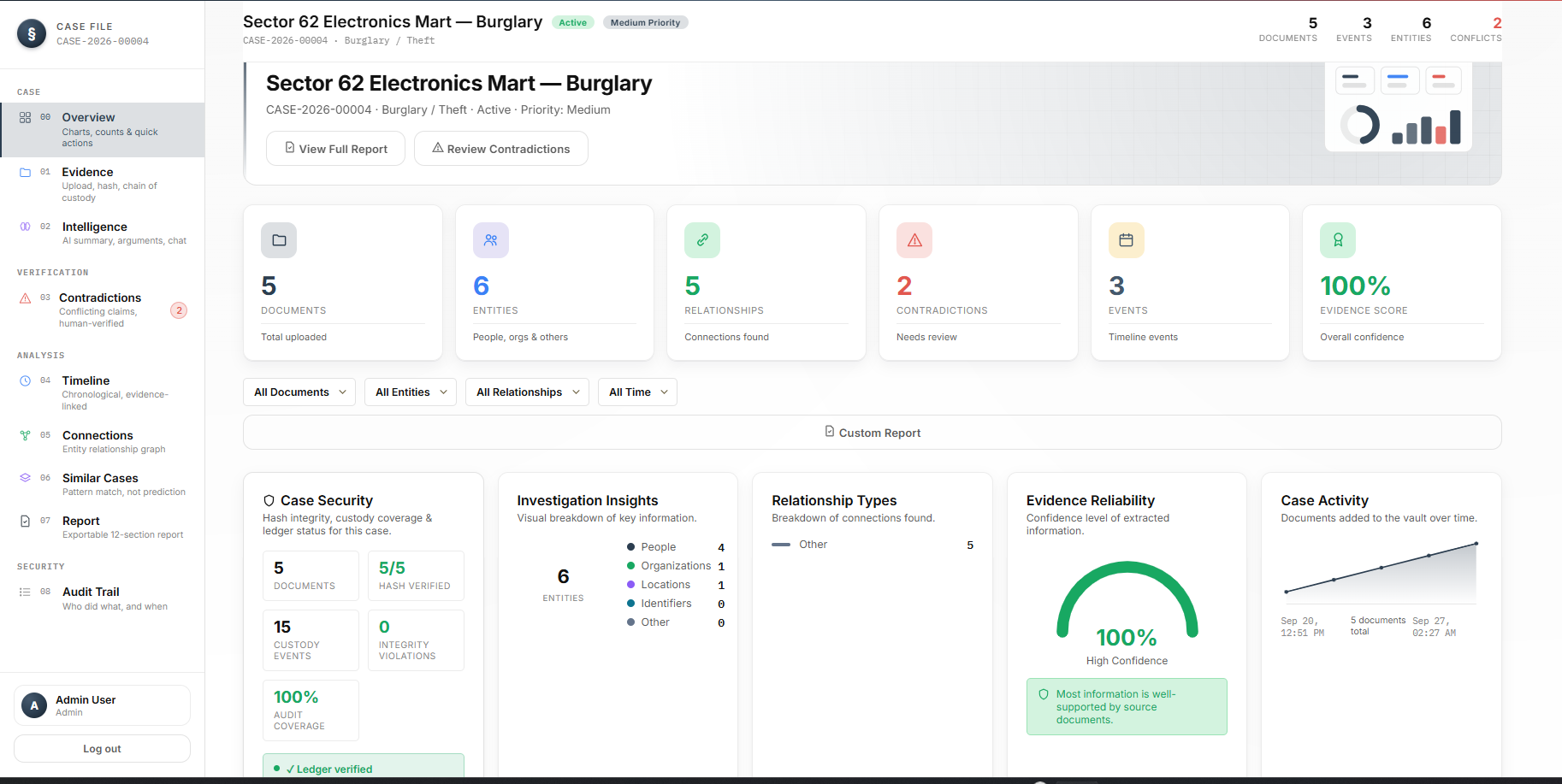
It transforms uploaded case documents into a structured case workspace with:
- Evidence validation and SHA-256 integrity hashing
- AI-powered document classification and information extraction
- Evidence-linked case summaries and timelines
- People, organizations, and location relationship graphs
- Cross-document contradiction detection
- Similar-case analysis
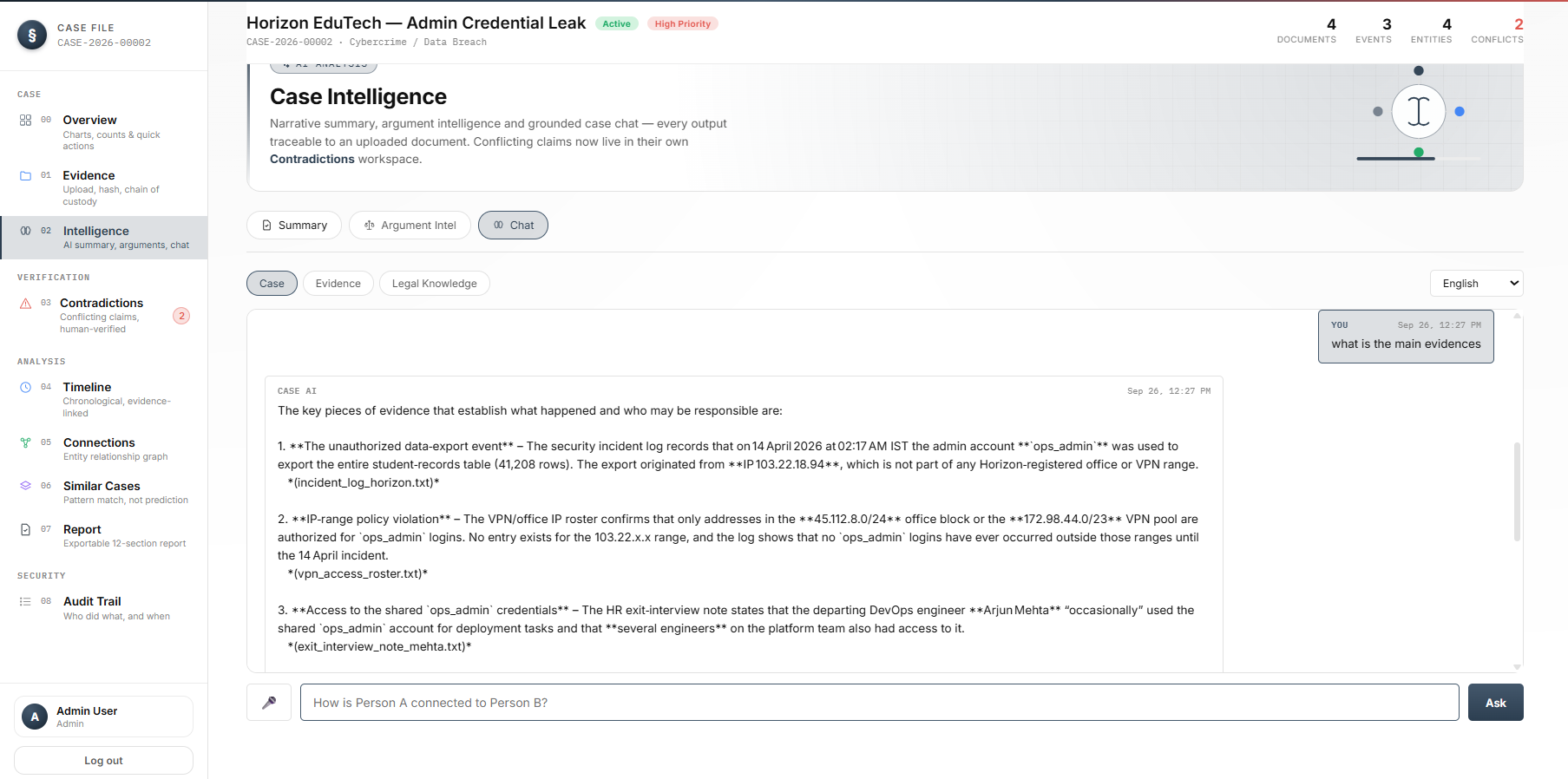
- Evidence-grounded case chat
- Potential arguments and counterarguments
- Exportable case reports
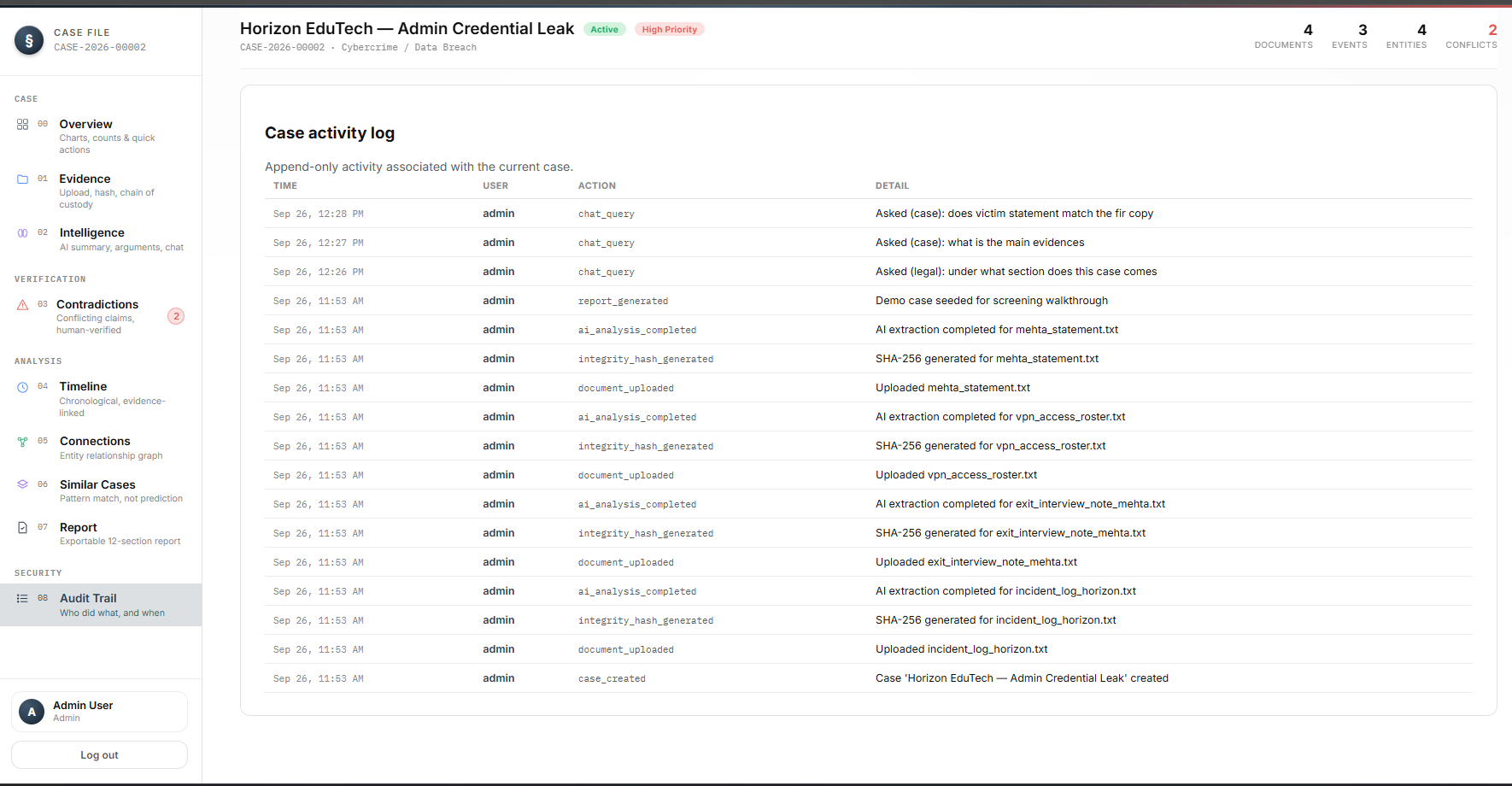
- Role-based access control and audit trails
AI findings are designed to assist investigators and legal professionals, not replace their judgment. Contradictions and important findings are surfaced for human verification.
How we built it
We built NayaySetu with Python and FastAPI for the backend and a lightweight HTML, CSS, and JavaScript frontend.
The core document pipeline follows:
Validate → Hash → Extract → Classify → Extract Entities/Events → Index → Build Case Intelligence
We use Llama 3.3 70B through Groq for AI-powered analysis, JWT authentication with role-based access control for protected workflows, SHA-256 hashing for evidence integrity, and vis-network for interactive relationship graphs.
The system connects these components into a case-centric workflow where documents become the source for timelines, relationships, contradictions, summaries, chat, reports, and audit records.
Challenges we ran into
One of our biggest challenges was making AI useful without treating AI-generated output as unquestionable truth. Since legal case analysis is sensitive, we had to design around traceability, uncertainty, access control, and human verification.
We also had to balance a large feature set with a simple workflow. Instead of building disconnected AI tools, we focused on keeping documents, evidence, timelines, relationships, and AI analysis connected to the same case.
Working with hackathon-scale infrastructure was another challenge. The prototype currently uses lightweight storage and a small local legal knowledge base, which helped us build and demonstrate the complete workflow while keeping the architecture easy to iterate on.
Accomplishments that we're proud of
We are proud of building a working end-to-end prototype rather than a standalone AI chatbot.
A single case can move from raw documents to structured evidence, timelines, relationship graphs, contradiction detection, grounded case chat, reporting, and audit history.
We are particularly proud of the evidence-integrity layer, where documents are hashed and actions are recorded so that the system maintains a traceable history of the case workflow.
What we learned
We learned that building AI for a high-stakes domain requires much more than choosing a powerful model.
The surrounding system — data processing, retrieval, provenance, access control, auditability, and human oversight — is just as important as the LLM itself.
We also learned how difficult it is to turn unstructured documents into reliable structured information. Building the extraction and evidence-linking pipeline helped us understand that good AI products depend heavily on the engineering surrounding the model.
What's next for NayaySetu
We want to take NayaySetu from a hackathon prototype toward a scalable legal intelligence platform.
Our next steps include:
- Scalable database and evidence storage
- OCR for scanned documents and image-based evidence
- Larger, licensed legal knowledge sources
- Vector-based retrieval and citation-aware responses
- Stronger evidence provenance and verification
- Advanced document comparison and case linking
- Production-grade security, monitoring, and deployment
The long-term goal is to make NayaySetu a traceable, human-centered intelligence layer for complex legal casework — helping professionals spend less time searching through documents and more time understanding the case.

Log in or sign up for Devpost to join the conversation.