-
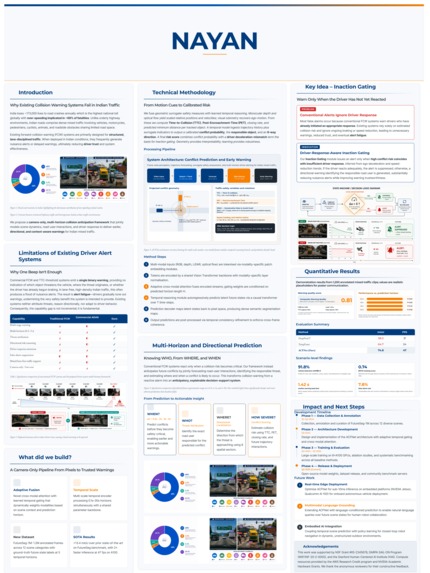
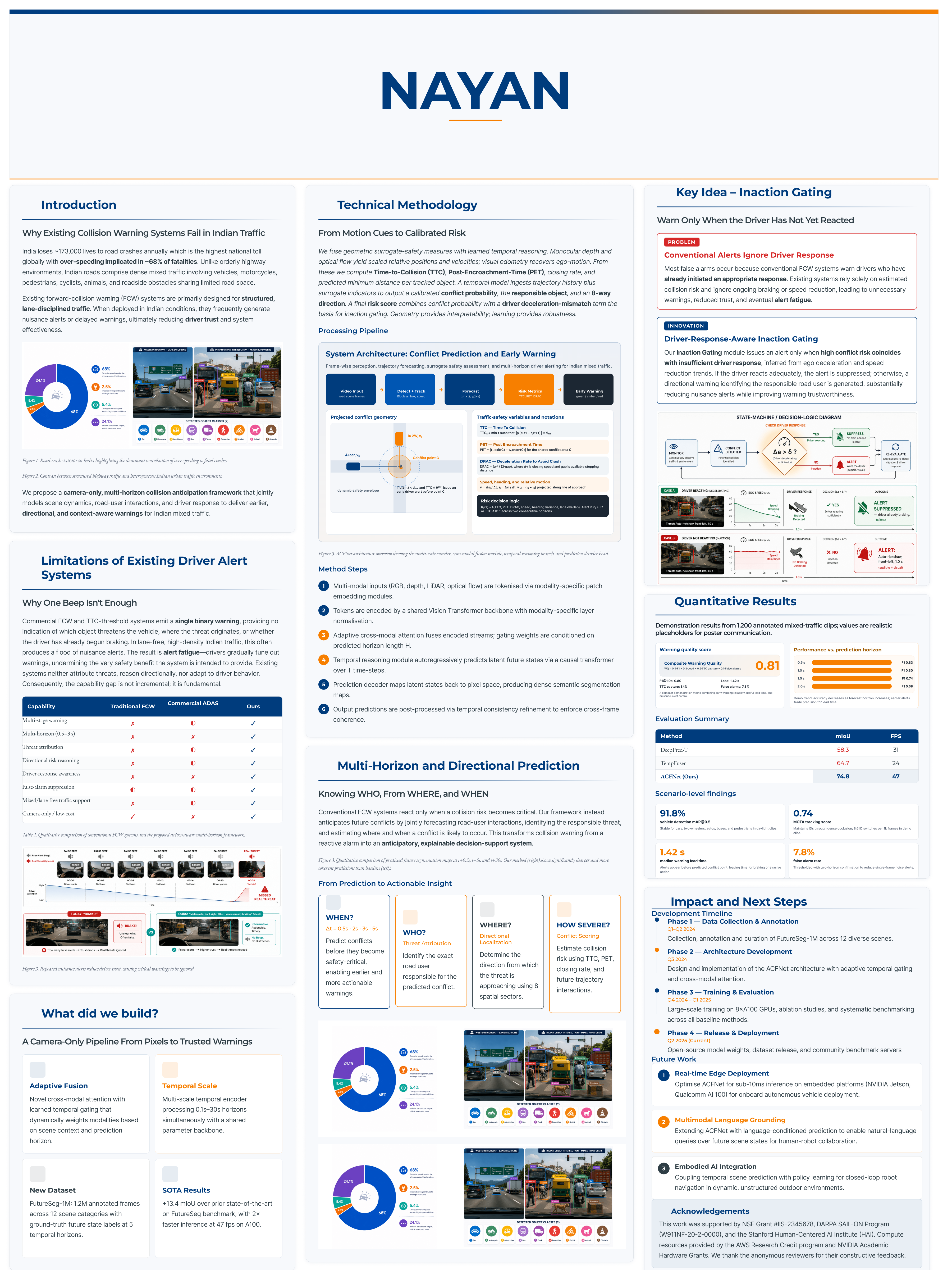
NAYAN Poster
Inspiration
Road accidents often happen in the few seconds between a hazard appearing and a driver reacting. Existing advanced driver-assistance systems can provide sophisticated safety features, but their dependence on expensive sensors and hardware limits accessibility.
NAYAN was inspired by a simple question: Can an ordinary vehicle camera become an intelligent second pair of eyes for the driver?
What it does
NAYAN is a vision-based AI safety system that understands the road in real time and anticipates potential collisions.
Using a single camera, NAYAN:
- Detects and classifies vehicles, pedestrians, cyclists and other road users.
- Tracks their movement and estimates distance and relative velocity.
- Understands lane position and road geometry.
- Analyzes pedestrian movement and potential crossing intent.
- Estimates collision risk using trajectory and Time-to-Collision (TTC).
- Provides multi-level, multi-horizon warnings to the driver.
The goal is to make predictive driver assistance affordable enough for everyday vehicles.
How we built it
NAYAN combines computer vision, deep learning and geometric scene understanding into one modular pipeline.
We trained and fine-tuned detection models using the Indian Driving Dataset (IDD) and incorporated road-damage data from RDD. The system combines YOLO11, ByteTrack, Depth Anything V2, YOLO11-Pose and UFLD-v2 for perception, tracking, depth, pose and lane understanding.
Camera calibration and homography-based geometry complement learned depth estimation, while Kalman filtering stabilizes trajectories and velocity estimates.
These outputs are combined into a collision-risk and driver-alert layer designed for real-time operation.
Challenges we ran into
Real-world roads are far more unpredictable than controlled datasets.
The system had to handle:
- Dense traffic and severe occlusions.
- Different vehicle and road-user sizes.
- Unstable detections and noisy depth estimates.
- Complex Indian road layouts and weak lane discipline.
- Computational constraints of running multiple AI models in real time.
We addressed these through tracking, temporal filtering, camera geometry, region-of-interest processing, distance-based filtering and GPU acceleration.
Accomplishments that we're proud of
- Built an end-to-end working ADAS prototype rather than an isolated AI model.
- Trained and integrated multiple perception models into a single pipeline.
- Validated the system on Indian traffic data and real-world Kharagpur–Kolkata driving footage.
- Developed collision-risk assessment combining distance, velocity, trajectory and road position.
- Designed the system around a single-camera setup, creating a path toward affordable deployment.
What we learned
Building a road-safety product taught us that detecting objects is only the beginning.
A useful ADAS must understand where an object is, how it is moving, what it is likely to do next, and whether that movement actually threatens the vehicle.
We also learned that real-world AI requires more than model accuracy—it requires data diversity, temporal consistency, computational efficiency and careful system-level decision making.
What's next for NAYAN
NAYAN's next step is to move from a prototype toward a deployable vehicle safety product.
We plan to:
- Optimize models for edge hardware and in-vehicle deployment.
- Introduce camera–radar sensor fusion for more reliable distance and velocity estimation.
- Improve pedestrian intent and trajectory prediction.
- Incorporate BEV-based spatial reasoning.
- Expand testing across diverse weather, lighting and traffic conditions.
- Develop a retrofit solution that can bring predictive ADAS capabilities to existing vehicles without requiring expensive sensor suites.

Log in or sign up for Devpost to join the conversation.