Inspiration
Online fashion shopping is fragmented. We discover styles on Pinterest, search for products across marketplaces, open separate virtual try-on tools, and still struggle to understand whether everything works together.
We wanted to create an experience that feels less like using multiple shopping tools and more like talking to a stylist who can actually see, remember, experiment, and shop with you.
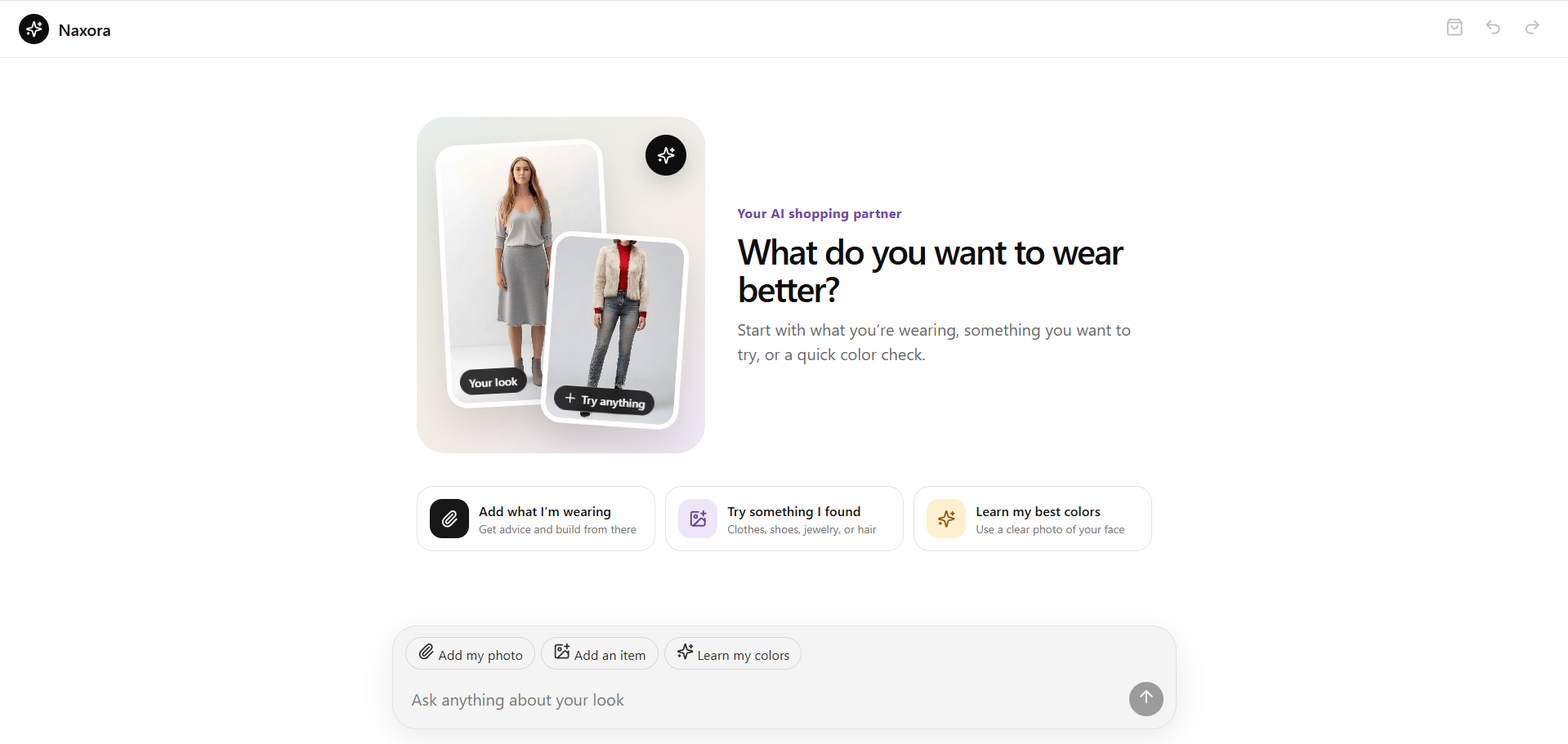
That idea became Naxora: an image-first shopping agent that helps users build a complete look through conversation.
What it does
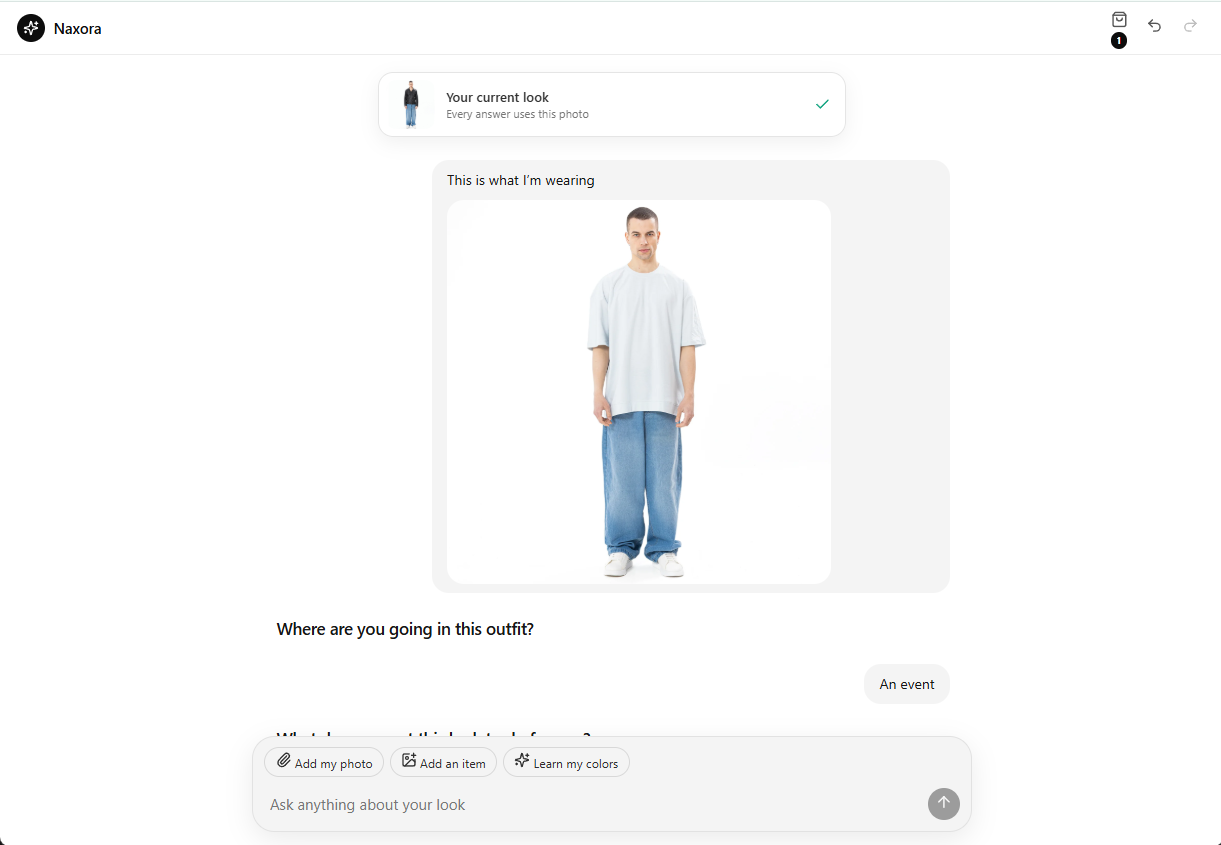
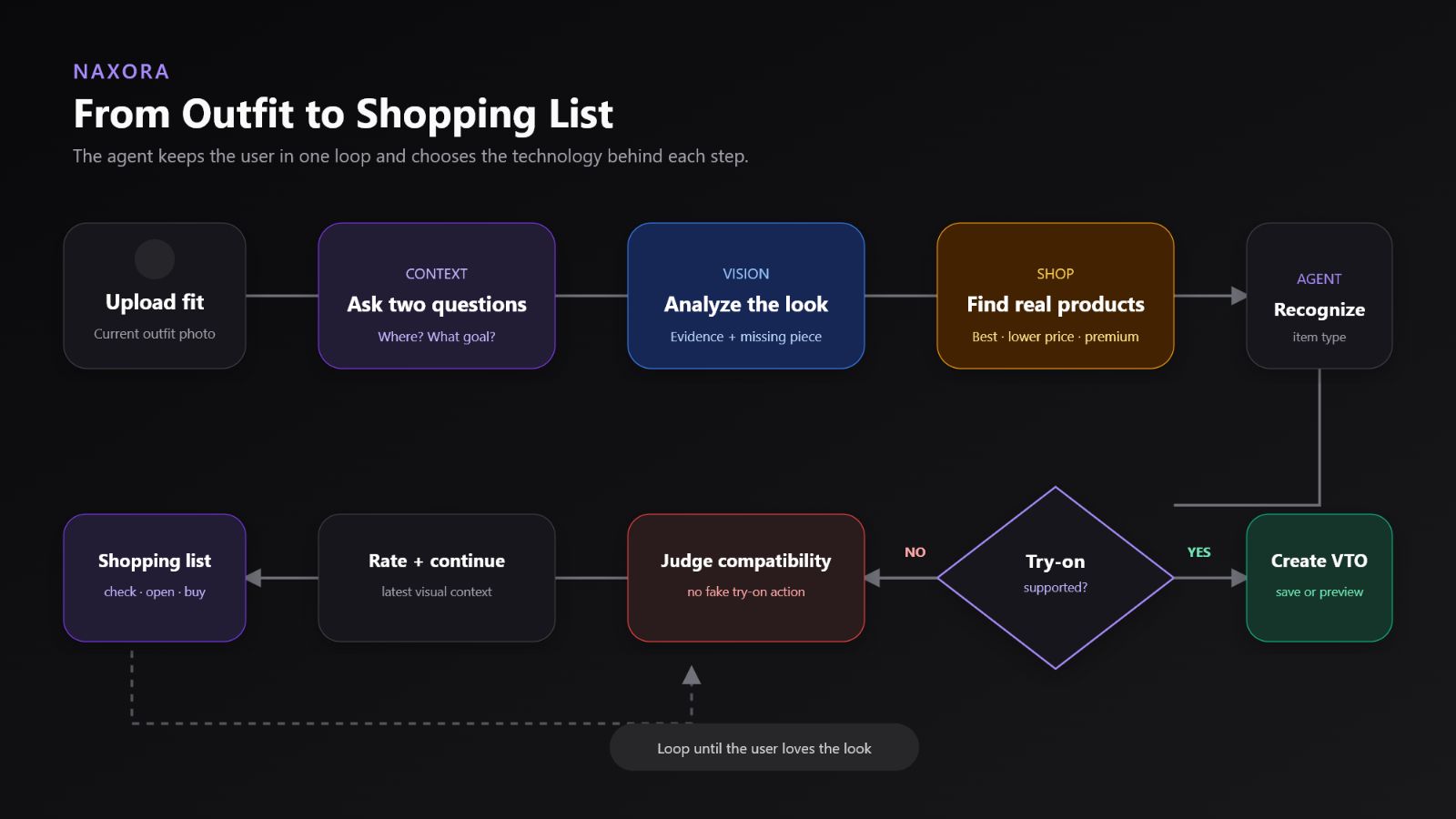
Users begin by uploading a photo of their current outfit. Naxora asks two simple questions:
- Where are you going?
- What do you want the outfit to achieve?
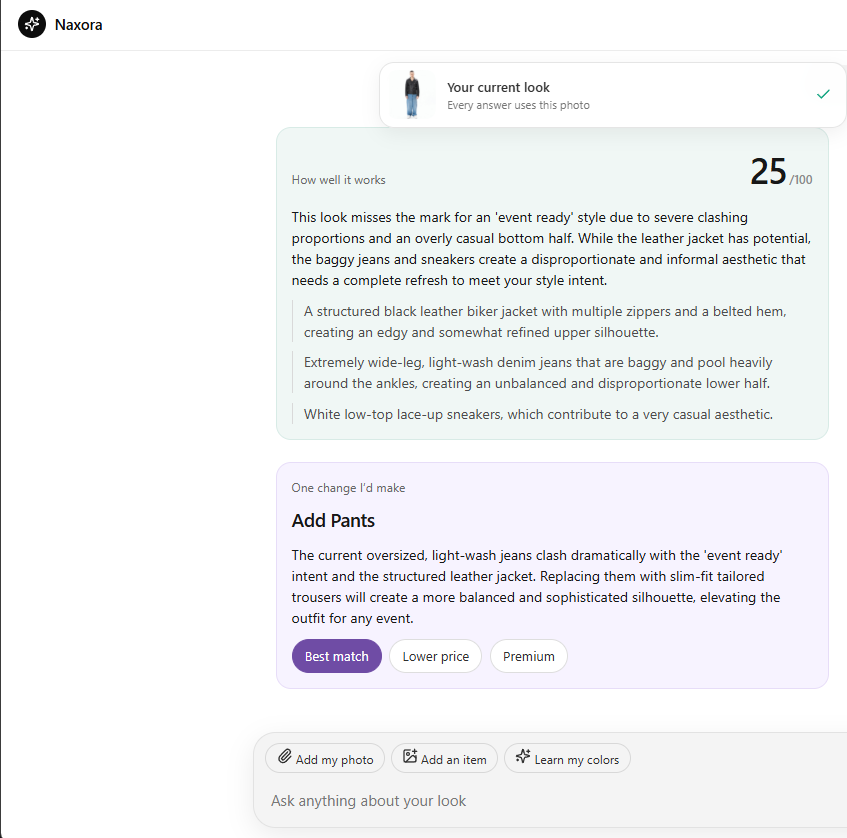
It then analyzes the actual image, rates the look, explains what is working, and recommends a concrete missing piece.
Users can:
- Discover real, buyable products
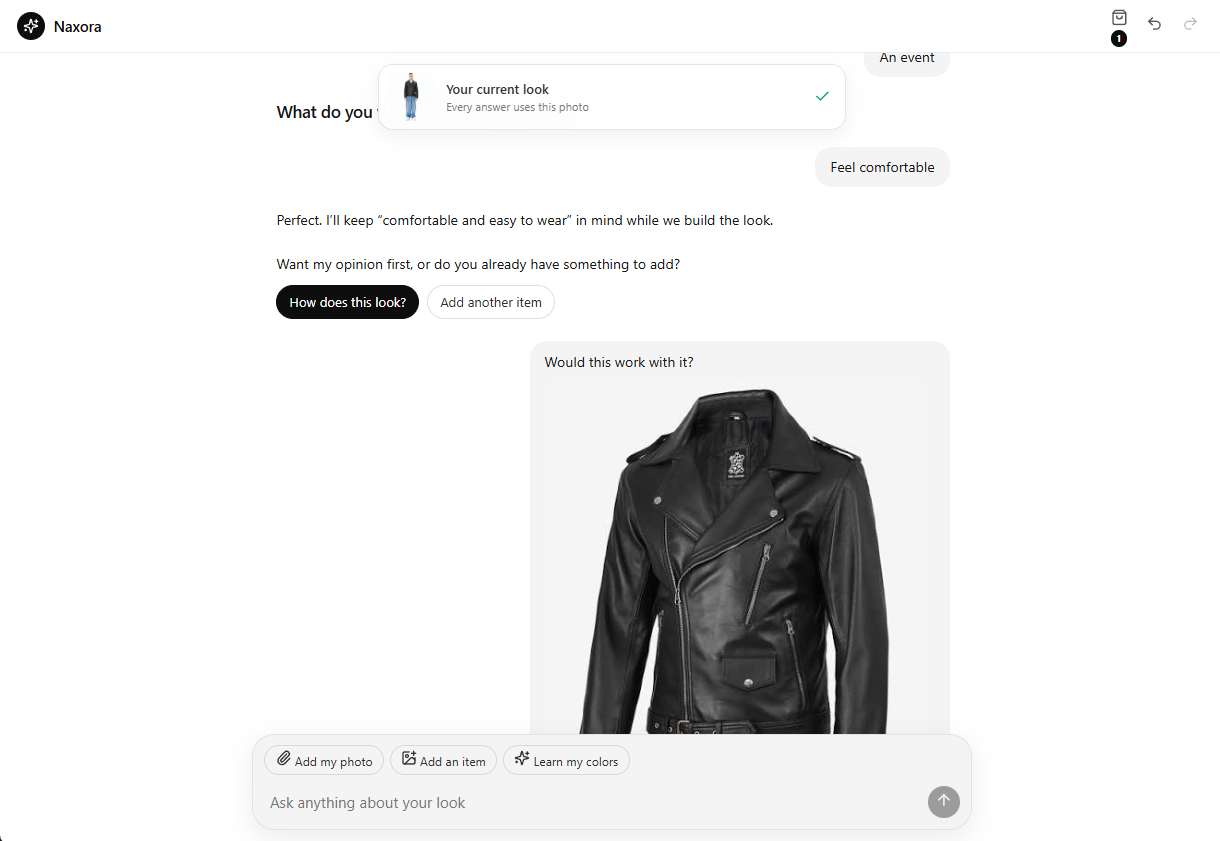
- Upload products they found elsewhere
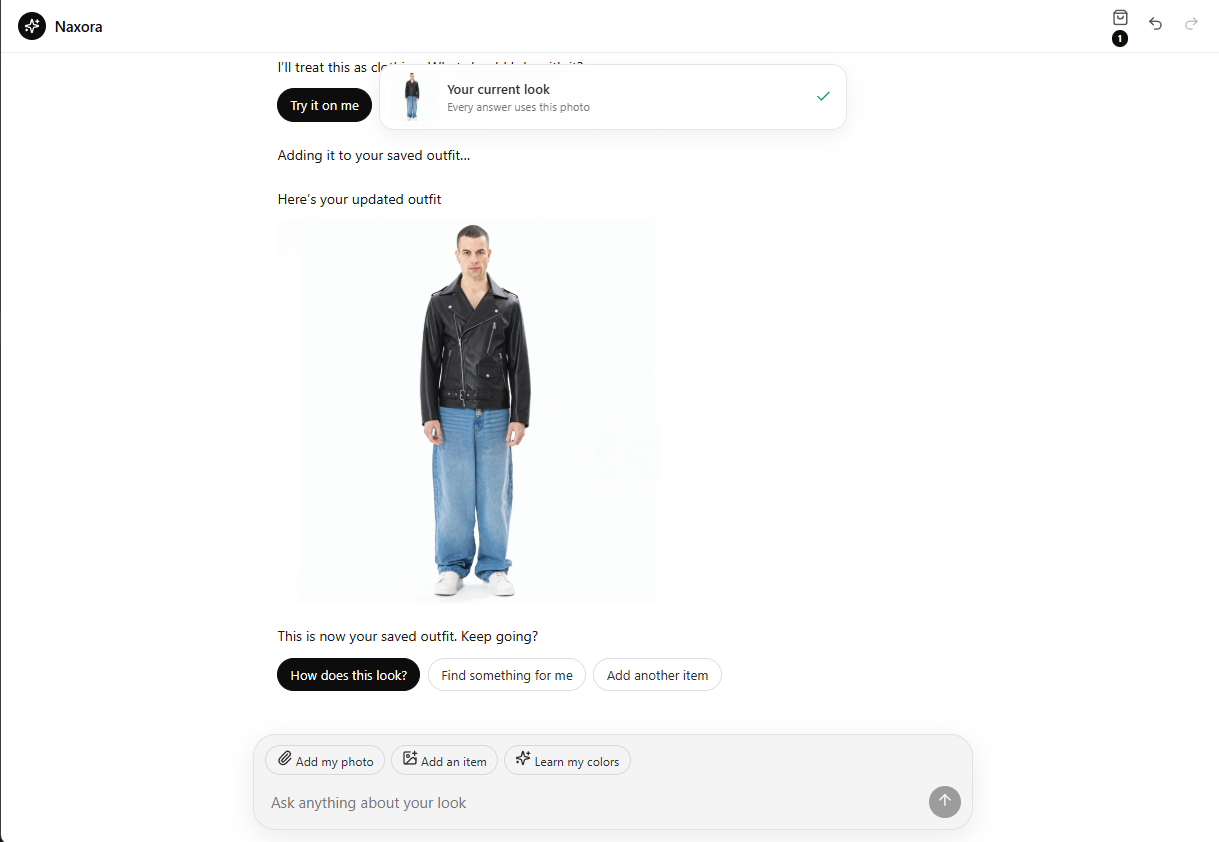
- Virtually try on clothing, shoes, hairstyles, and supported accessories
- Continue styling from their latest saved outfit
- Compare alternatives using visual undo and redo
- Create a personal color profile
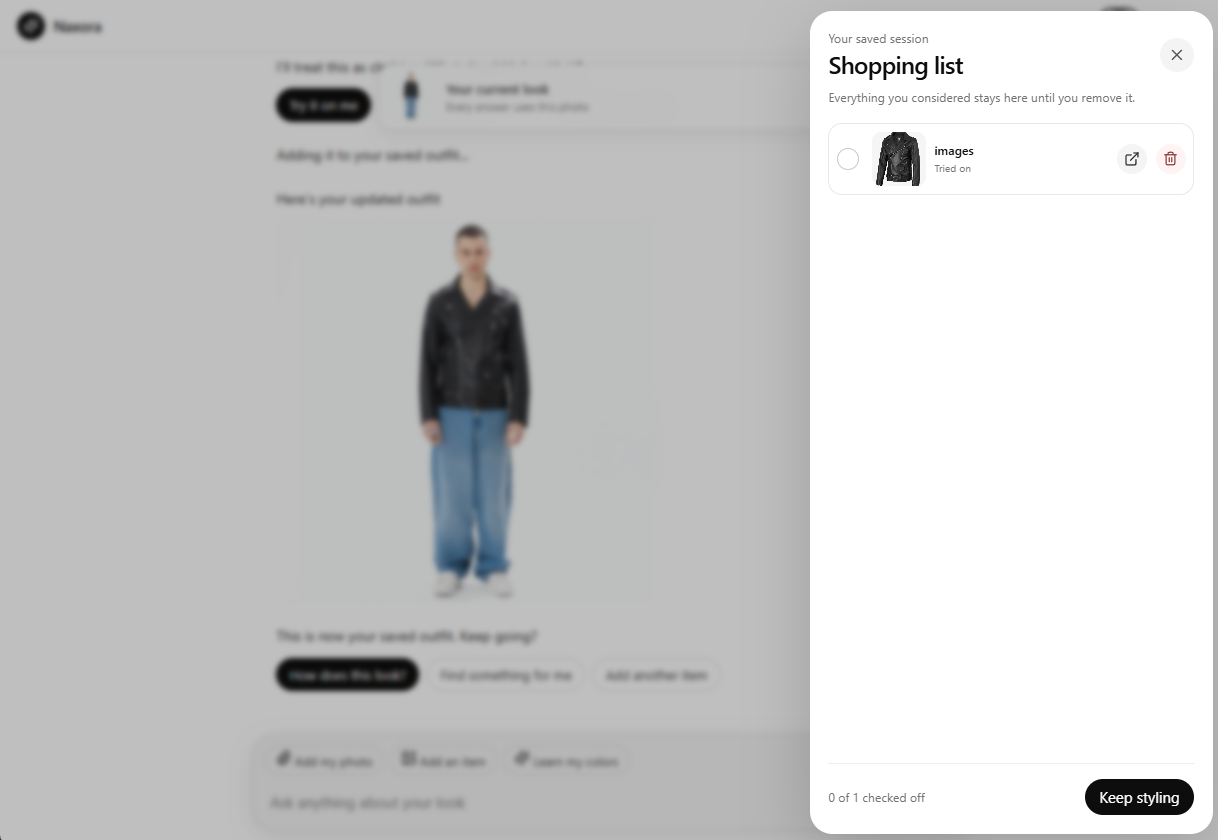
- Keep every considered product in a checkable shopping list
- Open the original product page when ready to buy
Naxora automatically recognizes what the user uploaded and chooses the appropriate workflow. Users never need to understand terms such as API endpoints, garment categories, or VTO engines.
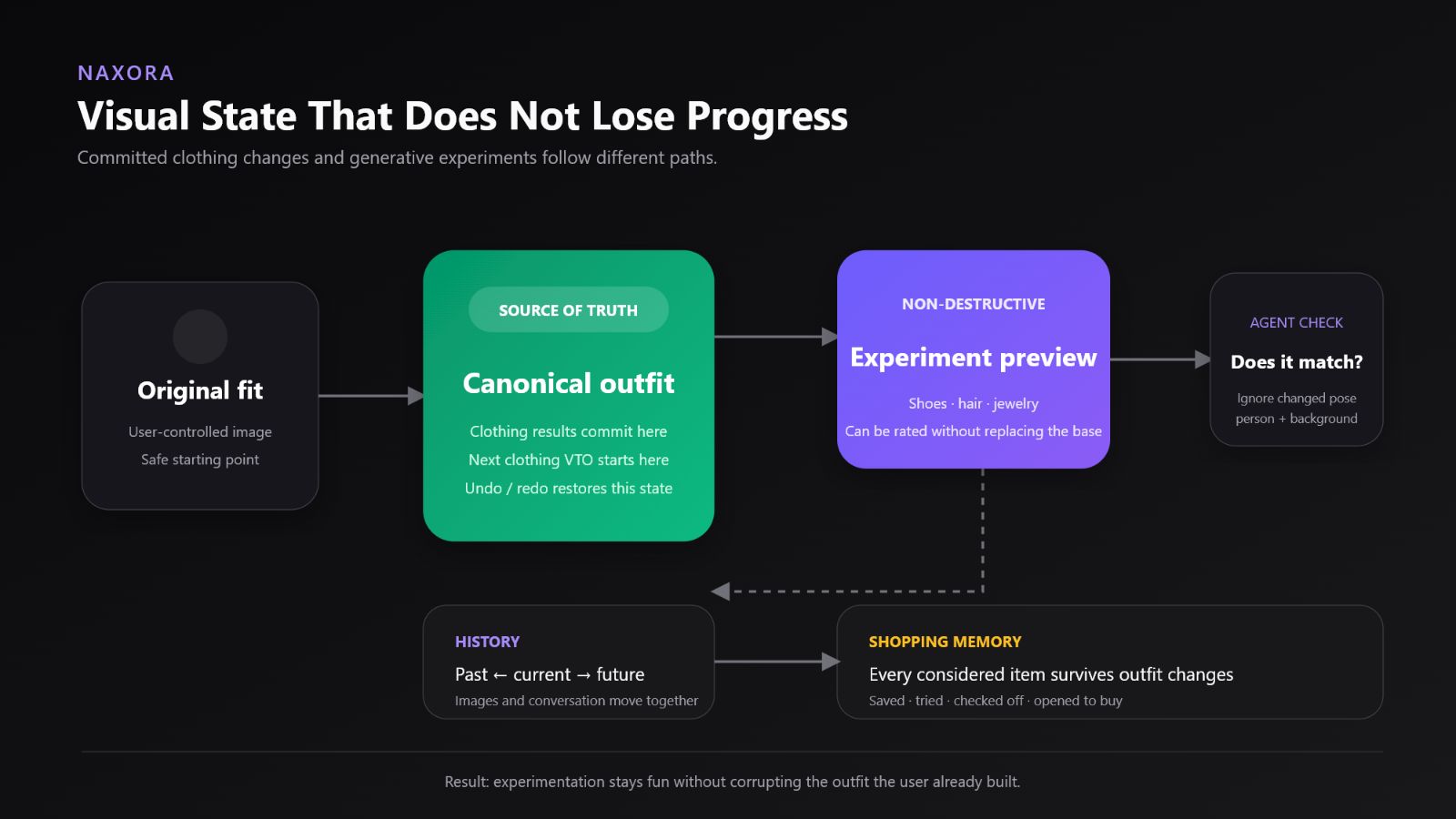
Because different generative engines can modify unrelated parts of an image, Naxora maintains a trusted canonical outfit. Compatible clothing results update this outfit, while shoes, hairstyles, and jewelry remain non-destructive previews. This prevents an experiment from silently destroying earlier progress.
How we built it
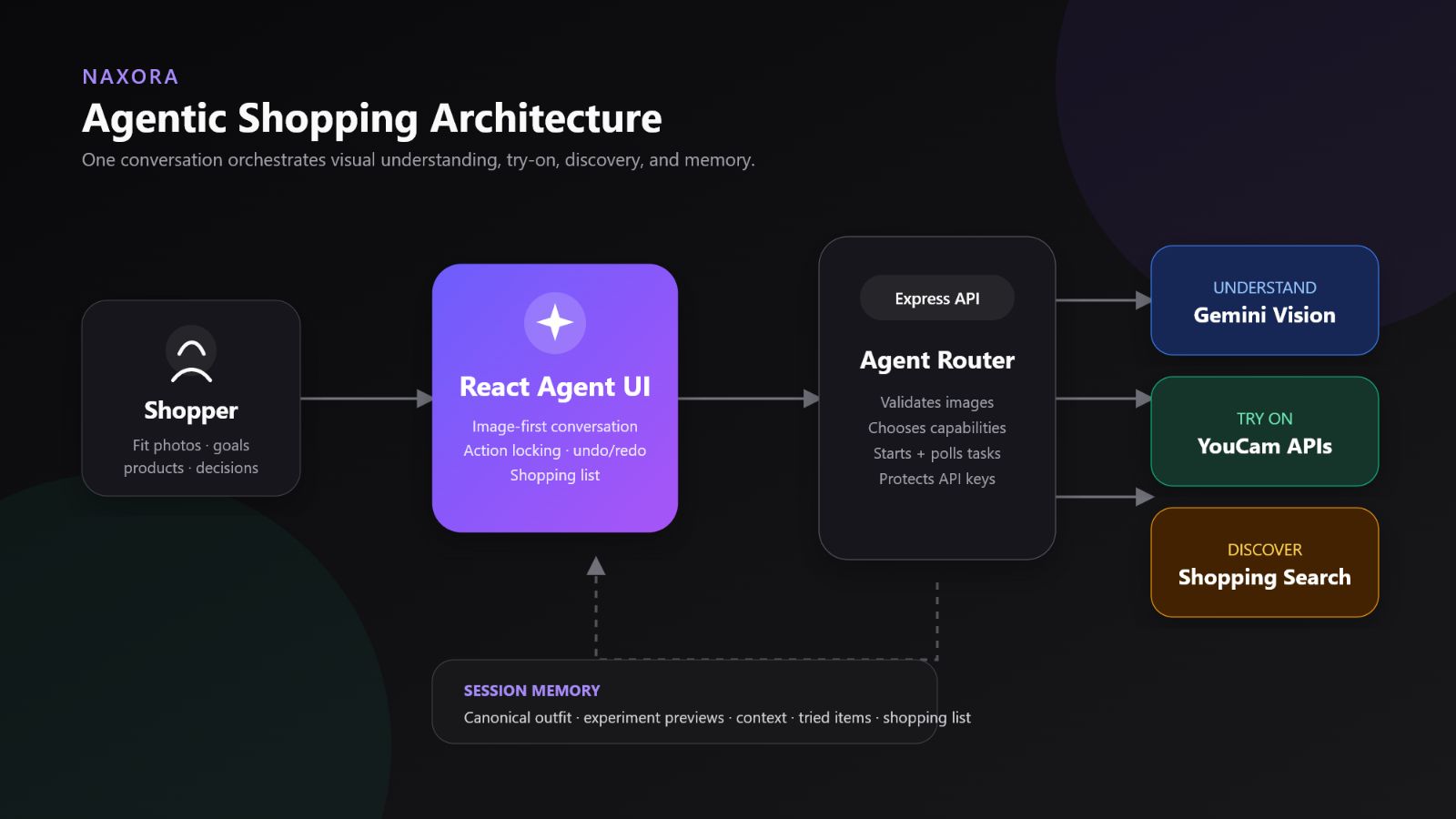
Naxora uses a React and Vite frontend with an Express backend.
We use Gemini multimodal analysis to inspect the actual outfit and product images. Gemini identifies product categories, evaluates visible styling details, considers the user’s occasion and goal, and produces structured shopping recommendations.
The backend routes each supported product to the appropriate Perfect Corp YouCam API, including:
- AI Clothes V3
- AI Shoes Virtual Try-On
- Hair Transfer V2.1
- Jewelry virtual try-on workflows
- Skin Tone Analysis
Skin Tone Analysis creates an optional color profile using detected skin, hair, eye, and lip colors. These verified colors become part of the agent’s memory and influence future recommendations.
Shopping recommendations use live product search when configured, with direct shopping and retailer-search fallbacks available in demo mode.
We also built session-level state management for:
- The canonical outfit
- Non-destructive previews
- Active products
- Outfit context and goals
- Undo and redo history
- Tried items
- The final shopping list
The application is deployable on Vercel, with provider credentials kept securely on the server.
Challenges we ran into
The most difficult challenge was preserving a coherent outfit across different AI engines.
Initially, every generated result became the source for the next action. This worked for sequential clothing changes, but some engines could also change the pose, background, person, or unrelated garments. The application technically used the “latest image,” but that image was no longer a trustworthy continuation of the original outfit.
We solved this by separating the canonical outfit from experiment previews. Clothing can update the canonical state, while cross-category results remain previews unless they are safe to continue from.
Another challenge was product routing. A belt and a pair of trousers are both fashion products, but they cannot use the same try-on engine. We added multimodal classification and explicitly disabled virtual try-on for unsupported categories instead of presenting an action that would fail.
We also had to design around asynchronous AI processing. During analysis, shopping search, or virtual try-on, competing actions are locked to prevent duplicate requests and broken state.
Finally, simplifying the interface was surprisingly difficult. Our early versions exposed too many controls and technical concepts. We rebuilt the experience around a single conversation where structured cards appear only when they genuinely improve understanding.
Accomplishments that we're proud of
We are proud that Naxora is more than a virtual try-on demo. It connects the entire journey:
understand → recommend → discover → try → compare → save → buy
We are especially proud of:
- Automatic routing between multiple Perfect Corp capabilities
- Multimodal analysis of real images instead of text-only descriptions
- Canonical outfit memory across an evolving session
- Non-destructive cross-engine previews
- A conversational interface accessible to non-technical users
- Personal color-aware recommendations
- A dynamic shopping list containing everything the user considered
- Honest handling of unsupported products
- A secure, open-source, Vercel-ready architecture
What we learned
We learned that agent-first design is not simply placing a chatbot beside existing controls. The agent must understand the user’s state, choose the correct capability, explain what is happening, and prevent invalid actions.
We also learned that the newest AI-generated image is not automatically the best source of truth. Reliable visual agents need explicit state models, validation boundaries, and a distinction between committed results and temporary experiments.
Most importantly, we learned that users should not have to understand the technology. They should only need to say what they want, show what they are wearing, and decide whether they like the result.
What's next for Naxora
Next, we plan to add:
- Guided camera capture with real-time lighting and framing feedback
- Persistent, privacy-aware user sessions
- Side-by-side visual comparison
- Budget, size, retailer, and sustainability preferences
- Automatic visual-preservation checks between try-on engines
- Smarter outfit planning across multiple product categories
- Shared and collaborative shopping lists
- Direct retailer checkout integrations
Our long-term goal is for Naxora to become a complete visual shopping agent that can understand personal style, safely experiment across an entire look, and turn inspiration into confident purchases.
Built With
- agentic-ai
- ai-clothes
- computer-vision
- e-commerce
- express-js
- fashion-tech
- gemini
- generative-ai
- google-ai
- google-shopping
- image-analysis
- javascript
- multimodal-ai
- node.js
- open-source
- perfect-corp
- react
- rest-api
- serpapi
- shopping
- vercel
- virtual-try-on
- vite
- youcam-api

Log in or sign up for Devpost to join the conversation.